

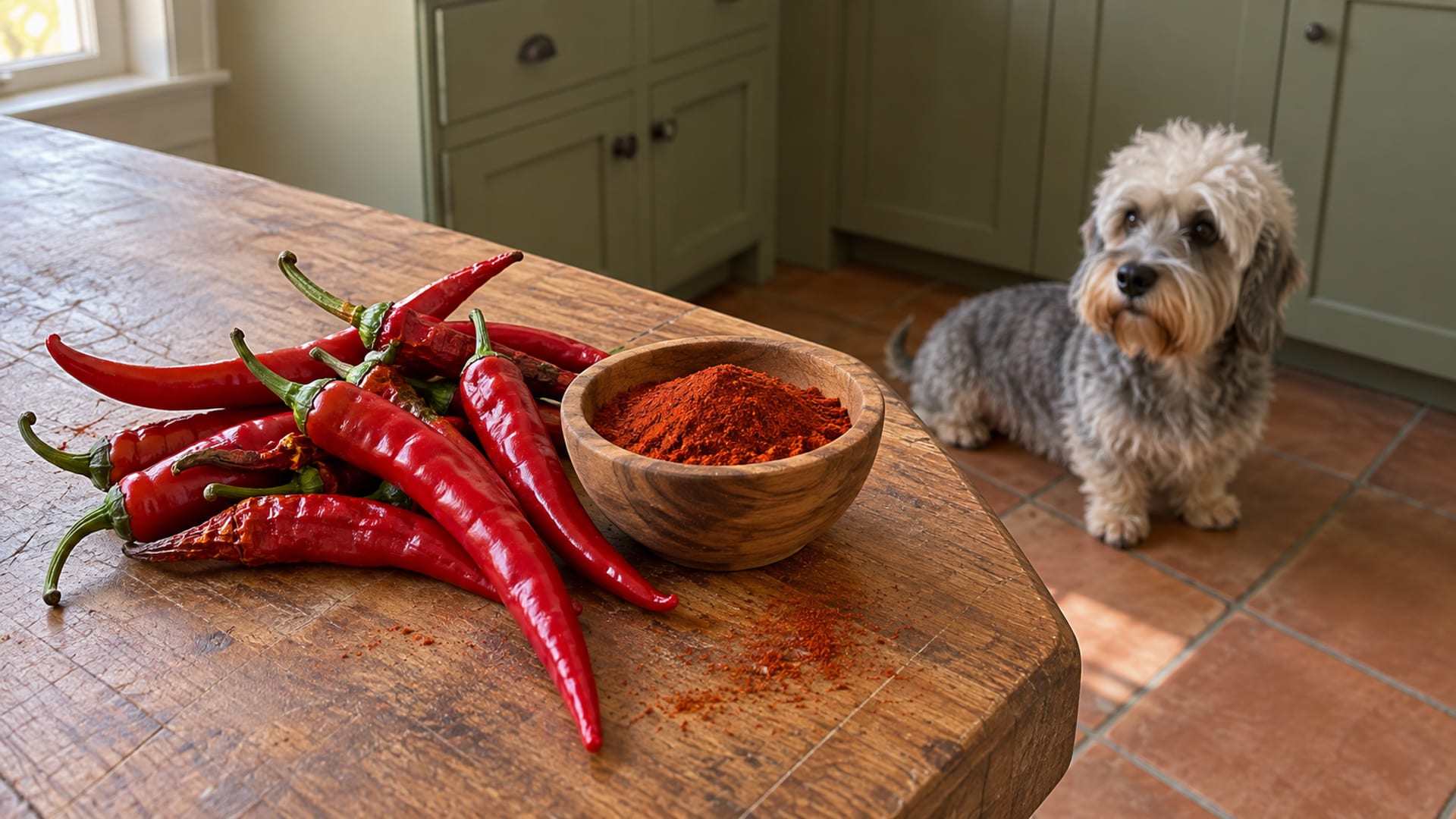
Cayenne pepper doesn't belong in your dog's food. Its heat comes from capsaicin, which irritates the mouth and stomach, so a dog that grabbed a pepper or licked up spilled powder will most likely drool, paw at its mouth, and may vomit or get diarrhea. The Merck Veterinary Manual says chili peppers of this kind can irritate the digestive tract but are not likely to be lethal.
If it already happened, give your dog fresh water, skip the home remedies, and hold on to the jar, bottle or plant tag. A lick of ordinary cayenne and a mouthful of extract or garlicky hot sauce are different phone calls.
Key takeaways
Tap a card to bring it forward.
- Cayenne's capsaicin burns the mouth and stomach, so it stays off your dog's plate, even as a sprinkle on leftovers.
- A small accidental taste of ordinary cayenne usually means discomfort, drooling, vomiting or diarrhea rather than a dangerous poisoning.
- Powder, extracts, oleoresin, pepper spray and hot sauce are more concentrated or carry extra ingredients, and they call for a talk with your vet.
- Ornamental pepper, sold as Jerusalem cherry, is a different plant, and it is toxic to dogs.
- Serving advice for bell peppers does not carry over to cayenne.
What to do if your dog just got into cayenne
The decision comes down to what the product was, how much is gone, and how your dog looks right now.
- Clean up the spill and offer fresh water. A burning mouth is the most likely problem, and a bowl of water lets your dog rinse at its own pace.
- Don't make your dog vomit, and don't give hydrogen peroxide, home remedies or medicine unless a veterinarian tells you to. The mouth and stomach are already irritated, and the right care depends on what was actually swallowed.
- Keep the label and jot down the details. Note the product, ingredients, your best guess at the amount, the time, your dog's weight and any signs, so your vet can tell whether this is only capsaicin irritation or something more.
- Call your vet or a pet poison line for anything beyond a small taste. That means a large or unknown amount, dried powder, an extract, oleoresin, pepper spray, a plant you can't name, a product with onion, garlic, alcohol, xylitol or other added ingredients, or any exposure in a small puppy or a dog with health problems. The ASPCA and VCA Animal Hospitals both advise contacting a vet or poison control as soon as possible when a dog may have eaten something toxic.
- Call right away if the signs get serious. Repeated vomiting, diarrhea that keeps going, obvious belly pain, weakness, collapse, trouble breathing, seizures, a badly irritated eye, or signs that don't settle all need a vet now.
A single tiny taste of ordinary cayenne in a healthy adult dog may only need watching and a routine call for advice. There's no amount below which a call is never needed, and if it were my dog, I'd rather hear "just watch him" from the clinic than guess.
Fresh, dried, sauce or spray: how the forms compare
Cayenne is usually a hot variety of *Capsicum annuum*, and sometimes *Capsicum frutescens*. Every part of the fruit can carry the heat, and some forms pack far more of it into a small amount.
Tap or hover a row to highlight it.
| Form | What it means for your dog |
|---|---|
| FormFresh raw pepper | What it means for your dogDon't feed it. A small accidental bite usually causes irritation or an upset stomach at most. |
| FormCooked pepper | What it means for your dogCooking doesn't reliably remove capsaicin, so treat it like fresh. |
| FormSeeds and inner membranes | What it means for your dogThese hold much of the heat. Removing them doesn't turn the pepper into a treat. |
| FormDried flakes or powder | What it means for your dogMore concentrated by weight and easy to eat a lot of. Can also irritate eyes and airways. |
| FormLeaves and stems of the plant | What it means for your dogContain solanine and scopoletin as well. Keep your dog off the plant. |
| FormHot sauce | What it means for your dogHeat varies, and many sauces add onion, garlic, salt or alcohol. Read the label. |
| FormExtract, oleoresin, pepper spray | What it means for your dogConcentrated capsaicin. Call your vet. |
| FormOrnamental pepper (Jerusalem cherry) | What it means for your dogA different, toxic plant. Call your vet. |
The Merck Veterinary Manual lists capsaicinoids in the ripe fruit and solanine and scopoletin in the foliage, which is why a chewed pepper plant is a bigger question than a bite of pepper. Capsaicin switches on the nerve receptors that sense heat, called TRPV1, and Merck's page on herbal medicine in veterinary patients lists stomach upset, nausea and vomiting as reported effects when it's swallowed.
Is any amount okay to share?
There isn't a serving size for cayenne. The AKC gives portion advice for mild bell peppers and says spicy varieties such as chili peppers shouldn't go to dogs at all. So, keep the advice in our Bell Peppers entry with the sweet peppers, and treat Jalapeños and other hot peppers like cayenne.
Lab work in dogs, such as a 28-day oral study in Beagles and an intravenous toxicity study in *Regulatory Toxicology and Pharmacology*, used measured doses of pure capsaicin. Peppers vary by variety, ripeness and preparation, so those experiments can't tell you a safe or dangerous amount of cayenne from your kitchen.
Size does matter: the same spoonful is a bigger dose per pound for a small terrier than for a large retriever. When you call, give your dog's weight and your best estimate of the amount.
Puppies, pregnant dogs, seniors, and dogs with bowel disease, past pancreatitis or another chronic illness may handle vomiting or rich food poorly, so call sooner for them. Spicy leftovers are often fatty too, which brings its own pancreatitis concern.
Signs to watch for as the burn wears off
Watch for:
- lip licking, drooling and pawing at the mouth
- a dog that seems uncomfortable or won't eat
- vomiting or diarrhea
- a tender or tight belly
- red, watering or squinting eyes, or irritated skin, after contact with powder, paste or spray
The Merck Veterinary Manual specifically lists vomiting and diarrhea for chili peppers and describes the care as supportive. Irritation is expected early in digestion, but when it starts and how long it lasts varies with the amount, the form and the dog. A dog that seems fine at first can still get an upset stomach later, so keep watching through the next few meals and bathroom trips.
The worst realistic result from ordinary cayenne is strong irritation, dehydration from vomiting or diarrhea that won't stop, or inhaling vomit if vomiting is severe. The risk rises with another toxic ingredient, a concentrated extract, or a "pepper" that was really ornamental pepper.
My dog ate it before and was fine
Plenty of people have a story like this: the dog stole a spicy wing, sneezed a few times, and was normal by dinner. That really happened, for that dog on that day. It just isn't a rule for the next dog or the next pepper:
- The amount. A trace on a chip is far less than a spilled jar of powder.
- The dog's size. The same amount is a smaller dose for a big dog and a larger one for a small dog.
- The form. Fresh pepper, dried powder, extract and hot sauce carry different amounts of capsaicin, and sauces add other ingredients.
- The individual dog. Dogs differ in how their stomachs react to foods and additives, as VCA Animal Hospitals explains in its article on food intolerance.
- Timing. A dog that looks normal at first can still develop stomach signs during digestion.
- The plant. One dog may have chewed an edible pepper plant while another found a toxic ornamental pepper.
Your dog's past experience was real, but each exposure deserves its own look.
Hot sauce, look-alike plants and other mix-ups
Cayenne often reaches dogs inside something else, and that can matter more than the pepper.
Hot sauce, spice rubs and seasoned leftovers. The ASPCA's list of people foods to avoid covers onion, garlic, alcohol, salt, xylitol and fatty foods, and onion and garlic can damage red blood cells as well as upset the stomach. Check the label, and see our Onions, Garlic and Alcohol entries if any of those are on it. VCA's game day tips warn against sharing spicy or fatty snacks like jalapeño poppers, which is exactly when a plate at nose level gets raided.
Chili, chile, red and hot pepper, red pepper flakes, crushed red pepper. These broad names cover several *Capsicum* species with very different heat. Treat them like cayenne.
Black pepper. This comes from a different plant, *Piper nigrum*, with different chemistry. Our Black pepper entry covers it separately.
Ornamental pepper, Jerusalem cherry, Natal cherry, winter cherry. These names belong to *Solanum pseudocapsicum*, a potted plant with small round fruit. The ASPCA lists it as toxic to dogs and cats because of solanine, with stomach and nervous system signs. If you aren't sure which plant your dog chewed, call your vet with a photo of it.
Check what you learned
Three quick questions on the points that matter most in the moment.
Quick check
Questions about dogs and cayenne peppers
These are the follow-up questions that tend to come up once the first scare has passed.
Can I use cayenne pepper to stop my dog from chewing furniture?
The AKC says swallowed cayenne may not harm a puppy, but a puppy that touches cayenne paste and then rubs its eyes can end up with irritated eyes. Management works better: keep the chewed item out of reach and offer a chew toy instead.
My dog got pepper spray in the face. Is that different?
Pepper and bear sprays can hold oleoresin capsicum at much higher strength than a spice jar, and they reach the eyes, skin and airway at once. Call your vet now, especially if your dog is squinting or breathing noisily, and have the canister's label handy.
My dog is a small puppy. Should I worry more?
Call sooner for a small puppy, because the same amount is a bigger dose per pound for a tiny dog. Give your vet your puppy's weight and your estimate of how much it got.
Is cayenne dangerous for cats too?
Cats aren't necessarily affected the same way, and there's no cat-specific amount to go by. The toxic ornamental pepper plant is a risk for cats as well as dogs, according to the ASPCA, so call your vet if your cat chewed a pepper plant you can't identify.
Sources
Checked September 25, 2026.
- Merck Veterinary Manual, Plants Poisonous to Animals
- Merck Veterinary Manual, Herbal Medicine in Veterinary Patients
- ASPCA Animal Poison Control Center, Ornamental Pepper
- ASPCA Animal Poison Control Center, People Foods to Avoid Feeding Your Pets
- American Kennel Club, Can Dogs Eat Bell Peppers?
- American Kennel Club, Is Cayenne Pepper Safe to Use as a Chewing Deterrent for Dogs?
- VCA Animal Hospitals, Dos and don'ts for a dog-safe game day!
- VCA Animal Hospitals, Food Intolerance in Dogs
- Bako et al., PubMed Central, Toxicokinetic Study of a Gastroprotective Dose of Capsaicin by HPLC-FLD Method
- Chanda et al., Regulatory Toxicology and Pharmacology, Toxicity studies with pure trans-capsaicin delivered to dogs via intravenous administration