

How to Trim Dog Nails: Step-by-Step Home Trimming, Black Nails and Bleeding First Aid
By Cal Hewitt · Published
Health
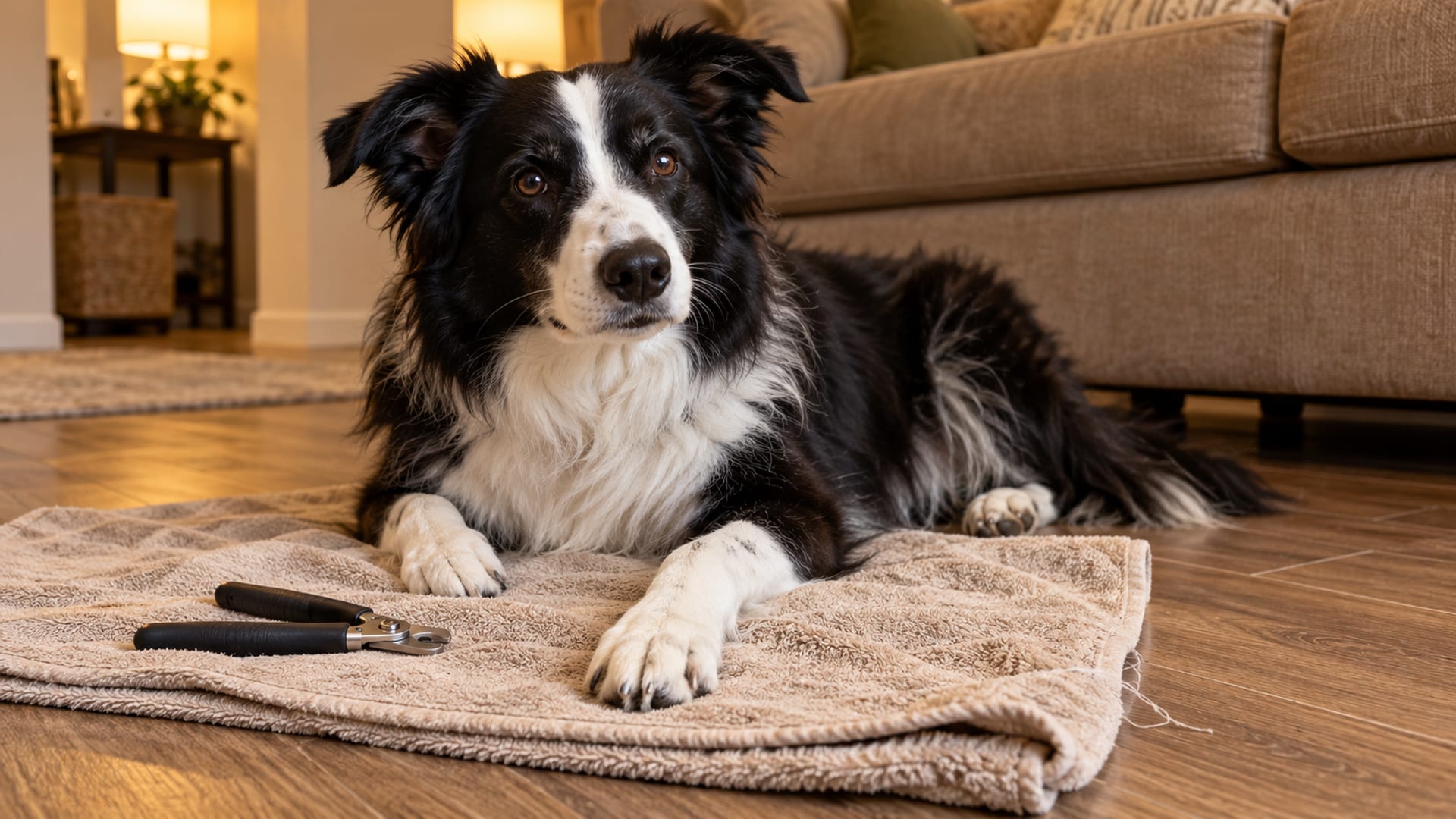
Trim your dog's nails when they touch the ground or click on hard floors. Use dog nail clippers or a grinder, remove only a small amount at a time, and stop before the quick, the part of the nail that contains nerves and blood vessels.
On clear nails, leave a visible margin before the pink quick. On black nails, take tiny slices and look at the cut surface after each one. Keep styptic powder nearby in case of bleeding. Stop if your dog panics, and use a groomer or veterinarian when safe handling is not possible.
Key takeaways
Tap a card to bring it forward.
- Nails that click on hard floors, touch the ground while your dog stands, snag, or curl are ready for a trim. Most dogs need one every few weeks.
- The quick has nerves and blood vessels. On clear nails, leave about 2 to 3 mm between your cut and the pink quick.
- On black nails, take slices of about 1 to 2 mm and check the cut surface after every slice.
- Keep styptic powder within reach. If a nail bleeds, stop, apply the powder with gentle pressure, and keep your dog quiet.
- One nail, or even one toe, is a good session. Stop while your dog is still relaxed.
- A groomer or vet is the right call for a dog you cannot handle safely, very long nails, a broken nail, or a nail growing into the pad.
If you are standing there with clippers in one hand and a nervous dog under the other, you are probably worried about two things: hurting your dog and making the next trim even harder. That worry is a good sign, because it makes you go slowly, and slow is how this is done safely. I'm not a veterinarian or a trainer, so I'll tell you where a professional should take over.
How do you know your dog's nails are too long, and how often should you check?
The ASPCA says nails should be trimmed when they just about touch the ground, and it lists clicking and snagging as signs that a trim is due. In practice, you look for these things:
- A clicking sound on tile, wood, or other hard floors.
- Nails that touch the ground when your dog stands still.
- Nails that snag on carpet, blankets, or upholstery.
- Nails that curve downward, or a dewclaw that is getting close to the paw pad.
There is no single schedule that fits every dog. VCA Animal Hospitals says most dogs need a pedicure every few weeks. The ASPCA says a leisurely dog may need a weekly trim, while a dog that walks on rough city sidewalks may go longer. Check the nails on a regular day each week, then trim when they need it rather than by the calendar.
Long nails are not only a looks issue. Veterinary sources link very long nails to changes in how a dog places the foot, breakage, and pain. A VCA grooming brochure says long nails can make walking difficult and distort the foot joints, which can lead to lameness. That does not mean every long nail causes permanent damage, but it is a good reason to act when you hear the click.
Where is the quick, and how do you find it on clear and black nails?
The quick is the living inner part of the nail. It contains nerves and blood vessels, so cutting into it hurts and bleeds. That is why the whole plan is built around stopping short of it. It is also more than "a vein."
On a clear or light nail, the pink quick is usually visible through the nail. VCA advises leaving roughly 2 to 3 mm between your cut and the quick. You can see your margin before you cut, which makes clear nails the easier place to learn.
On a black nail, you usually can't see the quick from the outside. The plan changes from one cut to a series of tiny ones. VCA's advice is to remove only about 1 to 2 mm at a time and look at the cut surface after each slice. The ASPCA describes the stopping signal as a nail-colored circle starting to appear on the cut surface. If you look at a cut and can't tell what you are seeing, that is a fine moment to stop and hand the job to a groomer or vet.
What do you need before you start?
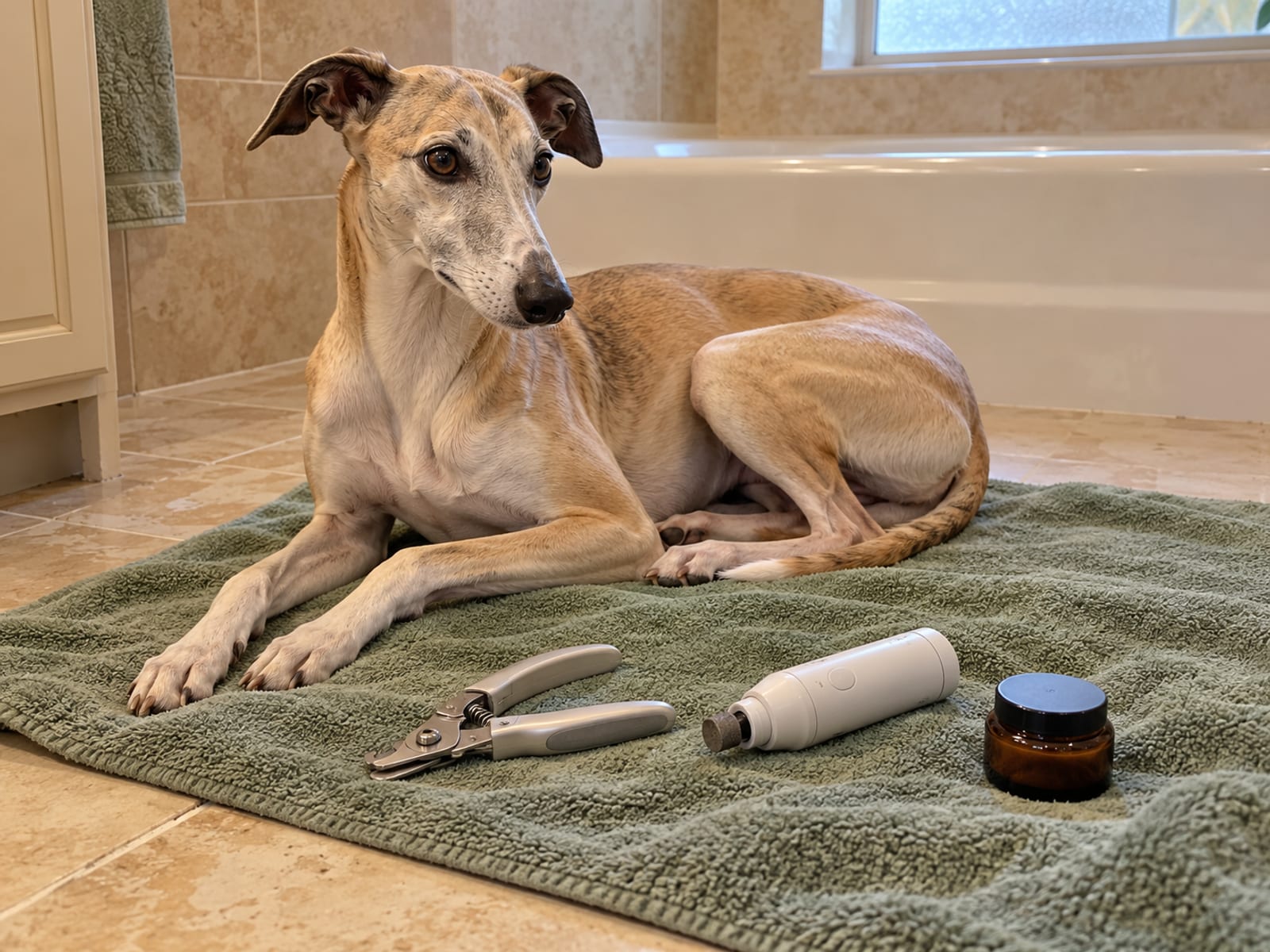
Set everything within arm's reach before you lift a paw, because you won't want to leave your dog halfway through. You need:
- Dog nail clippers sized for your dog's nails, or a nail grinder, or a nail file.
- Styptic powder, opened and ready.
- Treats your dog loves, cut small.
- Good light, so you can see the nail and the cut surface.
- A stable, nonslip surface for your dog to stand or sit on.
You can choose the tool that suits you and your dog, and there isn't one best tool for everybody. Clippers remove nail quickly and suit an owner who can make small, controlled cuts. A grinder or file takes off less material at a time and smooths the edges, but the noise, the vibration, and the heat can bother a dog, so use it in short touches rather than holding it on one spot. Hill's Pet also covers tool choice and bleeding guidance, in Spanish.
How do you trim a clear nail, step by step?
Work calmly and quietly. Start with one nail, and remember that a short session that ends well beats a long one that does not.
- Hold the paw firmly but gently, with your dog standing or sitting on the nonslip surface.
- Find the pink quick and decide where your cut will land, leaving about 2 to 3 mm of margin.
- Cut from top to bottom, not side to side, and take only a small tip.
- Look at the cut surface. The ASPCA says to stop when a nail-colored circle begins to appear there.
- File or grind the sharp edge if you like, then reward your dog right away.
The ASPCA advises taking only a very small amount at a time. When you are unsure, make the next cut smaller instead of bigger, and call it a day for that nail if you are worried.
How do you trim a black nail without hitting the quick?
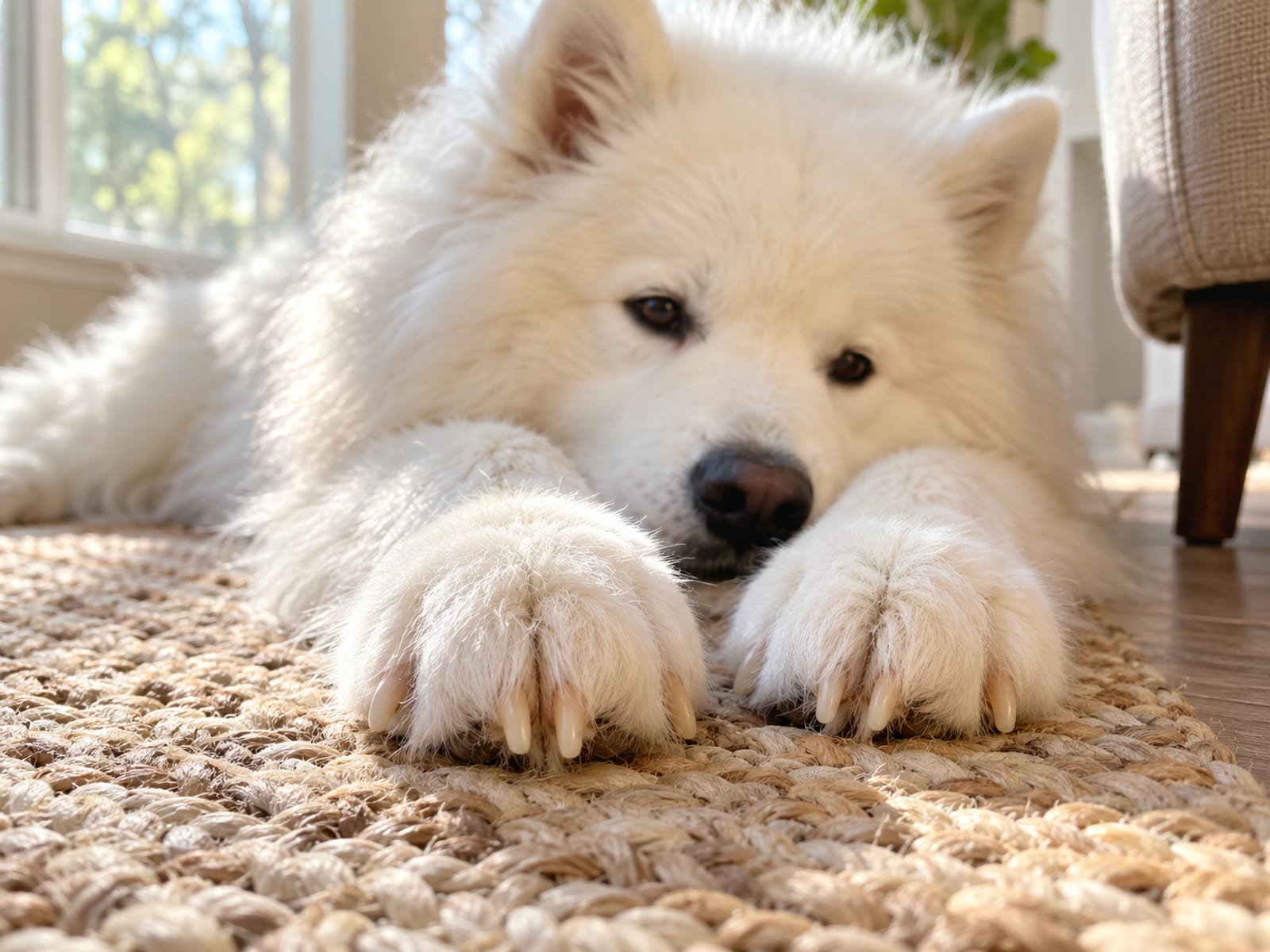
A black nail asks for patience, not skill. You can't see the quick, so you let the cut surface tell you where it is.
- Take one slice of about 1 to 2 mm from the tip, no more.
- Look straight at the cut surface under good light.
- If the surface still looks like plain nail, take another tiny slice and look again.
- Stop when the cut surface shows the dark center or anything that looks like the quick is near.
- Reward your dog, then move to the next nail only if your dog is still relaxed.
VCA's guidance for black nails is very small increments with an inspection after every cut. Resist the urge to take one big cut to finish faster. If you can't read the cut surface with confidence, a groomer or veterinarian can trim the nails and show you where a safe stopping point is.
What about dewclaws, and does walking on pavement keep nails short?
Dewclaws sit on the inner side of the leg, and they often do not touch the ground. Because they never wear against the floor, they can grow long and curl into the paw pad. VCA says dewclaws need their own inspection. The AAHA senior-pet guide says to trim nails regularly, to monitor length, and to check that nails are not curling into the pads, with attention to dewclaws. Trim a dewclaw with the same small-cut method as any other nail.
Does a daily walk do the trimming for you? Not reliably. Pavement can smooth some nails, but VCA says it may leave them too long, and active dogs still need their front nails checked and their dewclaws cared for. A long walk is great for your dog, and it still doesn't replace a look at every nail. If you want ideas on walking routines, see how often to walk your dog.
What is a low-stress way to do the first trim, and how do you hold your dog safely?
If your dog hates having the paws touched, don't start with the clippers. Start with touch. VCA describes a progression you can run over several days, always on a nonslip surface:
- Touch your dog's shoulder or hip, then glide your hand down the leg, and give praise and a treat.
- Touch the paw, then one toe, and reward each time.
- Show the clippers or grinder without using them, and pair the tool with a treat.
- Touch the tool to a nail.
- Make one tiny cut, or one brief touch with the grinder or file.
- Reward and stop while your dog is still relaxed.
- Repeat often, in short sessions.
For a fearful dog VCA describes sessions of just a minute or two. One nail a day is a reasonable way to follow that short-session idea, though it is not a veterinary schedule. If your dog is relaxed and can walk away whenever it wants, a lick mat with something tasty on it can keep your dog busy. A lick mat should not be used to cover up growing fear.
Hold the paw firmly but gently. Wrestling, pinning, or punishing a dog is not the way to finish a trim. Fear Free's training material says that when a dog needs to be held in a position because of moderate or severe fear, easing that fear takes priority over finishing the trim. If you've reached that point, stop and put the clippers away. You can read more about reading your dog in dog body language.
Slow down or stop when your dog:
- Moves away, looks away, yawns, folds the ears back, tucks the tail, or shakes off, which are the signs VCA lists.
- Pants, drools, trembles, whines, freezes, or cowers, which the ASPCA lists as distress signs.
- Growls, snarls, or snaps. That is the point to stop completely and bring in a professional.
The ASPCA and VCA both lead you to the same plan: go back a step, keep it short, and get help if fear keeps rising. Early handling practice matters too, and how to socialize your puppy covers it. For rewards-based training, see positive reinforcement dog training.
When should you start with a puppy? VCA recommends starting routine trims while puppies are young. In the beginning you can take off just the sharp tip with an appropriate tool, staying clear of the quick, and you can begin gentle paw handling right away.
What should you do if the nail bleeds?
Stop trimming. Put styptic powder on the nail tip and press gently so the powder contacts the bleeding spot. The ASPCA also names cornstarch as an option, and VCA's first aid page for bleeding lists styptic products, cornstarch, baking powder, and flour for external bleeding when appropriate.
Keep your dog quiet and don't let your dog run around until the bleeding has stopped. Follow the steps and give the powder and pressure a few minutes to work.
Call a veterinarian if:
- Bleeding keeps going beyond a few minutes or you can't control it.
- The nail is badly torn or irregularly broken.
Get prompt veterinary care for severe pain, persistent limping, a nail torn near the base, a nail growing into the pad, signs of infection, or bleeding along with weakness, pale gums, or rapid breathing, as VCA's paw injury page describes. If you can't reach your regular vet, use the emergency vet directory. For broken nails and other paw warning signs, see dog paw problems.

What do you do about very overgrown nails, and what does a professional charge?
When nails are very long, the quick may extend farther down the nail. Don't try to get back to a normal length in one cut. VCA supports shortening gradually: take a small amount, let the nail and the quick adjust, and repeat at short intervals. How often to repeat depends on your dog, so ask your veterinarian or groomer to set the schedule when nails are severely overgrown. A professional can also set a safe starting length.
Thick nails can be handled with appropriately sized dog nail clippers, a grinder, or a file. A grinder or file allows slower removal, but it can frighten a dog and heat up if held on one spot. If your dog's nails are thick, take your time and use small cuts, or let a groomer or vet handle them.
Use a groomer when your dog is manageable but you lack the confidence or equipment. Use a veterinarian when nails are severely overgrown, curled into the pad, broken, painful, or infected, or when your dog can't be handled safely. VCA notes that veterinary clinics can offer sedation for a very upset dog. Sedation is the veterinarian's decision, made for your dog and the procedure, so ask what the clinic recommends. You can find help in the groomer directory or the veterinarian directory.
Posted prices give you a rough sense of cost, and these come with the date and place. Your local price will differ, so call a groomer or vet nearby and ask what the trim costs and whether handling, an exam, grinding, or sedation changes the fee.
Tap or hover a row to highlight it.
| Item | Figure | Source |
|---|---|---|
| ItemTypical trim interval | FigureEvery few weeks | SourceVCA, accessed October 2026 |
| ItemVisible quick margin | FigureAbout 2 to 3 mm | SourceVCA, accessed October 2026 |
| ItemBlack-nail slice | FigureAbout 1 to 2 mm per clip | SourceVCA, accessed October 2026 |
| ItemPetco nail trim | Figure$12 | SourcePetco grooming price list (petco.com), accessed October 2026 |
| ItemPetco nail trim and buffing | Figure$20 | SourcePetco grooming price list (petco.com), accessed October 2026 |
| ItemPetco package with trim and buffing | Figure$22 | SourcePetco grooming price list (petco.com), accessed October 2026 |
| ItemVeterinary clinic nail trim, Overland Park, Kansas | Figure$34 | SourceQuivira Crossing Veterinary Clinic, accessed October 2026 |
| ItemVeterinary clinic nail grinding, Overland Park, Kansas | Figure$49 | SourceQuivira Crossing Veterinary Clinic, accessed October 2026 |
These are single posted prices, not a national average. I'm sharing them so you have a sense of the range, not to point you to any one business.
Questions about trimming dog nails
These answers cover the questions owners ask most about trimming at home.
Is it neglect to not cut your dog's nails?
If your dog's nails have gone long, the fix is to start trimming now, in small steps. It does become a welfare problem when nails stay long enough to interfere with foot placement, cause discomfort, snag, break, or grow into the pad. If you are dealing with nails like that, ask a vet or groomer to help you set a safe starting point.
Is it better to cut or file dog nails?
Either can work. Clippers are faster, while a file or grinder removes smaller amounts and smooths the edges, but noise, vibration, and heat need to be introduced slowly with short touches. Pick the tool you and your dog can both stay calm with.
Do dogs feel pain when their nails are clipped?
A cut that stays short of the quick should not hurt. The quick has nerves and blood vessels, so cutting into it causes pain and bleeding, which is why the margin on clear nails and tiny slices on black nails matter. Stress can make a trim feel bad even with no cut to the quick, so keep sessions short and reward often.
Can I soften thick nails before trimming?
Skip soaking and other softening tricks; use the right tool instead: dog nail clippers sized for thick nails, a grinder, or a file. Take small amounts and use short contact with a grinder. If the nails are very thick or hard, a groomer or veterinarian can do the trim.
What do you do if your dog won't let you cut their nails?
Stop forcing it, go back to the touch and treat steps, and keep sessions to a minute or two. If your dog growls, snaps, or panics, or if the nails are already long, a groomer or veterinarian is the safer choice, and a clinic can talk with you about sedation if it is needed. Fear should take priority over finishing the trim.
Can pavement replace trims?
No. Pavement may smooth some nails, but it does not keep every nail short, and dewclaws don't touch the ground. Check each nail, front and back, plus the dewclaws.
How do I hold a dog still for a nail trim?
You don't hold a dog still by force. Use a stable, nonslip surface, hold the paw gently but firmly, and keep the session short and rewarded. If your dog struggles harder, stop, because a dog in panic is not a dog you can trim safely.
When should I start trimming a puppy's nails?
Start while your puppy is young. Begin with gentle paw handling and treats, then take off just the sharp tips, avoiding the quick.
Quick check: dog nail trimming
What is the next step?
Check your dog's nails today. If they click or touch the ground, pick one nail and a calm moment, set out the clippers or grinder, the styptic powder, and some treats, and take one small cut. If that goes well, stop and reward your dog. If it doesn't, you've lost nothing, and you can try again tomorrow or book a groomer or veterinarian to take over.
Whichever you pick, go slowly, and never push through fear. For help close to home, try the groomer directory or the veterinarian directory, and read senior dog care if your dog is older and traction or mobility is a concern. I'm Cal, and all of us at DogServ hope the first trim goes better than you expect.
Sources
- American Animal Hospital Association: AAHA
- ASPCA: ASPCA
- hillspet.es: Hill's Pet
- petco.com: Petco grooming price list
- quiviracrossingvetclinic.com: Quivira Crossing Veterinary Clinic
- VCA Animal Hospitals: VCA Animal Hospitals
- VCA Animal Hospitals: VCA grooming brochure
- VCA Animal Hospitals: VCA's first aid page for bleeding
- VCA Animal Hospitals: VCA's paw injury page
- VCA Animal Hospitals: VCA
- VCA Animal Hospitals: VCA