
How to Start a Dog Grooming Business: Salon, Home or Mobile, Costs, Licenses and First Clients
By Cal Hewitt · Published
Business guides
To start a dog grooming business in the United States, choose a salon, home-based or mobile model, confirm your state and local requirements, register the business, arrange insurance for the dogs in your care, build a safe workspace, set prices from your time and operating costs, and create a booking and review system. The exact permits depend on where you work and what you offer. The SBA says zoning, licenses, permits, taxes and fees vary by location. Colorado licenses pet-grooming facilities, while Illinois says a state license is not required for a dog-grooming business. Treat wage figures as employee data, not a promise of what an owner will keep.
Key takeaways
Tap a card to bring it forward.
- There is no single national groomer license. Colorado licenses grooming facilities, Illinois says a state license is not required, and your city or county can add its own rules.
- A home business can still be subject to local zoning, so call the planning office before you sign a lease or modify your house.
- Published 2026 estimates run about $3,000 to $8,000 for a home setup, $15,000 to $50,000 or more for a salon, and $35,000 to $130,000 for a mobile van, depending on used or new.
- NDGAA, IPG and IGS certifications are voluntary credentials. They are not government licenses.
- BLS wages are for employees in a broad category. They do not tell you what an owner will earn.
You may be excited and nervous at once. You want to know if you can legally open, what to buy, whether the numbers hold up, and how to keep a dog safe while you build your name. This is the order I would take it in. I am a website and marketing professional, not a lawyer, accountant, insurance agent, veterinarian or groomer, so I can't rule on your permits or taxes. The offices I name can, and I will say which one decides each point.
Which model fits you: salon, home or mobile?
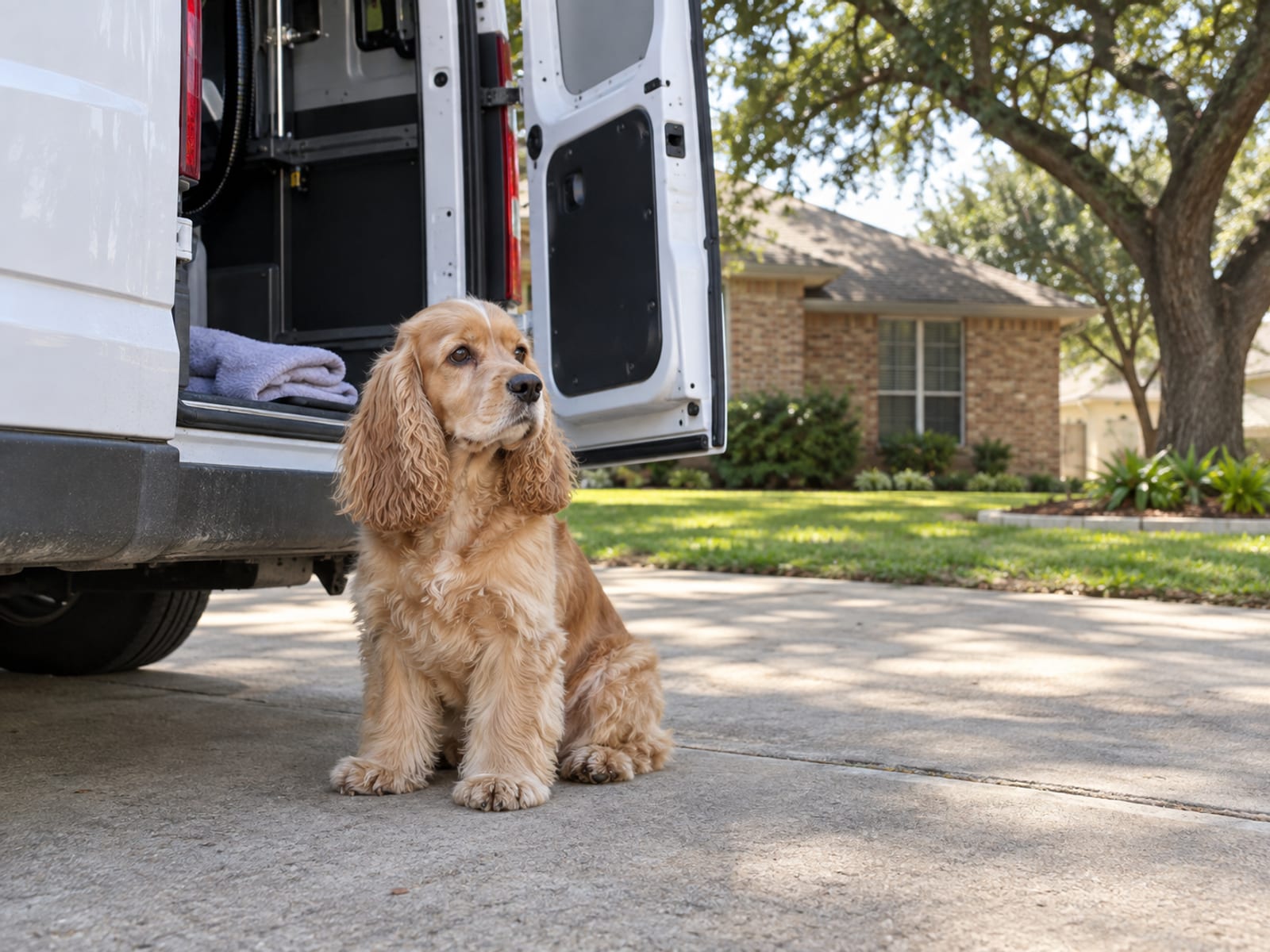
Pick the model first, because it sets your money, your space and the rules that apply to you. A salon gives you a fixed address, room for more than one station and a place clients can find, but it carries a lease, buildout and utilities. A home setup costs the least to start, yet the SBA says home-based businesses can still be subject to local zoning, so it is not exempt just because it is in your garage. A mobile van takes the groom to the client and can work well where parking is easy, but it adds a vehicle, a generator or shore power, water tanks and gray-water handling, plus fuel, maintenance and driving time between stops.
Capacity is the other difference. A van usually works one dog at a time, and a salon can add tables and staff as you grow. Ask yourself where you will park, how far you will drive between stops, and whether your area has the dog owners to keep a schedule full. A used van is not the only legitimate way into mobile grooming, and a new turnkey van is not required to be taken seriously. A home or small salon can be a lower-capital start, and you can add a second model later.
What should you do this week?
You can do most of the early work with a phone and a notebook, before you spend anything.
- Define your service area, such as the neighborhoods you can reach in a 20 to 30 minute drive.
- Look up two or three local groomers' price lists and note what each charges by size and coat.
- Call your city or county planning office and ask whether grooming is allowed at the address you have in mind.
- Check your state's agriculture or animal-facility agency for facility rules.
- Write a startup budget with a line for working capital.
- List the training gaps you have and the dogs you are not ready to handle.
- Request insurance quotes for your model.
- Choose a business structure and reserve your business name.
- Draft an intake checklist for owner contacts, vaccination or health information, and handling notes.
Write down who you spoke with, the date and the rule they cited. If a zoning office says no after you have bought equipment, that is expensive, so ask first.
Which licenses, permits, registrations and taxes apply?
Think of four layers: federal, state, county and city. The IRS explains how your business structure affects your tax return and why many businesses need an EIN, which you can get directly from the IRS at no charge. Your state Secretary of State handles entity formation and assumed names. Your state revenue or taxation department decides sales-tax registration and whether grooming is a taxable service. Your city or county decides land use, home occupation, signs, parking and any local business license. A state agriculture or animal-facility agency may license the grooming operation itself.
Those layers come out differently from state to state, and these documented examples show the range. None of them is a national rule.
- Colorado: the PACFA rules define permanent and mobile grooming facilities and require a valid facility license.
- Illinois: Illinois FirstStop says a state license is not required to operate a dog-grooming business.
- Nebraska: the Department of Agriculture FAQ says groomers are not licensed under its commercial dog and cat program, though overnight boarding can require a kennel license.
- Minnesota: the Board of Animal Health says it does not license groomers, and local rules may still apply.
- Washington: Clark County lists a facility license that covers grooming parlors and mobile grooming, with a $100 fee for each.
- Connecticut: Chapter 435 defines a grooming facility to include a vehicle or trailer under the state's animal-facility law.
If you plan to add overnight boarding or daycare, ask the same offices whether that changes the license you need. Also ask your DMV or transportation office about vehicle registration if you are going mobile. Texas readers can see how those layers play out in our Texas grooming guide and our Texas sales tax on pet services page. Readers in other states should ask their own revenue department.
When you call a city or county, these questions get you a clear answer.
- Is grooming allowed at this address, and is a home-occupation permit required?
- Are there limits on the number of dogs, holding time, noise, parking, signs or customer visits?
- Are grooming vans allowed on private or public property, and do generator, water or gray-water rules apply?
- Is a building, plumbing, electrical, fire or wastewater inspection required?
- Does my operation meet the local definition of a kennel, animal facility or commercial pet business?
- Which local business license or tax registration do I need, and what are the fees and renewal dates?
Ask for the answer in writing and keep the office contact, date and rule citation.
Do you need grooming certification, and how is it different from a license?
A license is permission from a government to operate. A certification is a credential from a trade body that shows what you know. Certification through NDGAA, IPG or IGS is voluntary, and none of the three is a government license.
The NDGAA offers workshops, practical grooming work, breed-specific knowledge and national certification materials. Ask NDGAA directly for current fees and exam details. The IPG guidelines describe Salon Details Certification, written and practical exams, a Certified Groomer exam and a top-level pathway, plus salon and school accreditation. Its exams cover behavior, handling, anatomy, bathing, safety, first aid, health, sanitation and ethical business practices, and the passing marks include 80% for Salon Details and 86% for the highest pathway. The International Grooming Society describes a certification built on skin and coat science, emotional grooming care and respectful techniques, with 100 credit points per year to renew a professional development certificate.
A certificate does not give you legal permission to open, and a missing certificate does not by itself stop you. Facility and local rules can still require training, inspection or other qualifications, so ask the state animal-facility agency and your city licensing office whether any credential applies to your operation. Even where nothing is required, training and an apprenticeship matter, because the thing you are selling is safe handling of other people's dogs.
What does equipment cost for a salon, a home setup and a mobile van?
These numbers are published market estimates, not government-set prices. Use them to start a budget, then replace each line with quotes from landlords, builders, insurers and your local offices.
Tap or hover a row to highlight it.
| Model | Estimate | Source and date |
|---|---|---|
| ModelHome-based | EstimateAbout $3,000 to $8,000 | Source and dateZendPaw, June 2026 |
| ModelSalon | EstimateAbout $15,000 to $50,000 or more | Source and dateZendPaw, June 2026 |
| ModelMobile, used retrofitted van | EstimateAbout $35,000 to $90,000 | Source and dateSnout Studios, June 2026 |
| ModelMobile, new turnkey van | EstimateAbout $85,000 to $130,000 | Source and dateSnout Studios, June 2026 |
The ZendPaw startup estimate for a home setup covers a table, a tub or bathing setup, a dryer, clippers, blades, shears, brushes, restraints, supplies, booking, insurance and working capital, and may include plumbing or flooring changes. A salon adds a lease deposit, buildout, plumbing, drainage, electrical work, ventilation, cages or holding areas, sanitation, signs and a point-of-sale system, and can cost much more where code compliance or several stations are needed.
For vans, the Snout Studios van estimate puts all-in startup around $56,000 to $150,000, and another 2026 estimate from PawsRoute puts mobile startup around $30,000 to $80,000. Bare equipment for a mobile setup, meaning the table, dryer, water system, generator or shore power, clippers, blades, scissors and supplies, was estimated at roughly $2,600 to $6,800. On top of that, plan for commercial auto coverage, fuel, maintenance, climate control, water tanks, gray-water handling, permits, branding and route software.
What insurance should you ask about?
Ask a licensed insurance agent for quotes that match your exact model. Bring these coverage types to the conversation.
- General liability, for injury or damage claims tied to your premises or operations.
- Professional liability, for claims about the grooming service itself.
- Care, custody and control, for dogs while they are in your hands.
- Commercial auto, if you run a van or drive for the business.
- Property coverage, for equipment, the building contents or the van's conversion.
- Workers' compensation, where you have employees.
Ask each quote what is excluded and whether it covers an animal injured while in your care, since that is the point of care, custody and control. Your state and city may also have insurance or vehicle requirements, and your landlord's lease may add its own. For a Texas example, see our dog business insurance in Texas page, and for dog health coverage on your own pet, see pet insurance for dogs. A business structure like an LLC affects liability and taxes, but it does not replace insurance, written policies and safe handling.
How do you price grooming, and what can a groomer earn?
Price from time, coat, size, condition and overhead, not weight alone. A matted double coat that takes two hours does not cost the same to groom as a short coat that takes 45 minutes. Count the time on the table, drying and cleanup, plus rent or van costs, insurance, taxes, supplies, booking tools and the hours you spend answering messages. Mobile service often earns a convenience premium, so account for drive time and fuel too.
For a reference point, the Whole Dog Journal reported these nationwide consumer price ranges in November 2024. They are not a required price list, and the source notes that location, supply, demand, coat and mobile service move prices.
Tap or hover a row to highlight it.
| Dog size | Basic grooming | Full package |
|---|---|---|
| Dog sizeSmall, up to 20 lb | Basic grooming$30 to $50 | Full package$50 to $80 |
| Dog sizeMedium, 20 to 50 lb | Basic grooming$50 to $80 | Full package$80 to $110 |
| Dog sizeLarge, 50 to 80 lb | Basic grooming$80 to $120 | Full package$110 to $150 |
| Dog sizeGiant, over 80 lb | Basic grooming$120 to $200 | Full package$150 to $250 |
The same source lists add-ons of $10 to $100 for dematting, $10 to $45 for flea baths or treatments, $15 to $45 for medicated or specialized skin treatments, and about $15 for a stand-alone nail trim. Compare two or three local rates before you set yours, and write the factors that change the final price on your service menu.
On earnings, the BLS May 2024 data reports a mean of $17.06 per hour, or $35,490 per year, for animal care and service workers, and $16.71 per hour, or $34,750 per year, for animal caretakers. Those are employee wages in broad categories, not what a grooming business owner takes home, and revenue is not profit. Subtract your costs, taxes and your own pay before you call any number income, and don't promise yourself or anyone else a result.
How do you keep dogs, staff and clients safe?
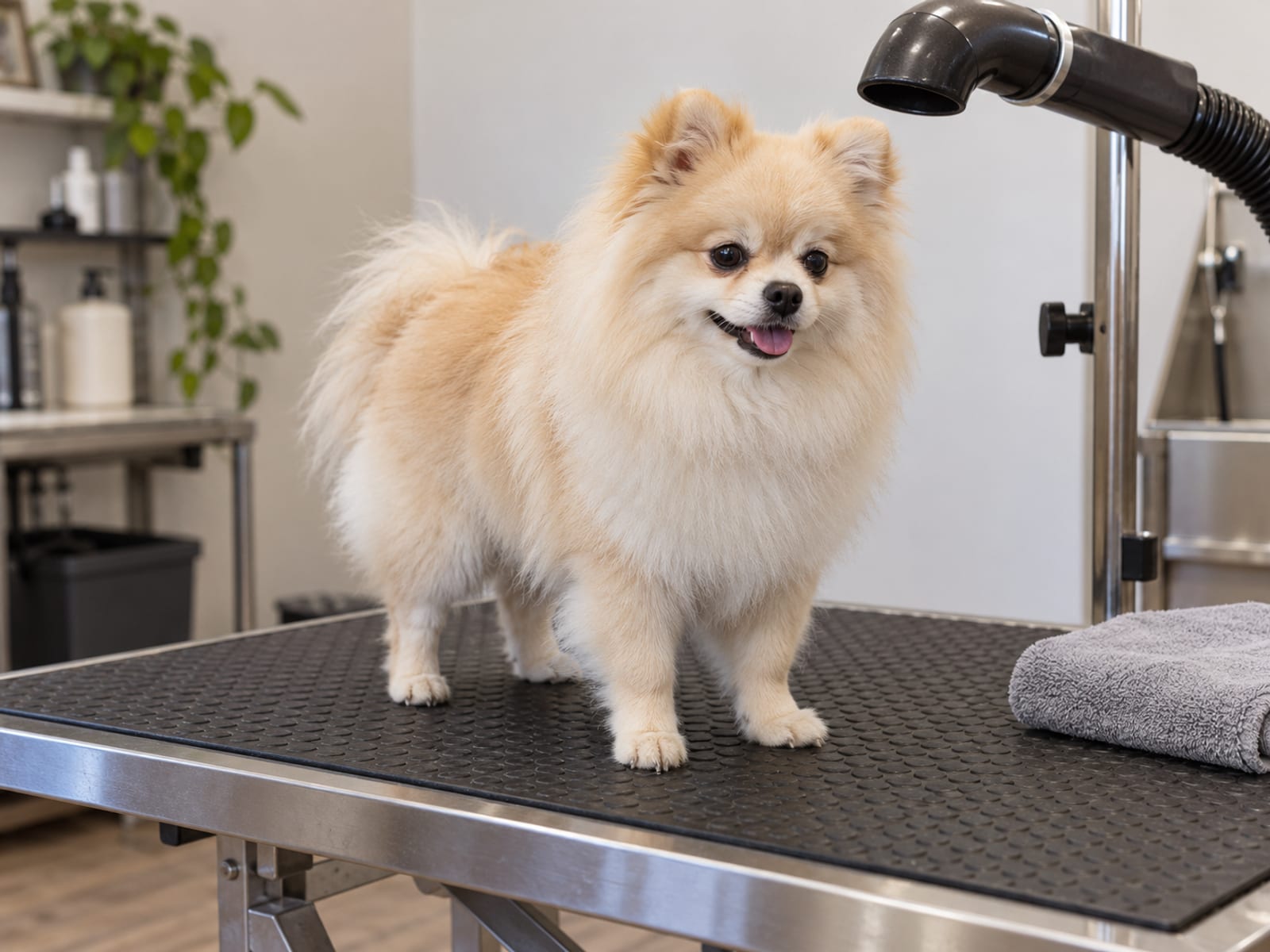
Safety is part of the business plan, not an extra. Start with your dryers. Use them according to the manufacturer's instructions and watch each dog the whole time for heat stress, distress, entanglement and being unable to move away from the airflow. A restraint is not a substitute for watching the dog, and a dog should never be able to fall or hang from a table or loop. For heat risk in a hot climate, see our Texas heat safety guide for dog businesses.
Other controls that matter every day:
- Use non-slip floors, stable tables and restraints that suit the dog and the task.
- Inspect cords, generators, water heaters and a van's climate system.
- Keep ventilation and temperature appropriate in the workspace or van.
- Control doors and pickup so a dog cannot slip out.
- Keep written intake forms and emergency contacts, and record services, owner instructions, disclosed health conditions, incidents, injuries, bites, escapes and pickup details.
- Clean and disinfect between dogs, and keep laundry, waste and equipment maintenance on a schedule.
- Train staff on chemical labels, safety data sheets, gloves, eye and skin protection, hand hygiene and spill response.
- Plan for lifting, awkward posture, noise, wet floors and sharp tools.
Stop work when a dog's handling or condition is beyond your training, and refer the owner to a veterinarian or a more experienced groomer. OSHA cited a grooming business for lacking a written hazard-communication program, safety data sheets and employee training for shampoos, ear cleaners, colognes and cleaners that caused chemical burns. OSHA's small-animal safety guidance covers protective equipment and hygiene in animal handling. For dryer settings and restraints, follow the manufacturer's instructions, your state's facility rules and qualified trade training. For handling cues that show a dog is stressed, see dog body language.
How do you find and keep clients?
Start with a verified Google Business Profile that lists your service area, hours, phone, website, booking link, services and photos. Google says reviews appear next to a Business Profile in Search and Maps, lets you ask for reviews with a link or QR code, and prohibits offering a discount, gift or free service in exchange for a review. Ask after a real, completed appointment, and answer reviews briefly, factually and politely.
Then make booking simple. Your booking path can ask for dog size, coat, condition, handling notes, location, a deposit and your cancellation policy. Send appointment texts, and rebook the next visit at pickup, since coat care repeats on a regular interval. Keep a clear service menu with starting prices and the factors that change them. Reliable pickup times, honest pricing and consistent records are what bring clients back.
A Spanish service description and intake form can help you reach Spanish-speaking dog owners. The IRS also publishes Spanish pages on starting a business and the EIN. You can also list your business in the DogServ directory and the groomers category, and our directory pages explain how to claim or add a listing.
Questions about starting a dog grooming business
These questions come up most, answered in short.
How much does it cost to open a dog grooming business?
It depends on the model. Published 2026 estimates are about $3,000 to $8,000 for a home setup, $15,000 to $50,000 or more for a salon, and $35,000 to $130,000 for a used or new mobile van. Get quotes for your own rent, buildout, vehicle and insurance before you commit.
How profitable are dog groomers?
Profit depends on your prices, hours, costs and how full your schedule stays. BLS reports a mean of $17.06 per hour and $35,490 per year for animal care and service workers, but that is employee pay in a broad category, not owner profit. Track your own revenue, costs and taxes to see what you keep.
What qualifications do I need to groom dogs?
There is no single national requirement. Colorado licenses grooming facilities, while Illinois says a state license is not required, and your city or county can add rules. NDGAA, IPG and IGS certifications are voluntary credentials, so ask your state agency and city office what applies to you.
Is it hard to start your own dog grooming business?
The grooming is the harder part to learn, and the setup is a list you can work through in order. Check zoning and facility rules first, then insure the business, train, set prices and open for a few clients. A small soft launch lets you fix your workflow before you scale.
Can I offer a discount for Google reviews?
No. Google prohibits incentives in exchange for reviews. You can ask for a review with a link or QR code after a completed appointment.
What is your next step?
This week, call your city or county planning office and your state's animal-facility agency, and write down what each one tells you. Then price your own costs against two or three local rates, and ask for insurance quotes for the model you chose. Everything else in this list gets easier once those answers are on paper. If you want to be found when you open, you can list your business in the DogServ directory and build your Google Business Profile before your first client.
Sources
- bah.state.mn.us: Board of Animal Health
- bls.gov: BLS May 2024 data
- cga.ct.gov: Chapter 435
- clark.wa.gov: Clark County
- firststop.custhelp.com: Illinois FirstStop
- internationalgroomingsociety.org: International Grooming Society
- irs.gov: EIN
- irs.gov: IRS
- irs.gov: starting a business
- nationaldoggroomers.com: NDGAA
- nda.nebraska.gov: Department of Agriculture FAQ
- osha.gov: OSHA
- osha.gov: small-animal safety guidance
- pawsroute.com: PawsRoute
- s3-eu-west-1.amazonaws.com: IPG guidelines
- sba.gov: SBA
- snoutstudios.co: Snout Studios van estimate
- sos.state.co.us: PACFA rules
- support.google.com: Google
- whole-dog-journal.com: Whole Dog Journal
- zendpaw.com: ZendPaw startup estimate