

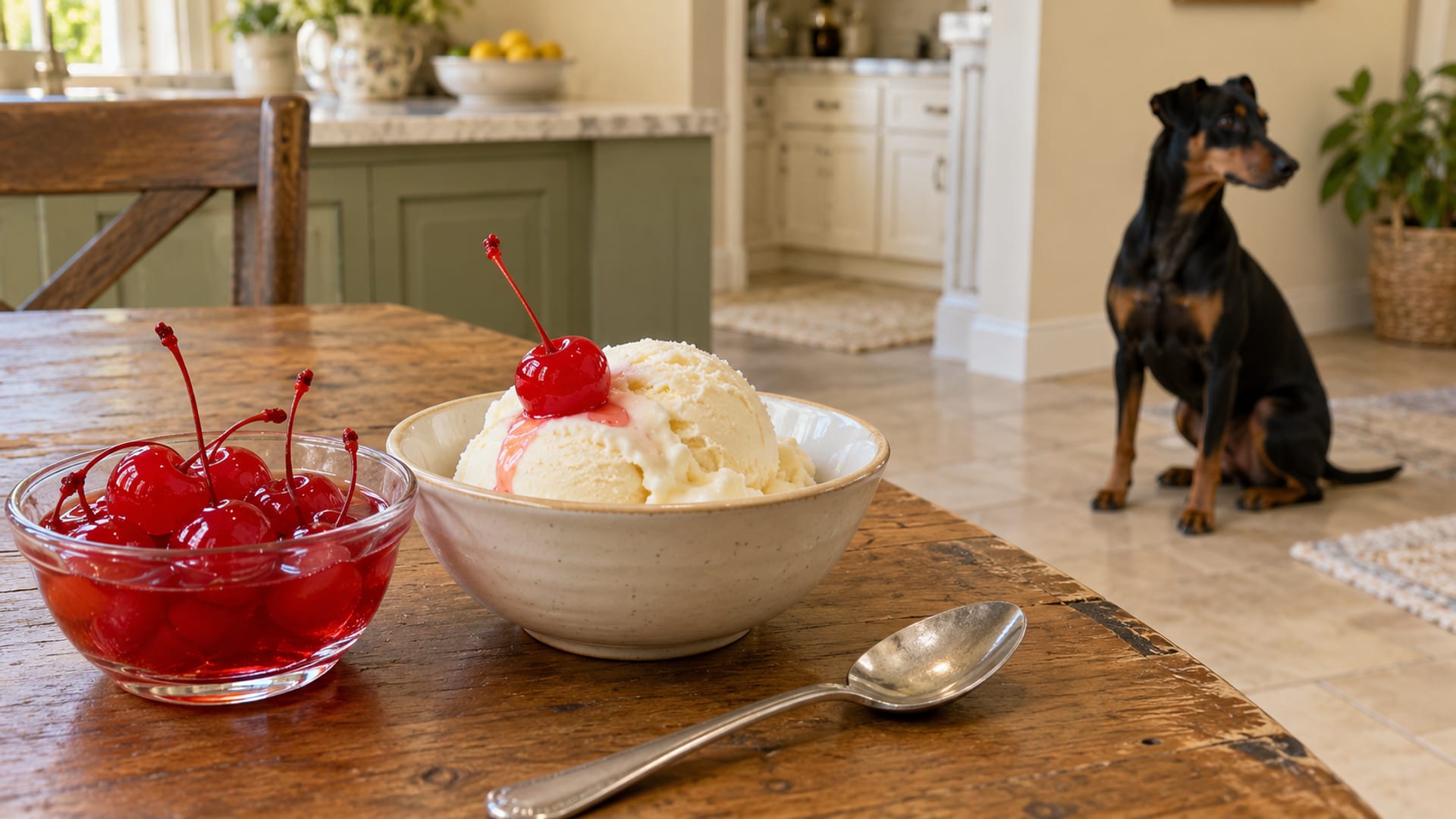
Not as a treat, though one store-bought maraschino cherry with no pit is not expected to poison your dog. The cyanide warning you may have heard about cherries belongs to the pits, stems and leaves, and a typical jarred maraschino cherry has had its pit removed, so what your dog swallowed is mostly fruit soaked in sugar syrup that can upset a stomach.
If your dog already ate one, a few quick checks below tell you whether to watch at home tonight or pick up the phone.
Key takeaways
Tap a card to bring it forward.
- A typical store-bought maraschino cherry is pitted, so the cyanide risk tied to cherry pits, stems and leaves does not apply to the fruit itself.
- The added sugar and syrup make maraschino cherries a poor treat, and they can cause an upset stomach.
- Call your vet or a pet poison line if the cherry had a pit or stem, your dog ate several, or it came from an alcoholic drink or a chocolate or sugar-free dessert.
- Breathing trouble, bright red gums, repeated vomiting or belly pain are reasons to call right away.
- A swallowed whole pit can block the gut even when poisoning is not expected, and those signs can take up to a day to appear.
What to do if your dog just ate a maraschino cherry
Work through these in order. Together they give your vet or the poison line what they need if you call.
- Clear away what's left. Move the jar, the glass or the dessert dish out of reach.
- Look for a pit or a stem. Check the leftover cherries, the jar label and the floor. Bright red grocery-store maraschino cherries are generally pitted, but cocktail cherries such as Luxardo or Amarena may still have pits, and a pit or stem is what brings cyanide and blockage into play.
- Count how many. Since there is no set number that counts as too many for a dog of a given size, the count itself is what your vet will ask for.
- Think about where it came from. A cherry fished out of a cocktail carries alcohol, one off a sundae may carry chocolate, and one from a sugar-free dessert may carry xylitol. Any of those can matter more than the cherry does.
- Factor in your dog's size and health. Small dogs face a bigger blockage risk from a whole pit, because the pit is large compared with their gut. A dog with diabetes, a weight problem or a history of stomach or pancreas trouble is a reason to call even for a plain cherry.
- Call now if any of that applies. Pet Poison Helpline says to call them or get immediate veterinary care if you think your pet ate something potentially toxic, and the ASPCA gives the same advice. One pit-free cherry, no alcohol or chocolate, and a dog acting normal is a situation you can usually watch at home.
- Skip home remedies. Don't give medicine or try to treat your dog yourself unless a vet tells you to.
Which cherry forms are lower risk and which need a call
The table sorts out the forms a dog is most likely to reach.
Tap or hover a row to highlight it.
| Form | Main concern | What to do |
|---|---|---|
| FormStore-bought maraschino cherry, pitted | Main concernAdded sugar and syrup, upset stomach | What to doDon't offer it; watch for tummy trouble; call if your dog has diabetes or shows signs |
| FormCocktail cherry with a pit (some Amarena or Luxardo style jars) | Main concernA chewed pit can release cyanide; a whole pit can block the gut | What to doCall your vet or a poison line |
| FormCherry stem or leaf | Main concernContains compounds that can release cyanide | What to doCall your vet or a poison line |
| FormMaraschino syrup or juice | Main concernConcentrated sugar | What to doDon't share it; check the label for alcohol, xylitol, chocolate or caffeine |
| FormCherry from a cocktail or dessert | Main concernAlcohol, chocolate, xylitol or a lot of fat | What to doCall your vet or a poison line |
| FormFresh cherry with pit, stem and leaves removed | Main concernA missed pit or stem | What to doSee the separate cherries entry |
The reason pits and stems get the attention is a group of plant compounds called cyanogenic glycosides. The seed inside a cherry pit holds one called amygdalin, and when the pit is chewed or crushed it can release hydrogen cyanide, which keeps the body's cells from using oxygen. Pet Poison Helpline rates cherry poisoning as mild overall but warns that a toxic amount can cause shock and death. The ASPCA lists the stems, leaves and seeds of cherry plants as toxic to dogs.
The pitted fruit is a different story. PetMD describes typical maraschino cherries as not toxic but unhealthy because of the added sugar and preservatives, and the AKC says they are not a good choice for the same reason. The FDA's standard for maraschino cherries defines them as a preserved, sweetened cherry product. Canning, cooking or packing in syrup should not be counted on to make a pit or stem safe.
Sharing cherry at all, and when the amount matters
For maraschino cherries there isn't a serving size to aim for. They are sweetened, syrup-packed fruit, and they belong off the dog's plate. That goes double for dogs with diabetes, dogs carrying extra weight, or any dog on a diet that limits sugar. Dogs with pancreatitis or a sensitive gut shouldn't get cherry desserts, pie filling or other rich cherry foods either.
If you want to give your dog cherry at all, the AKC says small amounts of plain, ripe cherry flesh with the pit, stem and leaves completely removed are potentially edible, though it still doesn't recommend cherries because it's easy to miss a pit. It gives no gram amount or per-size number. Our cherries entry covers fresh fruit and pits in more detail.
On the risky side, there is no published toxic dose per pound of body weight for cherry pits or maraschino cherries from the ASPCA, Pet Poison Helpline or the Merck Veterinary Manual. Pet Poison Helpline explains that the risk depends on how much was eaten, the size of the animal, whether the pit was chewed and which plant it came from. Have your dog's weight, the number of cherries, whether any pits or stems were involved, and the jar or recipe in hand when you call.
Signs to watch for, and when they show up
After a plain pitted maraschino cherry, the likely trouble is an upset stomach from the sugar and syrup. A dog that keeps vomiting, won't eat or seems uncomfortable should be seen.
If a pit was chewed or your dog got into stems or leaves, watch for signs of cyanide poisoning. The ASPCA lists brick red gums, dilated pupils, difficulty breathing, panting and shock. Cyanide acts fast once a toxic amount is released, and there's no fixed clock for how soon signs appear in a dog after cherries, so any of these signs means call immediately. At its worst, this kind of poisoning leads to breathing failure, shock and death.
A whole pit that was swallowed without chewing may pass with no poisoning at all, but it can still get stuck. Watch for vomiting, a drop in appetite, straining or little to no stool, and belly pain. The AKC says blockage signs may show up within 24 hours, though the timing varies, so keep watching through the next day. A blockage needs veterinary treatment.
My dog ate one before and was fine
That happened, and plenty of dogs have snatched a cherry off a sundae without any trouble. It just doesn't make a rule for the next time, or for the next dog. Pet Poison Helpline and the other sources point to several reasons one dog breezes through while another gets sick.
The first time may have been a pitted grocery-store cherry, so there was no seed to release cyanide. A pit may have been swallowed whole and passed intact, which is when poisoning isn't expected. The amount may have been small for that dog's size. The amount of these compounds changes with the cherry type, the plant part and how it was prepared. Dogs also differ in how sensitive their stomachs are and in whether a pit makes it through. And blockage signs can show up later than the moment you were watching for them.
Jars, desserts and names that get mixed up
"Maraschino cherry" can mean the bright red, pitted grocery-store kind or a pricier cocktail cherry such as Luxardo or Amarena Fabbri, which may contain pits or a different syrup. Jars may also say Tillen Farms, Royal Harvest or bourbon cherries. Read the label to learn whether there is a pit, alcohol or a sweetener involved.
Cherries also turn up inside other foods. Chocolate-covered cherries add chocolate, cherry pie and cobbler bring sugar and fat, and a cherry from a drink brings alcohol. "Cherry-flavored" candy, gum or drinks may contain no cherry at all and instead contain sweeteners, chocolate, caffeine, alcohol or xylitol.
Outdoors, the word cherry covers several plants. Chokecherry, black cherry, wild cherry and cherry laurel are all related to the cherry tree and carry the same pit, stem and leaf concerns, so a dog chewing on any of them warrants a call. Ground cherry and Cape gooseberry can refer to a different plant family, and Cornelian cherry is a dogwood, so identify the plant before assuming anything. Other stone fruits with pits, such as peaches, plums and apricots, have their own entries.
If you share your home with a cat, keep cherry pits, stems and leaves away from them too. The ASPCA lists cherry plants as toxic to cats as well as dogs.
Check what you learned
Three quick questions on the parts that matter tonight.
Quick check
Questions about dogs and maraschino cherries
A few more questions that come up often.
Can puppies eat maraschino cherries?
It's best to keep them away from puppies. Puppies can have more sensitive digestion, and the sugar is a concern for them too. If a puppy eats one with a pit or stem, call your vet.
Is the red juice in the jar a problem?
The juice is concentrated sweetened syrup, so a lick won't poison your dog, but it isn't something to pour over food. Check the label for alcohol or xylitol in flavored or specialty jars.
Are dried, canned or candied cherries any different?
It depends on what's in them. Pits, stems, alcohol, chocolate or xylitol are what change the risk, and processing doesn't make a pit or stem safe. Read the ingredient list and check for pits before deciding whether to call.
My dog ate a cherry from a Manhattan or an old fashioned. What now?
Call your vet or a poison line. The cherry has been sitting in the drink, the drink itself may have been lapped up too, and cocktail cherries are the kind more likely to have pits. Tell them what the drink was and how much might be gone.
Sources
Checked September 25, 2026.
- ASPCA Animal Poison Control Center, Toxic and Non-Toxic Plants: Cherry
- Pet Poison Helpline, Cherry Is Toxic To Dogs
- Pet Poison Helpline, Are Cherries Safe for Pets?
- AKC, Can Dogs Eat Cherries?
- PetMD, Can Dogs Eat Cherries? Benefits, Risks & Safe Serving Tips
- U.S. Food and Drug Administration, Code of Federal Regulations, 21 CFR 145.130, Maraschino Cherries
- Merck Veterinary Manual, Cyanide Poisoning in Animals