

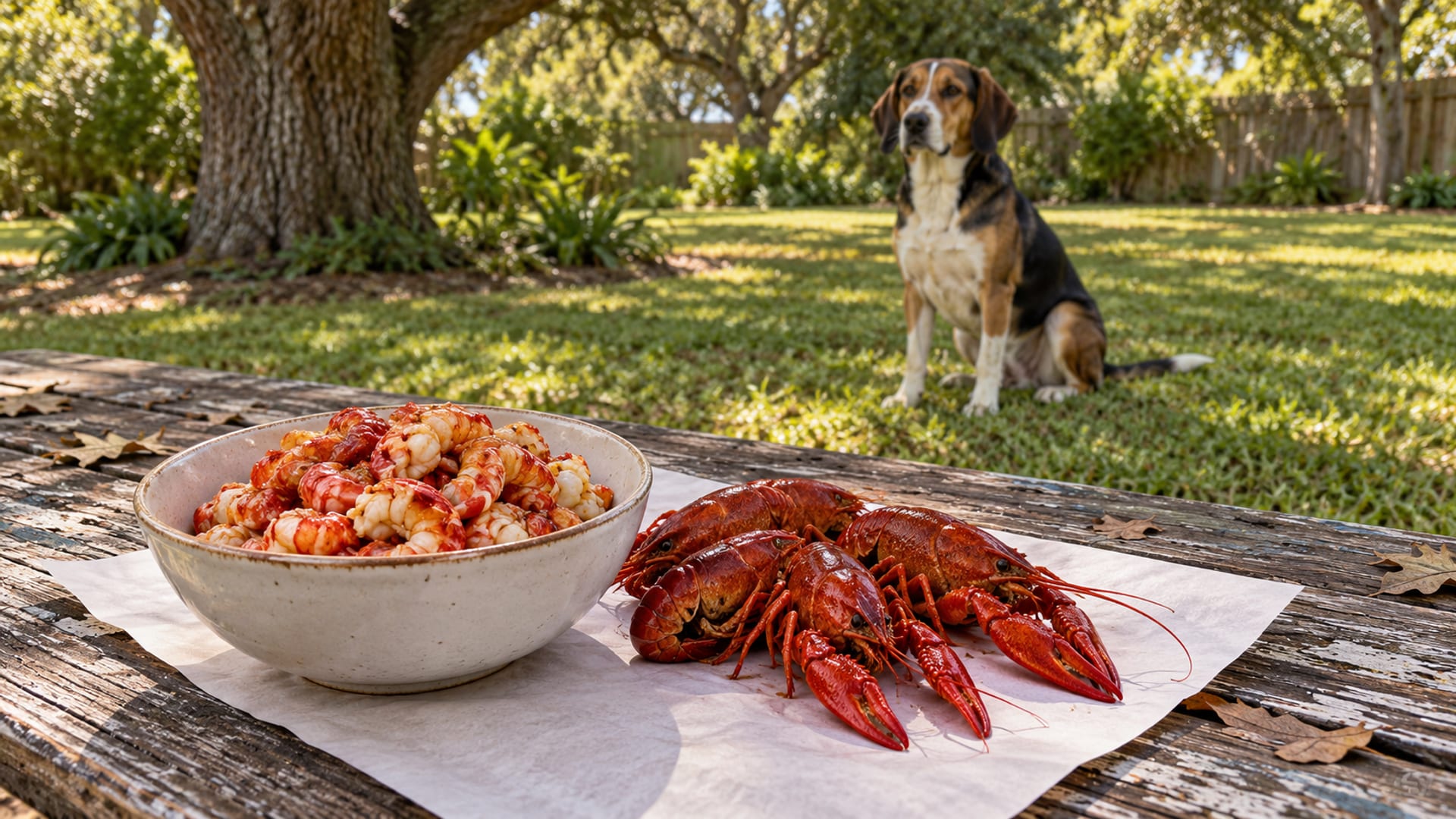
Caution. A small amount of plain, fully cooked crawfish tail meat with the shell taken off is lower risk for most dogs. Raw or undercooked crawfish, shell, and anything from a seasoned boil are the parts that cause trouble, so if your dog got into one of those, call your vet today and do not wait for signs.
Whether the crawfish came off a newspaper-covered table, out of a bucket, or from a restaurant plate, the same few questions decide how worried to be. Was it raw or cooked? Did your dog swallow shell? What was in the boil? How much did your dog eat, and how big is your dog? I'll walk through each one below, in the order you'll need them.
Key takeaways
Tap a card to bring it forward.
- Plain, fully cooked, shell-free tail meat is the lower-risk form, and only a small amount.
- Raw or undercooked crawfish can carry lung flukes, and the cough they cause can show up well after the meal.
- Shell, claws and whole crawfish can choke a dog or block the gut.
- Boil seasoning with onion, garlic, salt or butter is its own problem, separate from the crawfish.
- A dog that looks fine right after raw crawfish, shell or a seasoned boil still needs a vet call.
What to do if your dog already ate crawfish
Start with the steps below, in this order. Each one has a reason, so you can judge which parts fit your situation.
- Move your dog away from the rest and check that your dog is breathing and acting normally. Pet Poison Helpline tells owners to remove the pet from the area first, which also stops a second helping from the bucket.
- Write down what happened. Note whether the crawfish was raw or cooked, whether any shell or claws went down, what was in the boil or sauce, about how much your dog ate, what time it happened, your dog's weight and any signs you see. The vet or poison line will ask for exactly these details, and your answers shape the advice you get.
- Call your vet or a poison line now. Pet Poison Helpline advises contacting it right after a potentially harmful exposure instead of waiting for signs. Make the call promptly if the crawfish was raw or undercooked, shell or claws were swallowed, the amount is unknown or large, the seasoning may have had onion or garlic, your dog has any signs, or your dog is having trouble breathing.
- Skip home remedies and medication. Pet Poison Helpline says not to give home antidotes.
- Go to an emergency clinic right away for certain signs. Those are choking, trouble breathing, facial swelling, collapse, repeated vomiting, severe belly pain, bloody stool, inability to swallow and marked lethargy, according to the Merck Veterinary Manual and Pet Poison Helpline guidance on urgent signs.
If your dog ate one small piece of plain, fully cooked, shell-free meat and feels fine, the risk is lower, but I'd still phone your vet with the details, because a call costs little and they know your dog's history.
Which forms of crawfish are lower risk and which are not
The crawfish meat itself is not a dog poison. The trouble comes from how it was prepared, what came along with it, and whether it was cooked all the way through. This table sorts the common forms.
Tap or hover a row to highlight it.
| Form | Risk | What to do |
|---|---|---|
| FormPlain cooked tail meat, shell removed | RiskLower risk in a small amount | What to doA small taste is the most to offer |
| FormRaw or undercooked crawfish | RiskLung flukes and bacteria | What to doCall your vet, even if your dog seems fine |
| FormShell, claws, head, legs, whole crawfish | RiskChoking or a blocked gut | What to doCall your vet if any was swallowed |
| FormBoil water or cooking liquid | RiskOnion, garlic, salt, butter, spice | What to doKeep it away from your dog |
| FormCajun seasoning, garlic powder, onion powder, sauces | RiskOnion and garlic are dog toxins | What to doCall with the ingredient list in hand |
| FormDried or freeze-dried crawfish | RiskTreat as raw unless the label confirms a cooking step | What to doSkip it unless the label is clear |
| FormCanned, frozen or restaurant crawfish | RiskFine only if plain, shell-free and fully cooked | What to doCheck for additives before sharing |
The Merck Veterinary Manual says dogs catch lung flukes by eating raw crayfish that carry the parasite's cysts. In North America that parasite is usually *Paragonimus kellicotti*, according to the CDC. Cooking destroys the infectious parasite, which is why the fully cooked, plain version sits at the lower-risk end. Freezing alone does not make raw crawfish parasite-safe.
Pet Poison Helpline lists onion and garlic among the important dog toxins, and a crawfish boil commonly includes both. If you want the details on those, see our entries on onions and garlic. Butter and heavy salt add their own trouble; butter can upset the gut, and dogs with pancreatitis do worse on fatty boils.
How to serve a little, and how much of the risky forms is a concern
If you decide to share, use tail meat that was cooked all the way through, with no seasoning, butter, sauce or fried coating. Take off every bit of shell, and leave the claws, head and legs out of it.
How much is a small amount? Crawfish has no serving chart by dog size, so I'd keep it to a taste and ask your vet what suits your dog. For comparison with a similar shellfish, the AKC says one or two pieces of cooked, shell-free shrimp is usually enough for most dogs and a partial piece is more cautious for small dogs. Our shrimp entry has more on that. Treat it as a comparison, not a crawfish dose.
For the risky forms, I can not name an amount to call safe. Shell is the clearest case: skip it entirely, whatever the amount. Small dogs and puppies have less room for a piece of shell to pass, and the same piece of meat is a bigger dose for a small body. When you call about a raw or shell exposure, give the dog's weight and your best guess at the amount, and let the vet decide what comes next. For onion or garlic in the seasoning, the same applies: the ingredient list and your dog's weight are what the poison line works from.
Some dogs need extra care before any crawfish at all. A dog on a fat-restricted diet or with a history of pancreatitis can react badly to butter and oil in a boil. A dog with kidney disease may struggle with all the salt. A dog with food allergies or an earlier shellfish reaction should not be offered crawfish without a vet's go-ahead, and the Merck Veterinary Manual notes that dogs can develop an allergy to any dietary protein.
Signs to watch for and when they show up
After a small bite of plain, fully cooked meat, many dogs show nothing at all. When there are signs, they tend to be stomach-related: vomiting, diarrhea, belly discomfort or a dip in appetite, which can come from a rich meal, an unfamiliar food or a reaction to it.
Shell is a different story. A piece that lodges can cause repeated vomiting, gagging, trouble swallowing, belly pain, constipation, lethargy, or an inability to keep food and water down. The AKC warns that shell creates risks, and a complete blockage can become life-threatening and may need surgery. Any of those signs after shell means a same-day call to your vet.
The lung fluke signs are the ones people miss, because they can come late. The Merck Veterinary Manual describes a chronic, deep, intermittent cough, plus weakness and lethargy, and notes that some infections pass unnoticed. Merck also says the parasite can rarely reach organs beyond the lungs, including the brain. That is why a dog that seems fine right after raw crawfish still needs a vet call, and why a cough that lingers in the weeks that follow belongs in that conversation.
My dog ate crawfish before and was fine
I hear this one a lot, and I believe it. Plenty of dogs have finished off a dropped tail at a boil and gone on with their day. That happened, and in that dog, on that day, nothing went wrong.
It still isn't a rule for the next dog, and the reasons are practical. That dog may have eaten only a little plain cooked meat. It may not have swallowed shell. The crawfish may not have carried any live parasites, or cooking may have destroyed them. Dogs also differ in how they react to rich food and to any new protein. The Merck Veterinary Manual notes that some lung fluke infections pass unnoticed, and others show up as a cough long after the meal. So, the lack of signs on day one says little about a raw exposure. The next dog may be smaller, may grab a claw, or may find the pot of seasoned boil water, and that changes the odds.
Names, powders and look-alikes
People search for this animal under several names. Crawfish, crayfish, crawdad, mudbug and freshwater lobster can all mean the same freshwater animal. "Rock lobster" can mean a marine spiny lobster instead, so confirm what you actually have. Crawfish is also not shrimp, crab or langostino, and the advice for those foods may not cover freshwater lung flukes.
A "crawfish boil" is a prepared dish with onion, garlic, salt, butter, chili and more. "Crawfish powder," "crawfish seasoning" and "crawfish flavor" may hold little or no crawfish and may contain onion, garlic, salt or preservatives, so read the full ingredient label before your dog gets near it. For dried or freeze-dried crawfish, Cornell advises treating uncooked or freeze-dried animal products as raw.
Check what you learned
Quick check
Questions about dogs and crawfish
Can my dog eat crawfish etouffee or other cooked dishes?
Those dishes usually include onion, garlic, butter, salt and spice, which is the seasoning problem all over again, and the cooking does not remove it. Keep the plate away from your dog. If your dog ate some, call your vet with the ingredient list and the amount.
Is dried crawfish or freeze-dried crawfish a safe treat?
Treat it as raw unless the label says a validated cooking or pathogen-control step was used. Cornell advises that uncooked or freeze-dried animal products be handled as raw. Check the label for onion, garlic and salt as well.
Could my dog be allergic to crawfish?
Yes, in principle. The Merck Veterinary Manual says dogs can develop an allergy to any dietary protein, although crawfish is not among the most common ones. Facial swelling or trouble breathing after eating it is an emergency.
Is a crawfish claw okay if it has been cooked?
Cooking does not soften a claw enough to make it safe. Claws, heads and legs can choke a dog or block the gut, so take them all off before any meat is shared. If your dog swallowed one, call your vet.
Sources
Checked September 30, 2026.
- Merck Veterinary Manual, Lung Flukes in Dogs
- Merck Veterinary Manual, Nutrition in Disease Management in Small Animals
- Centers for Disease Control and Prevention, About Paragonimiasis
- American Kennel Club, Can Dogs Eat Shrimp?
- Pet Poison Helpline, 24/7 Animal Poison Control Center
- Pet Poison Helpline, Top 10 Pet Poisons
- Cornell University College of Veterinary Medicine, Raw foods for dogs: Evidence-based advice