
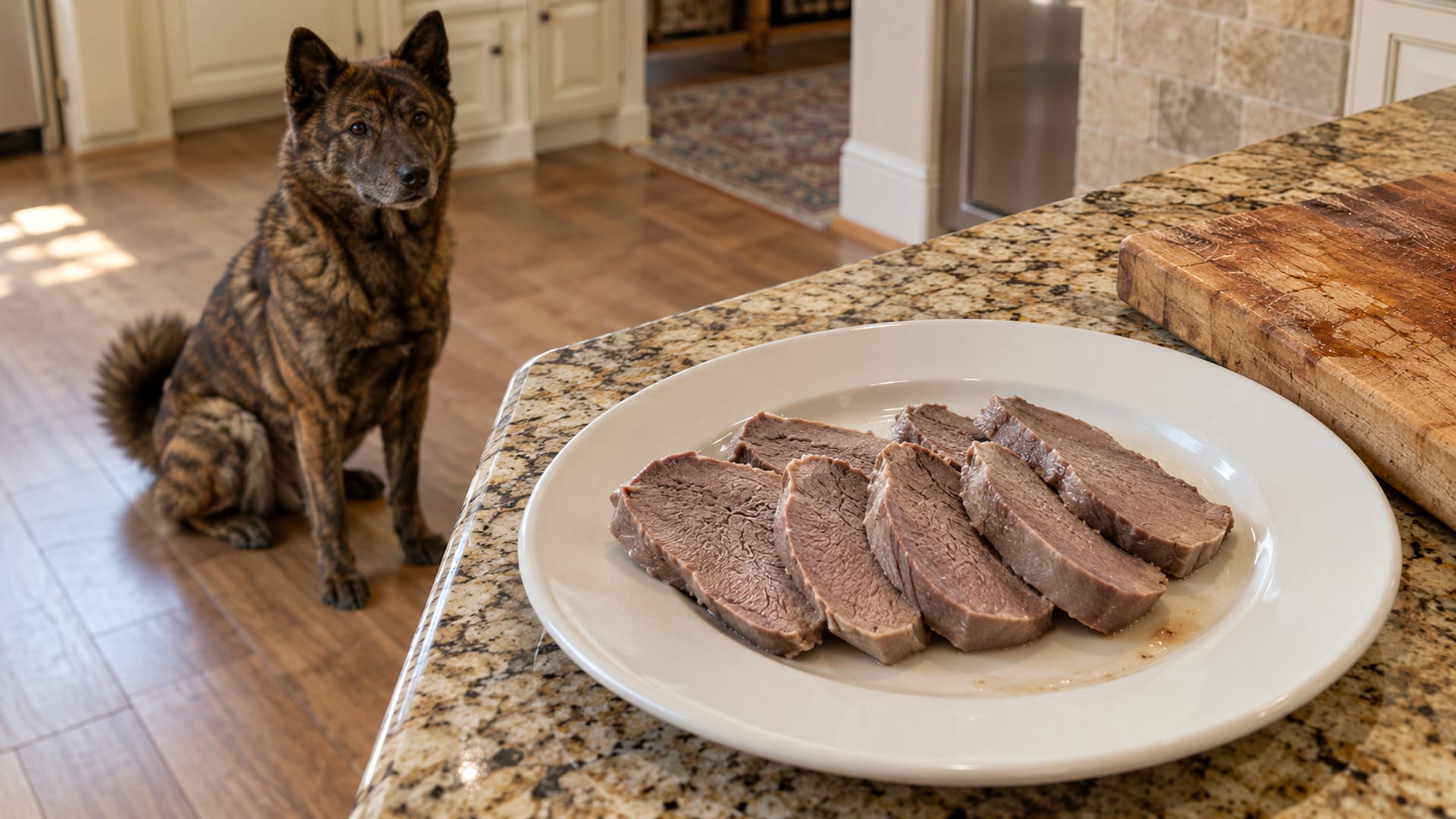
It depends on the form, which is why this one earns a caution. A small piece of plain, thoroughly cooked, boneless cow tongue is fine as an occasional treat, though it is a fatty food. Raw or undercooked tongue can carry germs, and large, fatty, seasoned or dried pieces are the ones I'd worry about.
If your dog already ate some, the form decides your next move. A small bite of plain cooked tongue from a dog who is acting normal usually means you write down what happened and watch. Raw tongue, a big amount, an unknown amount, onion or garlic, a salty product, packaging, string or bone means a call to your vet. The FDA warns that raw animal foods can carry Salmonella and Listeria monocytogenes, and that dogs can carry those germs without looking sick.
Key takeaways
Tap a card to bring it forward.
- A small piece of plain, thoroughly cooked, boneless tongue is fine as an occasional treat, though it is fatty.
- Raw, undercooked and freeze-dried raw tongue can carry germs such as Salmonella and Listeria, and freezing does not reliably remove them.
- Seasoned, gravy-covered, very fatty, dried and oversized pieces are the concern; onion and garlic are separate hazards on top of the tongue itself.
- Choking, trouble breathing, repeated vomiting, severe belly pain, collapse, bloody diarrhea or a suspected blockage means an emergency vet now.
- Dogs with a history of pancreatitis should skip tongue.
What to do if your dog already ate cow tongue
Start with what your dog ate, then pick the path that fits.
- Look at your dog first. Choking, trouble breathing, repeated vomiting, severe belly pain, collapse, bloody diarrhea or a suspected blockage needs an emergency veterinarian right away, since a swallowed large or tough piece can block the airway or gut.
- Write down four things: how much, how it was prepared, what else was in it, and what time. Your vet will ask for all four.
- If it was a small amount of plain cooked tongue and your dog is acting normal, watch your dog and keep notes. This is not a poison exposure, so there is nothing to treat.
- Call your vet promptly if the tongue was raw or undercooked, heavily seasoned, very fatty, dried and hard, or if the amount was large or unknown. Also call if the piece came with packaging, string, bone or a skewer, which carry choking and blockage risks.
- Call sooner for a puppy, an older dog, a pregnant dog or a dog with another illness that ate raw tongue. Merck Veterinary Manual reports that serious salmonellosis is seen especially in puppies and in adult dogs stressed by another disease.
- If onion or garlic was involved, or you can't read the label, call your vet or a poison line. Pet Poison Helpline also says not to give home antidotes and not to induce vomiting without checking with a vet or the Helpline, and that applies here too.
Which forms of cow tongue are fine and which are not
Raw, cooked, dried, canned and seasoned tongue are different foods for a dog. This table sorts them by the risk that comes with each.
Tap or hover a row to highlight it.
| Form | Main concern | What I'd do |
|---|---|---|
| FormPlain, thoroughly cooked, boneless, cut small | Main concernFat | What I'd doAn occasional small treat |
| FormCooked skin or outer covering | Main concernCan be fatty, tough or hard to chew | What I'd doTrim it off if it is tough or heavily fatty |
| FormRaw | Main concernSalmonella, Listeria, pathogenic E. coli and Campylobacter; freezing does not reliably remove them | What I'd doSkip it |
| FormUndercooked | Main concernThe same germs as raw | What I'd doCook it thoroughly or skip it |
| FormFreeze-dried raw | Main concernFreeze-drying is not the same as cooking and does not reliably kill all germs | What I'd doSkip it |
| FormDried or dehydrated | Main concernDrying does not make meat germ-free; can be very rich in calories, hard, and a choking hazard | What I'd doUse caution and read the label |
| FormSeasoned | Main concernOnion, garlic, extra salt, spice or sauce | What I'd doDon't share it |
| FormCooked in gravy, butter or lard | Main concernAdded fat raises the risk of stomach upset and pancreatitis | What I'd doDon't share it |
| FormWith bone, skewer, toothpick, string or packaging | Main concernChoking and blockage | What I'd doDon't share it |
| FormCanned or commercial dog food with tongue in it | Main concernA product with tongue is not automatically a problem | What I'd doFollow the label and check that it is complete and balanced |
The raw and freeze-dried rows come from the same concern. The FDA and CDC say raw pet food and treats can expose dogs and cats to Salmonella and Listeria, and the American Animal Hospital Association says raw diets raise the chance of passing germs to people.
How to serve cooked tongue, and how much is too much
If you want to share some, cook it thoroughly and keep it plain. Trim off visible fat, peel away any tough outer layer, and cut it into small pieces. Leave out salt, spices, onion, garlic, sauces, bones, skewers, string and packaging. VCA Animal Hospitals points out that fat from treats and human foods counts in a dog's diet, which is why trimming matters.
How much? Tongue is a treat, and your dog's regular complete food stays the main meal. USDA FoodData Central records beef tongue as a relatively high-fat food, so a few small pieces go a long way. There is no gram amount by dog size to hand you. If your dog ate a lot, call your vet with your dog's weight, the amount and the preparation, and let them judge it.
A large piece is a bigger deal for a small dog, because it raises the choking and blockage risk, as VCA describes for large food pieces.
Dogs with current or past pancreatitis should not get high-fat treats without a vet's diet guidance, and cow tongue is one of those treats. VCA names fatty meals as a possible trigger for pancreatitis.
Signs to watch for, and when they show up
Watch for different things depending on what went wrong.
- Choking or a blocked airway: gagging, choking, repeated swallowing. This happens right away.
- A blockage in the gut: vomiting, belly pain, not being able to pass stool. These can show up later than choking does.
- A germ from raw or undercooked tongue: vomiting, diarrhea, fever, tiredness, less appetite, belly discomfort and dehydration. Salmonella symptoms can begin within hours to several days, depending on the exposure, according to the CDC. Merck says canine salmonellosis can cause sudden diarrhea with or without a bloodstream infection.
- Too much fat: vomiting, diarrhea, belly pain, nausea, tiredness, fever and lower appetite. Severe pancreatitis can need hospital care and can be life-threatening, says VCA.
Go to an emergency vet for choking, trouble breathing, repeated vomiting, severe belly pain, collapse, marked tiredness, bloody diarrhea, not keeping water down, or a suspected blockage. The worst outcomes are not what a small piece of plain cooked tongue is expected to cause.
My dog ate it before and was fine
I believe you, and it probably did go fine. Plenty of dogs have had tongue and never shown a sign. It just doesn't work as a rule for the next piece or the next dog, and the reasons are practical.
- Amount and piece size. A small bite is different from a big serving, and a small piece passes without drama.
- Cooking. Thorough cooking lowers the chance of germs, so the dog who did fine may have eaten cooked tongue.
- Exposure and the individual dog. Your dog may not have met enough of a germ to get sick, and dogs differ in how they react.
- Silent carriers. The FDA and the American Animal Hospital Association both say dogs can shed germs without any signs, so a healthy-looking dog is not proof the tongue was clean.
- Late signs. Infection and pancreatitis can show up later rather than right away.
Lengua de res, tongue chews and look-alikes
Cow tongue, beef tongue, ox tongue and lengua de res usually mean the tongue of cattle. A tongue from another animal, like pork, lamb or bison, is a different product, so check the species and how it was prepared.
Tongue chews and treats often come with other ingredients, preservatives, salt, smoke flavor or processing aids. "Tongue-shaped" treats may have no tongue at all. The ingredient panel tells you what your dog ate, and the name on the front does not.
Lengua by itself is ambiguous in a mixed-food setting. Lengua de res is the one that means beef or cow tongue, according to the USDA Food Safety and Inspection Service terms for beef products.
Other beef parts such as trachea, esophagus, cheek, lung and beef liver differ in fat, texture, processing and blockage risk, as do beef jerky and beef bones. For raw feeding, see raw meat.
Check what you learned
A short check on the main points.
Quick check
Questions about dogs and cow tongue
These come up once the worry has settled.
Do I need a poison line for plain cooked tongue?
Plain cooked tongue is not a poison, so your vet is the first call if something seems off. A poison line such as Pet Poison Helpline or the ASPCA Animal Poison Control Center is more useful when the tongue had onion or garlic, when you can't read the label, or when you can't tell what your dog ate.
Can cats in the house share it?
The raw-food germ concern applies to cats too. The FDA says raw pet foods can expose dogs and cats to Salmonella and Listeria, and infected animals can shed germs while looking healthy. A small piece of plain cooked tongue is the only form I'd consider for either pet.
Can tongue replace part of my dog's dinner?
Tongue is a fatty treat and not a complete diet. Your dog's regular complete food should stay the main food, with tongue as a small extra.
Is tongue safe for a dog with diabetes or kidney disease?
Dogs with diabetes, kidney disease or other conditions may have diet or sodium limits of their own. Ask your vet whether tongue fits before you start.
Sources
Checked September 30, 2026.
- FDA, Get the Facts! Raw Pet Food Diets Can Be Dangerous to You and Your Pet
- Merck Veterinary Manual, Salmonellosis in Animals
- VCA Animal Hospitals, Pancreatitis in Dogs
- VCA Animal Hospitals, Nutrition and Pancreatic Disease in Dogs
- VCA Animal Hospitals, Top Safety Tips to Avoid a Pet Emergency for Your Dog This Thanksgiving
- USDA, FoodData Central
- CDC, Symptoms of Salmonella Infection
- CDC, About Pet Food Safety
- American Animal Hospital Association, Raw Protein Diet
- Pet Poison Helpline, 24/7 Animal Poison Control Center
- ASPCA, Animal Poison Control
- USDA Food Safety and Inspection Service, Beef From Farm to Table