
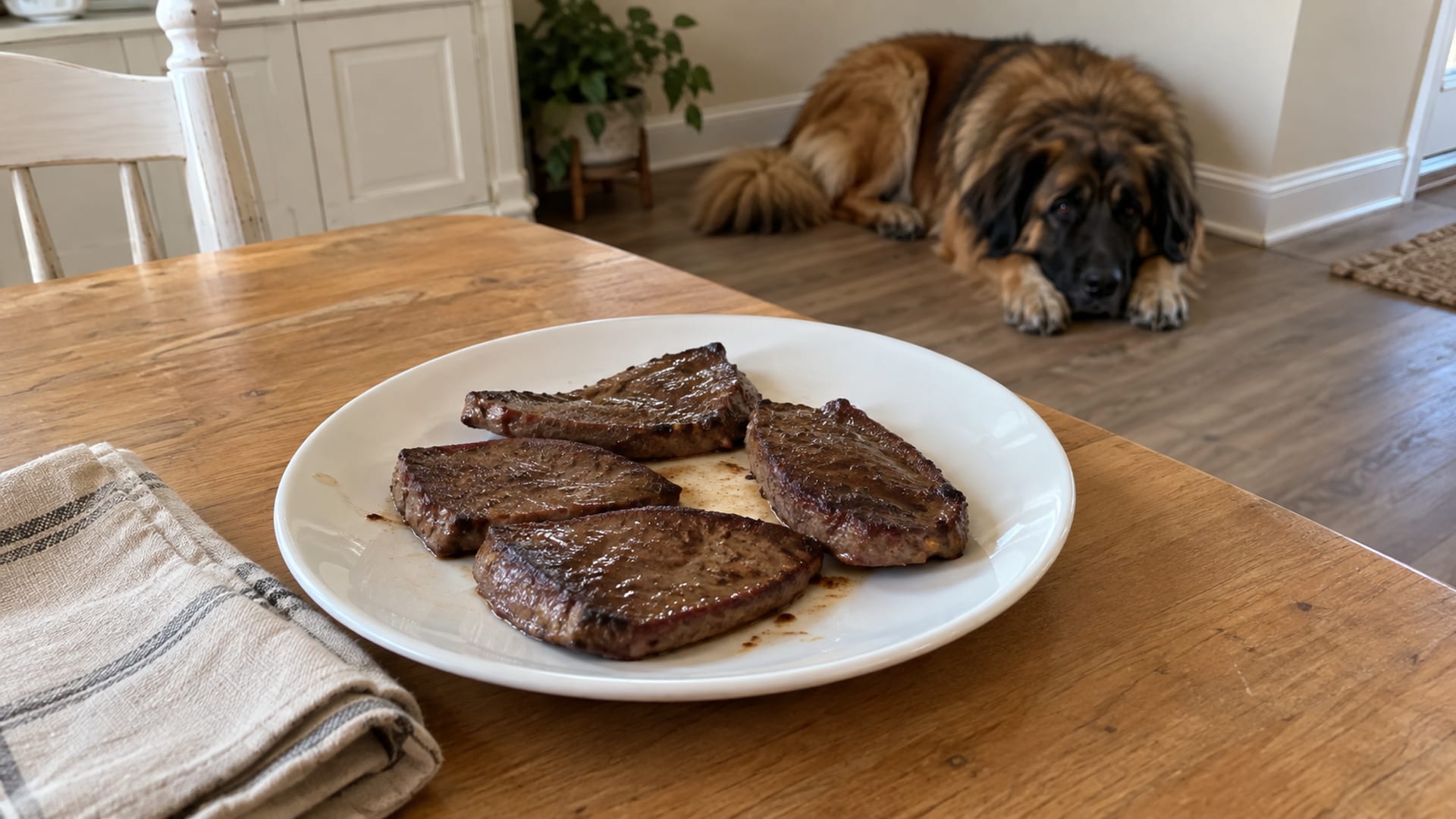
Yes. A small piece of plain, fully cooked beef liver now and then is fine for most dogs. If your dog just ate some, what decides your next step is whether it was raw or cooked, how much went down, whether it was a dried or powdered product, and whether onion, garlic or salty gravy came with it.
Liver is loaded with vitamin A, which is what turns a good treat into a problem once servings get big or come every day. Raw liver adds a second concern, bacteria such as Salmonella and Listeria.
Key takeaways
Tap a card to bring it forward.
- A small, plain, cooked piece of beef liver as an occasional treat is fine for most healthy dogs.
- Liver is very rich in vitamin A, so large or repeated servings can build up to vitamin A poisoning over weeks to months.
- Raw liver can carry Salmonella and Listeria, and freezing does not kill them.
- Dried, freeze-dried and powdered liver are concentrated, so a handful holds far more than a handful of fresh liver.
- Call your vet for a large amount, a whole bag of treats, liver cooked with onion or garlic, a vitamin A supplement on top, raw liver in a puppy or pregnant dog, or any signs of illness.
What to do if your dog just ate beef liver
The right move depends on exactly what went down, so run through these checks first.
- Find out the form. Dig out the package or think back to how it was cooked. Raw brings a bacteria risk, and dried products pack more vitamin A into every piece.
- Estimate how much, and note the time. Count the missing treats or check what is left in the pan. A vet or poison line will ask for the amount, your dog's weight and when it happened.
- Check what else was in it. Liver and onions, gravy, pâté and seasoned leftovers can hold onions, garlic, a lot of salt or butter, and those carry their own risks apart from the liver.
- Think about supplements. A vitamin A supplement, a multivitamin or a "liver support" product can stack more vitamin A on top of what the liver brought, so mention it when you call.
- Call when the checks point that way. VCA Animal Hospitals advises calling your veterinarian or Pet Poison Helpline right away if you believe your dog took in an overdose of vitamin A. Call for a large amount, dried or powdered liver in an unknown amount, ingredients you can't identify, raw liver eaten by a puppy or pregnant dog, or any signs at all.
- Otherwise, watch and hold off on more liver. One small piece of plain cooked liver in a healthy dog usually doesn't call for a poison line. Watch your dog for the next few days and skip liver for a while.
Raw, cooked, dried or powdered: how each form compares
The form decides most of the risk.
Tap or hover a row to highlight it.
| Form | Where it lands | Why |
|---|---|---|
| FormPlain cooked beef liver | Where it landsFine as an occasional small treat | WhyCooking to 160°F handles bacteria; the vitamin A stays, so keep it small |
| FormRaw or frozen raw liver | Where it landsUse caution | WhyCan carry Salmonella and Listeria; freezing does not kill them |
| FormDried, dehydrated or freeze-dried liver | Where it landsUse caution | WhyRemoving water concentrates vitamin A; freeze-dried raw also raises bacteria concerns |
| FormLiver powder or supplements | Where it landsUse caution | WhyConcentrated; the right amount depends on the product's nutrient analysis |
| FormLiver inside a complete dog food | Where it landsGenerally fine | WhyFed by the label, it is part of a balanced diet |
| FormLiver cooked with onion, garlic, gravy or butter | Where it landsDo not share | WhyThe added ingredients are the problem |
| FormBones, ducts or gallbladder attached | Where it landsNot a treat | WhyChoking, broken teeth, blockage or gut injury |
The USDA Food Safety and Inspection Service says organ meats, liver included, should be cooked to 160°F, or 71.1°C. On the raw side, the FDA found Salmonella in 15 of 196 raw pet food samples it tested and Listeria monocytogenes in 32, and notes that freezing does not kill these bacteria.
Liver in a complete commercial food is different: the American Kennel Club describes liver as a vitamin A rich animal byproduct used in dog food, and a food fed by its label already accounts for it. Trouble starts when extra liver goes on top, or liver starts replacing part of the regular diet, which the World Small Animal Veterinary Association links to nutritional imbalance.
How much beef liver to give, and how to cook it
Beef liver doesn't come with a serving chart by dog size, so the practical rule is small and occasional: a piece or two as a treat on some days, never a meal and never a daily routine. If you want liver in your dog's regular diet, talk it over with your vet first.
The Merck Veterinary Manual puts a dog's vitamin A requirement at 3,333 IU per kilogram of diet, treats up to 333,300 IU per kilogram of diet as safe, and says toxic effects generally take roughly 10 to 1,000 times the requirement. Those figures describe the whole diet over time, not one bite, which is why an occasional treat fits and a daily pile of liver can push past the limit.
If you cook liver for your dog, keep it simple:
- Cook it plain, with no onion, garlic, salt, butter, gravy or seasoning.
- Bring the thickest part to 160°F, checked with a meat thermometer.
- Trim off any bone, tough duct or attached tissue, and cut it into small pieces.
- Wash your hands, the board and the counter after handling it raw. The American Veterinary Medical Association notes raw animal-source foods can pose health risks to people as well as pets.
For store-bought dried or freeze-dried treats, follow the feeding directions on that specific bag and count each piece as more concentrated than it looks. Powder is even easier to overdo.
Signs to watch for, and when they show up
Raw liver and too much vitamin A cause different problems.
From raw liver. The FDA lists vomiting, diarrhea that may be bloody, fever, loss of appetite and lower activity as possible signs of Salmonella or Listeria illness, and advises seeing a veterinarian if they appear.
From one very large dose of vitamin A. VCA lists vomiting, nausea, drowsiness, irritability, peeling skin, weakness, tremors, seizures and paralysis, and in the worst cases death. These signs may come on suddenly or be delayed.
From too much liver over weeks to months. VCA names repeated raw liver feeding as a common cause of chronic vitamin A poisoning. Signs build slowly: a poor coat, dry or rough skin, weakness, weight loss, constipation, stiffness or pain when moving, extra bone growth, bones that break easily, and internal bleeding.
Call your vet promptly for any of these, or for marked tiredness, trouble walking or breathing problems.
Some dogs need a quicker call. The Merck Veterinary Manual notes growing dogs are vulnerable to skeletal problems from an unbalanced diet, and VCA links excess vitamin A during pregnancy to birth defects such as cleft palate. The serious outcomes above are not expected from a small piece of plain cooked liver in a healthy adult dog.
My dog ate liver before and was fine
I believe it. Plenty of dogs eat liver scraps for years with no trouble, and that was real for that dog and that liver. It just doesn't work as a rule for every dog.
- Amount. Vitamin A trouble comes from large or repeated servings, not a few scraps now and then.
- Form. Cooked liver was handled for bacteria, and a raw piece may simply not have carried any that time. Dried and powdered liver pack more vitamin A per bite.
- The dog. Size, age, pregnancy and the rest of the diet all matter. Merck says dogs are less sensitive to vitamin A than cats, and sensitivity varies from animal to animal.
- Timing. VCA notes chronic vitamin A signs can take weeks to months to appear, so a dog that looks fine this week hasn't necessarily cleared the question.
- Hidden carriers. The FDA says dogs can shed Salmonella or Listeria with no visible illness.
If your dog has done well on liver, keep to the same small, cooked, occasional serving.
Liver treats, liver powder, cod liver oil and other livers
Labels use "liver" loosely, and the difference matters.
- Other names for beef liver. Cow, bovine and ox liver are all beef liver. Calf or veal liver comes from younger cattle.
- Other livers. Chicken, pork, lamb, turkey, fish, and even polar bear or seal liver hold different amounts of vitamin A.
- Cod liver oil. This is fish oil, not beef liver, and Merck documents vitamin A toxicosis after large amounts of it. If your dog gets cod liver oil and liver treats, tell your vet about both.
- Liver treats and bites. These can be baked, dehydrated, freeze-dried, powdered or supplemented. Check the label for species, ingredients, guaranteed analysis and any added salt, onion, garlic or xylitol.
- Freeze-dried raw. "Freeze-dried raw," "fresh" and "frozen" all still mean uncooked, and the FDA has reported bacteria concerns in raw and freeze-dried raw pet foods.
- "Liver support" supplements. These are supplements, not food, and may contain concentrated vitamins, herbs or medications.
- Pâté, gravy and stew. These often carry onion, garlic, salt, dairy or fat.
For related questions, see our entries on beef jerky, beef bones and raw meat.
Check what you learned
Three quick questions.
Quick check
Questions about dogs and beef liver
These come up once the first worry has passed.
Is beef liver safe for my cat too?
Cats are more sensitive to vitamin A than dogs. The Merck Veterinary Manual describes vitamin A toxicosis in growing kittens fed diets high in liver, with abnormal bone growth around the spine and a stiff neck. Keep the dog's liver treats away from the cat.
Can puppies eat beef liver?
A tiny piece of plain cooked liver is not an emergency. Growing dogs are more vulnerable to bone problems from an unbalanced diet, though, so keep liver rare and ask your vet before it becomes routine. Raw liver in a puppy is worth a call.
Can I use beef liver as a daily training treat?
Daily use is where the repeated-serving risk comes in, especially with dried liver, since one session can mean many pieces. Use tiny bits, count them toward the day's food, and rotate in other treats.
What if my dog has pancreatitis or a special diet?
Dogs with pancreatitis, kidney disease, liver disease, diabetes or a prescribed restricted diet need their own vet's advice before any liver treats. Fat, calories, phosphorus, preparation and the rest of the diet all matter for these dogs.
Sources
Checked September 25, 2026.
- VCA Animal Hospitals, Vitamin A Poisoning in Dogs
- USDA Food Safety and Inspection Service, To what temperature should I cook beef?
- FDA, Get the Facts! Raw Pet Food Diets can be Dangerous to You and Your Pet
- American Kennel Club, How to Read a Dog Food Label
- World Small Animal Veterinary Association, Raw Meat-Based Diets for Pets
- Merck Veterinary Manual, Toxicoses in Animals From Human Multivitamins and Supplements
- American Veterinary Medical Association, Resolution #5, 2024, Raw or Undercooked Animal-Source Protein in Cat and Dog Diets
- FDA, FDA Cautions Pet Owners Not to Feed Performance Dog Raw Pet Food Due to Salmonella, Listeria monocytogenes
- Merck Veterinary Manual, Nutritional Requirements of Small Animals