
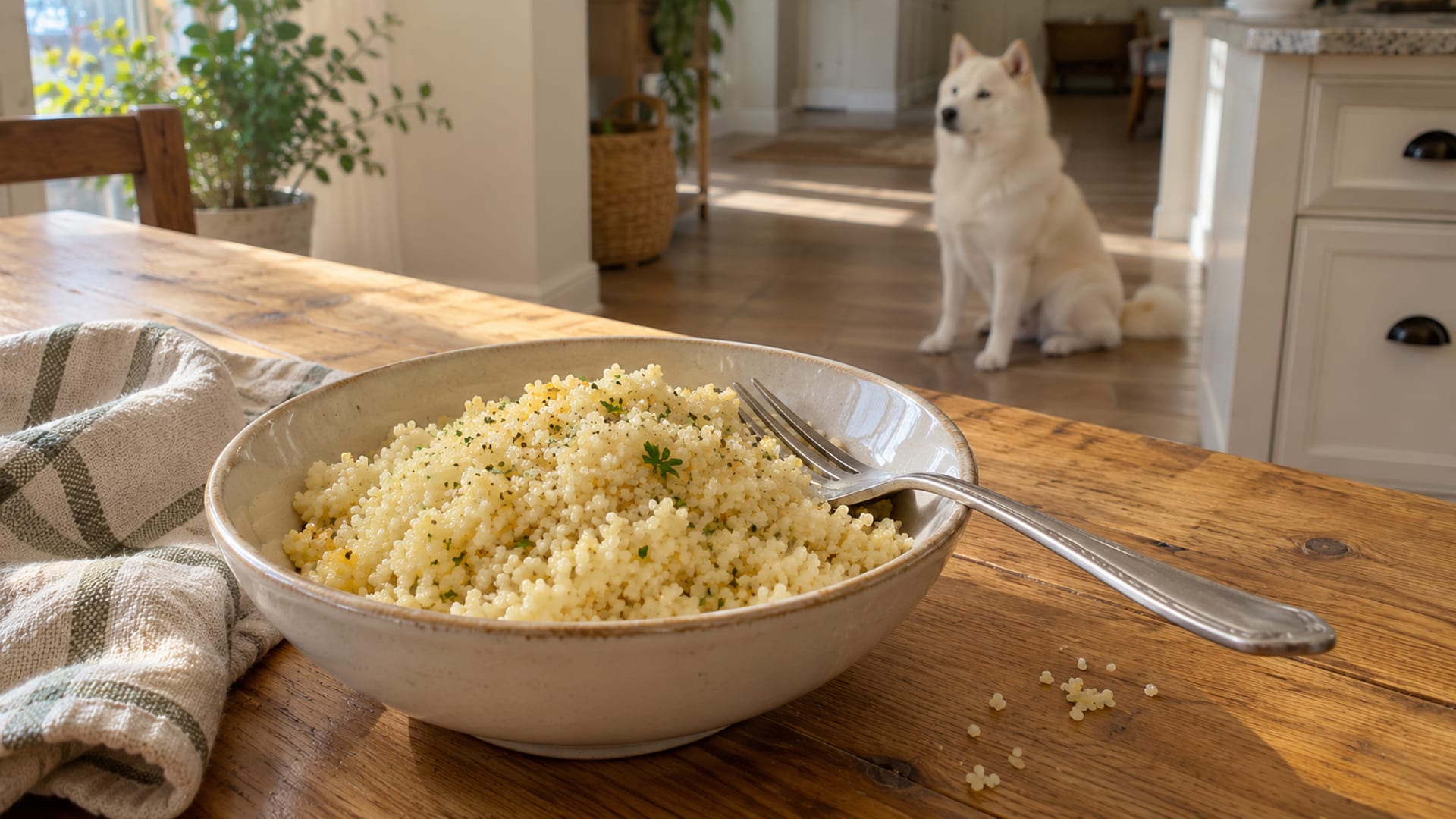
Yes, a small amount of plain, fully cooked couscous is generally fine for a healthy dog. The catch is the dish around it, because onion, garlic, raisins, grapes, xylitol, alcohol and heavy salt show up in couscous salads, boxed mixes and restaurant plates, and those are the things that can make a dog sick.
The USDA Agricultural Research Service describes couscous as coarse-ground wheat endosperm, and the Academy of Nutrition and Dietetics adds that it is usually made from durum-wheat semolina. Plain couscous is not a recognized canine toxin.
If your dog already ate some, find out what else was in the dish, how much was eaten and when. A seasoned plate or a mystery ingredient is a reason to call your vet or a pet poison line, and the steps are right below.
Key takeaways
Tap a card to bring it forward.
- A small amount of plain, fully cooked couscous is generally fine for a healthy dog.
- Onion, garlic, raisins, grapes, xylitol, alcohol and heavy salt are the ingredients that turn a couscous dish into a problem.
- Call your vet or a pet poison line if the dish was seasoned, if you do not know what was in it, or if your dog seems unwell.
- Serve couscous plain, cooked and cooled, and count it inside the 10% treat budget.
- Dogs with pancreatitis, diabetes, obesity, kidney disease, a food allergy or a prescribed diet should skip it unless the vet agrees.
What to do if your dog already ate couscous
Start with the plate, since the dish decides how serious this is.
- Find the package, the leftovers or the recipe, and read what went into it. Plain couscous and a seasoned couscous salad are two different situations, and the ingredient list tells you which one you have.
- Look for onion, garlic, chives, leeks, shallots, raisins or grapes, alcohol, xylitol and a lot of salt or fat. The ASPCA lists xylitol, alcohol, onions, garlic and excessive salt among the additions that hurt pets, so any of them means a call.
- Note how much your dog ate and what time. The ASPCA asks owners to note the amount eaten before contacting a vet or poison control.
- Call your vet or a pet poison line right away if the couscous held any of those ingredients, if you cannot tell what it held, if a large amount went down, or if your dog seems off. The same goes for repeated vomiting, severe diarrhea, weakness, tremors, seizures, trouble breathing, collapse, belly pain or choking.
- Hold off on home treatment. Skip hydrogen peroxide and any medication unless a vet directs it, because the ASPCA advises against treating at home without professional direction.
- If it was a small bite of plain couscous and your dog is acting normal, watch him or her and keep the package so the ingredients and amount are known.
Which kinds of couscous are fine and which are not
Couscous comes in several forms, and the dish matters more than the grain. The table sorts the ones people run into.
Tap or hover a row to highlight it.
| Form | What it means for a dog | What to do |
|---|---|---|
| FormPlain, fully cooked couscous | What it means for a dogFine in a small amount for most healthy dogs | What to doServe it plain and keep it small |
| FormDry or uncooked couscous | What it means for a dogLess digestible and may upset the stomach; it can also expand once it meets fluid | What to doDo not feed it on purpose; watch your dog after a large amount |
| FormWhole-wheat couscous | What it means for a dogNot toxic, but still wheat and gluten | What to doTreat it like plain couscous for a dog with no wheat problems |
| FormGluten-free couscous | What it means for a dogMay be made from corn, sorghum, buckwheat, millet or fonio | What to doRead the label to see the grain |
| FormIsraeli or pearl couscous | What it means for a dogA pasta-like product, commonly wheat | What to doTreat it like plain wheat pasta |
| FormMoghrabieh or maftoul | What it means for a dogRegional products that can differ in grain and size | What to doCheck the label |
| FormCouscous salad, boxed mix, restaurant or seasoned couscous | What it means for a dogDepends on the added ingredients | What to doCheck for onion, garlic, raisins, grapes, alcohol, xylitol, salt and butter |
| FormCouscous with meat, bones or skewers | What it means for a dogThe risk comes from the bones, skewers or hard pieces | What to doCall your vet if any were swallowed |
How to serve plain couscous and how much to give
The safe way to share is small, plain and cooked. Cook it fully, let it cool, and leave out salt, butter, oil, onion, garlic, chives, leeks, shallots, raisins, grapes, alcohol, xylitol and rich sauces. The AKC recommends plain, unseasoned portions, moderation and a gradual introduction of any new human food. Couscous should never replace a complete and balanced diet, which the Merck Veterinary Manual says a dog needs.
There is no serving size by body weight for couscous itself, so the treat budget does the work. The WSAVA says treats should make up no more than 10% of a dog's daily calories, and VCA Animal Hospitals describes the same split of 90% complete food and 10% treats. The table shows the WSAVA example limits for total treat calories in a day, and they cover every treat your dog gets, not couscous alone. One kilogram is about 2.2 pounds.
Tap or hover a row to highlight it.
| Dog weight | Most treat calories per day |
|---|---|
| Dog weight2 kg | Most treat calories per day14 kcal |
| Dog weight4 kg | Most treat calories per day24 kcal |
| Dog weight6 kg | Most treat calories per day32 kcal |
| Dog weight8 kg | Most treat calories per day40 kcal |
| Dog weight10 kg | Most treat calories per day47 kcal |
| Dog weight15 kg | Most treat calories per day64 kcal |
| Dog weight20 kg | Most treat calories per day79 kcal |
| Dog weight25 kg | Most treat calories per day94 kcal |
| Dog weight30 kg | Most treat calories per day108 kcal |
| Dog weight35 kg | Most treat calories per day121 kcal |
| Dog weight40 kg | Most treat calories per day134 kcal |
| Dog weight45 kg | Most treat calories per day146 kcal |
For the risky versions, there is no amount to aim for. If your dog ate a seasoned dish, call your vet or a poison line and give them your dog's weight and the amount eaten, and let them judge it.
Some dogs should skip couscous. The WSAVA says ordinary treats may not suit dogs with medical conditions, dietary sensitivities or veterinary-prescribed diets. That includes dogs with pancreatitis, obesity, diabetes, kidney disease, a food allergy or digestive disease, and dogs with a wheat or gluten problem. Ask your vet whether it fits.
Signs to watch for after couscous and when they show up
After a small amount of plain cooked couscous, many dogs show nothing at all. When there are signs, they are usually stomach signs such as gas, belly discomfort, vomiting, loose stool, diarrhea or a short dip in appetite, and food-related stomach upset generally shows up within hours.
Added ingredients can work on a different clock. The ASPCA says alcohol is absorbed rapidly and that liver damage from xylitol can appear within 12 to 24 hours, so a dog that seems fine after a xylitol exposure still needs a call. Salt, onion and garlic each bring their own signs, and a high-fat dish can lead to pancreatitis. Weakness, tremors, seizures, collapse, repeated vomiting or a painful belly mean it is time to call right away.
My dog ate it before and was fine
That is believable. Plenty of dogs have cleaned a plate of couscous, or taken a spill off the floor, and never had a bad day. It happened, and in that dog it was fine.
It still does not make couscous a sure thing for the next dog, for a few practical reasons:
- Amount: a small bite may cause nothing, while a large amount can upset the stomach or bring a lot of added ingredients with it.
- Size: the same amount is a different exposure for a small dog than for a large one.
- Form: plain cooked couscous is one thing, and dry couscous, a salty boxed mix or a high-fat dish is another.
- The individual dog: dogs differ in how they handle food, and some have allergies or diet-related disease.
- Timing: the ASPCA notes that some signs from added ingredients come late, such as xylitol liver damage within 12 to 24 hours.
So, a good run with couscous is real, and it still says nothing about the dish in front of you today. Read what was in it each time.
Couscous look-alikes and ready-made versions
Couscous shares a shelf with a lot of similar grains, and the box or restaurant menu does not always say what is inside.
Instant, flavored and boxed couscous. The seasoning packet is where onion, garlic and salt hide. Plain couscous from the box, cooked in water, is a different product from the flavored mix.
Brazilian cuscuz. In Brazil and some Portuguese-speaking homes, cuscuz usually means a dish made from cornmeal, often with added ingredients. Our page on cornmeal covers the grain, and the ingredient list covers the rest.
Check what you learned
Quick check
Questions about dogs and couscous
More questions come up once you know what was on the plate.
Can puppies eat couscous?
A puppy can eat a tiny plain portion, and it is best added slowly like any new food. Puppies and small dogs have less margin for a large amount of food or salt. A puppy that ate a seasoned dish, or an amount you cannot gauge, deserves a call to the vet.
Is gluten-free couscous safer for my dog?
Gluten-free couscous may be made from corn, sorghum, buckwheat, millet or fonio, so the answer depends on the grain and on what else is in the box. It helps a dog with a known wheat problem only after your vet approves the specific product. Plain and cooked still applies.
What if my dog ate dry couscous?
Dry couscous is not known to be toxic, but it is harder to digest than cooked couscous and can upset the stomach. A large amount can also swell after it meets fluid in the stomach, which is worth a call to your vet. A small spill usually calls for watching your dog for stomach signs.
Can cats have couscous?
Plain couscous is not known as a cat-specific toxin. The same seasoning rule applies to cats, so a cat should not get a dish with onion, garlic, a lot of salt, xylitol, alcohol or other harmful additions.
Sources
Checked September 30, 2026.
- USDA Agricultural Research Service, USDA National Nutrient Database documentation
- Academy of Nutrition and Dietetics, All About Couscous
- ASPCA, People Foods to Avoid Feeding Your Pets
- AKC, People Foods Dogs Can and Can't Eat
- WSAVA Nutrition Committee, Feeding treats to your dog
- VCA Animal Hospitals, Dog Treats
- Merck Veterinary Manual, Nutrition in Dogs and Cats