
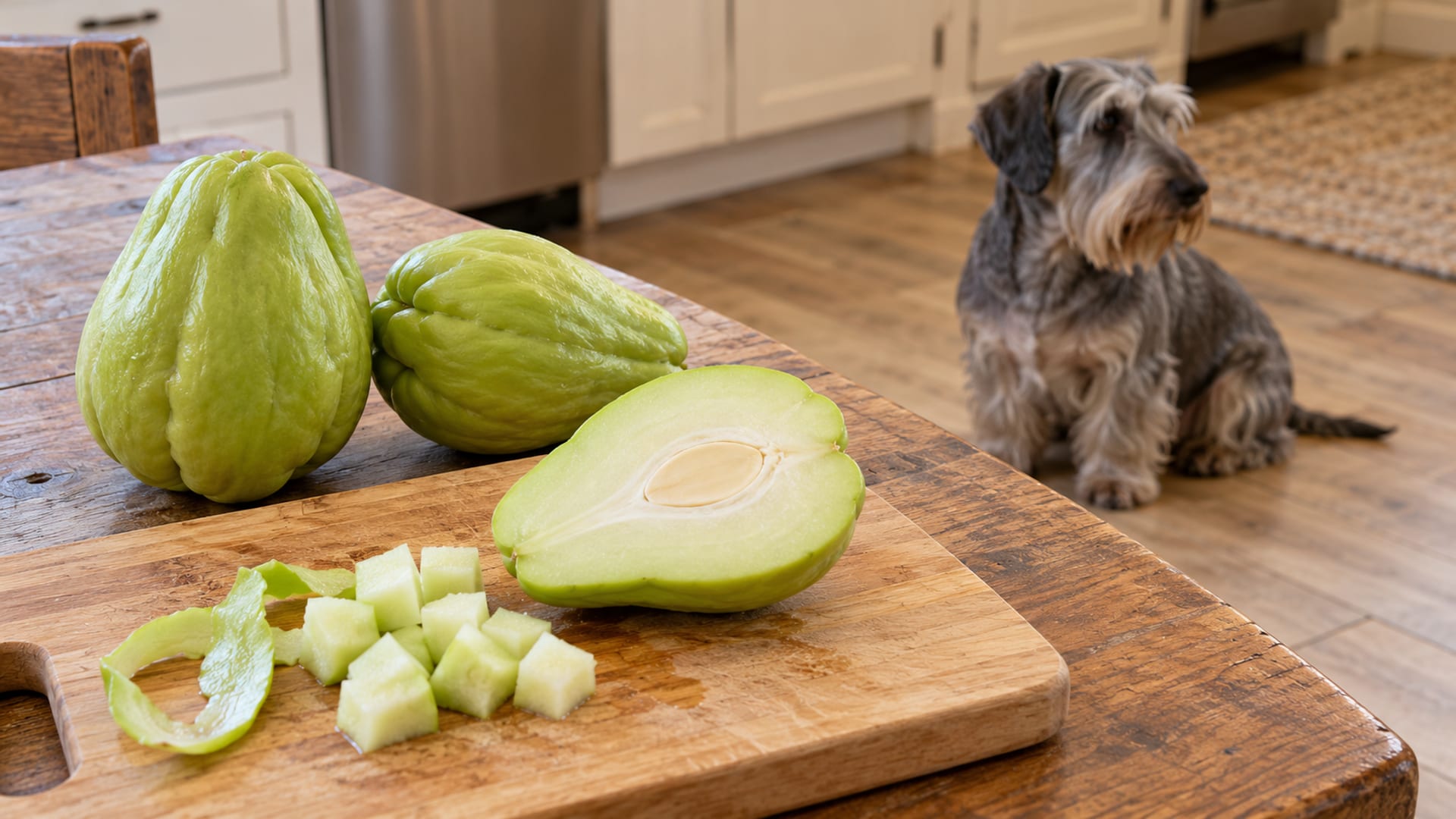
Yes. Plain chayote, the pale green squash also sold as mirliton, choko or vegetable pear, is not known to be toxic to dogs, and a small plain piece, raw or cooked, is low concern. What deserves your attention is a whole seed or big chunk swallowed at once, and whatever the chayote was cooked with, such as onion, garlic, butter or salt.
If your dog already ate some, pick up what's left, figure out whether it was plain or seasoned and how big the piece was, and check whether the large seed in the middle is missing. A few soft bites of plain chayote in a healthy adult dog usually just call for watching. Choking, repeated vomiting, a sore or swollen belly, marked tiredness, or trouble keeping water down mean it's time to call your vet now.
Key takeaways
Tap a card to bring it forward.
- Plain chayote flesh, raw or cooked, is low concern for dogs in small bite-sized pieces.
- The big central seed and large chunks are the main physical risk, since a piece swallowed whole can cause choking or a blockage.
- Seasoned dishes bring their own risks from onion, garlic, butter and heavy salt.
- Chayote extracts, powders and supplements are concentrated products; keep the label and call your vet if one was eaten.
- Call your vet for choking, repeated vomiting, belly pain or swelling, marked tiredness, or a dog that can't keep water down.
What to do if your dog just ate chayote
Most chayote grabs end with a quiet evening. These steps sort out the few that need a call.
- Take away whatever is left. Stopping a second helping keeps a small amount small, and the leftovers show you what your dog got into.
- Work out what was in it. A plain raw or boiled piece is a different situation from a stuffed mirliton or chayote soup, because onion, garlic, butter and salt carry risks the squash doesn't. If it was a capsule or powder, find the package.
- Look for the seed. Chayote has one large, flat seed in its center. If it's missing, assume it was swallowed.
- Think about your dog's size. The same chunk matters more to a small dog or a puppy, simply because there's less room for it to pass.
- Call your vet promptly if any of these apply. A whole seed or large piece went down; the dish had onion, garlic, xylitol, alcohol, lots of salt or lots of fat; it was an extract or supplement; the amount was large for your dog's size; or your dog is a puppy, very small, or has had a blockage or serious stomach trouble before. For plant material that may be harmful, Pet Poison Helpline advises against waiting for symptoms once you know a significant amount was eaten.
- Watch your dog through the next day. For a small plain bite, watching is the whole plan: look for vomiting, diarrhea, low energy, skipped meals, belly pain, or trouble breathing or swallowing.
Which parts and forms are fine, and which need care
The level of concern changes with the form your dog got. A 2026 review by Bilal and colleagues in the journal *Foods* describes the fruit, eaten the way people traditionally eat it, as having a favorable safety profile, while the evidence for concentrated products is thin.
Tap or hover a row to highlight it.
| Form | Level of concern | What to do |
|---|---|---|
| FormPlain raw or cooked flesh | Level of concernLow in small, unseasoned pieces | What to doCut it small and take out the seed |
| FormPeel | Level of concernNot known to be harmful; tougher to chew | What to doPeel it, or cut it very fine |
| FormCentral seed | Level of concernChoking or blockage risk if swallowed whole | What to doRemove it; call your vet if it went down whole |
| FormLeaves, shoots, stems, roots | Level of concernSafety for dogs unknown | What to doKeep them away from your dog |
| FormJuice or dried chayote | Level of concernMore concentrated; a lot may upset the stomach | What to doLeave these out |
| FormExtract, powder, capsule | Level of concernConcentrated; strength varies | What to doKeep the label and call your vet |
| FormStuffed, fried, pickled or seasoned | Level of concernDepends on salt, onion, garlic, fat and sauces | What to doCheck the recipe |
| FormMoldy or spoiled | Level of concernSpoilage brings its own risks | What to doThrow it out |
The peel is firmer than the flesh, so a gulped strip is harder to get down and can be rougher on a sensitive stomach. Its chemistry also differs from the pulp and leaves, according to a study of chayote peel, leaves and pulp listed on PubMed. Peeling the piece settles that question.
The seed is the part I'd keep out of reach. People eat it, and the Diccionario de americanismos entry for güisquil describes the fruit with its single central seed. For a dog, a whole seed is a solid object big enough to get stuck, and the Merck Veterinary Manual on gastrointestinal obstruction explains that a blockage's seriousness depends on where it lodges and how long it stays.
In prepared dishes, the other ingredients usually matter more than the chayote. Mirliton casseroles and chayote soup often start with onions and garlic, and butter or cream adds fat. The Merck Veterinary Manual's page on stomach and intestinal disorders in dogs covers the vomiting and diarrhea those ingredients can bring on.
Extracts are their own category. Researchers writing in *Molecules* identified cucurbitacins B, D, E and I, a group of bitter plant compounds, in chayote extracts, and a capsule concentrates what a slice of vegetable spreads thin.
How to share chayote if you choose to
There's no published serving chart for chayote by dog size, so keep it small and plain. Offer a few pieces of fresh or cooked flesh, cut small enough that your dog can't swallow one whole, with no salt, onion, garlic, butter, sauces, sweeteners or spices. Take the seed out entirely.
If I were sharing it, I'd use a little steamed or raw flesh from a peeled, seeded chayote, cut into cubes smaller than my dog's usual treats. Keep it an occasional extra. A new food can unsettle some stomachs even when it's harmless, so start with just a few bites. DogServ also has entries on squash, zucchini and cucumbers if you're comparing mild vegetables.
Signs to watch for over the next day
A small serving of plain chayote isn't expected to cause signs in most dogs. After a larger amount, or in a dog whose stomach dislikes new foods, you might see vomiting, diarrhea, gas, belly discomfort, a smaller appetite or low energy. Ordinary food-related upset like this tends to show up the same day or soon after eating, in line with the Merck Veterinary Manual's guide to digestive disorders in dogs.
A blockage can take longer to show. Its signs include repeated vomiting, refusing food, lethargy, belly pain or swelling, dehydration, diarrhea, fever or low body temperature, and in serious cases shock. The Merck Veterinary Manual notes that these signs vary with the cause, location and duration of the blockage, so a dog who seemed fine at bedtime still deserves a check the next morning if a seed or big chunk went down.
The worst realistic outcome from plain chayote is a blockage that needs a vet's treatment. A seasoned dish can cause a different problem depending on what was in it, so tell your vet about the recipe.
My dog ate chayote before and was fine
That happens, and it makes sense. The amount may have been small, or the piece soft, cooked or cut up. A bigger dog handles the same chunk more easily. It may have been plain chayote with no onion or garlic. And plain chayote isn't known to poison dogs, so a calm outcome is the usual one.
What that day can't promise is the next one. Every dog's digestion differs, and so does every exposure: a whole seed, a smaller dog or a spoonful of buttery mirliton stuffing changes things. Blockage signs also depend on where an object sits and how long it stays, according to the Merck Veterinary Manual, and they don't always show right away. Your earlier dog's good outcome was real, and the steps above still apply this time.
Mirliton, choko and the names that get mixed up
Chayote has many names, which helps when you're reading a recipe card or a label. The FAO's report on neglected crops lists it as *Sechium edule*, with regional names such as chayote squash, chayota, vegetable pear, pear squash, mirliton, christophine, choko and chuchu. Spanish speakers may say güisquil, pataste, tayota or guatila. A supplement label may use *Sechium edule* or its synonym *Sicyos edulis*.
In Louisiana, mirliton generally means chayote, but stuffed mirliton usually brings seafood, butter, salt, onion and garlic along with it, so the shrimp and onion entries may matter more than this one. Pickled chayote often carries salt, garlic or spices; our pickles entry covers that side.
Some names point to a different plant. Chilacayote, alcayota, cayote and fig-leaf squash can mean *Cucurbita ficifolia*, a separate species, so this answer doesn't carry over to it. "Chayote root," sold as ichintal or chayotestle, is a different plant part with far less information behind it. And a pumpkin pie filling is a separate question from plain chayote, even though both get called squash.
Check what you learned
Three quick questions on the main points.
Quick check
Questions about dogs and chayote
These cover the situations that come up next.
Can dogs eat chayote leaves or shoots?
People cook the tender shoots and leaves, but their safety for dogs hasn't been studied, and the same goes for stems, vines and roots. Keep them out of your dog's bowl. If your dog chewed a chayote vine in the garden and then vomits or acts off, call your vet and name the plant.
Is chayote extract or powder safe to give my dog as a supplement?
Ask your vet first. The review in *Foods* reports a mouse study where a methanol extract of the fruit caused no deaths at doses up to 5,000 mg/kg, but that was an extract tested in mice and gives no dose for dogs. The same review calls the evidence on concentrated products limited.
My dog has pancreatitis, diabetes or kidney disease. Does that change anything?
With pancreatitis, the worry is the fat in many chayote dishes, like butter, cream, cheese or meat drippings. With diabetes or kidney disease, skip salty preparations and concentrated chayote products unless your vet says they're fine. Your vet can tell you whether a few plain bites fit your dog's diet plan.
Can puppies eat chayote?
A puppy can have a tiny taste of plain, seedless flesh in very small pieces. Puppies have smaller digestive tracts and a habit of swallowing things whole, which raises the blockage risk, as the Merck Veterinary Manual explains. Keep whole chayotes and seeds off low counters.
Is chayote safe for cats?
Cats face the same practical risks from piece size, whole seeds, spoiled food, seasoned dishes and concentrated products. This entry is written for dogs, so check with your vet before sharing chayote with a cat.
Sources
Checked September 25, 2026.
- MDPI Foods, Sechium edule: Phytochemistry, Biological Activities, Potential Health Effects, Food-Industry Applications, and Future Perspectives (Bilal et al., 2026)
- Merck Veterinary Manual, Disorders of the Stomach and Intestines in Dogs
- Merck Veterinary Manual, Gastrointestinal Obstruction in Small Animals
- Pet Poison Helpline, Are Tomatoes Poisonous to Dogs?
- MDPI Molecules, Nutraceutic Characteristics of the Extracts and Juice of Chayote (Sechium edule) Fruits
- PubMed, Antioxidant and Carbohydrate-Hydrolysing Enzymes Potential of Sechium edule Peel, Leaves and Pulp Fresh and Processed
- ASALE, güisquil, Diccionario de americanismos
- FAO, Neglected Crops: 1492 from a Different Perspective