
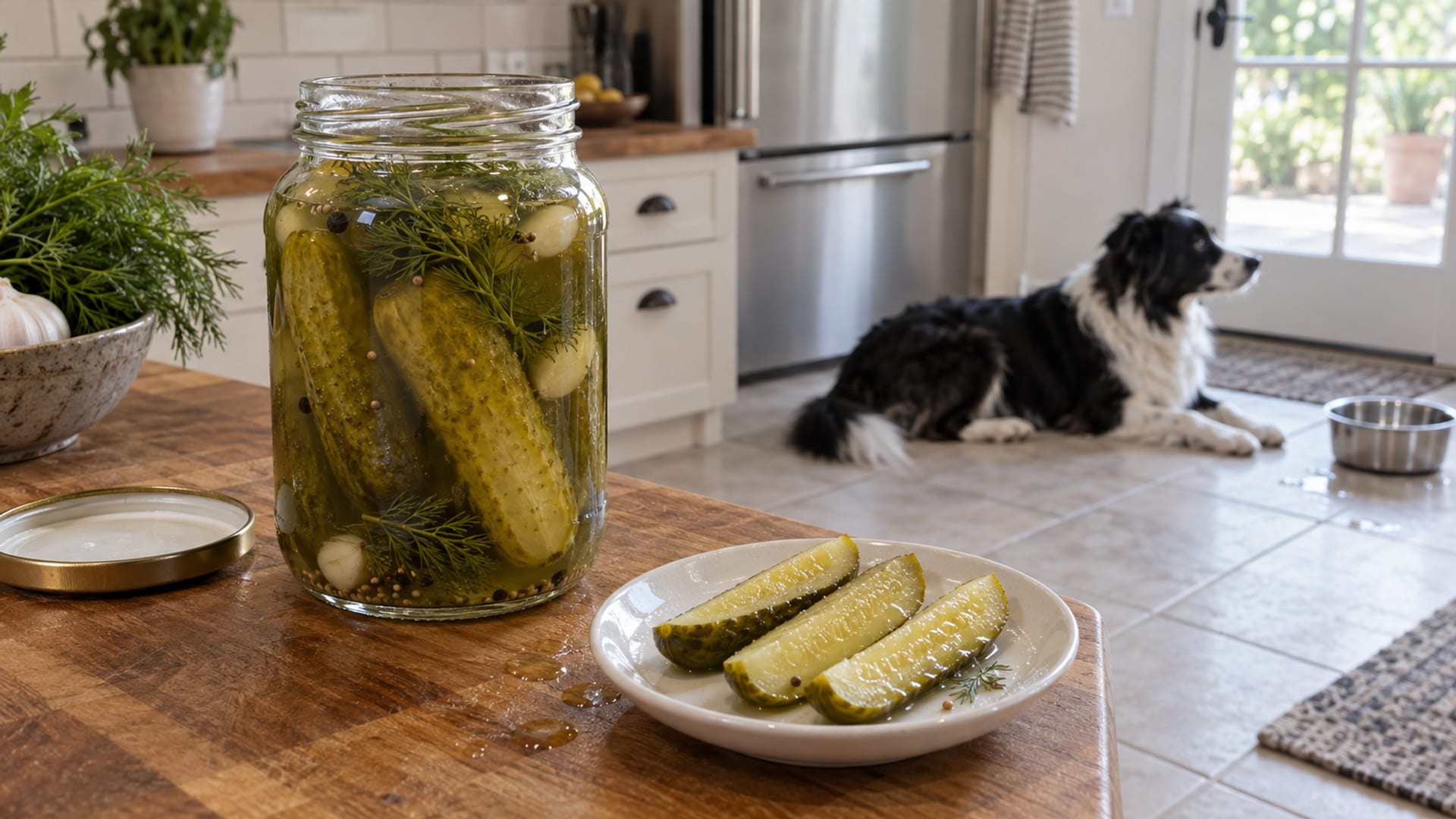
A small bite of plain dill pickle is unlikely to harm a healthy dog, but pickles make a poor treat. The AKC calls them extremely high in sodium, and recipes vary: some add onion or garlic, which damage a dog's red blood cells, according to the Merck Veterinary Manual.
If your dog grabbed one slice of a plain dill pickle, set out fresh water and carry on with your day. If they ate several pickles, drank from the jar, or ate a pickle made with onion or garlic, call your vet or a pet poison line today.
Key takeaways
Tap a card to bring it forward.
- One small bite of plain dill pickle is a low-risk slip for a healthy dog.
- The brine is the saltiest part, and a dog that drinks it gets a concentrated dose.
- Onion, garlic, chives or leeks in the jar turn it into a toxic exposure.
- Anemia from onion or garlic usually shows three to five days later.
- Fresh cucumber gives your dog the same crunch with none of the brine.
My dog ate pickles: what to do next
- Put out fresh water. Salt poisoning is unlikely while a dog's body is working normally and it can drink fresh water freely, according to Merck.
- Find the jar and read the ingredients. Look for onion, garlic, chives, leeks and hot peppers.
- Estimate the amount. How many pickles or slices, and whether your dog drank any brine. Note your dog's weight.
- Call your vet or a poison line if your dog ate more than a nibble, drank brine, is small or has heart disease, or if the jar lists any onion-family ingredient. For the onion family, VCA Animal Hospitals advises calling your vet or Pet Poison Helpline right away.
- Keep salt out of any home remedy. Table salt is sometimes suggested for making a dog throw up, and Merck warns it can cause salt poisoning by itself.
Go to an emergency vet now if your dog vomits repeatedly, trembles, walks as if drunk, has a seizure, has pale gums or red-brown urine, or collapses.
How much salt is too much for a dog?
Merck gives numbers for salt itself. Signs of salt poisoning in dogs can appear after about 2 to 3 grams of salt per kilogram of body weight, and the reported lethal dose is about 4 grams per kilogram.
Tap or hover a row to highlight it.
| Dog weight | Signs possible (2 to 3 g per kg) | Reported lethal dose (about 4 g per kg) |
|---|---|---|
| Dog weight11 lb (5 kg) | Signs possible (2 to 3 g per kg)10 to 15 g of salt | Reported lethal dose (about 4 g per kg)about 20 g of salt |
| Dog weight22 lb (10 kg) | Signs possible (2 to 3 g per kg)20 to 30 g of salt | Reported lethal dose (about 4 g per kg)about 40 g of salt |
| Dog weight70 lb (32 kg) | Signs possible (2 to 3 g per kg)about 64 to 96 g of salt | Reported lethal dose (about 4 g per kg)about 128 g of salt |
Source: Merck Veterinary Manual.
These figures are for salt. How much salt sits in one pickle depends on the brand and recipe, so the table cannot be turned into a count of slices. Bring the jar, or read out the sodium line on the label, and your vet or the poison line can work out where your dog stands.
The onion family has its own numbers. Merck reports signs in dogs after 15 to 30 grams of raw onion per kilogram, and garlic is 3 to 5 times more toxic than onion. VCA adds that dried and powdered onion and garlic, the kind in seasoning blends, are more concentrated than fresh. With a garlic dill pickle you rarely know how much garlic went into one spear, which is why an onion-family ingredient on the label is a reason to call. Can dogs eat onions? explains that risk in full.
Two groups need extra care. Small dogs take in more salt per pound from the same slice. And dogs with heart disease can hold on to fluid after a lot of sodium, according to the FDA.
Which pickles are the bigger problem
Tap or hover a row to highlight it.
| Type | Concern | Why |
|---|---|---|
| TypeA small piece of plain dill pickle | ConcernLow | WhySalt and vinegar; may upset the stomach |
| TypeA whole spear, small dog | ConcernModerate | WhyA choking risk if swallowed in one piece |
| TypePickle juice or brine | ConcernHigher | WhyConcentrated salt with no cucumber to dilute it |
| TypeBread-and-butter or sweet pickles | ConcernCheck the label | WhyThe AKC notes some recipes add onion and garlic, plus sugar |
| TypeHot or spicy pickles | ConcernAvoid | WhyChili and spices irritate the gut |
| TypePickle relish | ConcernCheck the label | WhyOften onion, garlic, sugar and stronger seasoning |
| TypePickled onions or pickled garlic | ConcernToxic | WhyThese are onion-family foods in a jar |
The cucumber part is not the worry. Cucumber skin and seeds are not toxic to dogs; the brine and whatever went into it are. Can dogs eat cucumbers? covers the plain vegetable.
Signs after pickles, and how long they take
Salt. Merck describes vomiting within several hours of a large salt intake, followed by weakness, diarrhea, muscle tremors, wobbly walking and seizures. Severe cases can lead to brain swelling, coma and death. A dog that ate a little and is simply thirstier than usual is showing the mild end of this.
Onion or garlic. Stomach upset can come early, but the blood damage runs on a slower clock. Merck says the changes in red blood cells start within 24 hours, peak around 72 hours, and the cells typically break down 3 to 5 days after the dog ate it. The ASPCA names the compound in onion, N-propyl disulfide. Between the ASPCA and Merck, the signs to watch for are:
- weakness and low energy
- pale gums
- panting or fast breathing, with a fast heart rate
- blood in the urine, or red to brown urine
- vomiting
A dog who ate a garlic pickle on Saturday and seems fine on Sunday may still be heading toward anemia by midweek.
"My dog gets a pickle chip every time we have burgers"
Plenty of dogs do, and for many of them nothing visible happens. That does not make pickles safe for every dog or every jar. One chip for a 70-pound dog is a far smaller dose than the same chip for a 10-pound one. Brands differ a lot in salt and seasoning. A dog with a full water bowl handles salt better than one with no water nearby. A plain dill slice is a different food from a garlic dill spear. And onion-family damage shows up days later, when nobody links it back to the burger night. If pickles are a habit in your house, keep them to the plain kind and keep them rare, or switch to cucumber.
Relish, fried pickles and other jarred look-alikes
- Fried pickles: the batter and frying oil add fat and a separate stomach risk.
- Pickle-flavored chips and snacks: usually salty, and often seasoned with onion or garlic powder.
- Pickled ginger: a different food in a similar jar, and the AKC points out that some products contain added ingredients such as xylitol. Read the label.
- Burgers, sandwiches and potato or tuna salad with pickles: check the whole dish, which often holds onion, fatty meat or mayonnaise.
- Gherkins, cornichons and kosher dills: all cucumber pickles. The same salt and label rules apply.
Check what you learned
Quick check
Questions about dogs and pickles
Can dogs have a little bit of a pickle?
A small piece of plain dill pickle is a low risk for a healthy dog, but it is still a salty snack with nothing your dog needs. Check that the jar has no onion or garlic, and do not make it a regular treat.
Is pickle juice bad for dogs?
Yes. Brine is concentrated salt and vinegar, often with seasonings. If your dog drank more than a lick, put out water and call your vet or a poison line, especially for a small dog.
Can dogs eat dill pickles?
Plain dill pickles are the least risky kind, in a small piece now and then. Garlic dills are a different story because of the garlic.
What if the pickles had garlic or onion in them?
Call your vet or a poison line, even if your dog looks normal. Onion and garlic damage red blood cells, and the anemia can take days to show.
Are pickles bad for cats?
Pickles with onion or garlic are worse for cats. Merck lists cats as the species most sensitive to the onion family, ahead of dogs.
Sources
Checked September 24, 2026.
- American Kennel Club, Can Dogs Eat Pickles?
- Merck Veterinary Manual, Salt Toxicosis in Animals
- Merck Veterinary Manual, Garlic and Onion (Allium spp) Toxicosis in Animals
- Merck Veterinary Manual, Drugs Used to Control or Stimulate Vomiting in Monogastric Animals
- ASPCA Animal Poison Control Center, Onion
- VCA Animal Hospitals, Onion, Garlic, Chive, and Leek Toxicity in Dogs
- U.S. Food and Drug Administration, Nutritional Tips for Pets with Heart Disease
- American Kennel Club, Can Dogs Eat Ginger?