
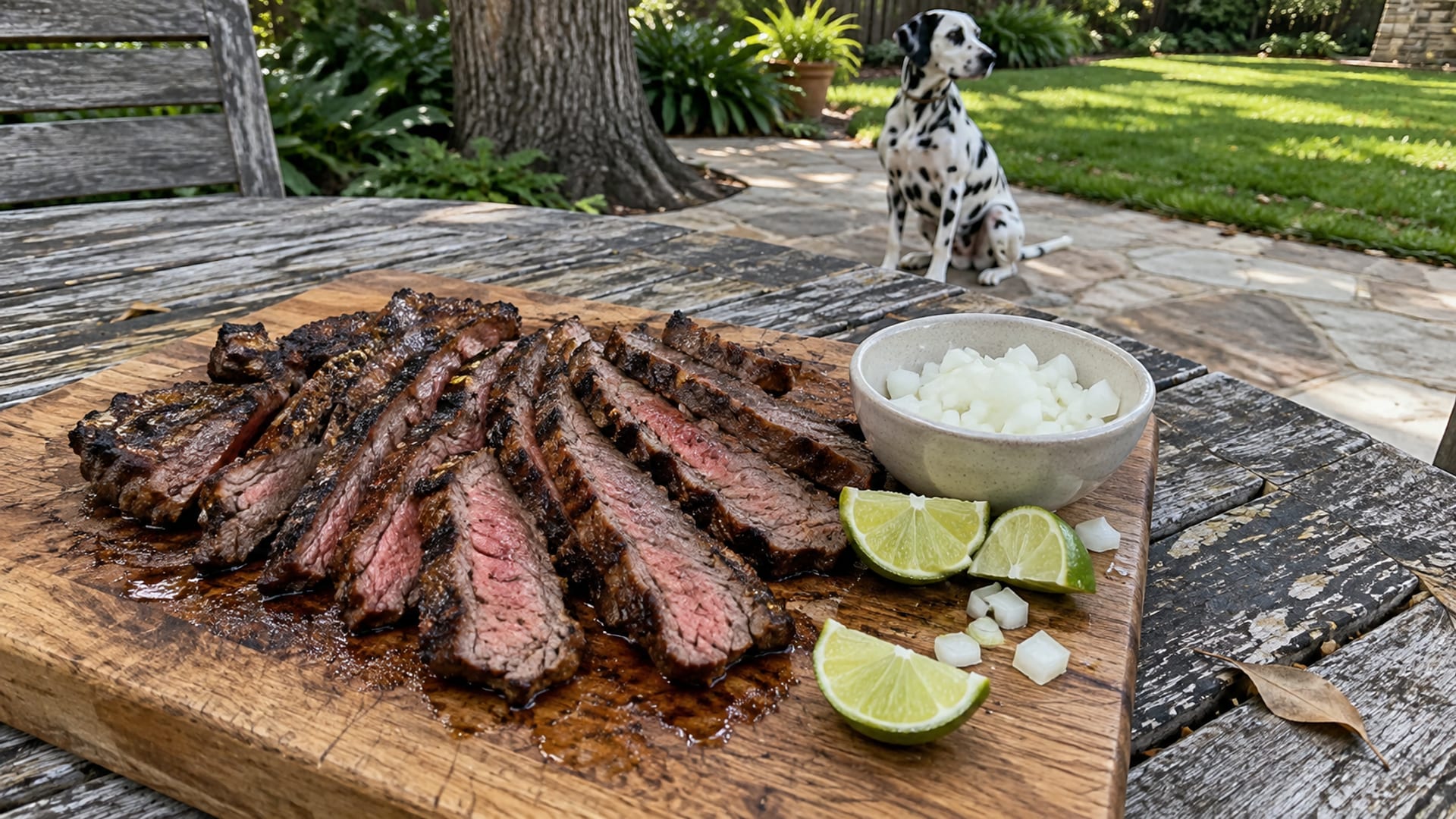
Carne asada is a caution food for dogs. A small piece of plain, fully cooked, lean beef with no bones is low concern, but most carne asada marinades carry onion or garlic, and the fat, grease, bones and skewers each bring a problem of their own.
If your dog already grabbed some off a plate, the grill or the trash, what was on the meat matters more than the beef. Find out whether the marinade had onion or garlic, how much your dog got, and whether bones, skewers or foil went down too. If any answer is yes, or you can't tell, call your vet or a poison-control line now. A dog that looks fine tonight can still show red blood cell damage days from now.
Key takeaways
Tap a card to bring it forward.
- A small piece of plain, fully cooked, lean, boneless beef is low concern for most dogs.
- Onion and garlic in a marinade or seasoning mix can damage red blood cells, often showing three to five days later.
- Fatty trimmings and grease can set off pancreatitis, especially in dogs that have had it before.
- Bones, skewers and foil can choke a dog or block the gut; raw beef can carry Salmonella and Listeria.
- Call your vet if your dog ate seasoned meat, fat, bones or skewers, or shows any sign of illness.
What to do if your dog already ate carne asada
The ASPCA tells owners to contact ASPCA Poison Control or their local veterinarian as soon as possible when a pet may have eaten something potentially toxic, and a garlic or onion marinade fits that description.
- Get the rest of the food out of reach. A dog that finds one piece often goes back for the platter, and a small exposure is easier to handle than a large one.
- Find out what went into the meat. Check the marinade bottle or seasoning packet, or ask the cook, for onion, garlic, their powders, garlic salt, onion salt, chives, leeks or shallots, because those decide the urgency.
- Estimate how much and when. Onion and garlic risk rises with the amount eaten per pound of dog, so a rough count and the time help your vet judge it.
- Look for bones, skewers, toothpicks or foil. These can choke a dog, block the gut or pierce it, which is a separate emergency from the seasoning.
- Check whether the meat was raw or undercooked. Meat taken off the counter before grilling carries a bacterial risk cooked beef doesn't.
- Call if any answer raises a concern. Have the recipe or label, the amount, the time and your dog's weight ready, since those let your vet decide whether your dog needs to be seen.
- Keep watching for several days. Onion and garlic signs can be delayed, so a quiet evening is good news but not the end of it.
A single small bite of plain, fully cooked, lean beef with nothing on it usually doesn't call for a poison-control call if your dog stays normal. If your dog has had pancreatitis or has another medical condition, call your own vet anyway.
Which parts of carne asada are low risk and which are not
Recipes vary by household and region, so sort out what your dog actually got.
Tap or hover a row to highlight it.
| Part or form | Concern for dogs | Main reason |
|---|---|---|
| Part or formPlain, fully cooked, lean, boneless beef | Concern for dogsLow in a small piece | Main reasonNothing added that is known to harm dogs |
| Part or formBeef marinated or seasoned with onion or garlic | Concern for dogsCaution; call your vet | Main reasonCan damage red blood cells |
| Part or formDry seasoning mix, onion or garlic powder, garlic salt | Concern for dogsHigher concern | Main reasonPowders concentrate onion and garlic |
| Part or formFatty trimmings, grease, marbled edges | Concern for dogsAvoid | Main reasonCan trigger pancreatitis |
| Part or formRaw or undercooked beef | Concern for dogsAvoid | Main reasonCan carry Salmonella and Listeria |
| Part or formBones, skewers, toothpicks, foil | Concern for dogsAvoid; call your vet | Main reasonChoking, blockage or a torn gut |
| Part or formSalsa, guacamole and sauces | Concern for dogsCheck each one | Main reasonOnion, garlic, chili, salt, avocado fat |
The seasoning is the part people miss. The Merck Veterinary Manual explains that onion, garlic, chives, leeks and related plants contain sulfur compounds that damage red blood cells and can cause hemolytic anemia, meaning anemia from red blood cells that burst. The ASPCA's garlic entry names N-propyl disulfide as a toxic compound in garlic, and the ASPCA's list of people foods to avoid adds that onion, garlic and chives can upset the stomach too. Our entries on onions and garlic cover each one.
Fat comes next. The ASPCA's cookout advice warns about fatty foods at gatherings, and the American Kennel Club links fatty food to pancreatitis, with Miniature Schnauzers and some small toy and terrier breeds at higher risk.
Then raw meat. The CDC notes that raw beef can carry Salmonella and Listeria and recommends against feeding raw food to dogs, and the FDA's handling tips name the same bacteria. See raw meat, steak bones and beef bones for those sides of it.
How to share plain beef, and how much seasoning is a concern
If you want to give your dog a taste, cut a piece for the dog before the marinade goes on. Cook it through, trim every bit of visible fat, remove any bone, and skip the salt, salsa and sauce. Keep it to a small, occasional piece, and ask your vet what amount fits your dog if you share often or your dog has had pancreatitis.
The risky part is harder to put a number on. Two published figures apply, both from the Merck Veterinary Manual.
Tap or hover a row to highlight it.
| Figure | What it describes | Source |
|---|---|---|
| Figure15 to 30 g of raw onion per kg of body weight | What it describesRaw onion amounts that have produced clinical signs in dogs | SourceMerck Veterinary Manual |
| FigureGarlic about 3 to 5 times more toxic than onion | What it describesA comparison, with no single garlic dose | SourceMerck Veterinary Manual |
Those numbers describe raw onion and garlic, not a marinade, a seasoning powder or a plate of carne asada. You usually can't tell how much soaked into the meat, and powders pack more into less food, so the Merck figures aren't meant for math at home. Call instead, with your dog's weight, what the recipe or label lists, and roughly how much meat went down.
Amount changes the risk a great deal. Pet Poison Helpline says the small amount of garlic in some dog treats is unlikely to cause harm, while concentrated forms and large or repeated exposures are a concern. A marinated steak sits somewhere in between, and since its dose is unknown and signs can come late, the cautious choice is to keep seasoned carne asada away from your dog.
Signs to watch for over the next several days
Stomach trouble tends to come first: vomiting, diarrhea, nausea, eating less or a sore belly. Fatty meat can add lethargy, and belly pain with repeated vomiting can point to pancreatitis.
Onion and garlic work on a slower clock. The Merck Veterinary Manual describes red blood cell damage starting within about 24 hours, one blood marker of it reaching its high point around 72 hours, and red blood cells bursting most often three to five days after the meal. Watch for:
- weakness or tiring quickly on a walk
- pale gums
- fast breathing or a racing heart
- a yellow tint to the gums, skin or eyes
- dark or bloody urine
- collapse
Severe anemia can injure the kidneys or be fatal, so any of these is a reason to call your vet the same day. Repeated retching, belly pain or straining after bones or skewers needs a call too.
With raw beef, a dog may get an upset stomach or show nothing and still carry bacteria. The FDA has warned that dogs can shed Salmonella and Listeria in feces and saliva without looking sick, which puts the household at risk too.
My dog ate carne asada before and was fine
That happens, and it went fine for that dog that night. The reasons don't carry over to every dog or every plate.
Amount matters, since onion and garlic risk is measured per kilogram of dog. Size matters for the same reason: the piece a Labrador shrugs off is a much bigger dose for a Chihuahua. The recipe matters, because one cook's carne asada is lime, salt and beef and another's is heavy on garlic powder. The dog matters, since Pet Poison Helpline lists Japanese breeds such as Akitas and Shiba Inus as possibly more sensitive. And timing matters most. A dog that seemed fine the night of the party may not have been watched on day three or four, when the anemia tends to show.
Tacos, fries, seasoning mixes and other carne asada foods
Carne asada rarely reaches a dog as plain meat. This is how the usual forms compare.
- Tacos, burritos, nachos and quesadillas. Tortillas, cheese, sauces, onion and garlic come together, so treat these as a mixed dish.
- Carne asada fries. Fries, seasoned meat, cheese and toppings add up to a lot of fat and salt. Our French fries page covers the potato half.
- Salsa, pico de gallo and guacamole. Most carry raw onion, and guacamole adds garlic and avocado fat. See avocado and jalapeños.
- Dry seasoning, garlic salt and onion salt. These are concentrated onion and garlic products, so a dog that licked a spilled packet had a stronger exposure than one that ate a seasoned piece.
- Carne seca and machaca. Dried and shredded beef can be saltier, and drying concentrates any seasoning. The beef jerky entry covers similar meats.
- Carne asada made with pork or goat. The fat changes with the meat; the seasoning hazards stay. See pork.
- Carne asada flavored dog treats and food. Here "carne asada" is a flavor name, so read the ingredient panel for onion or garlic.
Check what you learned
Try these before the next cookout.
Quick check
Questions about dogs and carne asada
These tend to come up once the plate is cleared.
Can my cat have carne asada too?
Keep seasoned carne asada away from cats. The Merck Veterinary Manual notes cats are more susceptible to onion and garlic than dogs, so a cat that ate marinated meat is a higher-risk case for your vet.
Is carne asada seasoning without onion or garlic safe?
It's lower risk, though salty or spicy meat can still upset a dog's stomach. Read the whole label, since many blends list garlic or onion powder partway down.
Does raw carne asada put my family at risk?
It can. A 2022 study in Veterinary Record found raw-fed dogs in the UK were more likely to carry antimicrobial-resistant E. coli, and Salmonella turned up in raw-fed dogs in that study. Wash hands, bowls and any surface the raw meat touched.
My dog has had pancreatitis. Can she have a plain bite?
Ask your vet first. The AKC counts a past bout of pancreatitis among the things that raise risk after fatty food, and even lean beef carries some fat.
Sources
Checked September 25, 2026.
- Merck Veterinary Manual, Garlic and Onion (Allium spp) Toxicosis in Animals
- ASPCA Animal Poison Control Center, Toxic and Non-toxic Plants: Garlic
- ASPCA Animal Poison Control Center, People Foods to Avoid Feeding Your Pets
- ASPCA, Be On the Lookout at Your Cookout
- Pet Poison Helpline, Onions Are Toxic To Dogs
- Pet Poison Helpline, Are Onions Poisonous To Dogs?
- American Kennel Club, Pancreatitis in Dogs: Symptoms, Causes and Treatment
- Centers for Disease Control and Prevention, About Pet Food Safety
- U.S. Food and Drug Administration, Tips for Safe Handling of Pet Food and Treats
- U.S. Food and Drug Administration, FDA Cautions Pet Owners Not to Feed Performance Dog Raw Pet Food Due to Salmonella, Listeria monocytogenes
- Veterinary Record (Leonard et al., 2022), UK dogs eating raw meat diets have higher risk of Salmonella and antimicrobial-resistant Escherichia coli faecal carriage