
Indestructible Dog Toys: What Lasts With a Heavy Chewer, and What to Avoid
By Cal Hewitt · Published , updated
Gear
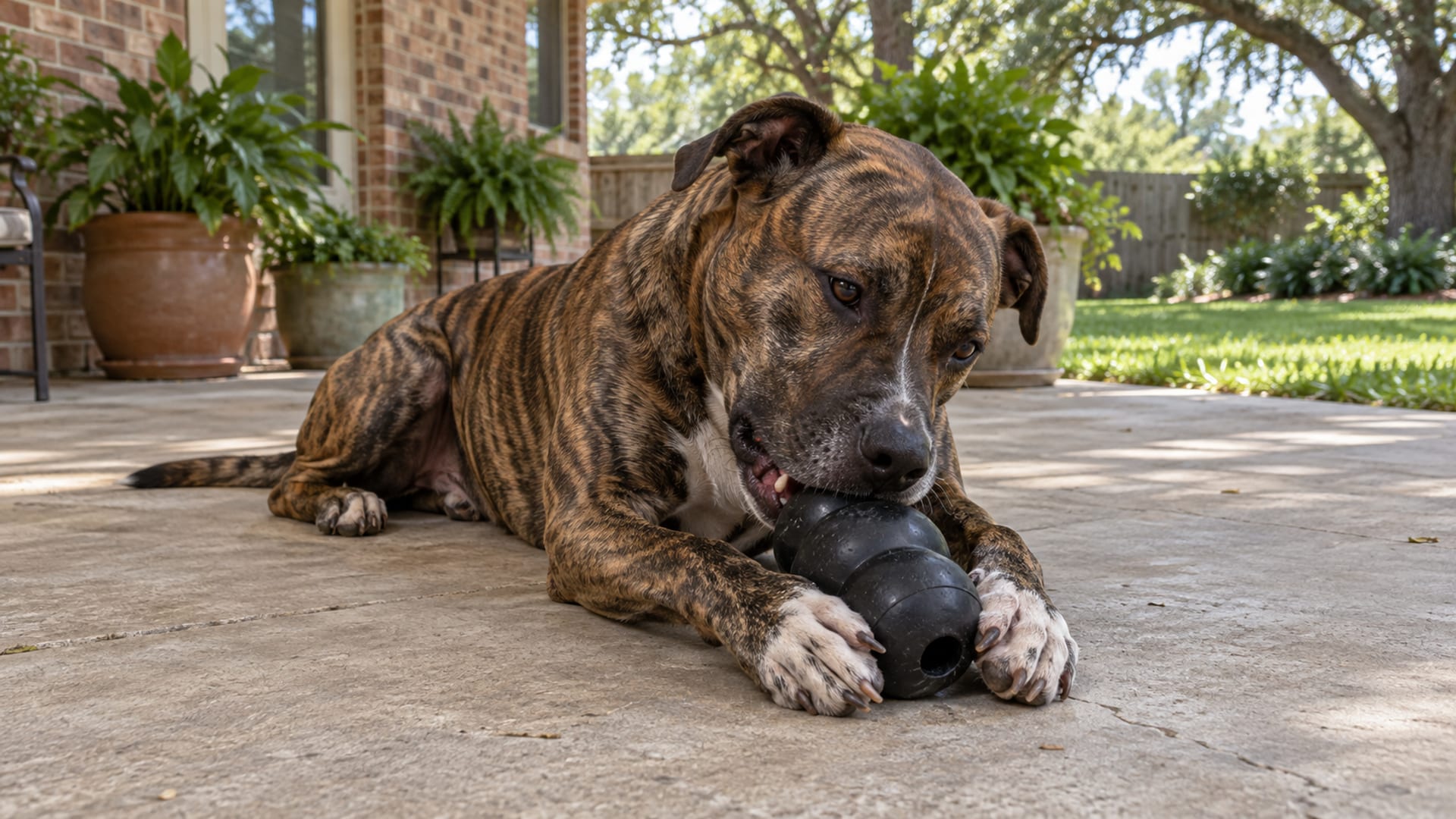
You bought the toy with "tough" on the label, and it lasted an afternoon. Maybe it was a plush toy with extra stitching, maybe a rubber ball, maybe the third one this month. Now you are standing in the toy aisle, or scrolling Amazon, trying to work out what might survive your dog and whether the pieces they already ate are a problem.
Here is the short answer. For a dog who chews hard, start with one correctly sized, one-piece, flexible rubber toy, and watch the first few sessions. Skip antlers, bones and very hard plastic, which can crack teeth. Throw a toy away the moment it cracks, loses a piece or gets small enough to swallow. And if you saw your dog swallow a chunk, call your vet now.
Key takeaways
Tap a card to bring it forward.
- Pick by how your dog chews: shredders, gnawers and gulpers need different toys.
- A flexible, one-piece rubber toy with no seams, stuffing or squeaker is the safest place to start for a heavy chewer.
- Size up. A toy your dog can fit fully in their mouth is a toy they can swallow or bite in half.
- If your fingernail cannot dent it, it is hard enough to break a tooth (University of Illinois veterinary dentists).
- Watch the first sessions, check the toy before every use, and bin it at the first crack or missing piece.
- A swallowed chunk, choking, repeated retching or a broken tooth means call the vet right away.
Which toy to try first, by how your dog chews
"Aggressive chewer" covers very different dogs. Watch what your dog does to a toy in the first few minutes, and match the toy to that. Breed tells you less than you would think; the ASPCA and AKC both put the focus on the individual dog's chewing habits and size.
Tap or hover a row to highlight it.
| If your dog... | Try | Skip |
|---|---|---|
| If your dog...Rips plush apart and pulls out stuffing or squeakers (a shredder) | TryA solid rubber toy; rope or fleece only for tug with you, then put away | SkipPlush, stuffed toys, anything with a squeaker |
| If your dog...Lies down and grinds on a toy for a long time (a gnawer) | TryA large, flexible rubber toy, stuffed with part of their daily food | SkipAntlers, bones, hard nylon, anything that fails the fingernail test |
| If your dog...Bites off pieces and swallows them (a gulper) | TryOnly toys too big to swallow, and only while you watch | SkipEdible chews left alone, small balls, toys with parts that come off |
| If your dog...Chases and catches | TryA ball too large to swallow, or a flexible rubber fetch toy | SkipTennis balls for heavy chewers (they wear down enamel and can be popped) |
The AKC's toy guidance is where the ball advice comes from: pick a ball too big to swallow, and know that tennis balls can wear down tooth enamel and be torn open. The AKC also says rope and fleece toys work best as interactive toys you hold, then put away, because dogs can shred and eat them.
For a gnawer, a food-stuffed rubber toy does two jobs: it lasts longer, and it gives your dog something approved to chew at the times they usually go looking for trouble. The ASPCA recommends exactly that for destructive chewing, a puzzle toy filled with something your dog likes, handed over at predictable chewing times. Count the food you put in it as part of the day's meals.
Three tough toys to trial first
There is no lab test or veterinary standard that ranks dog toys for durability. What does exist is a small independent test, and the makers' own claims and guarantees. Here is what each one says, so you can decide what to trial.
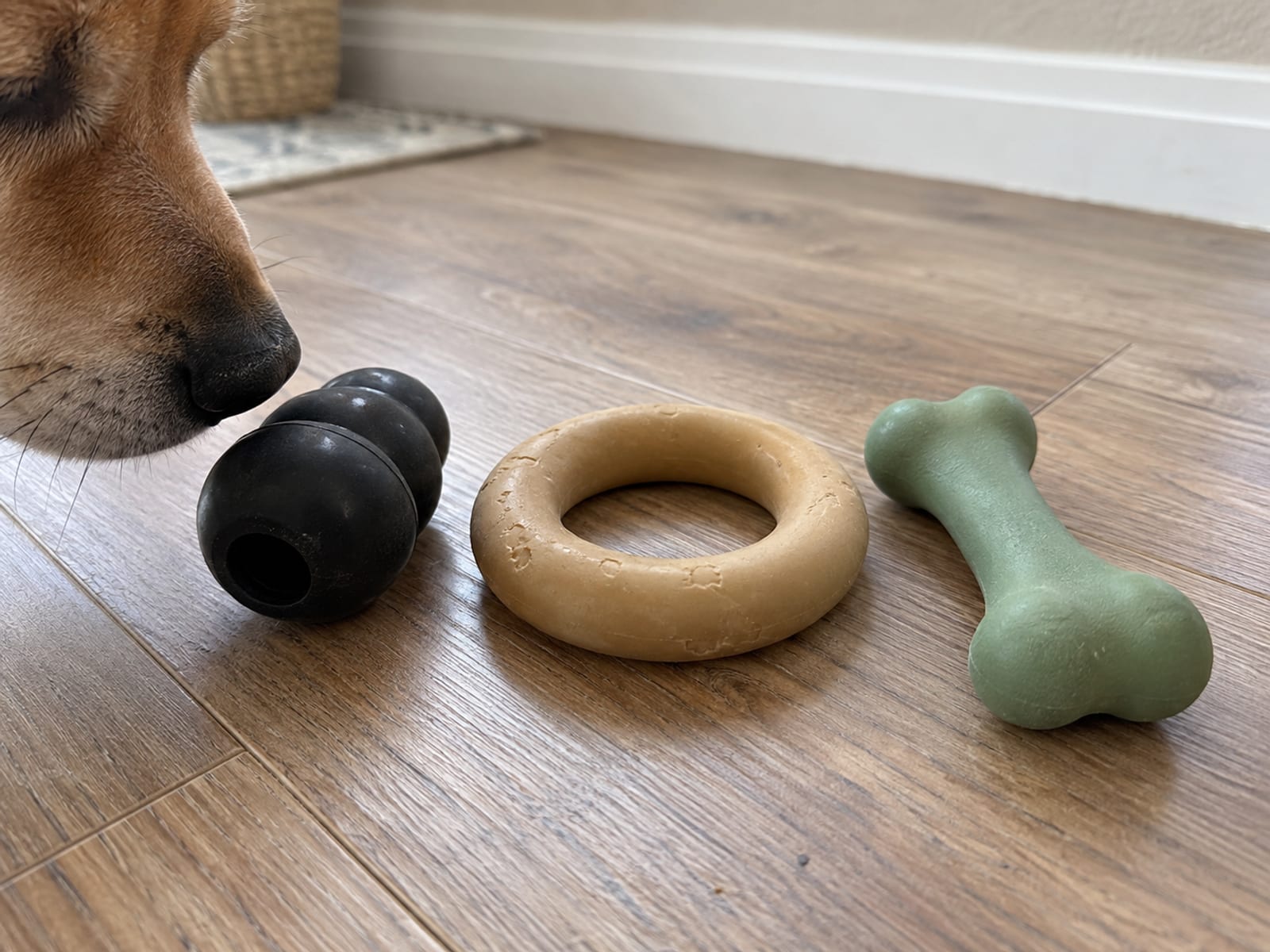
KONG Extreme. This is the black KONG. KONG describes it as its most durable natural rubber, made for power chewers, and sells it from Small up to XXLarge. It is hollow, so you can stuff it with food. In a three-month test by the UK consumer group Which?, published in April 2023, four dogs chewed through toys sold as tough, and a large KONG rubber toy was among the ones that lasted longest, according to Which?. That was four dogs over three months, so read it as one useful data point. KONG's 60-day guarantee lets you submit a claim for a damaged toy under its terms. If your dog is a gnawer, this is the one I would try first: see the KONG Extreme on Amazon.
Goughnuts ring. A thick, solid rubber ring. Goughnuts says the thick cross-section is there to stop a dog biting off the kind of chunk that causes a blockage, and its solid rings have a red layer inside. If you can see red, the toy is done: take it away. Goughnuts replaces a ring that shows red under its guarantee, and says the rings are for supervised chewing. The red layer is useful because it gives you a clear signal that a toy needs to go. See the Goughnuts ring on Amazon.
West Paw Zogoflex Hurley. A bendy bone that floats, good for a dog who likes to carry and fetch as well as chew. West Paw lists Hurley among its toughest Zogoflex toys, reports a return rate under 1% (its own figure), and offers a one-time replacement or refund if a dog damages one. West Paw also tells owners to supervise and remove a damaged toy. See the West Paw Hurley on Amazon.
A guarantee pays for a new toy if this one fails. Keeping your dog safe still comes down to size and supervision, so whichever you choose, buy the size the label gives for your dog's weight, or one size up for a strong chewer, and treat the first week as a trial.
Hard chews that can break teeth
When a dog destroys everything, the natural move is to buy something harder: an antler, a bone, a hard nylon chew. That is the one to be careful with. Veterinary dentists at the University of Illinois say antlers and many bones are too hard and commonly cause broken teeth, and they give a simple test: if you cannot dent it with your fingernail, it is too hard for your dog's teeth. The same school says a broken tooth needs a vet visit and may need a root canal or extraction, according to Illinois vet med.
The fingernail test is a quick screen for hardness. A toy can pass it and still be a choking risk for your dog, so size and supervision still matter.
Two more to leave out:
- Cooked bones. The ASPCA says they can splinter and seriously injure a dog.
- Edible chews for a gulper. The ASPCA warns a dog can choke on large pieces, especially when other dogs are around. Stay in the room, keep dogs apart while they chew, and take away the last end piece before it can be swallowed whole.
The first session, and when to throw a toy away
Give the new toy while you are there to watch, not at bedtime or before you leave for work. Offer one toy at a time. Watch how your dog holds it, whether they pin it and tear, and whether they are trying to get a piece off.
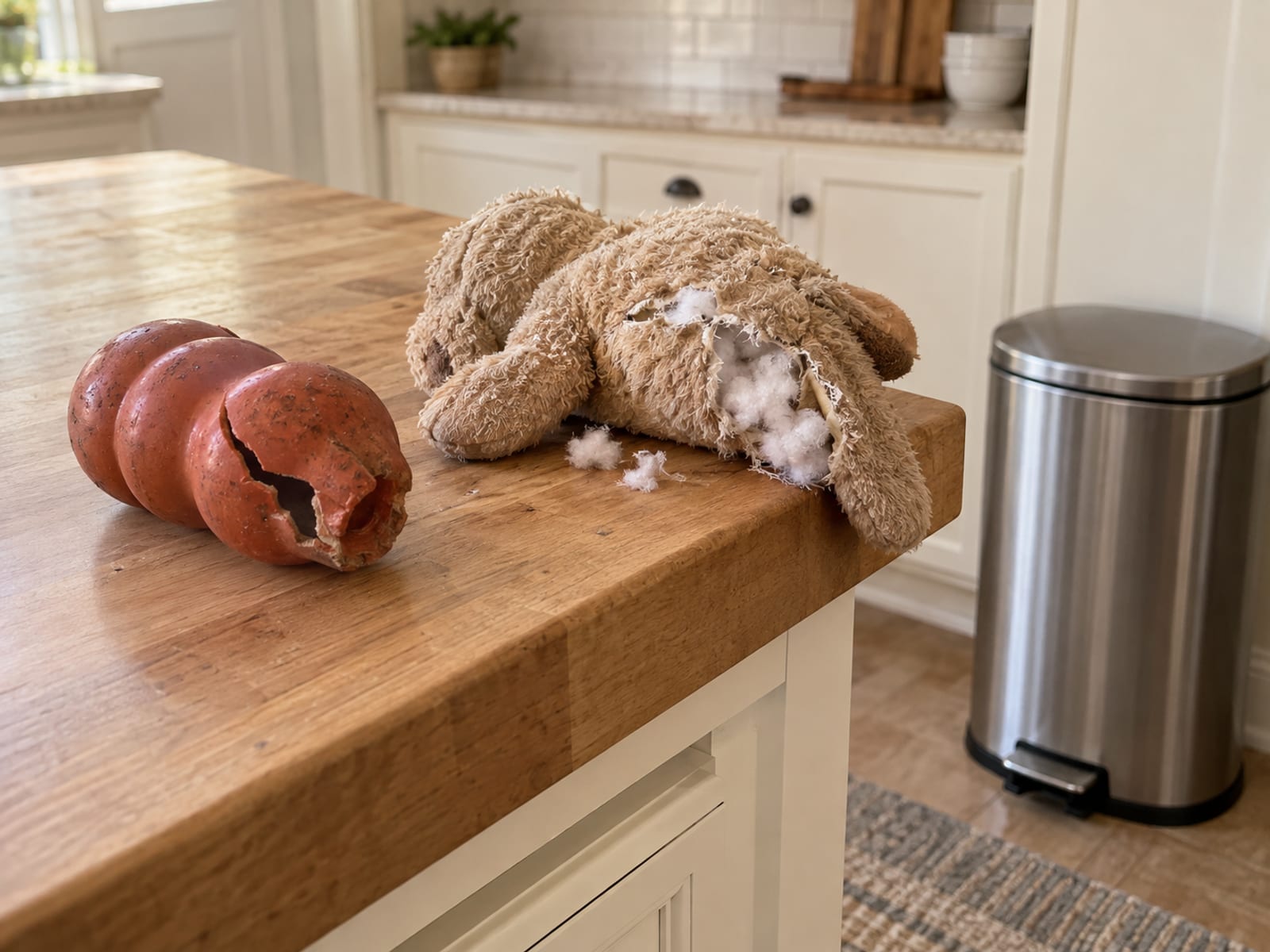
Take the toy away and bin it if:
- it cracks, splits or tears
- a piece comes off, or you find a piece missing
- the inside, a core or a seam is showing (on a Goughnuts ring, any red)
- it has worn down small enough to fit fully in your dog's mouth
- it has sharp or jagged edges
- your dog has pulled out a squeaker or any part that was inside
The ASPCA's advice is to watch your dog while they chew, never offer products that have broken into small pieces, and call your vet immediately if your dog swallows a chunk, because an intestinal blockage can need surgery. The AKC adds: do not let a dog chew on a squeaker they pulled out, since it can cause choking or a blockage.
A habit that helps: when a toy fails, take a photo and note the date and how long it lasted. You will need the photo for a guarantee claim, and after a few toys you will know which kind suits your dog.
Call the vet now if you see any of these
Do not wait and watch if your dog:
- swallowed a piece of toy, bone or chew
- is choking, gagging or retching over and over
- has trouble breathing
- is vomiting, has a sore or swollen belly, or refuses food
- seems unusually tired or flat
- has a broken tooth, or is suddenly chewing on one side, drooling or dropping food
The AVMA lists abnormal chewing, drooling and dropping food as signs to see a vet about. Your vet will tell you what to do based on what was swallowed, your dog's size and the timing. For other signs that something is off, Signs of a Healthy Dog has a nose-to-tail check.
When your dog chews the house too
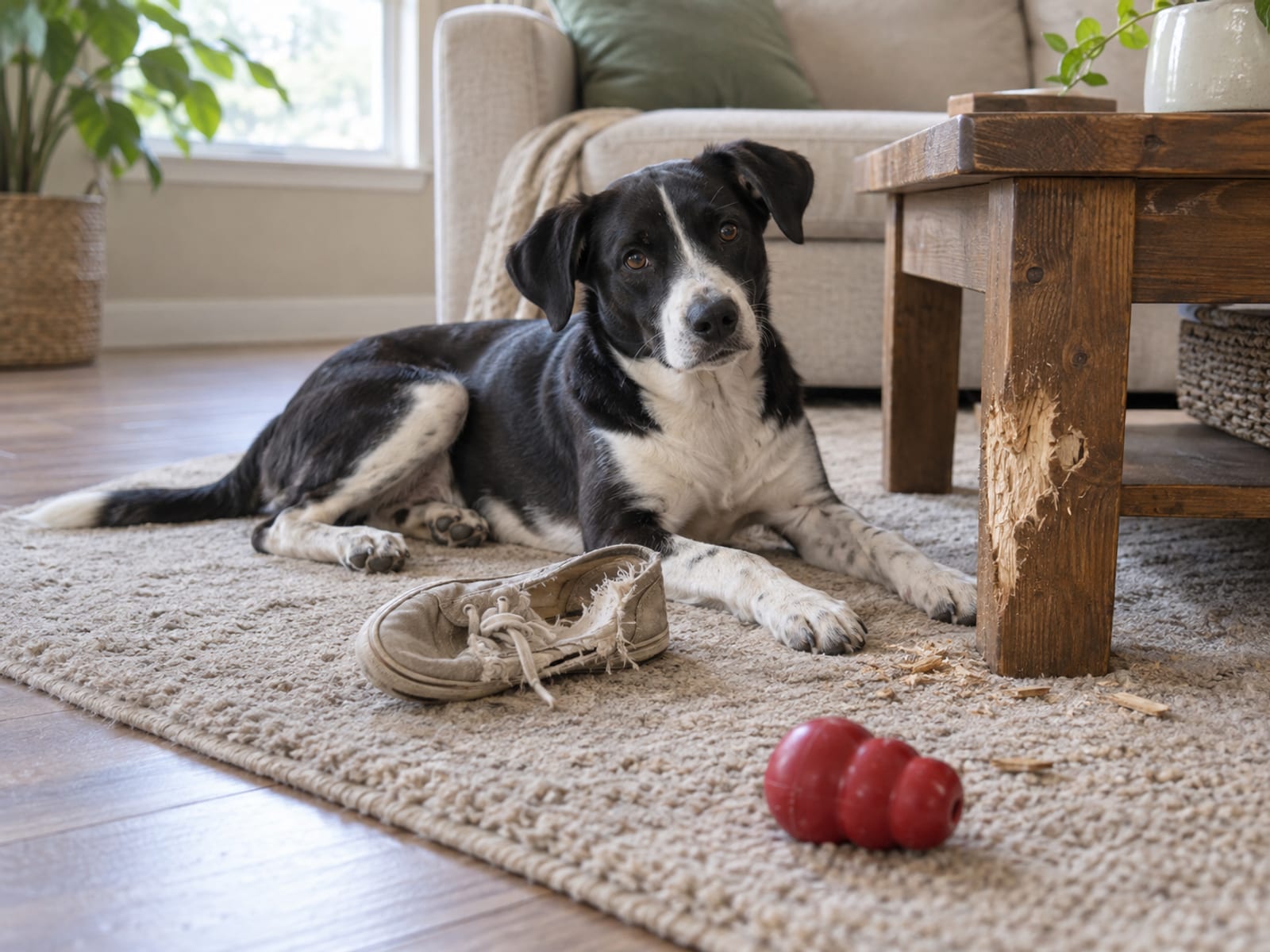
Chewing is normal dog behavior. When it is chewing on your couch, shoes and doorframes, a tougher toy helps, but it is only part of the answer. The ASPCA lists the usual causes: teething in puppies, boredom, not enough exercise, hunger on a diet, and stress or anxiety.
- Puppies. Chewing ramps up while adult teeth come in. The ASPCA says this usually ends by about six months of age.
- A dog who only destroys things when alone. If it comes with pacing, barking or howling, accidents or restlessness while you are out, that points to separation distress. Toys will not fix that; your vet or a behavior professional can.
- A sudden change in an adult or older dog. Pain, dental problems or illness can change chewing. Start with the vet.
For everyday chewing, the plan is management plus teaching. Put tempting things out of reach, hand over an approved toy before the times your dog usually chews, and when you catch them on the wrong thing, swap it for the right one and praise them when they take it. Rotate toys every couple of days so they stay interesting. Positive reinforcement training covers how to reward the choice you want, and How to Train a Dog covers the daily routine that uses up the energy behind a lot of chewing.
Finding a chewed shoe hours later and scolding your dog does not work; the ASPCA notes your dog cannot connect the punishment to something they did earlier. Dog Training Mistakes goes into why.
Mistakes that cost owners money and cost dogs teeth
- Buying the label. "Indestructible" and "for power chewers" are the maker's words. Fix: buy for your dog's size and chewing style, and watch the first sessions.
- Going harder to make it last. Antlers and hard bones last, and they are the ones veterinary dentists link to broken teeth. Fix: use the fingernail test.
- Keeping a damaged toy because it is still mostly there. A cracked toy sheds pieces. Fix: bin it and replace it with an intact one.
- Leaving chews alone with a dog, or with two dogs. Competition makes dogs gulp. Fix: stay in the room and keep dogs apart while they chew.
- Buying plush or squeakers for a known shredder. Fix: save rope and fleece for tug with you, and give solid rubber for solo chewing.
- Treating nonstop destruction as a shopping problem. If it is anxiety, pain or boredom, more toys will not stop it. Fix: talk to your vet, then a qualified trainer or behaviorist.
Who to call if the chewing keeps going
Start with your vet for anything medical: swallowed material, dental pain, vomiting, or a sudden change in behavior. A trainer cannot diagnose those.
For a management and teaching plan, look for a certified trainer who uses reward-based methods. The CCPDT's CPDT-KA certification means an exam plus at least 300 hours of training experience. For harder cases, such as chewing tied to separation distress, guarding a toy when you take it, or chewing your dog cannot stop, look for an IAABC certified behavior consultant (CDBC) or a board-certified veterinary behaviorist, listed in the ACVB directory. A veterinary behaviorist is a vet and can prescribe medication when it is needed.
Ask any trainer about cases like yours, what methods they use, and whether they work with your vet. Walk away from anyone selling dominance or punishment. The AVSAB's 2021 position statement says the evidence supports reward-based methods for all dog training.

Check what you learned
Quick check: picking a toy for a heavy chewer
Questions about tough dog toys
What is the toughest toy for a dog?
No toy has been tested against every dog. The black KONG Extreme, Goughnuts' solid rings and West Paw's Zogoflex line are the makers' toughest ranges, and a large KONG rubber toy was among the longest lasting in the Which? test. The toughest toy for your dog is the one that stays intact in your supervised trial.
What material can dogs not rip?
Thick, flexible rubber holds up best for most heavy chewers, because it gives under the teeth. Fabric, stitching and stuffing tear. Very hard materials, like antler and hard nylon, resist teeth by being harder than them, which is why they can crack teeth.
Are antlers safe for dogs?
University of Illinois veterinary dentists say antlers and many bones are too hard and commonly cause broken teeth. Use the fingernail test: if you cannot dent it, it is too hard.
Are lifetime-guarantee toys worth it?
A guarantee saves you money if the toy fails. Keep the photo and receipt, and read the terms before you buy. It does not make the toy safer, so the supervision and bin-it rules still apply.
How do I stop my dog from destroying all their toys?
Give the right type for how they chew, size up, rotate toys every couple of days, and give toys at the times they usually chew. If the destruction happens mostly when you are gone, or came on suddenly, talk to your vet.
Are stuffed toys and squeakers okay for a strong chewer?
Not for a dog who pulls them apart and eats the parts. The AKC warns a squeaker can cause choking or an intestinal blockage.
My dog swallowed a piece of a toy. What should I do?
Call your vet now. The ASPCA advises contacting a vet immediately after a dog swallows a chunk, and the vet will tell you what to do based on the piece and your dog.
Your next toy
Watch your dog with the next toy for ten minutes and note what they do to it: shred, grind or gulp. Then pick from the table above, one size up, and give it while you are home. Check it before every session, and keep a photo of any toy that fails. After two or three toys, you will know what your dog needs.
If you have a question about your dog and toys, reach me through the contact page.
Sources
- American College of Veterinary Behaviorists: ACVB
- American Kennel Club: AKC
- American Veterinary Medical Association: AVMA
- American Veterinary Society of Animal Behavior: AVSAB
- ASPCA: ASPCA
- ASPCA: ASPCA
- Certification Council for Professional Dog Trainers: CCPDT
- Goughnuts: Goughnuts
- IAABC: IAABC
- KONG: KONG
- KONG: KONG
- University of Illinois College of Veterinary Medicine: Illinois vet med
- University of Illinois College of Veterinary Medicine: University of Illinois
- West Paw: West Paw
- Which?: Which?