
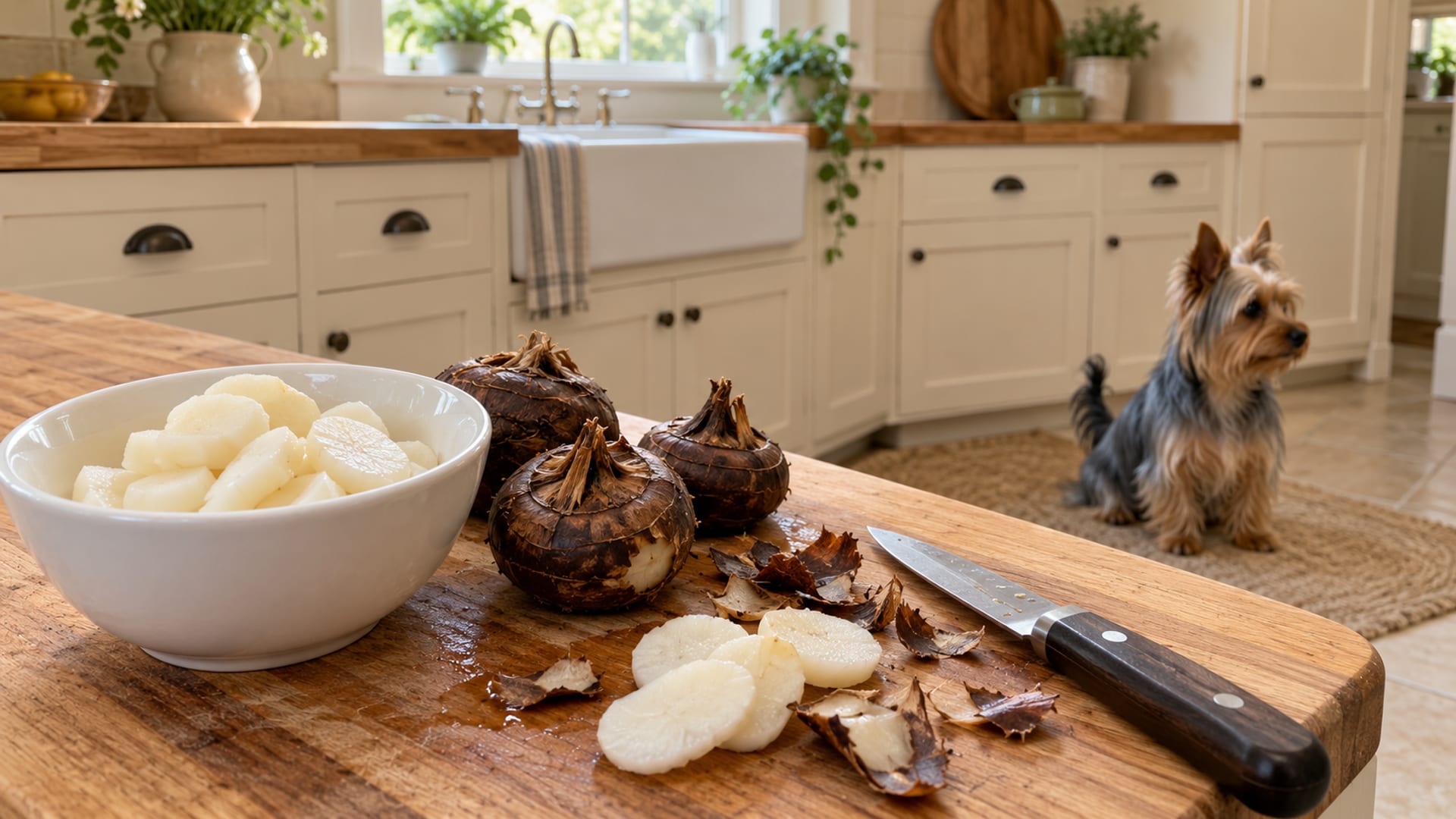
Yes, a small amount is fine for most dogs. The common Chinese water chestnut, *Eleocharis dulcis*, is the crisp white vegetable sold in cans and in Asian produce sections, and it does not appear on the ASPCA list of plants toxic to dogs, so a small plain, peeled piece is low risk. The risk sits in a few specific places: a whole hard corm that can lodge in the throat, a salty canned slice, a piece that came out of a sauce with onion or garlic, and a "water chestnut" that turns out to be a different plant.
If your dog has already eaten one, what it came with decides your next move. A slice or two of plain water chestnut in a dog who is acting normally usually calls for watching and checking the label. A mouthful of a garlicky stir-fry, a whole corm swallowed by a small dog, or a nut-like thing picked up near a pond is a reason to call your vet now.
Key takeaways
Tap a card to bring it forward.
- Plain, peeled Chinese water chestnut is not listed as toxic to dogs, and a small piece is low risk.
- A whole hard corm can choke a dog or block the gut, and small dogs face the higher risk.
- With canned or stir-fried water chestnuts, the salt, onion, garlic and sauce are the concern.
- Water caltrop (*Trapa*) and horse chestnut or buckeye are different plants; buckeye is toxic to dogs.
- Call your vet if your dog is choking, ate a seasoned dish, or you cannot say which plant it was.
What to do if your dog just ate a water chestnut
Go through these in order. They tell you whether to watch at home or pick up the phone.
- Check that your dog is breathing easily. Coughing, gagging, pawing at the mouth or struggling for air after a hard piece goes down can mean it is stuck. The ASPCA says a pet with trouble breathing, seizures or bleeding, or one that is unresponsive, should go straight to the nearest veterinary hospital.
- Find out what it was cooked in. Read the can label or think back through the dish. In a stir-fry, onion, garlic, soy sauce, salt and oil are the ingredients that matter for your dog, and our Onions and Garlic entries explain those two.
- Estimate how much and when. One slice is a very different situation from half a can or a whole corm. Cornell University's College of Veterinary Medicine advises having the product, ingredients, amount, time and your dog's weight ready when you call, so jot them down now.
- Confirm it was a Chinese water chestnut. The grocery kind is a round corm with dark skin and crisp white flesh. A hard, horned nut from a pond plant or a shiny brown seed from a tree is something else, with different risks.
- Skip home remedies. Hold off on any home treatment or medicine unless a veterinary professional tells you to give it.
- Call when anything is unclear. If you do not know the plant, the amount or what was in the sauce, or your dog shows any signs, call your vet, an emergency animal hospital or a poison-control line, the three places the FDA points owners to. The ASPCA warns that many poisons act on a delay, so a dog who seems normal right now has not ruled anything out.
Which water chestnut forms are fine and which to skip
The same vegetable comes in many forms, and the risk changes with each one.
Tap or hover a row to highlight it.
| Form | What to know | For your dog |
|---|---|---|
| FormFresh, peeled, plain | What to knowNo known dog toxin; firm and crunchy | For your dogSmall pieces are fine |
| FormPlain cooked | What to knowNo known dog toxin; cooking softens it | For your dogSmall pieces are fine |
| FormWhole raw corm | What to knowHard and round, a choking and blockage risk | For your dogCut it up or skip it |
| FormPeel or outer skin | What to knowTough and may carry soil | For your dogRemove it |
| FormCanned | What to knowMay hold a lot of sodium; other ingredients vary | For your dogRead the label first |
| FormStir-fried, pickled or seasoned | What to knowSalt, onion, garlic, sauce and oil | For your dogSkip it |
| FormDried slices | What to knowHard and concentrated | For your dogSkip it |
| FormFlour, powder, starch, juice or supplements | What to knowStrength and ingredients are unclear | For your dogSkip it |
| FormLeaves, stems and pond plant material | What to knowSafety of these parts is unknown | For your dogSkip it |
| FormWater caltrop (*Trapa*) fruit | What to knowA different plant; raw fruit can be harmful | For your dogSkip it; call if eaten raw |
| FormHorse chestnut or buckeye | What to knowA different plant, toxic to dogs | For your dogCall your vet |
The USDA Agricultural Research Service describes the *Eleocharis dulcis* corm as a different food from *Trapa* fruits, which can be toxic when eaten raw. With canned slices, the brine is the issue, so check the sodium and ingredient list first.
How to share a water chestnut piece safely
If you want to give your dog a taste, start with a fresh or plain cooked Chinese water chestnut that you know by name. Peel it, then cut it into pieces sized for your dog's mouth. A toy breed needs much smaller bits than a Lab, because the hazard is mechanical: a firm, round piece can slide to the back of the throat before a small dog has chewed it.
Keep the piece plain: no salt, soy sauce, onion, garlic, butter, oil or sauce. Set your dog's piece aside on the cutting board before the rest goes in the pan. Treat canned water chestnuts as a higher-risk choice because of the sodium, and leave dried slices, water chestnut flour or powder, and anything from an unidentified water plant out of the bowl entirely.
There is no published serving size for dogs, so think of it as a small taste. A new starchy food can upset some stomachs, which one or two small bits make less likely. For a dog with diabetes, kidney disease or a history of pancreatitis, ask your vet before adding it. The Merck Veterinary Manual treats carbohydrates and minerals such as sodium as parts of the diet that depend on the individual dog.
Signs to watch for after your dog eats one
A small amount of plain corm often causes nothing at all. When there is a problem, it tends to take one of these forms.
Choking happens right away. Coughing, gagging, retching, trouble breathing or collapse after a hard piece goes down is an emergency. A blockage in the stomach or gut can follow if a whole or large piece was swallowed. Watch for repeated vomiting, belly pain, weakness or low energy, and a dog who cannot keep food or water down.
An upset stomach is the mildest of these. A larger amount, or a food your dog has never had, can bring vomiting, diarrhea, gas, belly discomfort or a skipped meal. If mild signs keep going, call your vet; repeated vomiting or weakness means call now.
Illness from the dish depends on what else was in it, since onion, garlic and heavy salt bring their own signs. Since the ASPCA notes that some poisonings show up later, keep watching your dog for the rest of the day even if the first hour is quiet.
My dog ate water chestnuts before and was fine
That happened, and plenty of dogs eat a dropped slice without a problem. It still is not a rule for the next time or the next dog.
- The amount was small. A slice or two is not a whole can or a whole corm.
- It was the grocery kind. The dog ate *Eleocharis dulcis*, not water caltrop or a buckeye picked up on a walk.
- The piece was soft or small. A cooked, sliced piece goes down differently from a hard whole corm.
- The dish was mild. The next meal may have onion, garlic or a salty sauce.
- The dog was big enough. A large dog can swallow a piece that would lodge in a small dog's throat.
- Stomachs differ. One dog handles a new food easily; another gets diarrhea from the same bite.
- Some effects come later. The ASPCA warns that a pet can act normal for a while after a poisoning.
The form, the sauce and the size of the piece and the dog can all be different next time.
Other things called water chestnut, and look-alikes
The name covers more than one plant, and that is where most of the real danger sits.
Water caltrop (*Trapa natans*, *Trapa bicornis* and related species) is also sold and grown as "water chestnut." It is a hard, angular or horned nut-like fruit, and it goes by names like buffalo nut, devil's pod, bat nut and ling jiao. The U.S. Fish and Wildlife Service reports that raw *Trapa natans* nuts contain substances harmful to the digestive tract and need boiling before they are edible. The Journal of Ecology also links raw or undercooked *Trapa* to fasciolopsiasis, an infection with an intestinal fluke. If your dog chewed one of these, especially raw from a pond or lake edge, call your vet.
Horse chestnut and buckeye (*Aesculus* species, also called conkers) are tree seeds that look like chestnuts, and the ASPCA lists them as toxic to dogs because of aesculin and other saponins. Signs include vomiting, diarrhea, depression or excitement, dilated pupils, stumbling, coma and seizures. The Pet Poison Helpline advises contacting poison control right away when you suspect poisoning.
True chestnuts (*Castanea*, the sweet or roasting chestnut) are tree nuts and a separate food from both water chestnuts and buckeyes. Canned stir-fry mixes may hold brine, preservatives, sauce, onion or garlic, so the label decides. If the dish also had other vegetables, our entries on Bamboo Shoots, Bean Sprouts and Bok Choy cover those.
Check what you learned
Three quick questions to go over the main points.
Quick check
Questions about dogs and water chestnuts
A few more questions owners ask.
Can I bake dog treats with water chestnut flour?
It is better to leave it out. Flour, powder and starch are processed forms whose strength and added ingredients can differ from the fresh corm. A small piece of plain corm is the simpler way to share.
Is water chestnut safe for my cat too?
There is no known cat-specific problem with plain Chinese water chestnut. The bigger concern in a home with both pets is a buckeye or horse chestnut, which the ASPCA lists as toxic to cats as well as dogs. Identify the plant before assuming it is harmless for either.
Can puppies or senior dogs have water chestnuts?
There is no special rule for puppies, seniors or pregnant dogs. Size is what matters most, since a small mouth and throat make a hard piece riskier. Keep pieces tiny for young or small dogs, and check with your vet first if your dog has a stomach condition.
My dog chewed a water chestnut plant at the pond. Is that the same as the grocery kind?
Probably not. Plants growing in ponds as "water chestnut" are often water caltrop, and leaves and stems of water plants have no known safety record for dogs. Call your vet and describe what your dog chewed.
Sources
Checked September 25, 2026.
- ASPCA, Toxic and Non-Toxic Plants: Dogs Plant List
- ASPCA, Buckeye
- ASPCA, My Pet Ate Something! When Should I Seek Help?
- ASPCA, What to Do if Your Pet Is Poisoned
- USDA Agricultural Research Service, Waterchestnut
- U.S. Fish and Wildlife Service, Water Chestnut (Trapa natans) ERSS
- Journal of Ecology, International Biological Flora: Trapa natans
- Cornell University College of Veterinary Medicine, First-aid for poisonous substances
- FDA, Who Do You Call if You Have a Pet Emergency?
- Merck Veterinary Manual, Nutritional Requirements of Small Animals
- Pet Poison Helpline, Signs of Poisoning in Dogs and Cats