

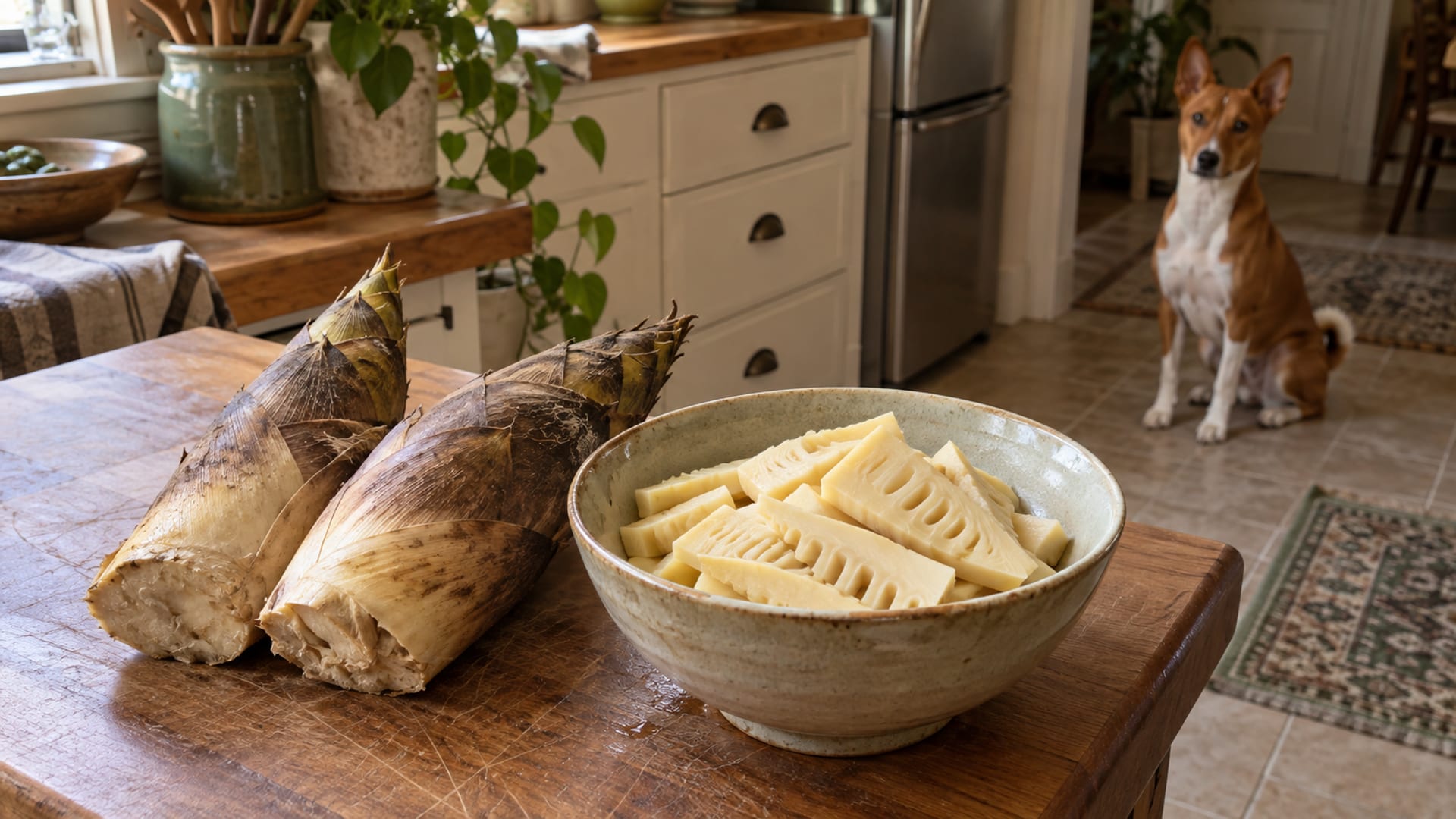
Sometimes, with caution, and which bamboo it was decides most of the answer. Plain bamboo shoots that were cooked or came out of a can are lower risk in a small amount, and the ASPCA lists golden bamboo, also sold as fishpole bamboo, as non-toxic to dogs, while raw shoots from some edible species contain a compound that can release cyanide.
If your dog just ate raw shoots, chewed a bamboo you can't name, or got into an amount you can't guess, call your vet or a pet poison line now rather than wait for signs. A bite of plain canned shoots or a chew on a plant you know is golden bamboo is a calmer situation.
Edible shoots come from many species with different chemistry, and two popular plants called bamboo aren't bamboo at all. Heavenly bamboo, also called sacred bamboo, is a shrub named *Nandina domestica* that the Merck Veterinary Manual lists as poisonous to some animals, and lucky bamboo is usually a *Dracaena*.
Key takeaways
Tap a card to bring it forward.
- Golden or fishpole bamboo (*Phyllostachys aurea*) is on the ASPCA non-toxic list for dogs and cats.
- Raw shoots of some edible bamboo species contain taxiphyllin, which can break down into hydrogen cyanide.
- Cooking and canning lower taxiphyllin, so plain cooked or canned shoots are lower risk, though no serving size for dogs has been set.
- Heavenly bamboo and lucky bamboo are different plants, and heavenly bamboo is poisonous to some animals.
- Fast breathing, weakness, staggering, tremors or collapse after raw or unknown shoots means an emergency vet visit right now.
What to do if your dog just ate bamboo
Four questions sort out how urgent this is: which plant, raw or cooked, how much, and how big your dog is.
- Name the plant or product if you can. The ASPCA listing covers one named species, golden bamboo, so a shoot from a grocery bag, a neighbor's hedge or a potted "bamboo" with no tag is a separate question.
- Work out whether it was raw or cooked. In their review of bamboo shoots as food, Patil and colleagues describe how boiling and processing lower taxiphyllin, so a raw piece carries more of the compound that matters here.
- Guess the amount and write down the time. The Merck Veterinary Manual says cyanide signs in animals generally begin within 15 to 20 minutes to a few hours, so the time tells your vet where your dog sits in that window. Have your dog's weight handy as well, because the same bite is a bigger dose for a small body.
- Keep a sample, the can, the takeout box or a photo. The ASPCA and the FDA both stress identifying what your pet ate, and a clear shot of the leaves or label can settle it.
- Call right away for raw shoots, an unknown plant, a large or unknown amount, or any sign at all. The ASPCA advises contacting a veterinarian or poison control promptly after a possibly toxic ingestion, without waiting for signs to get worse.
- Skip home remedies, and don't try to get your dog to vomit unless you're told to. Pet Poison Helpline advises against inducing vomiting or giving any treatment before a vet or their staff guide you.
Which bamboo and which form you're dealing with
Find the row closest to what your dog got into.
Tap or hover a row to highlight it.
| What your dog got into | What it means |
|---|---|
| What your dog got intoGolden or fishpole bamboo plant (*Phyllostachys aurea*) | What it meansListed by the ASPCA as non-toxic to dogs; tough pieces can still cause gagging or an upset stomach |
| What your dog got intoFresh raw bamboo shoots | What it meansSome species contain taxiphyllin, which can release cyanide; call your vet |
| What your dog got intoPlain canned or boiled shoots | What it meansLower risk because heat and processing reduce taxiphyllin |
| What your dog got intoDried, pickled, fermented or powdered shoots | What it meansSpecies, strength, salt and spices vary by product; check the label and call if your dog ate much |
| What your dog got intoShoots in a stir-fry or takeout dish | What it meansThe shoots are cooked; garlic, onion, salt, oil and sauce become the bigger concern |
| What your dog got intoLeaves, stalks or roots of an unnamed bamboo | What it meansDepends on the species; if you can't name the plant, call |
| What your dog got intoHeavenly or sacred bamboo (*Nandina domestica*) | What it meansA different plant, listed by Merck as poisonous to some animals |
Fresh raw shoots turn up in Asian groceries, often still in their husks, and in yards where bamboo pushes up new spears. The review by Singhal and colleagues names taxiphyllin in raw shoots, and a lab study on measuring cyanide in bamboo shoots explains how it forms hydrogen cyanide once the tissue is cut or chewed. It has been studied in edible species such as *Bambusa vulgaris* and *Gigantochloa verticillata*, and a peeled shoot gives you no way to tell its species.
Canned sliced shoots, the pale strips in many takeout dishes, have already been boiled and processed, and work on commercial products by Niyogi and colleagues supports that processing lowers taxiphyllin. Dried, pickled and fermented shoots, including the seasoned kind served on ramen, are their own products, and the label matters as much as the bamboo.
Sharing plain cooked shoots, and when raw becomes a concern
If you'd like to share, check with your vet first, then stick to plain shoots that were thoroughly cooked or came from a can. Leave out anything seasoned: salt, sauce, spices, oil, and especially garlic and onions, which often ride along in stir-fries. Cut the pieces small, since bamboo is fibrous and a tough chunk can make a dog gag.
Keep it to a small taste now and then, and ask your vet what that means for your dog's size, since no published serving exists by weight. I'd leave bamboo powders, extracts and supplements off the menu entirely.
I wouldn't offer raw shoots at all. Patil and colleagues report cyanogenic content of roughly 900 to 1,000 mg/kg in young shoots of two *Dendrocalamus* species, but that number describes the plant, and it doesn't tell you how much a dog can eat before getting sick. So, if your dog ate raw shoots, call and give your vet the dog's weight, the amount, the time, and the species or packaging if you have it.
Signs to watch for and how fast they show up
Watch your dog closely for the next few hours. According to the Merck Veterinary Manual, cyanide poisoning in animals can cause:
- rapid breathing or trouble breathing
- weakness or staggering
- tremors or seizures
- an abnormal heart rate
- collapse, coma and death
Merck reports that these signs generally begin within 15 to 20 minutes to a few hours after an animal eats toxic plant material. Once signs start, survival is rarely longer than two hours without effective treatment, which is why any of them means driving to the nearest emergency vet while someone calls ahead.
A plant listed as non-toxic may cause nothing at all, or a mild stomach upset. Tough, stringy pieces can bring on gagging, vomiting or belly discomfort, and a large piece can cause a blockage, so repeated vomiting also means calling a vet today.
My dog ate bamboo before and was fine
That happens, and I believe it. A dog can chew a garden cane or steal a few slices of canned shoots from a plate with no trouble at all. The reasons usually come down to what was eaten and how much: a small amount, a species low in taxiphyllin, shoots that were cooked, or a large dog for whom one bite is a tiny dose by weight.
None of that carries over to the next dog or the next bamboo. A different clump, a raw shoot from the store, a smaller dog or a bigger helping changes the math, and every dog handles it a little differently. Since cyanide signs usually come on fast, the call belongs at the start of the evening, before you know how it turns out.
Look-alike plants and products that share the bamboo name
A lot of what people call bamboo belongs to other plant families, and a few products only borrow the name. The ones owners most often mix up:
- Heavenly or sacred bamboo (*Nandina domestica*). A common yard shrub. Merck lists its foliage and fruit as poisonous to some animals because of cyanogenic compounds, so a chewed Nandina is a reason to call.
- Lucky bamboo (usually *Dracaena sanderiana*). The stalks sold in water in small pots. It isn't true bamboo, so check it by its own name or ask your vet.
- Japanese knotweed and horsetail. Unrelated plants sometimes described with bamboo names.
- Bamboo tea, vinegar, salt, beer, extracts and powders. Processed products with their own ingredients and strengths; bring the label to your vet.
- Bamboo fiber items and bamboo charcoal. Manufactured goods, where the swallowed object itself is the concern.
Check what you learned
Three questions on the essentials.
Quick check
Questions about dogs and bamboo shoots
These come up once the first scare has passed.
Can dogs chew on bamboo leaves and canes?
For golden or fishpole bamboo, the ASPCA listing covers the plant. For any bamboo you can't identify, a photo of the plant and a call to your vet is the safer route. Chewed canes also splinter into hard, stringy pieces, a good reason to redirect a dog who treats the hedge as a chew toy.
Is bamboo safe for cats in the same house?
The ASPCA lists golden bamboo as non-toxic to cats as well as dogs. The cyanide concern with raw edible shoots applies to cats too, so if a cat gets into raw or unknown shoots, the same call to your vet or a poison line makes sense.
My dog seems completely normal. Do I still need to call?
After raw shoots, an unknown plant or a large amount, yes. A dog acting normal in the first minutes doesn't rule out a problem, and the ASPCA's advice is to call promptly. After a small, clearly identified bite of golden bamboo or plain canned shoots, watch your dog and call if anything seems off.
Is a bamboo palm the same thing as bamboo?
It's a palm, *Chamaedorea elegans*, sometimes sold as a parlor palm. The ASPCA's plant list for dogs shows it as non-toxic, which makes a chewed frond a calmer question.
Does a small dog or puppy face more risk?
The same amount of shoots is a larger dose per pound for a small dog, which is simple arithmetic. For puppies, seniors and pregnant dogs, share what they ate and when, and let the vet factor in age and health.
Sources
Checked September 25, 2026.
- ASPCA, Toxic and Non-Toxic Plants: Bamboo
- ASPCA, Toxic and Non-Toxic Plant List, Dogs
- ASPCA, My Pet Ate Something. When Should I Seek Help?
- ASPCA, What to Do If Your Pet Is Poisoned
- Merck Veterinary Manual, Cyanide Poisoning in Animals
- Merck Veterinary Manual, Plants Poisonous to Animals
- Pet Poison Helpline, What to Do If Your Pet Is Poisoned
- U.S. Food and Drug Administration, Potentially Dangerous Items for Your Pet
- PubMed Central, Quality improvement of bamboo shoots by removal of antinutrients using different processing techniques: A review
- PubMed Central, Determination of cyanide in bamboo shoots by microdiffusion combined with ion chromatography-pulsed amperometric detection
- PubMed, Bamboo shoots: a novel source of nutrition and medicine
- PubMed, Cyanogenic Derivatives as Chemical Markers for the Authentication of Commercial Products of Bamboo Shoots