
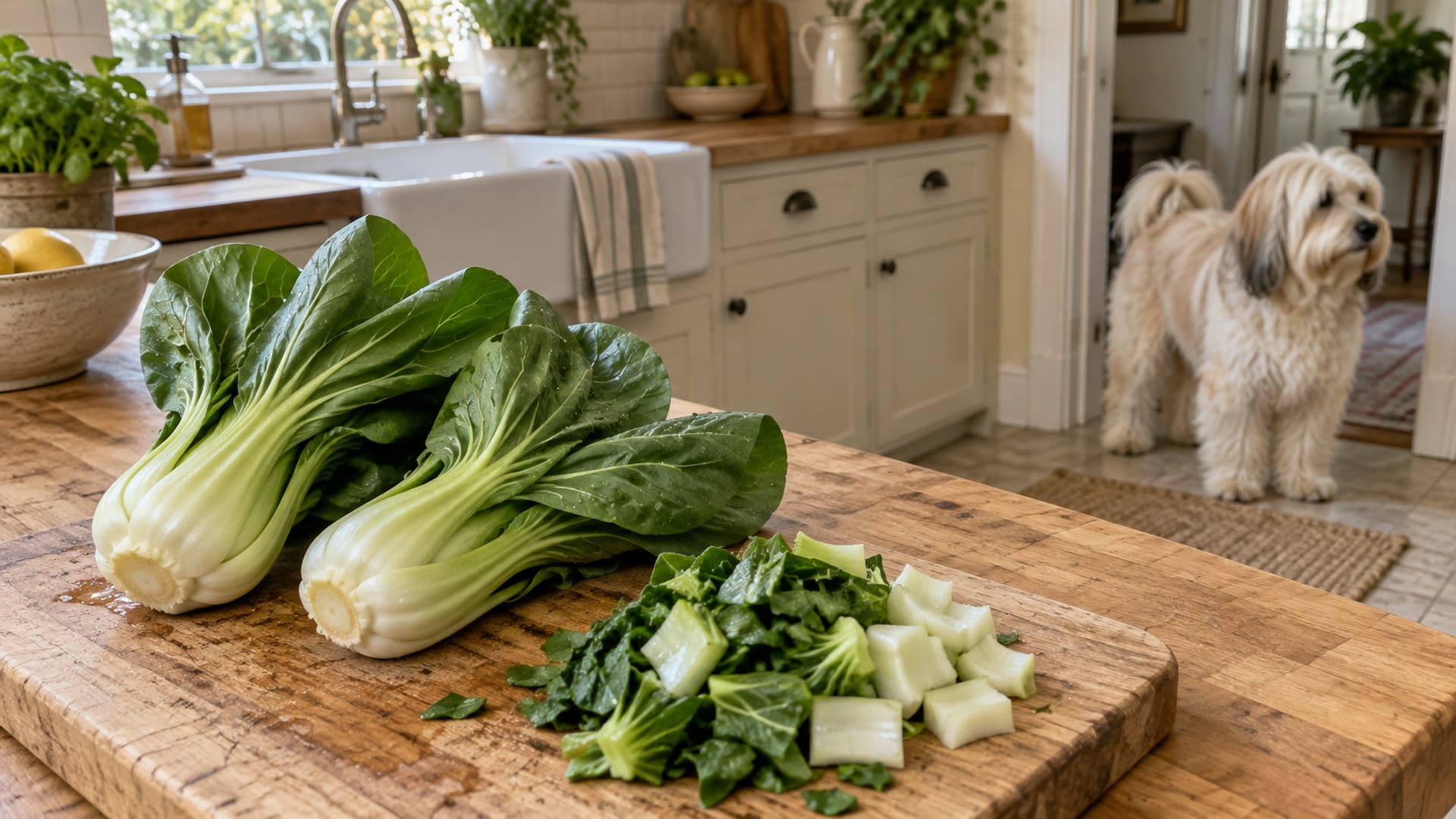
Yes. Plain bok choy is generally safe for dogs in small, chopped pieces, raw or lightly cooked, and the American Kennel Club lists it among the cabbage types considered safe for dogs. What changes the answer is what came with it: a stir-fry, soup or sauce can carry onion, garlic, lots of salt or fat, and fermented or pickled bok choy is a different food from the fresh leaf.
If your dog grabbed a raw leaf that slid off the cutting board, keep an eye on them for the rest of the day. Gas or a loose stool is the usual worst of a plain helping. If the bok choy came out of a seasoned dish, if your dog ate a large amount of something fermented like kimchi, or if they are gagging, coughing or struggling to breathe, call your vet now.
Key takeaways
Tap a card to bring it forward.
- Plain bok choy, leaves or stalks, is generally safe for dogs in small, chopped pieces, raw or cooked.
- Stir-fries, soups and sauces can hold onion, garlic, salt or fat, and those ingredients are the bigger concern.
- Fermented and pickled bok choy are separate foods; a large amount of fermented bok choy is a reason to call your vet.
- Choking on a stalk, trouble breathing, odd gum color, collapse or repeated vomiting all mean call right away.
- To share it, wash it, chop it small, serve it plain and keep it to a small amount.
What to do if your dog already ate bok choy
A few quick questions sort out most of these moments. Work through them in this order.
- Pick up what is left and move your dog away from it. The Pet Poison Helpline puts removing your pet from the source first, because the amount eaten is the one thing you can still limit.
- Check whether it was plain or part of a dish. Bok choy cooked with garlic or onions brings in separate toxins, and soy sauce, brine or an oily sauce adds salt and fat that plain greens do not have.
- Work out the form and the amount. A case report in *Veterinary Medicine: Research and Reports* describes a dog that became ill after eating a large volume of fermented bok choy, so a big serving of kimchi deserves a phone call even if your dog seems fine.
- Think about your dog's size. The same amount is a bigger dose for a small dog, and a long, fibrous stalk is harder for a small dog to swallow.
- Watch your dog afterward. Stomach upset can show up later rather than right away, and it can be mild enough to miss.
- Call your vet or a poison line for the red flags. The ASPCA advises calling right away when you think your pet swallowed something harmful. For bok choy, that means onion or garlic in the dish, a salty or fatty preparation, a large amount of fermented bok choy, choking, breathing trouble, odd gum color, collapse or repeated vomiting. The Pet Poison Helpline also asks owners not to give home antidotes.
If your dog ate a little plain bok choy and is acting normally, no treatment is needed. Keep the rest out of reach and carry on with your evening.
Which parts and forms of bok choy are safe
The leafy green tops and the white stalks both come from the same plant, *Brassica rapa* subsp. *chinensis*, and neither part is known to carry its own toxin. Served whole, the fibrous stalks can be a choking risk. Raw bok choy is fine in small pieces, though the AKC notes that boiled or steamed cabbage-family greens are less likely to upset a dog's stomach than raw ones.
Tap or hover a row to highlight it.
| Form | What to know |
|---|---|
| FormFresh leaves, plain | What to knowGenerally safe in small, chopped pieces |
| FormWhite stalks, plain | What to knowChop small; whole stalks are fibrous and can cause choking |
| FormRaw bok choy | What to knowFine in small pieces, more likely than cooked to cause gas |
| FormPlain steamed or boiled | What to knowSofter and easier to chew; a cautious way to serve it |
| FormStir-fry, soup, dumpling filling | What to knowJudge the whole dish; onion, garlic, salt and fat are the concern |
| FormFermented, pickled, kimchi | What to knowDo not share on purpose; call your vet after a large amount |
| FormDried, powdered or juiced | What to knowNo dog-specific safe amount; concentrated, so check with your vet |
| FormDog food or supplement with bok choy | What to knowRead the full label and judge the whole product |
How much bok choy to give and how to serve it
Preventive Vet suggests somewhere between 1/2 tablespoon and 3 tablespoons of cooked, cut bok choy, depending on the dog. Use that as a loose range for a treat and start at the low end for a small dog or a first taste.
The AKC's preparation advice for cabbage-family vegetables fits bok choy well:
- Wash it and trim tough or damaged parts. Grit collects at the base of the stalks.
- Chop it small to lower the choking risk from the fibrous stalks.
- Serve it plain, with no onion, garlic, spices, sauces or butter.
- Steam or boil it lightly if you like. It softens and may sit easier, though small raw pieces are fine too.
- Keep it small and occasional. It is an extra in the bowl and does not replace a complete dog food.
- Watch after the first serving for gas, vomiting, diarrhea or a sore belly.
If I were adding it to a dog's dinner, I'd set aside a few plain pieces before the soy sauce and garlic hit the pan.
Signs to watch for after your dog eats bok choy
After a small amount of plain bok choy, many dogs show nothing at all. When something does happen, it is usually mild: the AKC warns that cabbage-family vegetables can cause gas and digestive trouble, and the ASPCA's plant database notes that any plant material can cause vomiting and stomach upset.
Gagging, pawing at the mouth or trouble swallowing points to a piece caught in the throat, and in unusual cases a wad of fibrous greens can block the gut. Repeated vomiting, a painful belly or a dog that stops eating deserves a call.
The rare, serious concern comes from the fermented bok choy case. That dog showed signs of methemoglobinemia after eating a large volume earlier the same day. Methemoglobinemia is a change in the blood that makes it carry oxygen poorly, and the Merck Veterinary Manual describes weakness, fast or labored breathing, bluish or unusual gum color, collapse, and in severe cases death. That is not expected from a small serving of plain bok choy, and the report gives no standard timeline, so any of those signs after fermented bok choy means calling right away.
My dog ate bok choy before and was fine
That happened, and I believe it. Plenty of dogs have eaten a dropped leaf with no trouble at all. One good outcome covers that dog, that amount and that dish, though, and the next time can differ on any of them.
- The amount. A bite of stir-fry is a long way from the large volume of fermented bok choy in the published case.
- The dog's size. The same handful is a much bigger dose for a small terrier than for a big retriever.
- The form. Fermented, dried, salted or seasoned bok choy is a different exposure from the fresh leaf.
- The pieces. Chopped leaves go down easily; a whole stalk is where choking happens.
- The individual dog. Stomachs differ, and a dog prone to gas may react where another does not.
- Signs you did not see. Stomach upset can arrive later or pass quietly in the yard.
Even the case report's authors could not say for sure that bok choy caused their patient's illness. That is a reason not to panic over a leaf, and also a reason not to hand over a bowl of kimchi on the strength of one good experience.
Bok choy products and look-alike greens
Bok choy goes by a lot of names. According to UC Davis Postharvest Research and Extension, pak choi, pok choi and bok choi all refer to *Brassica rapa* subsp. *chinensis*, and spoon cabbage, Chinese chard, baby bok choy and Shanghai bok choy are the same vegetable.
"Chinese cabbage" is the name to double check, since it can also mean napa cabbage, a related plant with tightly packed pale leaves. Round cabbage has its own entry. Gai lan, or Chinese broccoli, is a different plant, and tatsoi, komatsuna, choy sum and mustard greens are relatives that are not necessarily bok choy. If you are unsure what your dog ate, check the label or the recipe.
Dumplings, wonton soup, noodle bowls and fried rice often pair bok choy with garlic, onion or scallions and salty sauces, so judge the whole dish. Kimchi and other pickled or fermented greens are salty too. Greens powders and supplements that list bok choy are judged by the full ingredient list. Its cousins broccoli and kale have entries of their own.
Check what you learned
Quick check
Questions about dogs and bok choy
These come up once the first worry has passed.
Can a dog with thyroid disease eat bok choy?
Bok choy is a *Brassica* vegetable, and a study of *Brassica rapa* sprouts in the *International Journal of Plant Biology* confirms it contains glucosinolates, compounds found across the cabbage family. A small serving now and then is not shown to cause thyroid problems in dogs. If your dog is being treated for a thyroid condition, ask your vet before serving bok choy regularly.
Does bok choy cause bloat in dogs?
Cabbage-family greens can make dogs gassy, and the AKC advises caution for dogs prone to gas or bloat. If your dog is a deep-chested breed or has had stomach trouble before, keep the pieces small and the serving smaller still, or skip it.
Can puppies eat bok choy?
There is no bok choy rule specific to puppies, but their small size makes the amount and the piece size matter more. Chop it very fine and offer only a taste. If a puppy got into a larger amount or anything seasoned, call your vet rather than waiting.
Is bok choy safe for cats?
The ASPCA notes that any plant material can cause vomiting and stomach upset in cats as well as dogs. The one published bok choy case involved a dog, and there is no cat-specific warning for plain bok choy, so a nibble is unlikely to be more than a stomach upset.
Sources
Checked September 25, 2026.
- American Kennel Club, Can Dogs Eat Cabbage? Can Dogs Have Cabbage?
- ASPCA Animal Poison Control Center, Toxic and Non-Toxic Plants
- ASPCA, My Pet Ate Something! When Should I Seek Help?
- Pet Poison Helpline, Emergency Instructions for Pet Poisoning
- Hendricks J, Gates K, *Veterinary Medicine: Research and Reports*, Transient methemoglobinemia suspected secondary to ingestion of Brassica species in a dog
- Merck Veterinary Manual, Hepatotoxins in Small Animals
- Preventive Vet, Safe and Unsafe Vegetables for Dogs & Cats
- UC Davis Postharvest Research and Extension Center, Bok Choy (Pak Choi, Pok Choi)
- International Journal of Plant Biology, Analysis of Glucosinolates and Phenolic Content in Sprouts of 7 Brassica rapa Subspecies