
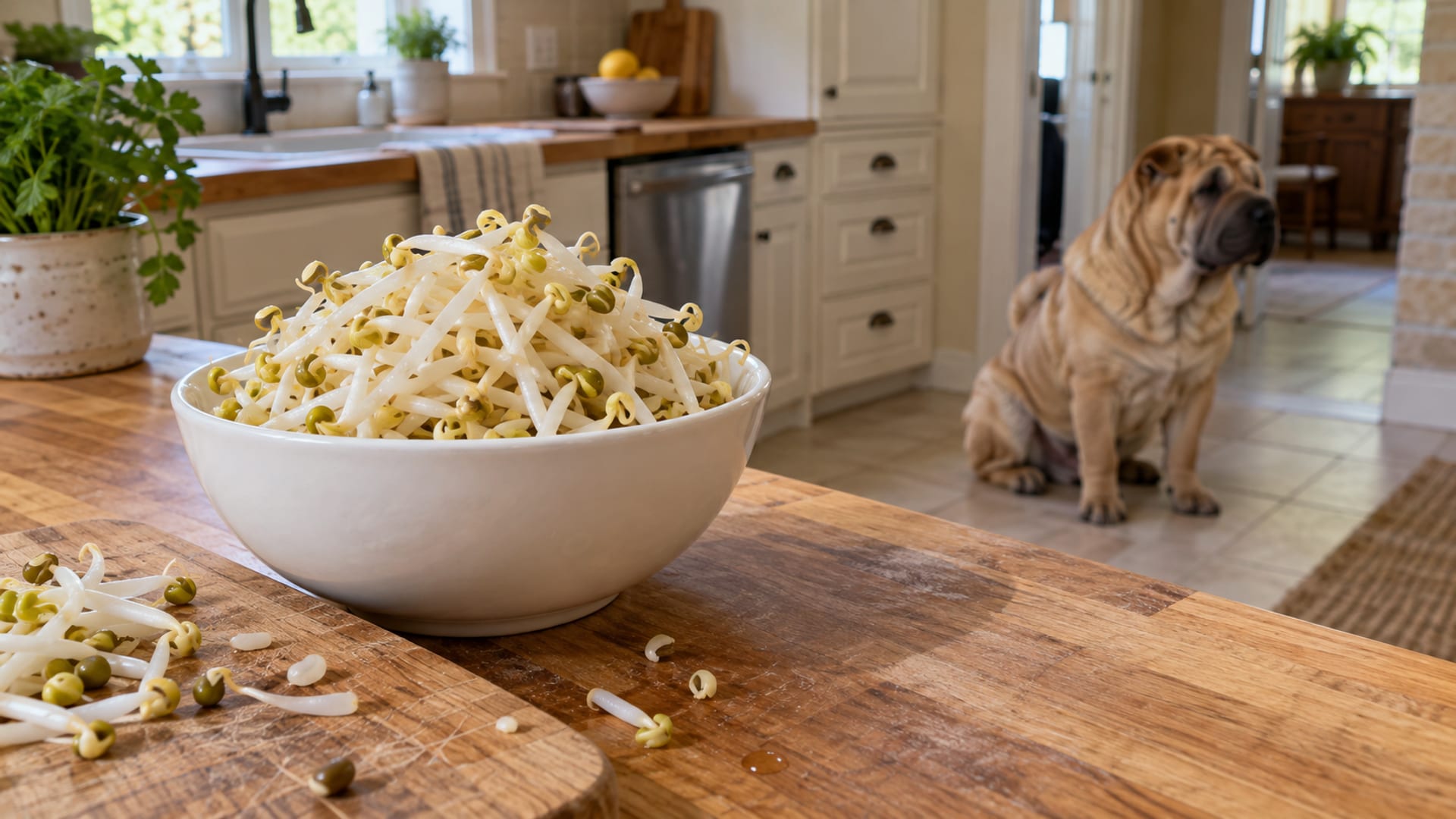
Yes, in small amounts. Plain mung bean sprouts are not a known dog poison, and the ASPCA does not list them as toxic to dogs; the concern with raw sprouts is bacteria such as Salmonella, and plain sprouts cooked until steaming hot are the safer form.
If your dog just pulled a few strands out of a salad, a sandwich or a ramen bowl, the usual plan is to watch for stomach trouble over the next few days. Two things change that plan: what else was in the dish, and whether the package has been recalled.
Key takeaways
Tap a card to bring it forward.
- Plain mung bean sprouts are not a known dog poison; the worry with raw sprouts is bacteria such as Salmonella.
- Sprouts cooked until steaming hot and served plain are the safer way to share them.
- Onion, garlic, chives and salty sauces in the dish can be a bigger problem than the sprouts.
- Salmonella illness usually starts 12 to 72 hours after eating contaminated food, so keep watching for a few days.
- Hold on to the package or the restaurant name in case a recall comes up.
What to do if your dog already ate bean sprouts
Work through these in order. Each one takes a minute or two, and together they tell you whether tonight is a watch-at-home night or a call to your vet.
- Figure out whether the sprouts were raw or cooked. The CDC counts raw and undercooked sprouts as the riskier choice and sprouts cooked until steaming hot as the safer one, so this tells you how closely to watch.
- Estimate how much your dog ate and when. The ASPCA asks owners to note the amount eaten whenever a pet gets into something questionable, and the time gives you a starting point for the watch window below.
- Check what else was in the dish. Stir-fries, ramen, pho and sandwiches often carry onions, garlic, chives, salty sauces or fatty toppings, which the ASPCA lists as hazards of their own, so if any of them were on the plate, call your vet.
- Keep the package or the restaurant name. Sprout recalls and outbreak notices from the FDA name specific growers and products, and a match with a recall is a reason to call your vet now instead of waiting for signs.
- Write down the time and start watching. Signs from contaminated food can take a day or more to appear, so a dog who seems fine an hour later still needs an eye on him for the next several days.
For a healthy dog that ate a small amount of plain sprouts and is acting normally, watching at home is a reasonable plan. If the dish had risky ingredients, the amount was large, or your dog starts to look sick, that is when your vet should hear about it.
Which sprouts and forms carry less risk
In most US grocery stores and restaurants, "bean sprouts" means mung bean sprouts, the young seedlings of *Vigna radiata*. The USDA Agricultural Research Service describes mung bean as the most common sprout on the market, and the NCBI Taxonomy Browser files the plant under that same scientific name. You may also see it sold as moong or green gram sprouts.
The concern with sprouts comes from how they are grown. Warm, moist, nutrient-rich conditions produce the sprouts and can also let bacteria multiply. In a major sampling study, the FDA found Salmonella on 2.35% of tested seed samples and in 0.21% of finished sprout samples. Those are food-production results, and they tell you most samples tested clean while some did not. A study indexed on PubMed by Keene and colleagues tied raw mung bean sprouts to Salmonella Enteritidis outbreaks in people, and the FDA's guidance on seed for sprouting traces contamination back to the seed itself.
Tap or hover a row to highlight it.
| Form | What to know |
|---|---|
| FormPlain mung sprouts cooked until steaming hot | What to knowThe safer form to share, in a small amount |
| FormRaw mung sprouts | What to knowCan carry Salmonella, Listeria or E. coli; watch for stomach signs |
| FormLightly cooked or just warmed sprouts | What to knowStill counted as undercooked, so treat them like raw |
| FormSprouts from stir-fry, ramen, pho or a salad | What to knowCheck the dish for onion, garlic, chives, salt and fatty sauce |
| FormCanned sprouts, powders, juices, capsules, extracts | What to knowNo known safe amount for dogs; read the label for salt and seasoning |
| FormSeeds meant for sprouting | What to knowCan carry contamination; keep them away from your dog |
| FormDry, uncooked mung beans | What to knowA different food; hard beans swallowed whole can cause choking or an upset stomach |
How to share bean sprouts if you want to
There is no published serving size for bean sprouts by dog weight, so think of it as a small taste. A few strands mixed into dinner or offered as a single bite is plenty.
Cook them plain until they are steaming hot, which is the form the CDC lists as safer than raw or undercooked sprouts. Leave out onion, garlic, chives, soy sauce and other salty sauces, spicy seasoning and oily toppings. That usually means setting a few sprouts aside before they go into the family stir-fry. Let them cool, and for a small dog, cut long strands into short pieces so they go down as a bite instead of a tangle.
A few dogs should skip the extra. Dogs with a weakened immune system or a serious illness may have a harder time with a foodborne infection, and a dog on a prescription or therapeutic diet should not get new foods without your vet's okay, as the ASPCA advises for people food in general.
Signs to watch for over the next few days
Most dogs that eat a small amount of sprouts show nothing at all. If the sprouts were contaminated, the signs are mostly in the gut: vomiting, diarrhea, belly discomfort, fever, a smaller appetite, low energy and dehydration.
Timing matters here. The FDA says Salmonella illness usually begins 12 to 72 hours after eating contaminated food and usually lasts four to seven days. That timing comes from Salmonella, and it can vary with the germ involved and with the dog. A severe infection can bring bloody diarrhea, a hospital stay, or rarely death, though that is not the expected result of a small bite.
Call your vet promptly if you see any of these:
- vomiting more than once, or diarrhea that keeps going or has blood in it
- marked tiredness, weakness or collapse
- fever, belly pain or signs of dehydration
- stumbling, shaking or other changes in how your dog moves or acts
- trouble breathing
Call right away, before any signs show up, if the sprouts came from a recalled product, if your dog ate a large amount, if the dish had onion, garlic, chives, alcohol, xylitol or a lot of salt, or if what your dog ate was an unknown plant or seed sold as a "bean."
My dog ate bean sprouts before and was fine
That happens, and it is a real result. It just does not make sprouts safe for every dog every time, and the reasons are specific.
The amount may have been small, or that batch may have been clean; the FDA's sampling found contamination in some samples and not in most. The sprouts may have been cooked, which lowers the risk. They may have been a different sprout, since mung, soybean, alfalfa, broccoli and lentil sprouts are different plants from different growers. The dog matters too: age, immune health and any illness change how a body handles a germ. And Salmonella signs can show up 12 to 72 hours later, which is easy to miss if nobody connects Tuesday's diarrhea with Sunday's leftovers.
So, a past plate of sprouts that went fine tells you about that plate and that dog. It does not tell you what a raw handful from a different package will do.
Other sprouts, seeds and plants called beans
The word "sprout" and the word "bean" cover a lot of different plants, and a few of them matter for this question.
Soybean sprouts come from *Glycine max*, a separate plant from mung bean. Treat them with the same raw-sprout caution. Edamame is the soybean itself and has its own entry.
Alfalfa sprouts come from *Medicago sativa*, which is not a bean at all. Raw alfalfa sprouts have their own history of foodborne illness outbreaks, and the same raw-versus-cooked caution applies.
Broccoli, radish, clover, lentil and pea sprouts are separate plants. What holds for mung bean sprouts does not automatically carry over, so check the specific plant before sharing.
Home sprouting seeds are the start of the contamination chain. The FDA's guidance on seed for sprouting focuses on the seed because bacteria can ride in on it, so a dog that gets into the sprouting jar or the seed bag should get the same watch as one that ate raw sprouts.
**Brussels sprouts** are a cabbage relative, *Brassica oleracea*, and unrelated to bean sprouts. Cooked beans and black beans are also separate foods with their own entries.
Precatory bean, also called rosary pea, lucky bean or love bean, is *Abrus precatorius*. Pet Poison Helpline describes it as a highly toxic plant that contains toxalbumins, and it has nothing to do with the mung bean sprouts in your fridge. Castor bean, *Ricinus communis*, contains ricin and is also unrelated. If your dog chewed on seeds from an ornamental plant or a piece of seed jewelry, call your vet right away.
Check what you learned
Three quick questions to lock in the parts that matter tonight.
Quick check
Questions about dogs and bean sprouts
These are the questions owners ask most after the first one.
Can puppies eat bean sprouts?
The same rules apply: plain, cooked until steaming hot, and only a taste. A puppy's small size means a handful is a bigger exposure for him than for a grown dog. If your puppy is on a special diet or has any health problem, ask your vet before adding new foods.
Are canned bean sprouts okay for dogs?
Canned sprouts may come with added salt or seasoning, so read the label before sharing any. If your dog helped himself to a can, note the amount, check the ingredients, and call your vet if the amount was large, the liquid was heavily salted, or signs show up.
Can dogs eat dry mung beans?
Dry mung beans are a different food from the sprouts. Plain, properly cooked mung beans are not on the ASPCA's list of toxic plants, but hard, dry beans swallowed whole can cause choking or an upset stomach. Keep the bag of dry beans out of reach.
Can my cat eat bean sprouts too?
The raw-sprout bacteria concern is the same for cats, and there is no separate cat-specific toxin named for bean sprouts. Cooked and plain is still the safer form, and the same signs are worth watching for.
Sources
Checked September 25, 2026.
- ASPCA, Toxic and Non-Toxic Plant List, Dogs
- ASPCA, People Foods to Avoid Feeding Your Pets
- CDC, Safer Food Choices
- FDA, FDA Concludes Major Sampling Study of Sprouts
- FDA, Guidance for Industry: Reducing Microbial Food Safety Hazards in the Production of Seed for Sprouting
- FDA, Outbreak Investigation of Salmonella: Sprouts
- USDA Agricultural Research Service, Sprouts
- NCBI, Taxonomy Browser, Vigna radiata
- PubMed, Keene et al., Salmonella infections associated with mung bean sprouts
- Pet Poison Helpline, Precatory Bean