
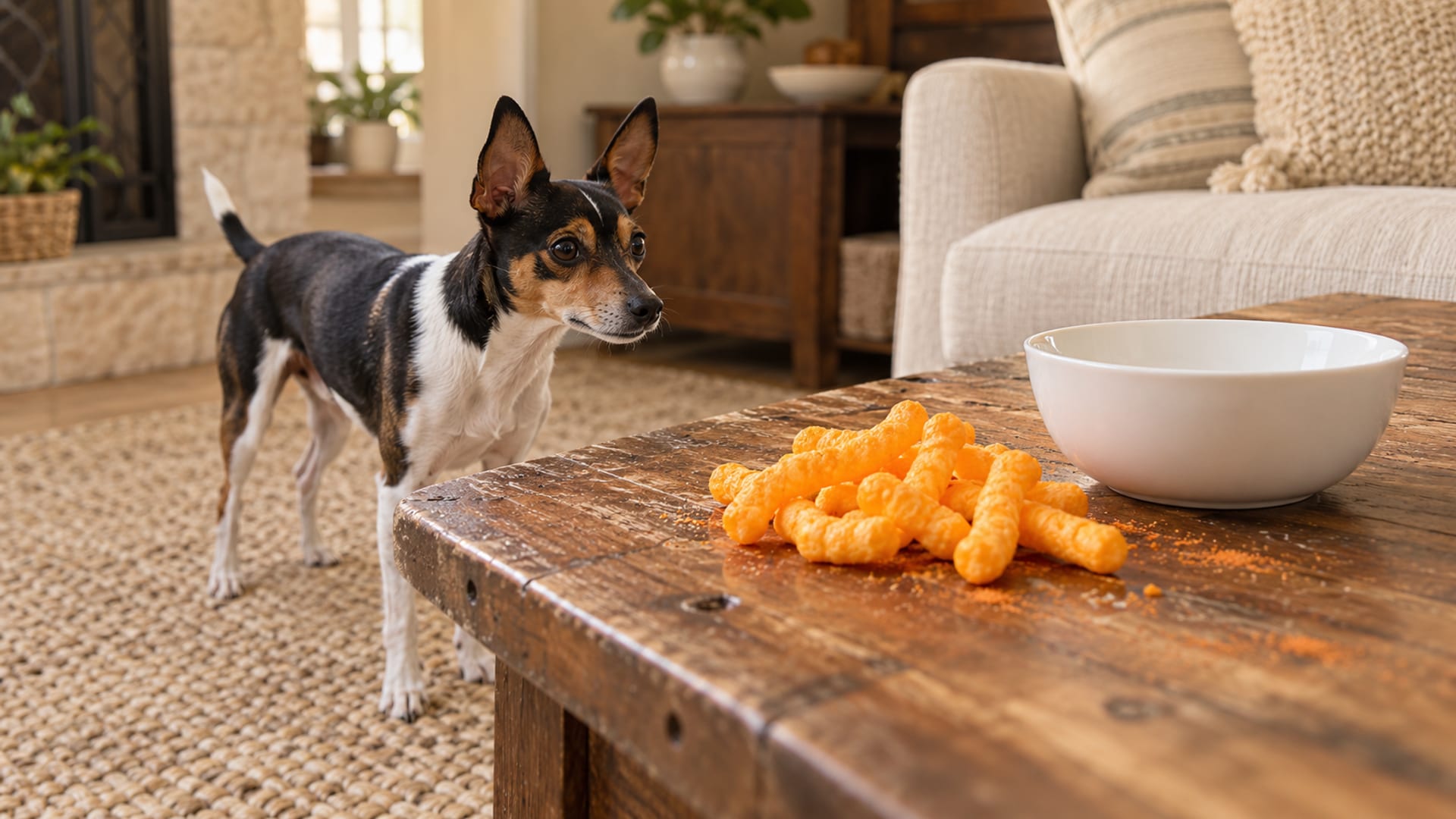
Caution. One Cheeto or a few crumbs is usually low concern for a healthy dog, while a large or unknown amount matters because of the salt and, to a lesser degree, the fat. The Merck Veterinary Manual explains that too much sodium chloride can cause salt toxicosis in dogs, so the size of the helping matters.
If your dog already ate some, start with water and a few facts. Put down a full bowl of fresh water, find the bag, and work out roughly how many are gone and when it happened. A crumb or one piece usually just means watching your dog today. A whole bag, a small dog that ate a lot, a dog with no water nearby, or any vomiting, heavy thirst, wobbliness or tremors means calling your vet or a pet poison line now.
Key takeaways
Tap a card to bring it forward.
- A crumb or a single Cheeto is usually low concern for a healthy dog; the amount compared with your dog's size is what changes the answer.
- Salt is the main problem with a big helping, and the fat and spicy seasonings can upset the stomach too.
- Fresh water matters, because going without water makes salt harder on a dog.
- Salt-related signs usually show up within about 12 hours, so a dog that seems fine right away still needs watching.
- Keep Cheetos as a human snack; there is no amount that works as a regular dog treat.
What to do if your dog already ate Cheetos
Work through these in order; together they give your vet or the poison line what they will ask for.
- Move the bag and any leftovers out of reach. A dog that found one open bag will go back for the rest.
- Put out fresh water and let your dog drink. The Merck Veterinary Manual names water restriction as an important factor in salt toxicosis, so don't leave your dog shut in a crate or room without it.
- Read the package. Note the exact product, such as Crunchy, Puffs, Flamin' Hot or Cheddar Jalapeño, and look for onion or garlic on the ingredient list, because the ASPCA warns that larger onion and garlic exposures can damage red blood cells.
- Estimate how much and when. A few pieces, half a bag or the whole bag, plus the time it happened and your dog's weight, is the core of any conversation with a vet.
- Leave the home remedies alone. The ASPCA's advice on inducing vomiting warns that salt, an old home trick to cause vomiting, can itself cause life-threatening toxicity, and with Cheetos salt is already the problem.
- Call if the amount is large or unknown, or if any signs start. The ASPCA Animal Poison Control Center asks owners to contact a veterinarian or a poison line right away when they think a pet ate something harmful. For a serious salt exposure, Merck describes vet care that checks hydration and electrolytes and corrects sodium and water balance slowly.
Which Cheetos and forms matter most
The Cheetos name covers a whole shelf of snacks, and each one has its own recipe. The Cheetos product page for Crunchy lists that one flavor; the label that counts is on your bag, since seasoning, sodium, fat and spice vary from product to product.
Tap or hover a row to highlight it.
| What your dog got into | Level of concern | Why |
|---|---|---|
| What your dog got intoA lick, crumb or single piece | Level of concernUsually low in a healthy dog | WhyVery little salt or fat reaches the dog |
| What your dog got intoA handful of Crunchy or Puffs | Level of concernCaution, depends on the dog's size | WhySalt and fat add up faster in a small dog |
| What your dog got intoFlamin' Hot, Cheddar Jalapeño or another spicy flavor | Level of concernCaution | WhySpicy seasoning can irritate the stomach on top of the salt |
| What your dog got intoCheeto dust or the crushed bits at the bottom of the bag | Level of concernCaution, more so with a larger amount | WhyThe same ingredients are packed tighter by weight |
| What your dog got intoA whole bag or an amount you can't pin down | Level of concernCall your vet or a poison line | WhyThe product's sodium and your dog's weight decide the risk |
| What your dog got intoA flavor with onion or garlic on the label | Level of concernMention it on the call | WhyA separate concern for red blood cells |
Flamin' Hot and Cheddar Jalapeño can bring more stomach irritation because of their seasonings, but the salt and the total amount still matter most. If your dog went after actual peppers rather than the snack, the jalapeños entry covers that separately.
How much is too much for your dog's size
The first half of this question is whether to share any, and I'd leave Cheetos out of your dog's bowl entirely. The ASPCA's page on foods you can share separates snacks that suit pets from processed human foods that are high in salt or fat, and Cheetos sit firmly in the second group. Preparing them differently doesn't remove the sodium, fat or seasoning.
The second half is how much of an accidental snack should worry you. The same ten Cheetos give a small dog a much larger dose per kilogram than they give a big one. The Merck Veterinary Manual gives salt figures for dogs.
Tap or hover a row to highlight it.
| Merck figure | Amount of salt per kilogram of body weight | What it tells you |
|---|---|---|
| Merck figureClinical signs of salt toxicosis can appear | Amount of salt per kilogram of body weightAbout 2 to 3 g | What it tells youWhy a large amount in a small dog is worth a call |
| Merck figureAcute oral lethal dose | Amount of salt per kilogram of body weightAbout 4 g | What it tells youWhy vets treat big salt exposures as urgent |
These figures are for salt itself. They can't become a Cheetos count without your bag's exact sodium, and they aren't meant as a cutoff for deciding at home. If your dog ate more than a few pieces, call and give your dog's weight, the product name and the amount.
Some dogs deserve a lower bar for calling. Puppies may be more prone to dehydration and tend to gulp snacks fast. Dogs with kidney disease may have a harder time regulating fluid and electrolytes, so any real exposure is worth a vet's advice. Dogs with a history of pancreatitis shouldn't get fatty table snacks at all; a 2022 review in the Journal of Veterinary Internal Medicine lists high-fat diets, unusual foods and table scraps as possible risk factors, while noting that cause and effect are hard to pin down.
Signs to watch for over the next 12 hours
Keep your dog close tonight. According to Merck, vomiting in dogs shows up within several hours after too much salt, and the ASPCA says salt-related signs usually appear within 12 hours.
Watch for these:
- drinking and peeing much more than usual
- vomiting or diarrhea
- acting unusually flat, quiet or weak
- wobbling, stumbling or poor coordination
- muscle tremors or seizures
Any of these after Cheetos is a reason to call. A small helping is not expected to cause the worst outcome, but after a large enough salt exposure, Merck describes severe sodium imbalance that can lead to brain and nerve injury, seizures, coma or death.
My dog ate Cheetos before and was fine
That happened, and plenty of dogs have cleaned up a dropped bag and slept it off. It still isn't a rule for the next time or the next dog, because what decides the outcome changes each time.
- The amount. A crumb, a handful and a whole bag are very different doses.
- The dog's size. The same number of Cheetos lands much harder on a small dog.
- Water. A dog that could drink freely afterward had a factor on its side that a crated or shut-in dog doesn't.
- The product. Flavors differ in sodium, fat and seasoning.
- The dog's health. Kidney disease or past pancreatitis can raise the risk for one dog and not another.
- Timing. Signs can take several hours and often show within 12, so a dog that looked fine at bedtime wasn't in the clear yet.
Cheese puffs, Cheeto dust and other look-alikes
Generic cheese puffs, cheese curls and cheese balls resemble them, but their formulas differ too. Cheeto dust, the orange powder on fingers and at the bottom of the bag, is more concentrated by weight than a single curl. Cheetos-flavored popcorn is its own product with its own ingredients; the popcorn entry covers the plain kind.
Cheetos are also a different question from real cheese, plain cornmeal or a cheese-flavored treat made for dogs. For other salty crackers or chips, the entries on Cheez-Its and BBQ chips follow the same salt and seasoning logic.
Onion powder or garlic powder brings its own concerns, covered in the onions and garlic entries, and xylitol or caffeine on a label would be a separate and more urgent problem. At parties and game days, the ASPCA's game-day tips point to salt, onion and garlic as the snack-table risks.
Check what you learned
Three quick questions on what matters tonight.
Quick check
Questions about dogs and Cheetos
Owners often ask these once the first worry passes.
Do Cheetos give a dog any nutrition?
They supply calories, carbohydrate, fat and a little protein. They aren't a complete or balanced food for dogs, though, and they offer little practical benefit compared with a treat made for dogs.
My cat got into the Cheetos too. Does the same apply?
The salt hazard applies to cats as well. The ASPCA lists salty foods as a risk for pets in general, and the Pet Poison Helpline food guide includes salt toxicity for both dogs and cats. Call your vet with the amount and your cat's weight.
My dog has had pancreatitis before. Does a single Cheeto matter?
Fatty table snacks are best kept away from a dog with that history. A 2025 review in the Journal of the American Veterinary Medical Association found the link between dietary fat and pancreatitis in dogs isn't straightforward, which is exactly why your own vet's read on your dog matters. If your dog got a few, tell your vet, and watch for vomiting.
How long until my dog is back to normal?
The ASPCA says recovery from salt toxicity is expected within 24 to 72 hours when it's managed appropriately. If signs appeared, follow your vet's plan for the days after.
Why is my dog drinking so much after eating Cheetos?
The ASPCA notes that salty snacks can bring on more thirst and urination. Keep the bowl full. Heavy, nonstop thirst after a big helping is a sign to call.
Sources
Checked September 25, 2026.
- Merck Veterinary Manual, Salt Toxicosis in Animals
- ASPCA Animal Poison Control Center, People Foods to Avoid Feeding Your Pets
- ASPCA, Have a Pet-Safe Super Bowl Sunday with These Tips
- ASPCA, Is It Ever Safe to Induce Vomiting?
- ASPCA, Sharing is Caring: Foods You Can Safely Share with Your Pet
- Cheetos, CHEETOS Crunchy Cheese Flavored Snacks
- Journal of Veterinary Internal Medicine, Cridge et al., 2022, etiology, risk factors and pathogenesis of pancreatitis in dogs
- Journal of the American Veterinary Medical Association, High fat, high risk? Evaluating the strength of evidence linking dietary fat and pancreatitis in dogs
- Pet Poison Helpline, Toxic & Hazardous Food Guide for Pets