
North Carolina Boarding Kennel License: Who Needs One, the $75 Fee and Inspections
By Cal Hewitt · Published
Business guides
If you take dogs or cats for a fee and keep them overnight, you generally need a boarding kennel license from the NCDA&CS Animal Welfare Section, and that includes paid boarding in your own home. The state fee is $75 for each license year (July 1 through June 30).
You have to apply, pass a Facility Compliance Inspection and receive the license before any client dog stays with you. A pending application is not permission to board. Zoning, wastewater, building, fire, tax and insurance are separate questions with separate offices, so make those calls before you sign a lease or take your first booking.
Key takeaways
Tap a card to bring it forward.
- Paid in-home boarding needs the NCDA&CS boarding kennel license, the same as a kennel building.
- The fee is $75 for each license year or part of one that begins July 1; licenses expire June 30.
- No client dogs until the application is in, the inspection is passed and the license is in your hands.
- Operating without a valid license is a Class 3 misdemeanor, and each day counts as its own offense.
- Senate Bill 275 (the "small kennel" bill) has not become law; the six-dog threshold is not current law.
- Planning, wastewater and fire or building offices decide separate things; call them first.
Do you need the license if you board dogs in your home?
Yes. The Animal Welfare Section says the boarding requirement applies to in-home boarding, including services you advertise through online pet-service companies and other online listings. G.S. 19A-28 requires a license before you operate a boarding kennel, and a dog sleeping on your couch for pay counts the same as a dog in a run.
I know that is not the answer a lot of home-based sitters hope for. The useful way to read it is as a planning step: the license is a known list of things to fix and prove, and a few of them (running water, food storage, alarms) are things many homes can meet with small changes.
Not everything you do with dogs lands in this category. Occasional boarding that is not a business is treated differently under G.S. 19A-37, and a private breeding kennel is not automatically a boarding kennel. The state points those situations toward local animal control or law enforcement rather than the boarding license. If your setup sits in a gray area, call the Animal Welfare Section and describe exactly what you do. They decide, not me and not a forum thread.
There is no single generic business license in North Carolina that covers every requirement, either. The state boarding license is one piece, and your city or county has its own.
What does the license cost, and when does it renew?
The fee is $75 for each fiscal-year license period or part of one that begins July 1. Animal Welfare licenses expire June 30, and the Animal Welfare Section page gives June 16 as the renewal deadline for sending renewal materials and fees. If you open in the spring, you still pay for the period you are in, so plan your start date with the July 1 cycle in mind.
Tap or hover a row to highlight it.
| Item | Figure | Source |
|---|---|---|
| ItemState license fee | Figure$75 for each fiscal-year period or part of one beginning July 1 | SourceG.S. 19A-28 |
| ItemLicense period | FigureJuly 1 through June 30 | SourceNCDA&CS licensing page |
| ItemRenewal deadline | FigureJune 16 | SourceNCDA&CS Animal Welfare Section |
| ItemDeath or escape notice | FigureWithin 48 hours | Source02 NCAC 52J .0102 |
| ItemRecord retention | FigureOne year after release | Source02 NCAC 52J .0103 |
| ItemCleaning | FigureAt least twice daily | Source02 NCAC 52J .0207 |
| ItemCivil penalty | FigureUp to $5,000 per violation | SourceG.S. 19A-40 |
Confirm the current fee and deadline with the Animal Welfare Section before you mail a check. How much you charge your own clients is a separate question; see dog service prices in North Carolina.
What should you do before you apply?
Order matters here, because the state license will not rescue a property the city will not allow. The safest sequence is:
- Describe the proposed use to city or county planning and ask whether paid dog boarding is allowed at that exact address.
- Ask about wastewater and building requirements.
- Speak with an NCDA&CS Animal Welfare Section inspector, which the application itself tells you to do before you submit.
- Prepare the facility and your records.
- Submit the application and fee.
- Pass the inspection.
- Receive the license before housing client dogs.
If the building is not yours, do steps 1 through 3 before you sign the lease. A signed lease on a property that fails zoning or cannot take kennel wastewater is the expensive version of this mistake. Also check deed restrictions, your lease language and any homeowners association rules, since those can bar a dog business no matter what the state allows.
What does the application ask, and why is a pending application not permission to board?
The boarding kennel application asks for your facility name and physical address, county and contact information, owner and mailing information, public hours and days, cleaning times, the number of dog and cat enclosures, and the maximum number of dogs and cats on site. The owner or an authorized agent signs it. An application that requires a fee is mailed with the check.
After that comes the Facility Compliance Inspection. Corrections, if needed, come before the license. NCDA&CS states that you must submit the application and fee, pass the inspection and receive the license before housing dogs or cats. So, a "yes, I applied" is not a defense if a client's dog is already sleeping in your spare room. Ask your inspector for the current timeline and do not promise clients an opening date until the license is issued.
When you fill in the maximum animal count, use a number your space can truly handle under the standards below. That count goes on the application, and it is the number you will be held to.
What do inspectors check under 02 NCAC 52J?
The facility standards are in 02 NCAC 52J. Read them before you buy a single kennel run, because most of them are about water, food, fire and cleaning, not fancy buildouts. The rules include:
- Food and bedding: protected from infestation and contamination. Open food bags and edible treats go in airtight containers with lids, and perishable food, including opened cans, is refrigerated.
- Water and temperature: hot and cold running potable water, and a working room thermometer in each separate indoor enclosure, common area and exercise area.
- Waste and drainage: daily removal of animal waste, food waste, soiled bedding and debris, with drainage that prevents standing water and keeps animals dry.
- Outdoor access: a separate five-foot perimeter fence where dogs have unsupervised outdoor access, or direct supervision where the yard lacks that fence.
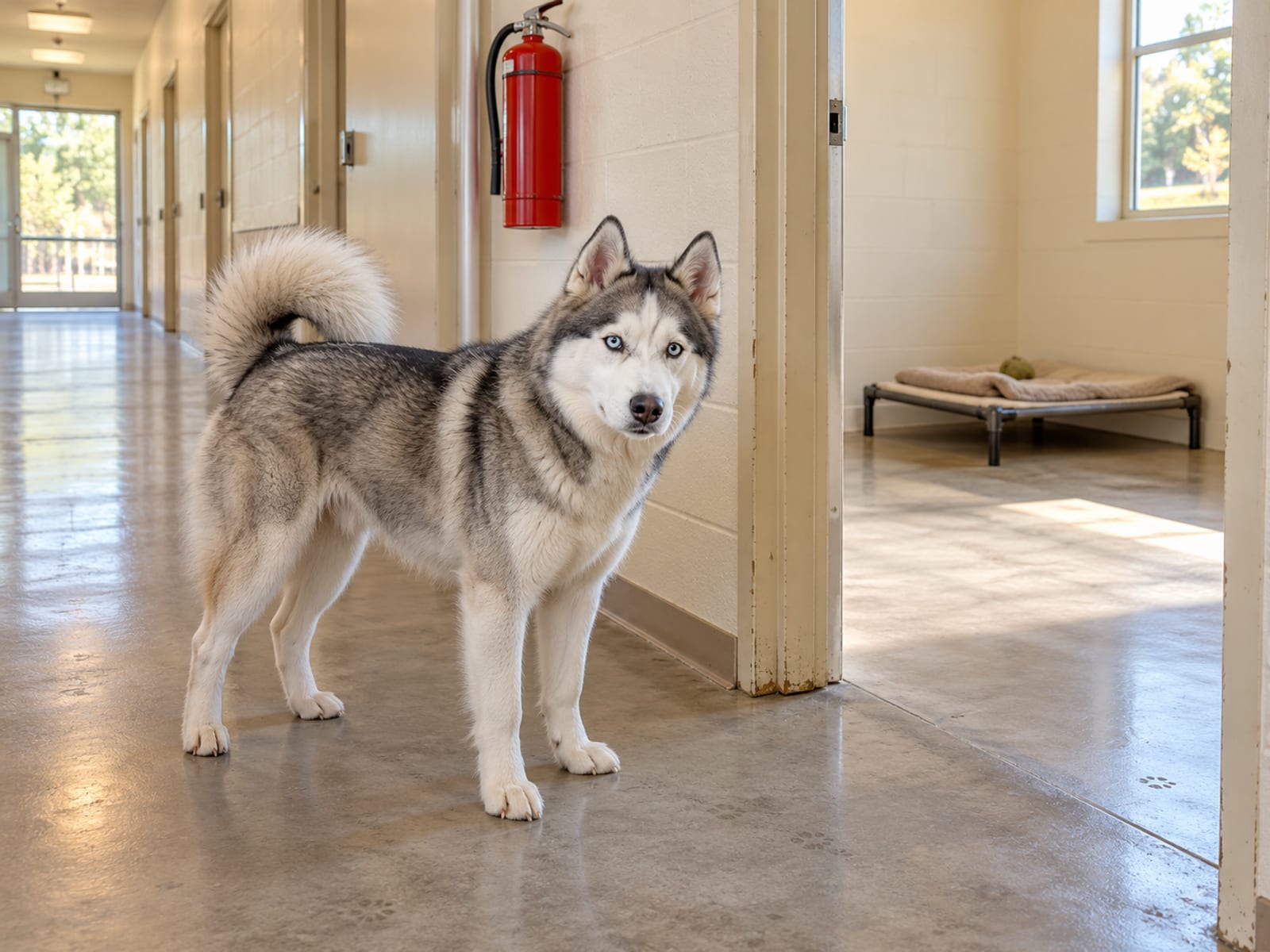
- Fire and safety: working smoke and carbon-monoxide alarms, and fire suppression such as functional fire extinguishers or a sprinkler system.
- Emergency planning: a continuity-of-care or evacuation plan. The NCDA&CS boarding application requires a written disaster plan under 02 NCAC 52J .0201(r), so write it down before inspection day. If you are on the coast or anywhere hurricanes reach, think through where the dogs go and how you reach their owners.
- Cleaning: enclosures and exercise areas cleaned at least twice daily, and food and water receptacles sanitized daily.
- Enclosures: large enough for the animal to stand, sit, lie down, turn around and move naturally, and safe against escape.
- Separation: animals from different owners kept apart unless the owners give written permission for contact.
- Access: the facility and records open for review during normal business hours, 8:00 a.m. to 5:30 p.m., Monday through Friday.
Walk your property with this list in hand. The places homes most often come up short are the obvious ones: no thermometer, food left in the open bag, a yard fence that is lower than five feet, a missing carbon-monoxide alarm, no written emergency plan. Fix those and ask your inspector to flag anything specific to your site.
What records do you keep, and when must you report an incident?
Keep an intake and release record for each dog or cat, and a record of any veterinary care given while the animal is with you. Keep an incident file for illness or injury that needs veterinary care, for a death and for an escape. You must notify the Animal Welfare Section within 48 hours after an animal dies or escapes. Records are kept for one year after release, and they must be available during the listed business hours or on inspection, under 02 NCAC 52J .0102 and .0103.
A simple binder or a shared folder works if it is organized. Intake forms that capture the owner's contact details and the dog's description, plus vaccination records, make the first inspection and the first bad day much easier. For rabies requirements, see the related business guides on this site rather than guessing.
What are the penalties for operating without a license?
G.S. 19A-33 makes operating a kennel without a currently valid license a Class 3 misdemeanor, with each day of operation treated as a separate offense. The statute states a fine of $5 to $25. Separately, G.S. 19A-40 lets the Director assess a civil penalty of up to $5,000 for a violation of the Article or of rules adopted under it.
That is the cost of a casual start. A few weeks of paid boardings before the license is issued can be counted day by day. If you already board a few dogs without a license, I would not wait for a complaint: call the Animal Welfare Section, say where you are and ask what to do next. I can't tell you how they will respond to your situation, and I am not a lawyer, so this is exactly where to ask the office.
Do veterinary boarding rules and Senate Bill 275 change anything?
Two things get mixed up here, and they are separate from your NCDA&CS license.
First, the NC Veterinary Medical Board adopted boarding kennel rules in 21 NCAC 66, effective January 1, 2025. They apply to boarding kennels that operate under a veterinary facility permit, meaning boarding tied to a veterinary facility. The Board's facilities page lists a veterinary facility permit with a boarding kennel permit at $225, compared with $150 for a veterinary facility permit without boarding. These rules grew out of S.L. 2023-63. They do not replace the NCDA&CS license for an ordinary stand-alone boarding kennel or an in-home sitter, and that license stays with the Animal Welfare Section.
Second, Senate Bill 275, titled "Deregulate Small Boarding Kennels," was filed in the 2025 to 2026 session. As filed, it proposed redefining a boarding kennel as a facility that regularly boards six or more dogs or cats for a fee, with an October 1, 2025 effective date. It did not become law. Its last recorded action was a referral to the Senate Rules and Operations Committee on March 13, 2025. Today, the six-animal threshold is a proposal, not an exemption you can rely on. If it moves, the bill page will show it, so check the page before you plan around it.
Where does kennel wastewater go, and will zoning allow your site?
Wastewater surprises people, so ask early. NCDA&CS classifies kennel wastewater as industrial process wastewater, which must go to a wastewater system approved by the North Carolina Department of Environmental Quality. For a septic system with a drainfield, contact your county health department's Environmental Health Section; per the NCDA&CS licensing page, local health departments use state-approved design criteria that address kennel waste. For anything other than septic, such as a land-surface application system, the contact is the regional office of the NCDEQ Division of Water Resources. Before you lease, ask whether that parcel and your planned number of dogs can be permitted.
Zoning is decided city by city and county by county, and the three big cities show how different the answers can be:
- Charlotte: its home-business guidance lists kennels among prohibited home businesses, and defines a commercial kennel as a use for breeding, storage, training or overnight boarding of animals for people other than the occupant. A commercial kennel is a different use from an ordinary home occupation.
- Raleigh: a home occupation happens wholly inside the dwelling and does not allow nonresident employees or visiting clients. A live-work use does allow customers to visit. A business taking dogs at the property needs a site-specific classification from Raleigh planning.
- Durham: a home occupation permit is required in certain cases, including property in Durham County outside city limits and city businesses that do not qualify as no-impact home businesses. The criteria look at clients, traffic, visibility, outside storage and where the business activity happens.
When you call your planning office, ask these questions:
- Is paid dog boarding allowed at this parcel?
- Is it a commercial kennel, a home occupation, a live-work use or something else?
- Do I need a zoning-use permit, special-use approval, a site plan or a change of use?
- Are there limits on animal counts, parking, noise, setbacks, fencing, drainage or hours?
- Do county rules differ from city rules?
If the property is in a city, call the city planning department; outside city limits, call the county. Also ask the local animal-control office about its own rules, including any local dog-count limit. Ask for the answer for your specific address and the number of dogs you plan to board.
What about business registration, tax and insurance?
Those are real steps, but they are not part of the NCDA&CS license. The North Carolina Secretary of State handles entity registration, the IRS handles the EIN and federal tax questions, and the NC Department of Revenue handles sales-and-use-tax registration where it applies (the state says registration has no application fee). Whether sales tax applies to your boarding, daycare, grooming or retail add-ons depends on exactly what you sell, so ask the Department of Revenue or a tax professional about your service menu. Insurance is also its own conversation with an insurance professional.
For the broader rules, see North Carolina dog business license requirements.
Questions people ask about North Carolina boarding kennel licenses
These short answers each point back to the office that decides.
Can I board dogs in my home?
Yes, once you hold the NCDA&CS boarding kennel license and your address allows the use. Paid in-home boarding is covered by the license, and local zoning or lease rules may still limit it.
How many dogs can I legally have?
North Carolina's boarding rules set standards for space and care, and your application states the maximum number of dogs and cats on site. A parcel-specific limit, if any, comes from your city or county, so ask planning and animal control for the number that applies to your address.
Do I need a license to watch dogs in my home, and what can I charge?
If you board dogs for a fee on a regular basis, the license applies even at home. Your rates are your own decision; compare a few local rates before you set yours.
Can I board dogs while my application is pending?
No. NCDA&CS requires the inspection and the license first, so a pending application does not allow you to house client dogs.
What should you do this week?
Start with the calls, in this order. Call city or county planning about your address and the use. Call the county Environmental Health Section about septic, or the NCDEQ regional office if your system is something other than septic. Call an NCDA&CS Animal Welfare Section inspector and talk through your site. Then walk the property against the 02 NCAC 52J list: running water, food storage and refrigeration, thermometers, drainage, five-foot fencing or supervision, alarms, fire suppression, and your written emergency plan. Build your intake, release, veterinary-care and incident records. Submit the application and $75 fee, pass the inspection and wait for the license before you accept a client dog.
Once you are licensed and legal, a DogServ directory listing can help local owners find you. That comes after the compliance steps, since a listing never gives permission to operate. And if you want help with a website or marketing for a dog business, that is what we do at DogServ. If you plan to breed as well, read breeding dogs in North Carolina.
Quick check: North Carolina boarding kennel license
This page is general information, not legal, tax or veterinary advice. The Animal Welfare Section, your local planning and environmental health offices, and the other offices named above give the rulings for your situation.
Sources
- charlottenc.gov: home-business guidance
- deq.nc.gov: NCDEQ Division of Water Resources
- durhamnc.gov: home occupation permit
- irs.gov: IRS
- law.cornell.edu: 02 NCAC 52J .0102
- law.cornell.edu: 02 NCAC 52J .0103
- law.cornell.edu: 02 NCAC 52J .0207
- law.cornell.edu: 02 NCAC 52J
- ncagr.gov: boarding kennel application
- ncagr.gov: NCDA&CS Animal Welfare Section
- ncagr.gov: NCDA&CS licensing page
- ncdor.gov: NC Department of Revenue
- ncleg.gov: G.S. 19A-28
- ncleg.gov: G.S. 19A-37
- ncleg.gov: S.L. 2023-63
- ncleg.gov: Senate Bill 275
- ncvmb.org: Board's facilities page
- raleighnc.gov: home occupation
- sosnc.gov: North Carolina Secretary of State