
Hurricane Planning for Dog Businesses in North Carolina: Triggers, Destinations, Records and Reopening
By Cal Hewitt · Published
Business guides
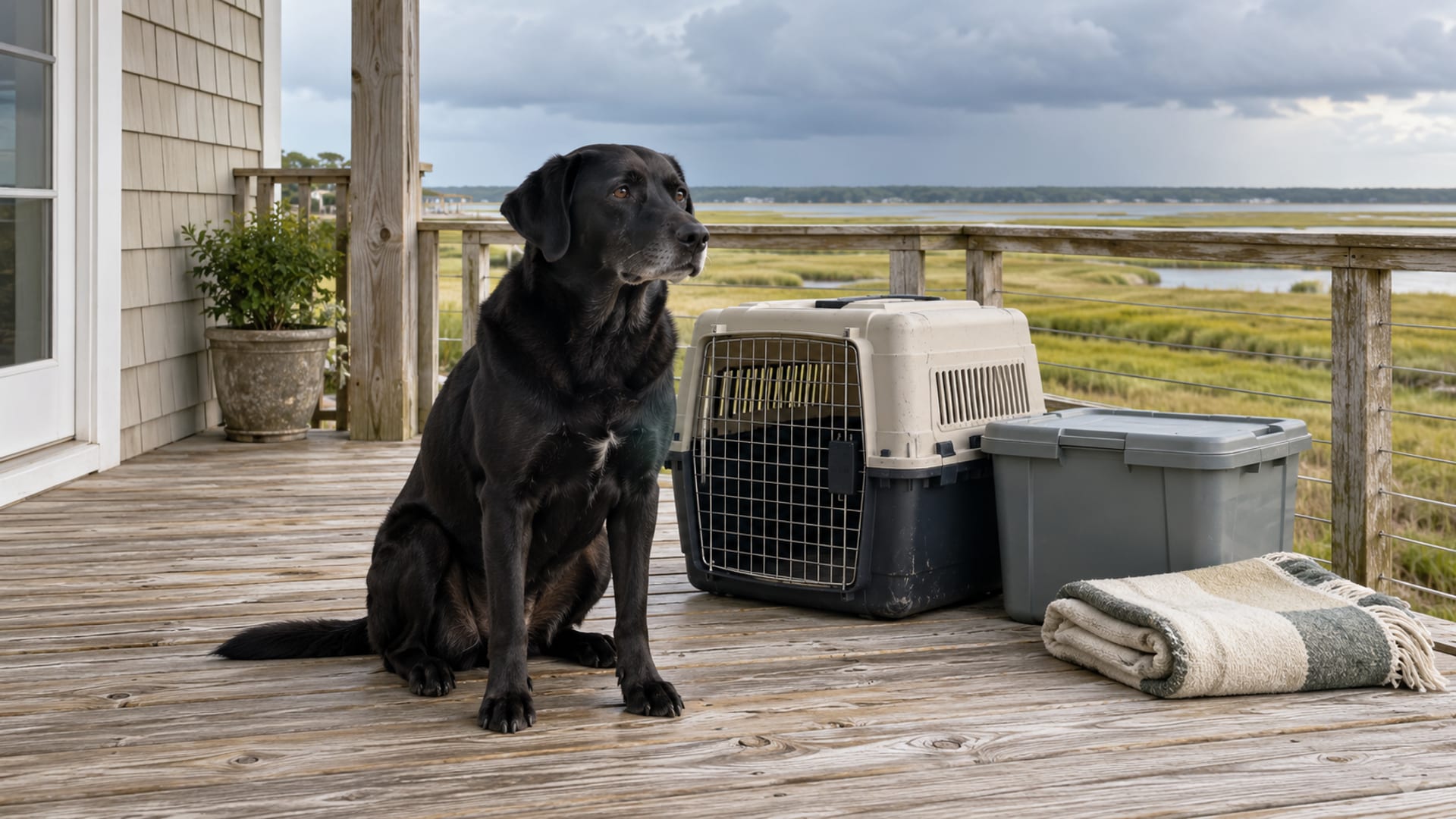
Write your storm plan before the forecast turns urgent. It should say when intake stops, when you close, whether dogs stay or move, where they go, who drives them, how many crates and vehicles you have, which records travel with each dog, how you reach owners and staff, and what you inspect before you reopen.
If your boarding facility is licensed or registered, the state already requires a written plan for the continuity of care or evacuation of animals under 02 NCAC 52J. Shelter and zoning rules differ by county and city, so confirm those locally.
I build websites and marketing for dog businesses; I am not a lawyer, a vet or a kennel owner. So, treat this as a planning checklist, and take every legal question to the office named below.
Key takeaways
Tap a card to bring it forward.
- Licensed and registered facilities must keep a written continuity-of-care or evacuation plan; the NCDA&CS boarding application cites 02 NCAC 52J .0201(r).
- Write triggers for each hazard: evacuation orders, flooding, unsafe travel, power or water loss, and winter ice.
- Name destinations only after you confirm space, dog acceptance, vaccination rules and fees; never assume a public shelter takes dogs.
- Keep at least a week of food and water per dog, plus printed and off-site digital copies of every record.
- Reopen only after a logged inspection of the building, utilities, water, temperature, ventilation, fencing and access.
What to settle this week: your service, your license and your local approvals
Start with what you actually sell, because that decides which office has a say. NCDA&CS licenses or registers animal shelters, pet shops, boarding kennels and dealers. It says the boarding-kennel license also applies to in-home boarding. The application lists a $75 fee per license period. Walking dogs, sitting in a client's home and grooming are not automatically in that same category, so ask NCDA&CS or your local animal control to classify your exact service model. The boarding-kennel definition and license authority sit in G.S. Chapter 19A, Article 3.
Local approvals are a separate question. NCDA&CS tells new boarding applicants to check city and county zoning, permitting and environmental services before they apply. Ask your city or county planning and zoning office, inspections office, environmental health office, fire marshal, animal-control office and county emergency-management office these questions:
- Does my address permit boarding, daycare, grooming or client drop-off?
- Do I need a home-occupation or change-of-use permit?
- Is there a dog-count or enclosure limit?
- Which fire, building or occupancy inspections apply?
- How must kennel wastewater be handled?
- Which county office handles pet sheltering in an emergency?
If you are still sorting out licenses, our guide to the North Carolina boarding kennel license and the one on North Carolina dog business license requirements cover that ground. This page covers the storm.
The written disaster plan North Carolina requires of licensed boarding facilities
The NCDA&CS boarding application requires a written disaster (continuity-of-care) plan under 02 NCAC 52J .0201(r). The rule text reads: "All licensed and registered facilities must develop and maintain a plan of action for the continuity of care and/or evacuation of animals in the event of a natural or manmade disaster." Read the rule text NCDA&CS publishes and keep a copy with the plan.
The rule does not hand you an itemized template, so build one that answers these points:
- Alternate housing locations and their confirmed capacity.
- Whether each destination accepts dogs from outside its county.
- Vehicles, drivers, fuel and crate capacity.
- Records, photographs, identification and owner contacts.
- Food, potable water, medication information and sanitation supplies.
- Staff assignments, backups and how you will communicate.
- Contacts for owners, veterinarians, animal control, county emergency management and NCDA&CS.
- Intake-reduction and closure triggers.
- Shelter-in-place and evacuation decision points.
- Reopening criteria and the inspection record.
- A way to account for every dog at departure, arrival, transfer and reunification.
The same rule publication sets indoor temperatures between 50°F and 85°F, with special provisions documented in the record of any animal that cannot hold its body temperature. It also calls for a working room thermometer in each indoor enclosure area, common area and exercise area, hot and cold running potable water, adequate drainage, and operational smoke and carbon-monoxide alarms with fire suppression. During an outage, assign one person to check temperature, ventilation, water, alarms, generator safety, fuel and communications on a schedule.
If you are not a licensed boarder, say a walker or in-home sitter, the rule may not bind you. The plan is still worth writing. The SBA advises assessing realistic hazards, building a plan specific to your business and practicing it with staff. Pet Sitters International standards call for documented contingency plans, backup arrangements and emergency veterinary authorization forms.
Storm hazards by region: coast, east, Piedmont, mountains and winter ice
One generic storm rule fails in a state this varied, so write triggers by hazard.
Tap or hover a row to highlight it.
| Region | Main hazards | Planning point |
|---|---|---|
| RegionCoast and east | Main hazardsTropical-storm winds, storm surge, heavy rain, river flooding, evacuation orders | Planning pointEarly closure, blocked roads, utility loss |
| RegionPiedmont and inland | Main hazardsTornadoes, flash flooding, falling trees, power outages | Planning pointInterior shelter room, road closures |
| RegionMountains | Main hazardsFlash flooding, landslides, washed-out roads, isolation, communications damage | Planning pointLimited access to vets and boarding, long outages |
| RegionAny region in winter | Main hazardsIce, snow, power loss | Planning pointStaff relief and supply delivery may stop |
ReadyNC tells people to stay off the roads during ice and snow events, warns that power may go out, and says plans should be final before the storm arrives. For a business, that means staff may not reach you and supplies may not reach you, so a winter trigger can fire on the forecast alone.
When to cut intake, when to close, and whether to stay or go
A trigger is a condition that makes the decision for you once it happens. Pick yours with your staff, write them down, and date the page. Strong candidates include:
- An official evacuation order or direction from local emergency management.
- A floodwater threat to the building, the access road or the utilities.
- Forecast conditions that make staff travel unsafe.
- Loss of power, water, ventilation or temperature control.
- Building damage, roof damage, broken fencing or unsafe debris.
- Confirmed destination capacity dropping below the number of dogs you hold.
- Loss of the communications you need to coordinate care.
- A winter forecast likely to block staff relief or supply deliveries.
Then pair each trigger with a step on a ladder: stop new intake, stop extended stays, close and send dogs home, shelter in place, or evacuate. Decide who holds the authority to call each step. When authorities order an evacuation, their direction controls, whatever your plan says.
A generator alone does not settle shelter-in-place. You still owe the dogs water, a safe temperature, ventilation, staff on site, fuel and a working way to reach people, and you need an evacuation option if any of those fail.
Alternate destinations and transport: confirmed space, dog acceptance, crates, vehicles and drivers
Name a destination only after someone there has confirmed it. Options include another licensed boarding facility, a veterinary facility, a pet-friendly hotel, private property or a county animal shelter. For each, confirm capacity, whether they take dogs, vaccination requirements, fees, staff access and an emergency contact.
Do not treat a general public shelter as a place for dogs. ReadyNC notes that some hotels and motels accept pets, but those rooms can vanish in an emergency. Shelter acceptance is set locally and can change, so ask the county emergency-management office and your animal-control office before you move any dog. Register for the county's alerts before hurricane season, since that office explains local alerts, shelter status, evacuation instructions and animal-shelter arrangements. The state's companion animal resources page is another place to start. A DogServ listing does not verify anyone's emergency capacity, so call each place yourself.
Then do the arithmetic on transport:
- One crate or safe transport space per dog where you can.
- Vehicle capacity, assigned drivers, fuel and a backup vehicle.
- Staff assigned to dogs, transport, records, communications, supplies and owner reunification.
If your dog count is greater than your crate count or your seat count, the shortfall is your answer for how early to start.
Records, identification and medication information that travel with each dog
- Several days of food in a waterproof container, and at least a week of food and water for each pet where you can manage it.
- Food and water bowls.
- Leash, harness and collar with current identification.
- A crate or sturdy carrier.
- Vaccination and veterinary records.
- Medication information and backup medication supplied by the owner.
- Owner, emergency-contact and veterinarian phone numbers.
- A current photograph and identifying description.
- Waste bags and sanitation supplies.
- A familiar bedding item, a flashlight and extra batteries.
- Paper copies in a waterproof bag, plus digital copies stored outside the affected area.
Give medication exactly as the owner or veterinarian instructs. Do not improvise treatment. Basic first-aid supplies for people and routine animal-care supplies belong in the kit, but they are not a substitute for a vet. ReadyNC also warns against letting dogs drink floodwater or contaminated water.
Get written owner permissions before storm season: who may pick up the dog, whether you may relocate it, and whom to call if the owner cannot be reached. A missing record or an unreachable owner is a bad moment to learn the form was never signed.
Owner messages and reunification, with a storm closure template
Draft your messages now and keep them where any staff member can send them. Fill in the brackets.
Storm closure:
> We are closing [business name] at [time] because of [storm, evacuation order, flooding, unsafe travel or utility loss]. Your dog, [dog's name], is currently [at the facility / being moved to a confirmed destination]. We will update you by [time or method]. Please keep your phone available and reply with any changed emergency contact information.
Relocation:
> [Dog's name] has been moved to [confirmed destination] at [time]. The receiving contact is [name and phone]. We have the following records and supplies with your dog: [list]. We will send another update by [time].
Reunification:
> We are ready to arrange reunification for [dog's name]. Please reply with your preferred pickup time and bring identification. If someone else will collect the dog, send that person's full name before arrival.
Plan a backup channel in case cell service fails, such as a phone tree, a printed contact sheet or a voicemail greeting that points to a recorded update. Keep a Spanish version of each message if your clients use one.
For each reunification, record the dog's name, the owner, the receiving person, the identification checked, the date and time, the destination, condition notes, belongings returned, outstanding charges and a signature or electronic confirmation. If a dog goes missing after a relocation, that record is where your search starts.
Hurricane Helene in western North Carolina: what it showed about roads, power and shelters
Helene shows that a hurricane plan is not only a coastal plan. NC Emergency Management reported catastrophic flooding in the western part of the state, more than 400 road closures and more than 450,000 customers without power at one point on September 30, 2024. An earlier state report from September 28 described damaged water plants, power failures, boil-water advisories and dangerous travel.
Tap or hover a row to highlight it.
| Measure | Figure | Source and date |
|---|---|---|
| MeasureRoad closures | FigureMore than 400 | Source and dateNC DPS, September 30, 2024 |
| MeasureCustomers without power | FigureMore than 450,000 | Source and dateNC DPS, September 30, 2024 |
| MeasureShelters opened | Figure54 | Source and dateNC DPS, December 20, 2024 |
| MeasureOvernight shelter stays | Figure22,847 | Source and dateNC DPS, December 20, 2024 |
NC Emergency Management later reported that many pets came to emergency shelters and that NCDA&CS helped locate, deliver and staff animal-sheltering equipment. The lesson for you is about timing. Decide beforehand:
- Whether dogs stay or move before roads become unsafe.
- Which destination has confirmed space.
- How dogs travel if roads close.
- How you will keep food, water and records going without power or normal water service.
- How owners get updates if cellular service fails.
- Who has the authority to make the move and account for every dog.
If you work in the mountains, you may be cut off from vets and boarding resources for a long stretch, so your supply target should lean toward the high end.
Reopening inspection, and the log that records each check
The storm passing does not mean you can reopen. Walk the property, check each item below, and write the result down before the first dog comes back:
- Access routes and the building's condition.
- Power, water, temperature and ventilation.
- Sanitation, and any floodwater or debris concerns.
- Fencing and gates.
- Pest or contamination concerns.
- Records recovered, and dog-by-dog status.
Your reopening log should show the inspector, date, weather event, building condition, each utility, corrective actions, and the decision to reopen or stay closed. Send owners a short note once you decide.
> We are not reopening until the building, utilities, water, temperature, ventilation, sanitation, fencing and access routes have been inspected. We will confirm the next intake time after that inspection.
Keep the log with your business records. The IRS advises backing up financial and tax records, documenting equipment and valuables, keeping copies away from the risk area and reviewing plans every year. For insurance, ask a licensed agent whether property, business-interruption, evacuation and flood risks are covered, since coverage and exclusions differ by policy.
Quick check: North Carolina storm planning for dog businesses
Questions North Carolina dog businesses ask about storm plans
Short answers follow, each pointing to the office that decides.
Does North Carolina require a disaster plan for boarding kennels?
Yes. 02 NCAC 52J requires licensed and registered facilities to maintain a continuity-of-care or evacuation plan for natural or manmade disasters. Your plan should name the triggers, destinations, transport, records, staff roles, owner contacts and reopening criteria.
Are pets usually allowed in evacuation shelters in North Carolina?
Policies vary by shelter and county, and you should not assume a general shelter takes pets. Ask the county emergency-management office and your animal-control office, and line up a pet-friendly hotel or boarding destination as a backup.
What should go in a hurricane emergency kit for pets?
Food and water for at least a week where possible, bowls, a leash and collar with identification, a crate, vaccination and medication records, owner and vet phone numbers, a current photo, waste bags and a flashlight. Keep paper copies in a waterproof bag and digital copies outside the affected area.
How do I keep a dog safe during a storm?
Move dogs to your planned shelter room or destination before travel turns dangerous, keep identification on every dog, and count them at each step. Keep dogs away from floodwater and contaminated water.
What should a storm plan for a dog daycare or boarding kennel include?
It should cover triggers for closing and evacuating, confirmed destinations, crate and vehicle capacity, drivers and staff roles, records and owner permissions, food, water and medication, power-loss and temperature checks, owner messages, and a reopening inspection log.
Your next step
Pick one afternoon this week and call two offices: your county emergency-management office, to ask how it handles pets and animal sheltering, and your city or county zoning and animal-control offices, to confirm what your address allows. Then write down your three biggest triggers and one confirmed destination. A page that exists beats a plan in your head. If you also want the rest of your business in good order, our guides on heat safety for dog businesses, how to start a dog boarding business and dog business insurance are good places to go next.
Sources
- irs.gov: IRS
- legacy.sba.gov: SBA
- ncagr.gov: companion animal resources page
- ncagr.gov: NCDA&CS
- ncagr.gov: rule text NCDA&CS publishes
- ncdps.gov: earlier state report
- ncdps.gov: NC Emergency Management
- ncdps.gov: NCDA&CS helped locate, deliver and staff animal-sheltering equipment
- ncleg.gov: G.S. Chapter 19A, Article 3
- petsit.com: Pet Sitters International
- ready.gov: Ready.gov
- readync.gov: ReadyNC
- readync.gov: ReadyNC