
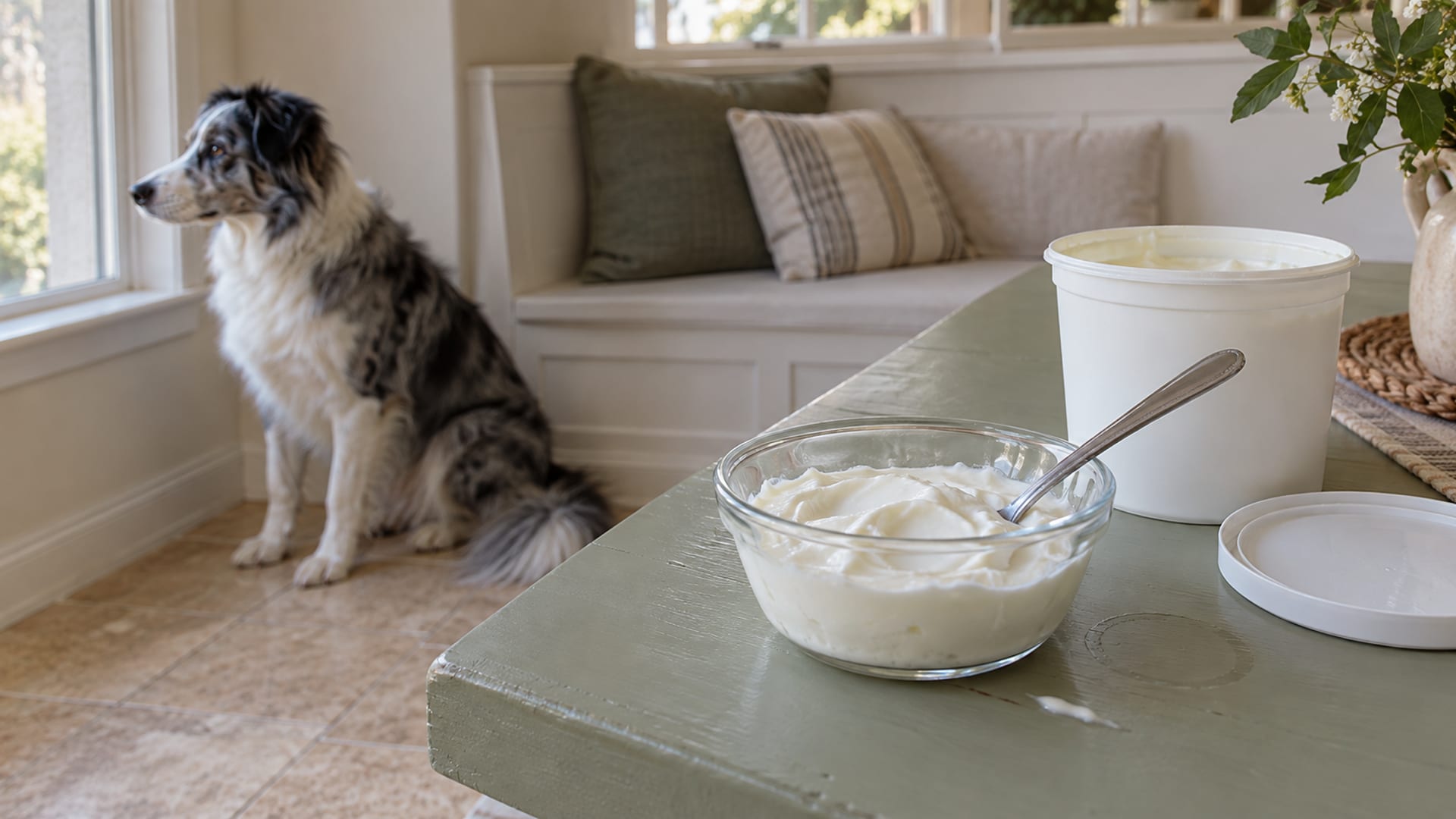
Yes. A small amount of plain, unsweetened yogurt is fine for most dogs, as long as it has no xylitol. The AKC says yogurt is not toxic, though the lactose in it gives many dogs gas, diarrhea or vomiting.
If your dog licked a bowl of plain yogurt, check the tub or cup. No xylitol on the label means you can simply watch for an upset stomach. If the label lists xylitol, birch sugar or wood sugar, or you cannot tell, call your vet or a pet poison line now, even if your dog seems fine.
Key takeaways
Tap a card to bring it forward.
- Plain, unsweetened yogurt is safe in small amounts for dogs that tolerate dairy.
- Xylitol in sugar-free, light or keto yogurt can drop a dog's blood sugar fast and damage the liver.
- Lactose is the usual reason yogurt causes gas, loose stool or vomiting.
- Plain Greek yogurt usually has less lactose, which some dogs handle better.
- Frozen yogurt and yogurt-covered snacks bring their own risks, like chocolate and raisins.
Your dog already ate yogurt: what to check
Start with the label. The ingredients decide what happens next.
Tap or hover a row to highlight it.
| What they ate | What to do |
|---|---|
| What they ateA lick or a spoonful of plain yogurt, no xylitol | What to doNothing. Watch for gas or a loose stool. |
| What they ateA whole cup or tub of plain yogurt | What to doExpect possible diarrhea, gas or vomiting. Call your vet if it is severe or lasts. |
| What they ateAny yogurt listing xylitol, birch sugar or wood sugar | What to doCall your vet or a pet poison line now, before signs appear. |
| What they ateSugar-free yogurt and you cannot find the label | What to doTreat it as if it had xylitol and call now. |
| What they ateFrozen yogurt, yogurt-covered raisins or chocolate | What to doCall now. Raisins and chocolate are toxic to dogs on their own. |
| What they ateThe cup, lid or foil seal | What to doWatch for vomiting, belly pain or no stool. Call your vet if any appear. |
The FDA tells owners to call a vet, an emergency animal clinic or an animal poison control center if they think their dog ate a product with xylitol. Have the container, your dog's weight and a guess at how much is missing in front of you when you call.
Get to a vet right away for weakness, staggering, collapse, trembling, seizures, trouble breathing, or vomiting or diarrhea that will not stop.
Plain, Greek, flavored, frozen: which yogurts are fine
Tap or hover a row to highlight it.
| Kind | Okay for dogs? | Why |
|---|---|---|
| KindPlain, unsweetened yogurt | Okay for dogs?Yes, in small amounts | WhyNot toxic; lactose may upset some dogs (AKC) |
| KindPlain Greek yogurt | Okay for dogs?Yes, in small amounts | WhyUsually less lactose, per the AKC |
| KindLactose-free yogurt | Okay for dogs?Usually | WhyLess lactose, but still check sugar, fat and sweeteners |
| KindVanilla or fruit-flavored yogurt | Okay for dogs?Better skipped | WhyAdded sugar, and some use artificial sweeteners |
| KindSugar-free, light or keto yogurt | Okay for dogs?Check for xylitol | WhyXylitol is toxic to dogs (FDA) |
| KindFull-fat yogurt | Okay for dogs?Small amounts only | WhyFat can upset the stomach and, in excess, add to pancreatitis risk |
| KindFrozen yogurt | Okay for dogs?Check the label | WhyCan contain more sugar and fat, chocolate or sweeteners |
| KindYogurt-covered raisins, chocolate or nuts | Okay for dogs?No | WhyThe coating does not make the center safe |
| KindRaw or unpasteurized yogurt | Okay for dogs?No | WhyThe ASPCA warns raw animal products can carry Salmonella and E. coli |
Xylitol can hide under other names. The FDA lists birch sugar, wood sugar and birch bark extract, so read the full ingredient list and not only the front of the package.
Why xylitol yogurt is an emergency
In dogs, xylitol causes a big release of insulin, and blood sugar falls. The FDA's consumer update says signs can start within 10 to 60 minutes: vomiting, weakness, low energy, staggering, collapse and seizures. Larger amounts can lead to liver failure and bleeding problems.
The ASPCA notes that signs of liver damage may not show for two or three days, which is why a dog that looks normal an hour later still needs a call. How much xylitol is in a given yogurt varies by brand, and the Pet Poison Helpline points out that the danger depends on the product, the amount and the dog's size. A small dog gets a bigger dose from the same spoonful.
Treatment is a job for the vet clinic. The ASPCA's xylitol warning describes the veterinary monitoring and hospital care a dog may need after eating it.
How much yogurt to give, and how to serve it
Offer only a little the first time and see how your dog's stomach handles it over the next day, as the AKC suggests. Smaller dogs get smaller portions.
- Buy plain, unsweetened yogurt and read the whole ingredient list for xylitol.
- Plain Greek yogurt is often the easier choice for dogs that are sensitive to lactose.
- Serve it on its own or as a topper, and count it as part of the day's treats.
- Spoon small portions into an ice tray and freeze them if your dog likes cold snacks. Freezing does not make an unsafe yogurt safe.
Dogs with a history of pancreatitis or trouble with fatty food should skip full-fat yogurt. If your dog has diabetes, avoid sweetened yogurt and ask your vet what fits.
Does yogurt help a dog's stomach?
Some yogurts contain live cultures, and the AKC says yogurt can act as a probiotic. The AKC's probiotics guide also explains that not every culture is a proven probiotic and that dogs have better sources. Research on probiotics for dogs, such as a trial of a dog-specific probiotic for diarrhea, tested defined strains made for dogs. Those results do not carry over to a cup of grocery-store yogurt.
If your dog has diarrhea, yogurt can make a lactose-sensitive dog worse. Ask your vet whether a probiotic made for dogs is a better fit.
Signs of a yogurt upset, and when to worry
Plain yogurt that does not agree with a dog usually shows up as gas, loose stool, diarrhea, vomiting or a sore belly. These tend to pass. Call your vet if they are severe, keep going, or your dog stops eating or drinking.
After a xylitol yogurt, the signs are different: vomiting, weakness, wobbliness, collapse or seizures, sometimes within the hour. Liver trouble can come days later. Any of these is a reason to go now.
"My dog has yogurt every morning and is fine"
That may be true, and it is real for your dog. Many dogs handle a little plain yogurt well. The trouble is that "yogurt" covers very different products, and the next dog or the next tub can change the picture:
- The product. Two yogurts with the same name can differ in fat, sugar, cultures and sweetener. Switching to a sugar-free one can add xylitol.
- How much. A spoonful is different from a whole tub stolen off the counter.
- Dog size. The same amount is a bigger dose for a small dog, which matters most with xylitol.
- The dog's gut. Dogs vary in how well they digest lactose.
- Timing. Liver damage from xylitol can take up to a few days to appear.
Keep buying the same plain, unsweetened yogurt and check the label each time you switch brands.
Frozen yogurt, yogurt treats and look-alikes
- Frozen yogurt: can have more sugar and fat than regular yogurt, and some flavors include chocolate or sweeteners. For ice cream, see can dogs eat ice cream?.
- Yogurt-covered raisins: the coating does not change the raisin. Can dogs eat grapes? covers raisins and what to do.
- Yogurt-covered pretzels or chocolate: chocolate is toxic; see can dogs eat chocolate?.
- Yogurt drops and dog yogurt treats: these are made products, so read the full ingredient list.
- Kefir, lassi and other fermented milk drinks: related, but they differ in lactose, sugar and sometimes alcohol. Treat each one on its own label.
- Probiotic yogurt: the word "probiotic" on the tub does not mean the cultures help dogs.
- Yogurt powders and supplements: can include added vitamins, herbs or xylitol. Ask your vet first.
Milk and cheese have their own entries: can dogs drink milk? and can dogs eat cheese?.
Check what you learned
Quick check
Questions about dogs and yogurt
Can dogs eat plain Greek yogurt?
Yes, a small amount, if it is plain, unsweetened and free of xylitol. The AKC says Greek yogurt usually has less lactose than regular yogurt.
Can dogs eat vanilla or flavored yogurt?
It is better to skip it. Flavored yogurts usually add sugar, and some use sweeteners. If the label lists xylitol, keep it away from your dog completely.
Can yogurt give my dog diarrhea?
Yes. The AKC lists gas, diarrhea and vomiting as possible effects, mostly in dogs that do not digest lactose well. Stop giving it if your dog's stool changes.
Can puppies eat yogurt?
A tiny amount of plain yogurt is not toxic to puppies, but their stomachs can be sensitive. Ask your vet before adding it, and never give a puppy sugar-free yogurt.
Is yogurt a good probiotic for dogs?
Not a reliable one. Some yogurts have live cultures, but the AKC says not all cultures are probiotics and better sources exist for dogs.
Is xylitol yogurt dangerous for cats too?
According to the FDA and ASPCA, xylitol is much less dangerous to cats than to dogs. A flavored yogurt can still contain other ingredients that harm a cat.
Sources
Checked September 24, 2026.
- American Kennel Club, Can Dogs Eat Yogurt?
- American Kennel Club, Probiotics for Dogs
- U.S. Food and Drug Administration, Paws Off! Xylitol Is Toxic to Dogs
- U.S. Food and Drug Administration, Paws Off Xylitol; It's Dangerous for Dogs
- ASPCA Animal Poison Control Center, Xylitol: The Sweetener That Is Not So Sweet for Pets
- ASPCA Animal Poison Control Center, Updated Safety Warning on Xylitol: How to Protect Your Pets
- ASPCA Animal Poison Control Center, People Foods to Avoid Feeding Your Pets
- Pet Poison Helpline, Xylitol Is Toxic To Dogs
- Gómez-Gallego and others, Veterinary Microbiology, A canine-specific probiotic product in treating acute or intermittent diarrhea in dogs