
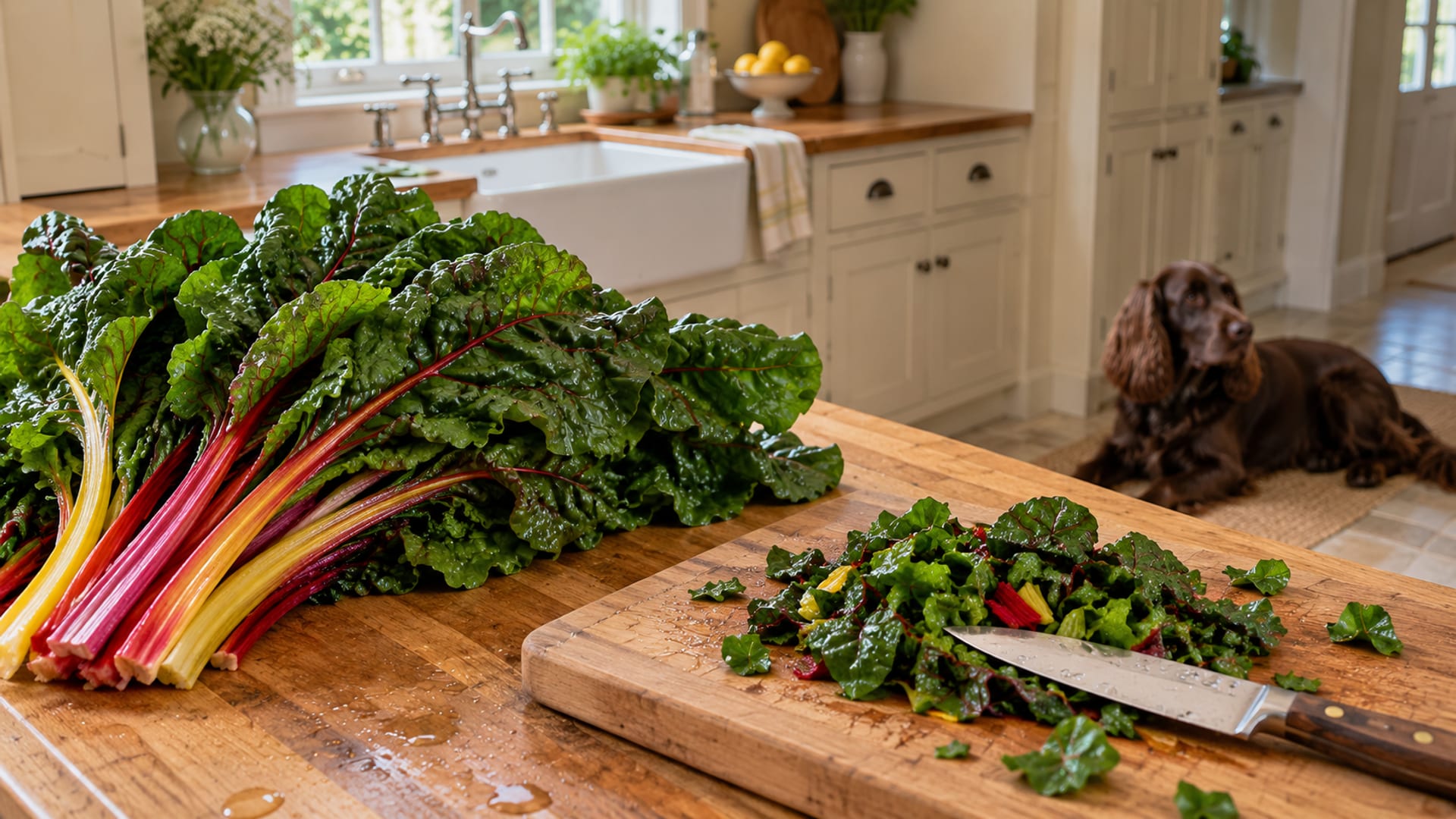
Yes, a small amount is fine for most healthy dogs. Plain Swiss chard, the leafy vegetable *Beta vulgaris*, is listed by the ASPCA as non-toxic to dogs, but it is high in oxalates, so it stays an occasional bite and is a poor choice for dogs with calcium oxalate stones or kidney problems.
If your dog grabbed a few leaves or a stem and is acting normally, you can usually watch them at home. The amount, the form, any onion or garlic in the dish, whether the plant was really chard, and a stone or kidney history are what change that answer.
Key takeaways
Tap a card to bring it forward.
- Correctly identified plain Swiss chard is on the ASPCA's non-toxic plant list for dogs.
- Chard is a high-oxalate green, so keep it a small, occasional extra and never a regular part of the bowl.
- Dogs with a history of calcium oxalate stones or kidney disease should skip chard unless their vet has built it into the diet.
- Call right away for repeated vomiting, weakness, tremors, collapse, seizures or trouble urinating, and call soon for a large amount, a powder or juice, or a dish made with onion or garlic.
- Garden sorrel and dock are different plants, and the ASPCA lists common sorrel as toxic to dogs.
What to do if your dog just ate Swiss chard
These steps sort out the chard snacks that need a phone call from the ones that do not.
- Move the rest out of reach and note the time. A vet or poison line will ask when it happened, roughly how much is gone, and what your dog weighs.
- Check what the chard was cooked with. Sautéed chard and chard soups often include garlic or onions, which are hazards of their own. Butter, cream, bacon, wine, heavy salt and raisins also matter more than the chard does.
- Confirm the plant really was chard. If your dog grazed on something in the yard that you did not plant as chard, or something called sorrel, dock or "sour grass," treat it as an unknown plant and call. The ASPCA lists common sorrel as toxic to dogs.
- Look at the label on anything concentrated. Chard powder, greens powders, dried chard and juice pack more plant material into a smaller serving, and there is no safe dog dose to compare against, so call with the label in hand.
- Keep your dog where you can see them. For a small plain amount, the expected outcome is no signs or a mildly upset stomach, and watching lets you catch anything more.
- Call promptly if your dog has a stone or kidney history, even if they seem fine, because oxalates matter more for these dogs.
- Skip home treatments. Give no medication or home remedy unless a vet or a poison-control professional tells you to, because the wrong treatment can cause its own problems.
Which parts and forms of chard carry more risk
The concern grows as chard gets more concentrated, mixed into seasoned food, or turns out to be a different plant.
Tap or hover a row to highlight it.
| Form | What matters | What to do |
|---|---|---|
| FormRaw leaves and stems, plain | What mattersNon-toxic per the ASPCA; contains oxalates | What to doA small bite is low risk for a healthy dog |
| FormCooked leaves and stems, plain | What mattersBoiling generally lowers soluble oxalates, by a variable amount | What to doFine in a small amount; pour off the cooking water |
| FormChard powder, greens powder, dried chard | What mattersMore plant material by weight; no dog safety dose | What to doCall your vet with the label |
| FormJuice or extract | What mattersOxalate strength is unknown | What to doCall your vet |
| FormSeeds | What mattersComposition may differ from the leaves | What to doTreat as unknown and call your vet |
| FormSoups and seasoned side dishes | What mattersOnion, garlic, salt, butter, cream, bacon, wine or raisins | What to doCheck the recipe and call for any hazardous ingredient |
| FormSorrel, dock or "sour grass" | What mattersA different plant; common sorrel is listed as toxic | What to doCall your vet or a poison line |
The reason chard gets a caution label at all is oxalate. A review of oxalate in foods by Hernández-Suárez and colleagues classes Swiss chard as a high-oxalate food and notes that boiling generally reduces the soluble oxalates through leaching into the water. Soluble oxalates can bind calcium in the body. The Merck Veterinary Manual describes very large exposures to soluble oxalates from toxic plants causing low blood calcium, weakness, muscle tremors, seizures, heart rhythm problems and kidney injury.
The ASPCA does not put Swiss chard in that toxic group. For chard, the realistic worry is a big or concentrated serving, a stone-prone dog, or a misidentified plant. Chard's cousins, beetroot, sugar beet and beet greens, have their own answers on the beets entry.
How to share a little chard, and how much is too much
If you want to share, offer a small amount of plain chard, chopped into bite-sized pieces, as an occasional extra. Plain cooked leaves and stems are a better choice than anything from your own plate, and boiling may take some of the soluble oxalate out.
Chard should never become a regular, large part of your dog's food. The same goes for other high-oxalate greens such as spinach. If you are thinking about other leafy greens, kale has its own entry.
There is no published chard dose for dogs that marks where a snack turns into a problem, so there is nothing reliable to calculate at home. If you are unsure whether the amount your dog ate was a lot for their size, call your vet or a poison line and give them your dog's weight, how much was eaten, the form, any other ingredients and the time.
Some dogs should skip chard altogether. VCA Animal Hospitals advises avoiding leafy greens such as spinach and Swiss chard in dogs with a history of calcium oxalate bladder stones, and the American Kennel Club gives the same caution for dogs prone to kidney or bladder stones. The Merck Veterinary Manual notes that calcium oxalate stones can form in any breed and are seen more often in several small breeds, including Miniature Schnauzers, Chihuahuas, Bichon Frises, Yorkshire Terriers, Shih Tzus and Lhasa Apsos. If your dog has kidney disease or a past stone, ask your vet before sharing any.
Signs to watch for after your dog eats chard
After a small plain serving, most dogs show nothing. The ASPCA describes small exposures to soluble-oxalate plants as causing stomach upset, so a bout of vomiting or loose stool is the mild end of what you might see.
The serious signs belong to very large exposures. The ASPCA ties that severe pattern to massive exposures or long-term eating of its toxic sorrel example. Call your vet or a poison line right away if you see any of these:
- trouble breathing
- vomiting more than once
- marked weakness or wobbliness
- trembling, twitching or muscle tremors
- collapse or seizures
- an unusual heartbeat
- straining to urinate or not urinating
Chard has no set timetable for signs. Oxalate effects follow absorption and calcium binding, so they are not always immediate; if something seems off later, call instead of waiting.
My dog ate chard before and was fine
That happened, and it is good to know your dog handled it. It still does not cover every dog or every serving.
The amount was probably small. The ASPCA separates small exposures, which tend to cause only stomach upset, from very large ones linked with severe signs.
The form may have been different. Boiled chard carries less soluble oxalate than raw, according to the Hernández-Suárez review, though how much less varies. A powder or juice is a different exposure again.
It may not have been the same plant. Chard is listed as non-toxic, while common sorrel is listed as toxic.
Dogs are not all built the same. Merck explains that urinary stone risk depends on diet, genetics, conditions that raise calcium in the urine, and other health problems.
Size matters, but it cannot be turned into a formula. The same handful means more to a small dog, yet no chard study gives a safe or toxic amount by weight, so one uneventful snack cannot become a safe dose for all dogs.
Chard powders, supplements and plants that get confused with chard
Chard turns up in more places than the produce drawer, and other plants share its names.
Greens powders and supplements. Products labeled chard powder, greens powder or "detox greens," along with green juices and supplements, may contain concentrated chard or a long list of other plants. Read the full ingredient list, and call with the label if your dog ate a scoop or chewed open a container.
Sorrel and dock. Common sorrel, garden sorrel, spinach-dock and narrow-leaved dock are *Rumex* plants. The ASPCA lists common sorrel, *Rumex scutatus*, as toxic to dogs because of its soluble oxalates, and it is toxic to cats as well. Name alone is not enough to identify a garden plant.
Rhubarb chard. This is a Swiss chard variety name, and rhubarb leaves are a different plant, so check the seed packet or where you bought it.
Houseplant oxalates. Plants such as Dieffenbachia, philodendron, pothos and peace lily contain insoluble calcium oxalate crystals, which irritate the mouth. Pet Poison Helpline covers that problem, which differs from the soluble oxalates in leafy greens.
Check what you learned
Quick check
Questions about dogs and Swiss chard
These come up once the first worry has passed.
Can my dog eat the stems as well as the leaves?
Yes, the stems are part of the same plant and fall under the same non-toxic listing. They are tougher and more fibrous than the leaves, and a large fibrous piece can be a choking risk for a dog that gulps its food. Chop stems into small pieces before sharing.
Can my dog drink the water I boiled chard in?
It is better to pour it out. Boiling pulls soluble oxalates out of the leaves and into the water, so some of that oxalate ends up in the pot liquid. Plain fresh water is the better drink.
Is rainbow or red chard any different for dogs?
Rainbow, red, ruby and rhubarb chard are names for Swiss chard varieties, all *Beta vulgaris*. The same small, occasional approach applies to all of them. The stem color does not change the advice.
Why does the ASPCA call chard non-toxic while the AKC says some dogs should avoid it?
Both are answering different questions. The ASPCA list is about poisoning, and chard is not on its toxic side. The AKC and VCA guidance is about dogs prone to stones, for whom a high-oxalate food is a poor fit even though it is not a poison.
Sources
Checked September 25, 2026.
- ASPCA, Toxic and Non-Toxic Plant List, Dogs
- ASPCA, Toxic and Non-toxic Plants: Sorrel
- Hernández-Suárez et al., Oxalate in Foods: Extraction Conditions, Analytical Methods, Occurrence, and Health Implications
- Merck Veterinary Manual, Houseplants and Ornamentals Toxic to Animals
- VCA Animal Hospitals, Nutritional Assessment in a Dog with Urolithiasis
- American Kennel Club, Can Dogs Eat Kale?
- Merck Veterinary Manual, Urolithiasis in Dogs
- Pet Poison Helpline, Oxalates, Insoluble