

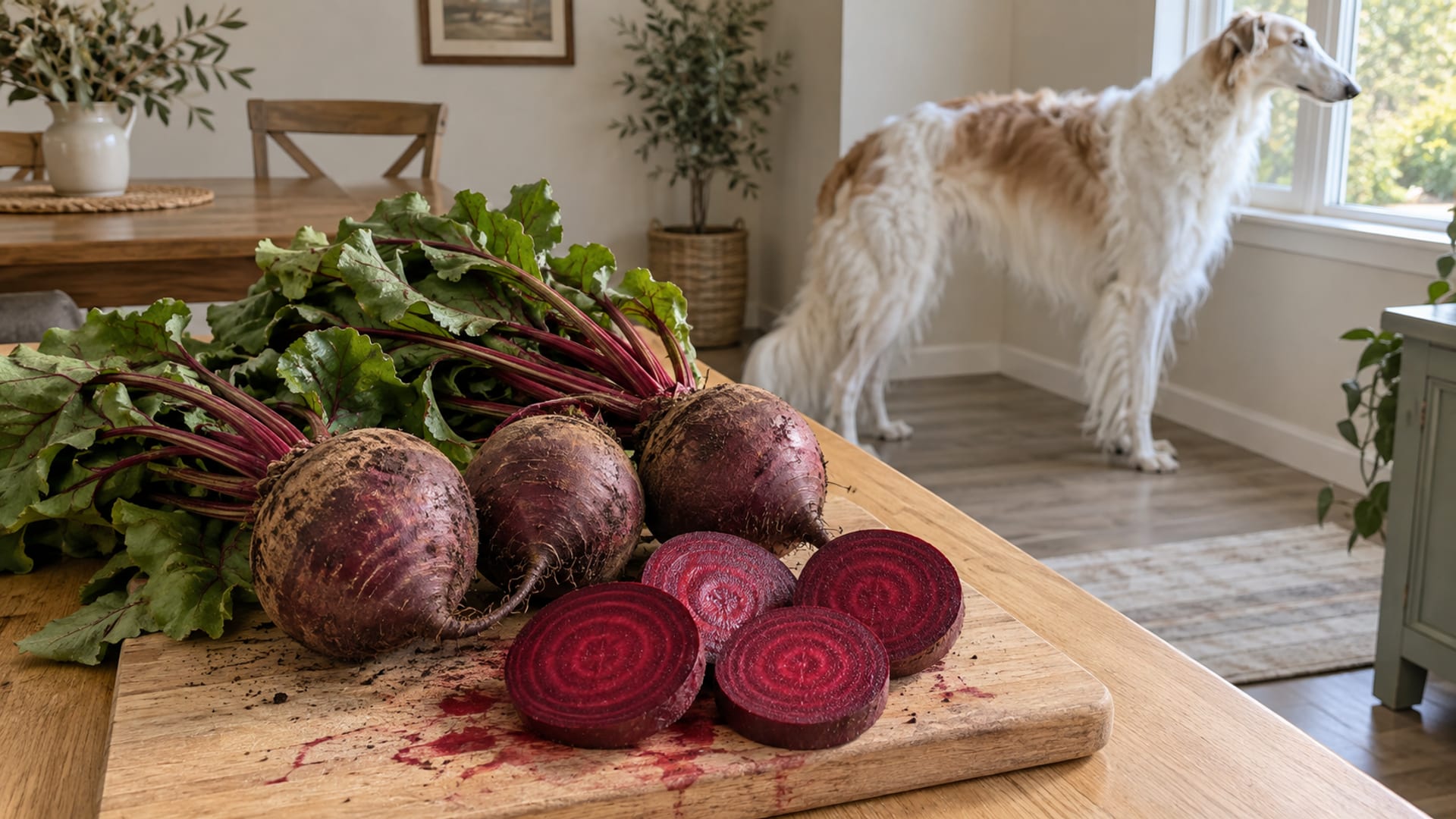
Yes. A small amount of plain raw or cooked beetroot is safe for most healthy dogs, and the ASPCA lists beets as non-toxic to dogs. If your dog already ate some, sort out three things: which part of the beet it was, roughly how much, and whether it was plain or part of a seasoned dish.
A piece of beet swiped off the cutting board usually ends with a little gas, maybe a soft stool, and pink pee for about a day. It's a different situation when a dog eats a big pile of mature beet leaves, gets into beet powder, or cleans up a beet salad made with onion, garlic or plenty of salt, and when the dog has had calcium oxalate bladder stones. Those are the cases where I'd call the vet today instead of waiting.
Key takeaways
Tap a card to bring it forward.
- Plain raw or cooked beetroot is non-toxic to dogs, and a small amount is fine for most healthy dogs.
- Large amounts of mature beet leaves, Swiss chard included, contain oxalic acid and are worth a call to your vet.
- Pink or red urine for about 12 to 24 hours after beets is usually pigment; red urine that lasts longer needs a vet.
- Dogs that have had calcium oxalate bladder stones should skip beets.
- Pickled beets, seasoned beet dishes, juice and powder bring extra ingredients or a stronger dose, so read the label.
What to do if your dog just ate beets
For most dogs this takes a couple of minutes of checking and a day of keeping an eye out.
- Figure out which part your dog ate. The ASPCA's warning is about large amounts of mature leaves, which contain oxalic acid, while the plant itself is listed as non-toxic.
- Get a rough idea of how much. The Merck Veterinary Manual explains that small tastes of oxalate-containing plants aren't expected to cause severe illness, while large amounts can.
- Check the recipe or the label. A beet roasted with garlic, tossed with onions, pickled in brine or baked into something sweetened with xylitol is a question about those ingredients first.
- Think about your dog's health history. VCA Animal Hospitals advises that dogs with calcium oxalate bladder stones avoid high-oxalate foods such as beets, so call your vet even about a small amount if that's your dog, or if your dog has kidney disease or eats a prescription urinary diet.
- Keep watch over the next day. The American Kennel Club says beet pigment can color urine for roughly 12 to 24 hours, and knowing that ahead of time saves you a scare on the next walk.
- Call your vet or a pet poison line if the exposure was big or unclear. That covers a large amount of mature leaves, beet powder or another concentrated product, a dish with risky ingredients, or a plant you only think was a beet.
For a small amount of plain beet in a dog that's acting like itself, watching is the plan. Pet Poison Helpline's food guide doesn't list ordinary beetroot among its highlighted toxic foods.
Which beet parts and products are fine for dogs
The root, the leaves and the products made from beets each come with their own advice.
Tap or hover a row to highlight it.
| Form | What matters | What to do |
|---|---|---|
| FormPlain raw beetroot | What mattersNon-toxic; big chunks can be a choking risk | What to doWash, peel, then grate or cut small |
| FormPlain cooked beetroot | What mattersNon-toxic when nothing is added | What to doServe mashed or in small pieces, unseasoned |
| FormBeet peel | What mattersCan be hard to digest | What to doPeel it off when you can |
| FormCanned beets | What mattersSalt and additives vary by product | What to doOnly plain, no-salt-added cans |
| FormPickled beets | What mattersUsually salt, vinegar, sugar or spices | What to doKeep them for people |
| FormBeet juice | What mattersConcentrated; may have added sugar | What to doSkip it; read the label if your dog drank some |
| FormBeet powder or supplement | What mattersStronger by weight; often mixed with other ingredients | What to doCall your vet if your dog ate a lot |
| FormBeet greens and Swiss chard | What mattersLarge mature leaves contain oxalic acid | What to doKeep leaves away; call after a large amount |
| FormBeet pulp in dog food | What mattersA processed fiber ingredient | What to doA normal ingredient in many dog foods |
The leaves deserve the most attention. Swiss chard and silver beet are leafy forms of the same plant, *Beta vulgaris*, so a dog that snagged a leaf from a salad is in a different spot from one that pulled a whole bunch of greens off the counter. Stems come from the same plant; if your dog chewed through a big pile, handle it like a big pile of leaves and call.
Juice has lost the structure of the whole vegetable and often has sugar added, and powder shows up in supplements next to other ingredients. If your dog got into either, keep the container in hand when you call so your vet can read the whole label.
Beet pulp is the version many dogs already eat. The Merck Veterinary Manual's nutrition chapter says this fermentable fiber can give good stool quality at up to 7.5% of a food's dry matter. That figure describes a manufactured ingredient in a balanced diet and doesn't work as a serving size for table beets.
How much beet to share and how to prepare it
Beets work best as a small, occasional extra. The AKC recommends washing and peeling fresh beets, then grating them or cutting them into small pieces. Cooked beets should be plain, mashed or cut small, and canned beets should have no added salt or other additives.
That means a few small pieces or a little grated beet on top of your dog's regular food, now and then. The AKC notes that beets are high in carbohydrates and sugar, which is a good reason to keep them occasional, even though they bring fiber, vitamin C, potassium, folate and magnesium.
The first time, give a small amount and watch the next stool, since the AKC says some dogs get gas or diarrhea from beets.
Some dogs need their vet's input first: dogs with kidney disease, urinary stones, a calcium disorder, diabetes or pancreatitis, and any dog on a prescription diet. The Merck Veterinary Manual's chapter on urinary stones notes that Miniature Schnauzers, Chihuahuas, Bichon Frises, Yorkshire Terriers and Shih Tzus are more commonly affected by calcium oxalate stones. If your dog is one of them and has had urinary trouble, ask first.
Red urine and other signs to watch in the next day
Plenty of dogs show nothing after a bit of beet. Others get gas, a soft stool, diarrhea or some vomiting, according to the AKC.
Beet pigment can turn urine pink or red for roughly 12 to 24 hours, the AKC says. The stool can look reddish too, and the fur around your dog's mouth may be stained pink.
Red urine that hasn't cleared after about a day is a different story. Blood in the urine and urinary disease can look much the same, so don't put it down to beets at that point. Call promptly if you see any of these:
- vomiting more than once
- marked weakness, trouble walking or collapse
- tremors or seizures
- straining to pee or pain while peeing
- urine that looks like blood, or red urine past about 24 hours
The Merck Veterinary Manual says a large amount of oxalate-containing plant material, such as a big pile of mature leaves, can cause vomiting, loss of appetite, lethargy, a wobbly walk, tremors or seizures from low blood calcium (hypocalcemia), and possible kidney injury. That's the worst realistic outcome, and it isn't what a small serving of plain beetroot is expected to do. A review in the Journal of the South African Veterinary Association describes this kind of poisoning as relatively rare in dogs and cats compared with livestock.
My dog ate beets before and was fine
If your dog has eaten beets before with no trouble, I believe you. That happened, and a small plain serving is exactly the kind of exposure that's expected to go smoothly. It still isn't a rule for every dog or every beet, for specific reasons.
- Amount. A few pieces of root is a small exposure and a bunch of greens is a large one, and Merck separates small tastes from large ingestions.
- Size. The same handful is a much bigger share of a Chihuahua than of a Borzoi.
- Form. Last time might have been plain roasted beet; this time it could be juice, powder or a salad with onions.
- The dog. The AKC notes that some dogs get gas or diarrhea from beets and others don't.
- Health. A dog with no stone history may handle beets well, while VCA advises dogs with calcium oxalate stones to avoid them.
- Timing. Pink urine can show up over the next 12 to 24 hours, after you've decided everything was fine.
Beet products and names that get mixed up
Beet, beetroot, red beet and table beet generally mean the root of *Beta vulgaris*. Sugar beet is the same species grown as an industrial crop, usually met as a processed ingredient.
Swiss chard, silver beet and Roman kale can all refer to leafy forms of the same plant. Give them the same care as beet greens.
Check what you learned
Three quick questions on the parts that matter most.
Quick check
Questions about dogs and beets
These tend to come up once the main question is settled.
What if my dog pulled beets out of the garden?
A garden beet comes with its leaves, so the first question is how much greenery your dog ate. A bite of root with a leaf or two is the ordinary case. If you aren't sure the plant was a beet at all, treat it as an unknown plant and call your vet or a poison line.
Can cats eat beets too?
The ASPCA lists *Beta vulgaris* as non-toxic to cats as well as dogs. The same split applies: a bit of plain beetroot is one thing, and a large amount of mature leaves or a seasoned product is another.
Is beet pulp in my dog's food a problem?
For a dog with no urinary stone history, beet pulp is an ordinary part of the recipe. Dogs on a prescription urinary diet should stay with whatever food their vet chose, and it's worth asking before adding any beets on top.
Can a dog with diabetes or kidney disease have beets?
Ask your own vet first. The AKC points out that beets are high in carbohydrates and sugar, which matters for a diabetic dog, and kidney or urinary disease can change which foods fit at all.
Sources
Checked September 25, 2026.
- ASPCA Animal Poison Control Center, Toxic and Non-toxic Plants: Beets
- American Kennel Club, Can Dogs Eat Beets?
- VCA Animal Hospitals, Calcium Oxalate Bladder Stones in Dogs
- Merck Veterinary Manual, Houseplants and Ornamentals Toxic to Animals
- Merck Veterinary Manual, Nutritional Requirements of Small Animals
- Merck Veterinary Manual, Urolithiasis in Dogs
- Journal of the South African Veterinary Association, Potential plant poisonings in dogs and cats in southern Africa
- Pet Poison Helpline, Toxic and Hazardous Food Guide for Pets