

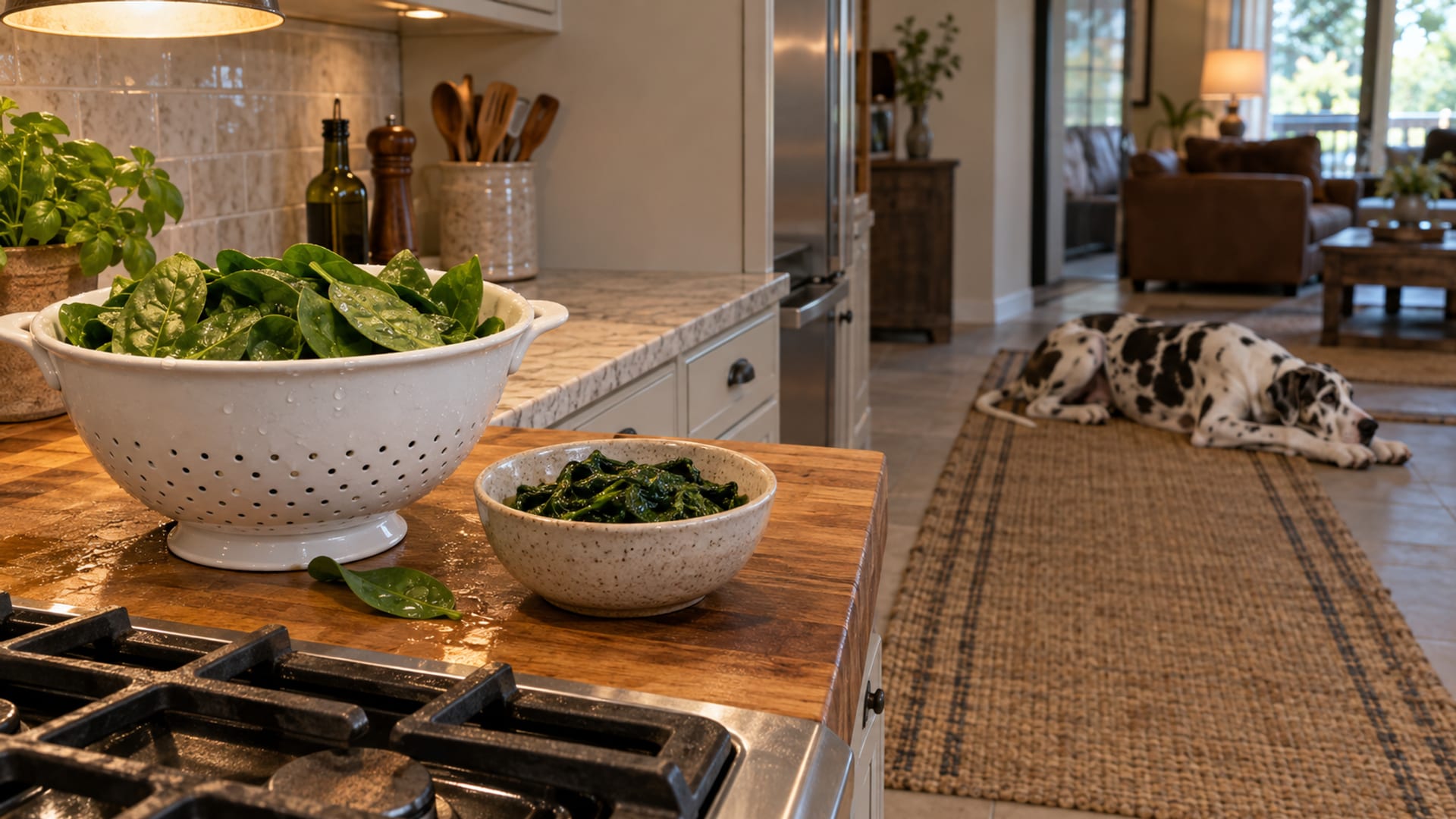
In small amounts, yes. The American Kennel Club says dogs can eat spinach, but it is high in oxalic acid, and large quantities may interfere with calcium absorption and damage the kidneys. Share it plain and only now and then, and leave it out entirely for a dog with kidney disease or a history of calcium oxalate stones.
If your dog nosed a few leaves out of the salad bowl, watch for a queasy stomach and go on with your evening. A whole bag, dried or powdered spinach, a spinach dish made with onion or garlic, or a garden plant you are not sure was spinach is a reason to call your vet.
Key takeaways
Tap a card to bring it forward.
- Plain spinach is fine for most healthy dogs in small, occasional amounts. The concern is its soluble oxalate.
- A taste or a nibble is not expected to cause serious signs, though it can upset the stomach.
- A large or concentrated amount can pull calcium out of the blood and injure the kidneys.
- Dogs with kidney disease or calcium oxalate stones should skip spinach unless their vet includes it.
- Spinach dip, creamed spinach, green powders and garden "spinach" that might be sorrel each need a closer look.
Your dog ate spinach: what to do next
The Merck Veterinary Manual says a taste or nibble of a soluble-oxalate plant may cause stomach upset, and more serious signs are not expected. The bigger and more concentrated the dose, the more that changes.
Tap or hover a row to highlight it.
| What they ate | What to do |
|---|---|
| What they ateA few plain leaves, raw or cooked | What to doWatch for vomiting or loose stool. Nothing else is needed. |
| What they ateA large bowl or a whole bag of spinach | What to doCall your vet with your dog's weight and a guess at how much went down. |
| What they ateDried spinach, spinach powder or a green smoothie mix | What to doCall your vet. These pack a lot of spinach into a small amount. |
| What they ateCreamed spinach, spinach dip, quiche or a casserole | What to doCheck the recipe or label for onion, garlic, salt and fat. Call if any were in it or your dog ate a lot. |
| What they ateA garden or wild plant you thought was spinach | What to doCall and describe the plant, or take a leaf with you. Sorrel, sometimes sold as spinach-dock, is toxic to dogs. |
Before you call, gather the bag or plant, the ingredient list, how much your dog ate and when, and your dog's weight. Pet Poison Helpline asks owners who think a pet ate something potentially toxic to call them or get to a vet right away.
Call right away, whatever the amount, if your dog turns weak or wobbly, trembles, has a seizure, drinks and pees far more than usual, or pees much less or not at all.
Why spinach is a caution food
Spinach carries soluble oxalate. In a large exposure, Merck explains, soluble oxalates can bind calcium in the blood and bring it dangerously low, and calcium oxalate crystals can settle in the kidneys and injure them. Low calcium is what leads to the tremors, seizures and heart rhythm problems in a severe case.
Houseplants such as pothos, philodendron, peace lily and dieffenbachia carry a different kind of oxalate, in tiny needle-shaped crystals. Those cause mouth pain, drooling and swelling right away, as Pet Poison Helpline describes. Spinach works more slowly and through the blood and kidneys.
Raw, cooked, frozen and powdered spinach
Tap or hover a row to highlight it.
| Form | Okay? | What to know |
|---|---|---|
| FormRaw leaves, plain | Okay?A little | What to knowKeeps all its soluble oxalate and can be harder to digest (AKC) |
| FormBoiled, water poured off | Okay?The better choice | What to knowBoiling lowers soluble oxalate more than steaming |
| FormSteamed, plain | Okay?A little | What to knowThe AKC suggests steaming; it removes less oxalate than boiling |
| FormFrozen, plain | Okay?Same as fresh | What to knowCheck the bag for butter, sauce or salt |
| FormCanned | Okay?Only if plain | What to knowCheck for salt, onion, garlic and seasoning |
| FormDried, powder, juice | Okay?Better not | What to knowFar more spinach in every spoonful |
| FormStems | Okay?Treat like leaves | What to knowChop small, since a tough piece can choke |
Two food studies explain the cooking advice. Chai and Liebman found that boiling lowered soluble oxalate in vegetables, spinach included, more than steaming did. A 2018 spinach study found that two minutes of boiling at 100°C removed about 67% of the oxalic acid under its test conditions. Both measured spinach in a lab and neither fed it to dogs, so they guide the cooking and give no safe portion.
The oxalate that leaves the leaves ends up in the pot. Pour that water down the drain instead of saving it as a spinach broth for your dog.
How much spinach to give, and how to serve it
The AKC recommends small amounts, given infrequently, and only for dogs with healthy kidneys. It gives no measured serving, so keep it to a few chopped leaves now and then, with less for a small dog.
- Wash the leaves well.
- Boil them briefly and throw out the water, or steam them plain.
- Chop small so nothing gets gulped in one clump.
- Serve plain: no salt, oil, butter, onion, garlic, herbs or spices.
- Try a little the first time and see how your dog's stomach handles it.
A dog eating a complete and balanced food gets what it needs without vegetables, according to the AKC. Spinach is an extra, and skipping it costs your dog nothing.
Dogs that should go without spinach
Keep spinach out of the bowl for a dog with kidney disease, a history of calcium oxalate bladder stones, or a prescription diet, unless the vet managing that condition says it fits. The Merck Veterinary Manual notes that calcium oxalate stones can form in any breed but show up more often in Miniature Schnauzers, Chihuahuas, Bichon Frises, Yorkshire Terriers and Shih Tzus, and that diet may play a part.
Size matters too. The same handful of leaves is a much bigger dose for a Yorkie than for a Labrador.
Signs to watch for after a lot of spinach
A mild reaction looks like vomiting, diarrhea or a dog who turns down the next meal.
After a large amount, Merck lists weakness, tiredness, wobbling, muscle tremors, seizures and an abnormal heart rhythm. If the kidneys are affected, you may see vomiting, no appetite, heavy drinking and peeing, then less urine or none. Clinical material from Pet Poison Helpline puts those kidney signs at roughly 24 to 36 hours after a soluble-oxalate plant was eaten, so a dog who seems fine that evening still needs watching the next day.
"My dog eats spinach all the time and is fine"
That can be exactly right for your dog. Plenty of healthy dogs eat spinach with no trouble at all, and your dog's story is real. It still is not a rule for every dog. A few boiled leaves differ from a scoop of spinach powder, a Great Dane differs from a Chihuahua, and a dog with healthy kidneys differs from one prone to stones. Kidney signs can also trail a day or more behind the meal, and the "spinach" from a neighbor's garden may be a different plant. Keep the amount small and plain, and let your vet weigh in if your dog has a kidney or bladder history.
Spinach dip, green powders and plants called spinach
- Spinach dip and creamed spinach: the onion, garlic, fat, salt and dairy are the bigger worry. Onion is covered on its own page, can dogs eat onions?, and garlic on can dogs eat garlic?.
- Green powders and "superfood" blends: concentrated spinach, often mixed with herbs, sweeteners or supplements. Treat these as a call-your-vet exposure.
- Spinach dog treats and dog food: judge the whole label. A formulated product differs from a bowl of fresh leaves.
- Sorrel and spinach-dock: the ASPCA lists sorrel (*Rumex scutatus*) as toxic to dogs and cats because of its soluble oxalates.
- New Zealand spinach, water spinach (kangkung, ong choy) and Malabar spinach: different plants that share the name. Ask your vet before sharing them.
- Kale and other greens: kale carries oxalate too. Can dogs eat kale? covers it.
Check what you learned
Quick check
Questions about dogs and spinach
Can dogs eat raw spinach?
A few raw leaves are unlikely to cause a healthy dog serious trouble. Raw spinach keeps all its soluble oxalate and can be harder to digest, so cooked and plain is the gentler way to share it.
Is cooked spinach better for dogs?
Yes. Boiling lowers the soluble oxalate, especially when you throw out the cooking water. It stays an occasional food, even cooked.
What if my dog ate a lot of spinach?
Call your vet or a pet poison line, and sooner if it was dried, powdered, seasoned or from a plant you could not identify. Merck lists vomiting, weakness, tremors, seizures, low blood calcium and kidney injury after large soluble-oxalate exposures.
Can a dog with kidney disease eat spinach?
Only if the vet managing the kidney disease specifically says so. The same goes for a dog with a history of calcium oxalate stones.
Is spinach dip safe for dogs?
Treat it as its own food. Onion, garlic, fat, salt and dairy each bring a separate risk, and dip usually has several of them.
Can puppies eat spinach?
The advice for adult dogs applies: a little, plain and cooked. A puppy is small, so the same few leaves count for more.
Sources
Checked September 24, 2026.
- American Kennel Club, Is Spinach Safe for Dogs?
- Merck Veterinary Manual, Houseplants and Ornamentals Toxic to Animals
- Merck Veterinary Manual, Urolithiasis in Dogs
- ASPCA Animal Poison Control Center, Sorrel
- Pet Poison Helpline, Oxalates, Insoluble
- Pet Poison Helpline, Soluble Oxalates: Clinical Signs
- Chai and Liebman, Journal of Agricultural and Food Chemistry, Effect of Different Cooking Methods on Vegetable Oxalate Content
- Wang et al., Food Science and Technology Research, Effects of Cooking Conditions on the Relationships Among Oxalate, Nitrate, and Lutein in Spinach