
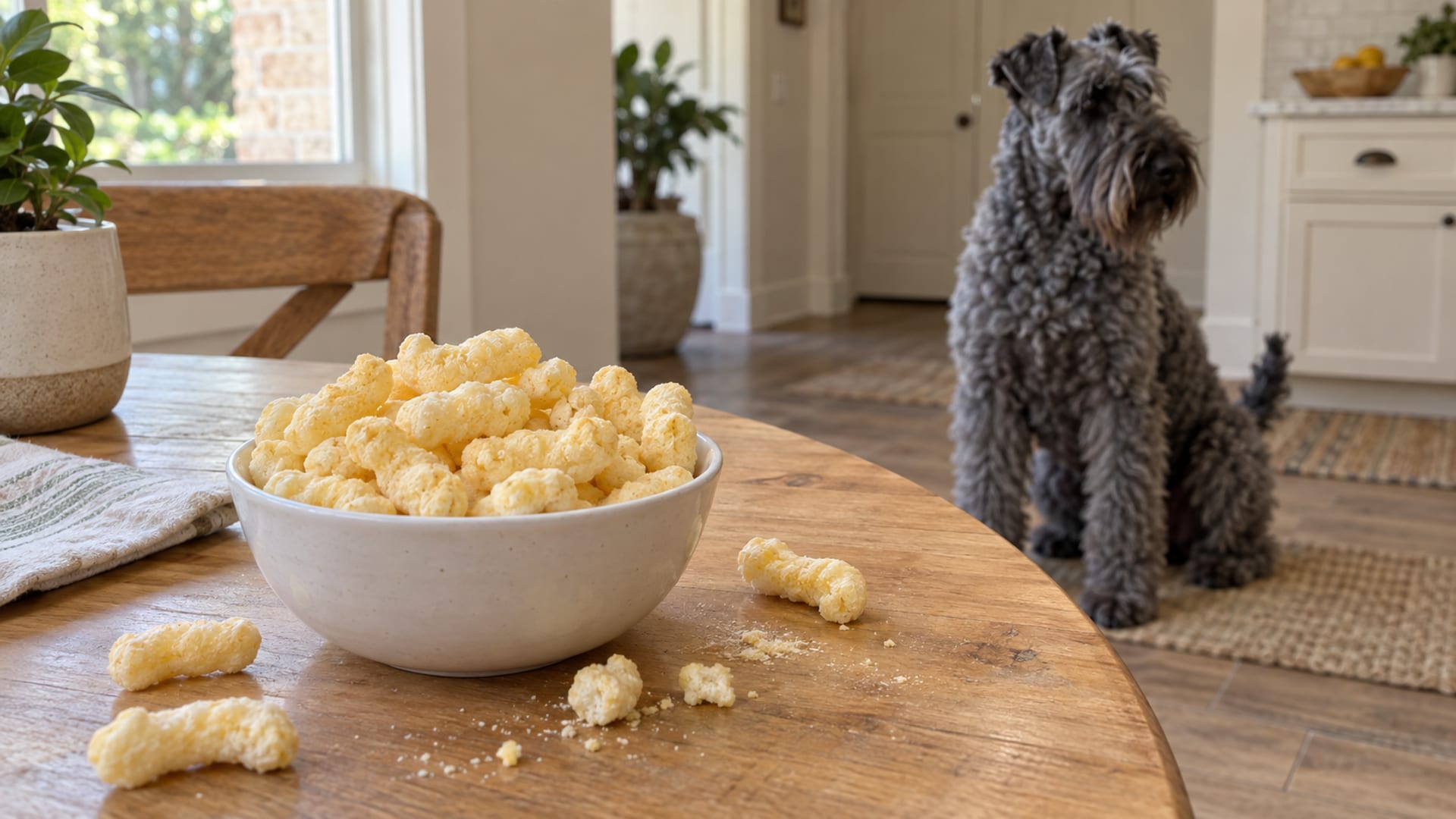
Yes, a few Pirate's Booty puffs are low risk for a healthy dog. Hershey describes the snack as a cornmeal and rice-meal puff, and the standard product is not a known dog poison. The amount is what matters: a big share of a bag carries a lot of salt, oil and cheese, and a chewed bag may mean swallowed plastic.
If your dog just got into it, work out roughly how many puffs are gone and whether any of the bag is missing, set out fresh water, and watch your dog for the rest of the day. For a few puffs in a healthy adult dog, that is usually enough.
Key takeaways
Tap a card to bring it forward.
- A few puffs are low risk for a healthy dog; the standard snack is puffed corn and rice with cheese flavoring.
- A large amount means extra salt, oil and cheese, which can upset the stomach and, in some dogs, set off pancreatitis.
- A swallowed bag or wrapper can cause choking or a blockage, so call your vet if packaging is missing.
- Salt-related signs usually show within about 12 hours; keep fresh water available the whole time.
- Before sharing, check the flavor label, since other cheese puffs and new flavors can contain onion or garlic.
What to do if your dog already ate Pirate's Booty
Two puffs or a whole bag, the same few questions sort it out.
- Estimate how much your dog ate. The Merck Veterinary Manual measures salt poisoning against body weight, so a few puffs and most of a bag are very different situations.
- Check whether any packaging is missing. A swallowed bag or large piece of wrapper can cause choking or a blockage in the gut, whatever the puffs are made of.
- Think about your dog's size and health history. A small dog or a puppy reaches a risky amount of salt sooner than a big dog. A dog with kidney disease may struggle to handle extra sodium, according to Pet Poison Helpline, and VCA Animal Hospitals advises keeping high-fat treats away from dogs who have had pancreatitis, because a fatty meal can bring it back.
- Set out fresh water and let your dog drink normally. The Merck Veterinary Manual notes that salt toxicity is unlikely when a dog has fresh water and its body can regulate sodium the usual way.
- Hold on to the bag. The flavor and ingredient label tell your vet what your dog ate and how much salt came with it. Hershey says its ingredients can change, so the bag in your hand beats your memory of the last one.
- Call your vet or a poison line if any of these fit. Your dog ate a large amount, is small or a puppy, may have swallowed packaging, or shows repeated vomiting or diarrhea, heavy thirst, weakness, stumbling, tremors or seizures. The ASPCA advises contacting your veterinarian or its Animal Poison Control Center right away if you think your pet ate something potentially toxic, and not knowing how much went down is reason enough to call.
Puffs, powder, flavors and the bag: what each one means for your dog
Each form of the snack carries a different kind of risk.
Tap or hover a row to highlight it.
| What your dog got into | What to know |
|---|---|
| What your dog got intoA few standard puffs | What to knowLow risk for a healthy dog; keep water out and watch |
| What your dog got intoA large part of a bag, or more | What to knowMore salt, oil and cheese than a dog needs; call your vet, and sooner for a small dog or puppy |
| What your dog got intoLoose cheese powder from the bottom of the bag | What to knowPacks more salt and flavoring than a single puff; keep your dog from licking up a lot of it |
| What your dog got intoWhite Cheddar and other cheese flavors | What to knowDairy, oil and salt; cheese upsets some dogs' stomachs |
| What your dog got intoNew or limited-edition flavors | What to knowRead the label for onion, garlic, xylitol, chocolate or raisins |
| What your dog got intoThe bag or wrapper | What to knowNot food; it can cause choking or a blockage, so call your vet |
The cheese flavoring is where some dogs run into trouble. The American Kennel Club says plenty of dogs can have cheese in moderation, but some don't tolerate it, and too much cheese or fat can lead to pancreatitis. If a bite of cheese already gives your dog loose stools, a pile of cheddar puffs may do the same.
Pancreatitis is inflammation of the pancreas, and VCA Animal Hospitals lists fatty meals as a possible trigger and describes it as potentially serious. For its size, a small dog that ate half a bag took in far more fat than a big dog that had a handful.
How to share a puff or two with your dog
If your kid's snack bag is open and your dog is sitting there hoping, a puff or two is a reasonable thing to share with a healthy dog. Keep it to a few individual puffs now and then, and count them as a treat rather than part of dinner. The serving size on the bag is written for people, so it tells you nothing about a dog.
- Break each puff into smaller bits for a small dog, so it doesn't get gulped whole.
- Hand them over one at a time, with the water bowl full.
- Never give your dog the bag to lick out, and store open bags out of reach.
If your dog has had pancreatitis, has kidney disease, is overweight, eats a special diet or has a food sensitivity, ask your vet before sharing people snacks like this one.
VCA Animal Hospitals warns that salty, fatty snacks left out on game day are within easy reach of dogs. With guests over, I'd move open bowls up high before anyone sat down.
Signs to watch for tonight and into tomorrow
Most dogs that eat a few puffs show nothing at all. After a larger amount, watch for extra thirst, peeing more than usual, vomiting, diarrhea, not wanting to eat, low energy and weakness. Stumbling, tremors and seizures point to salt poisoning, and Pet Poison Helpline notes that severe cases can be fatal.
The ASPCA says salt-toxicity symptoms usually appear within 12 hours, and that dogs in typical cases are expected to recover within 24 to 72 hours. The Merck Veterinary Manual describes vomiting within several hours, followed by weakness, diarrhea, tremors and seizures as it gets worse.
Your vet may mention salt doses. The published figures are for salt itself:
Tap or hover a row to highlight it.
| Source | Amount of salt | What it means |
|---|---|---|
| SourceMerck Veterinary Manual | Amount of saltAbout 2 to 3 g per kg of body weight | What it meansSigns of salt toxicosis can appear |
| SourcePet Poison Helpline | Amount of saltAbout 1.5 g per lb (about 3.3 g per kg) | What it meansToxic dose |
| SourceMerck Veterinary Manual | Amount of saltAbout 4 g per kg of body weight | What it meansAcute lethal dose |
Pet Poison Helpline gives its figure as grams of salt, which is why the bag matters: your vet can use the sodium on the label and your dog's weight to work out how close your dog came.
Repeated vomiting or diarrhea after a fatty snack is worth a call too, since pancreatitis signs vary, according to VCA. If packaging went down, call without waiting for any sign.
My dog ate it before and was fine
Plenty of people remember a dog that cleaned out a bag of cheese puffs and was running around the yard an hour later. That really happened, and that dog was fine that day. It still isn't a rule you can count on for the next bag, because several things change from one time to the next:
- The amount. Pet Poison Helpline says the amount eaten, the dog's size and other factors decide the risk.
- Water. The Merck Veterinary Manual ties salt toxicity to situations where water is limited, so a dog with a full bowl nearby is better off than one shut in a car.
- The flavor. Another flavor or brand may contain ingredients the last one didn't.
- The individual dog. Some dogs handle dairy and fat easily and some don't. VCA notes that a fatty meal can trigger pancreatitis in some dogs, and that it can also happen with no clear cause.
- Timing. A dog that seems fine right after eating may not have had time to show signs yet.
This time, run through the same questions: how much, what flavor, any plastic, and how your dog is acting.
Other cheese puffs and snacks that get mixed up with Pirate's Booty
People search for this snack as pirate booty, pirates booty, white cheddar puffs or just cheese puffs, and those names don't always mean the same bag. The one covered here says PIRATE'S BOOTY and comes from Hershey.
Within the brand, White Cheddar, Aged White Cheddar, organic, veggie and limited-edition versions can have different formulas. Outside it, "cheese puffs" covers a wide range of snacks, and some may contain onion, garlic, spicy seasonings or other ingredients that change the answer. If a label lists onions or garlic, read those entries first. Pirate-themed snacks and toys can carry similar names, so trust the package.
Check what you learned
Test what you would do if the bag hit the floor.
Quick check
Questions about dogs and Pirate's Booty
A few more questions owners ask.
My dog ate a whole bag. Is that an emergency?
Treat it as a reason to call your vet or a poison line now. The risk depends on your dog's weight, the bag size, the exact product and its sodium. Have the bag and your dog's weight ready when you call.
Can a puppy have Pirate's Booty?
A crumb is unlikely to matter, but puppies are small and may have less in reserve than an adult dog. Call your vet if a puppy ate more than a puff or two, and stick to treats sized for puppies as rewards.
Can Pirate's Booty give my dog pancreatitis?
The snack itself isn't proven to cause it, but VCA lists fatty meals as a possible trigger in some dogs, and a large amount of cheesy, oily puffs counts. If your dog has had pancreatitis before, skip this snack entirely.
My cat ate some too. Is it the same for cats?
Cats can get salt poisoning as well, and Pet Poison Helpline lists vomiting, diarrhea, thirst, lethargy, tremors and seizures among the signs in pets. Since a cat is smaller than most dogs, call your vet if your cat ate more than a nibble or seems off.
Sources
Checked September 25, 2026.
- Hershey, PIRATE'S BOOTY Snacks
- ASPCA, People Foods to Avoid Feeding Your Pets
- Merck Veterinary Manual, Salt Toxicosis in Animals
- Pet Poison Helpline, Salt
- Pet Poison Helpline, Should You Give Salt to Your Dog
- Pet Poison Helpline, Ice Melts Safe For Dogs
- Pet Poison Helpline, Sodium Toxicity Symptoms in Pets
- American Kennel Club, Can Dogs Eat Cheese?
- VCA Animal Hospitals, Pancreatitis in Dogs
- VCA Animal Hospitals, Nutrition and Pancreatic Disease in Dogs
- VCA Animal Hospitals, Dos and Don'ts for a Dog-Safe Game Day