

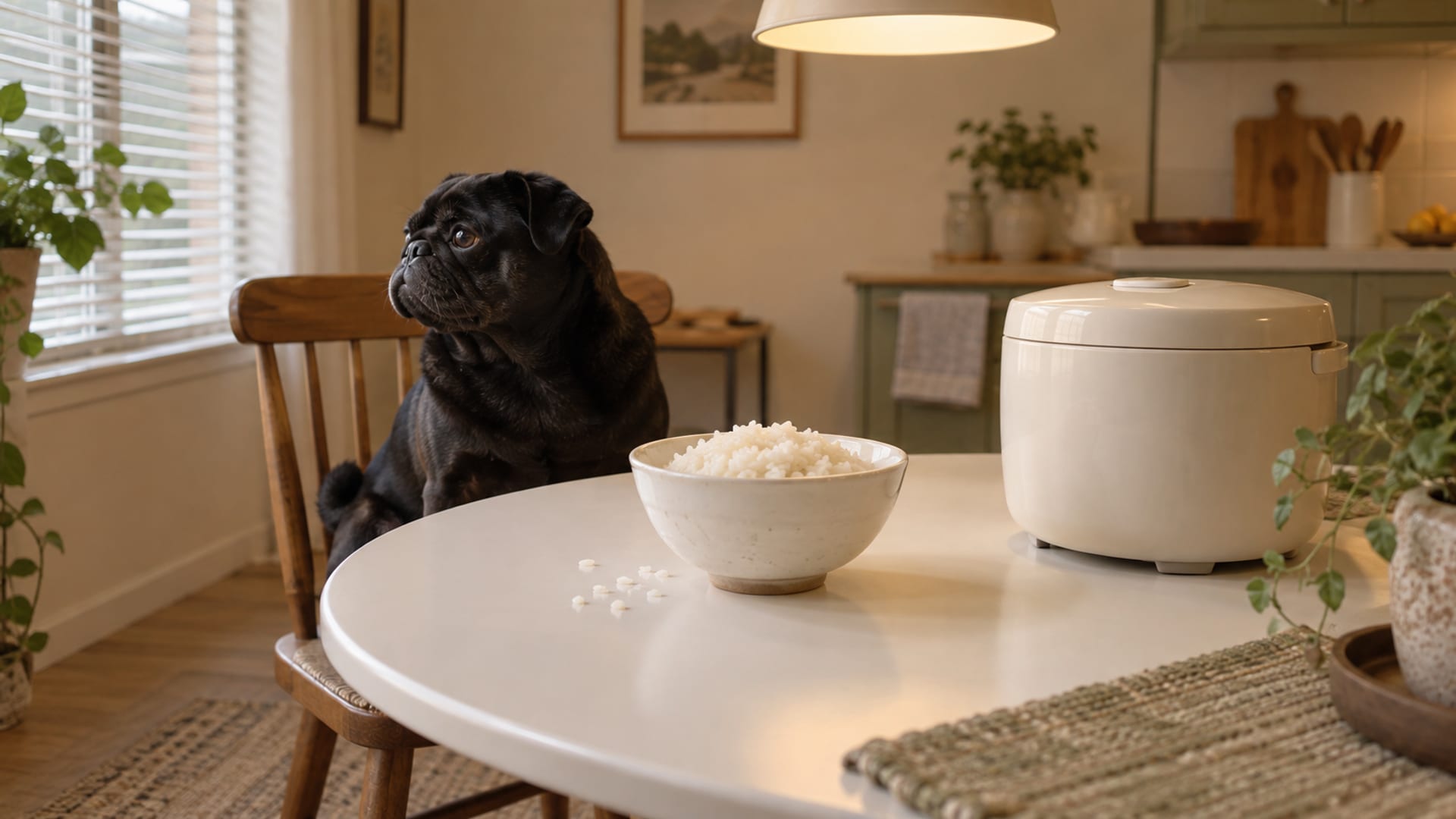
Yes. Plain, cooked rice is safe for most dogs, and the American Kennel Club notes that white rice is easy to digest, which is why it turns up in bland diets. Serve it cooked through, with no butter, salt or seasoning, and keep it a side to your dog's regular food.
If your dog helped themselves to a scoop of plain rice, nothing needs doing. If it was fried rice, a takeout container, rice pudding, or rice that had gone moldy, check what else was in it, because the other ingredients decide the answer.
Key takeaways
Tap a card to bring it forward.
- Plain cooked rice, white or brown, is safe for most dogs in small amounts.
- White rice is lower in fiber and gentler on the stomach; brown rice has more fiber and is harder to digest.
- White rice raises blood sugar more, so dogs with diabetes need their vet's input.
- Rice is an extra. Homemade chicken and rice is not a complete diet for the long run.
- Fried rice, seasoned mixes and rice pudding can contain onion, garlic, salt, sugar or raisins.
If your dog already ate rice
Plain rice is not a poisoning worry, so for most dogs this is about what came with it.
Tap or hover a row to highlight it.
| What they ate | What to do |
|---|---|
| What they atePlain cooked rice, white or brown | What to doNothing. A big bowlful may cause loose stool or gas. |
| What they ateDry, uncooked rice from the bag | What to doWatch for vomiting or a sore belly. Call if a small dog ate a lot. |
| What they ateFried rice or takeout rice | What to doCheck for onion, garlic and heavy salt. Call if they were in it. |
| What they ateSeasoned rice mix or instant flavored rice | What to doRead the seasoning packet and call if it lists onion or garlic. |
| What they ateRice pudding or sweet rice desserts | What to doCheck for raisins, chocolate or xylitol. Call if any are listed. |
| What they ateRice that smelled off or had mold on it | What to doCall your vet. Mold can produce toxins. |
For anything beyond plain rice, the ASPCA's advice is to keep the packaging so you can tell your vet or poison control what was eaten and how much. It also warns that some toxic ingredients act later, so a normal-looking dog after garlic fried rice still warrants a call.
Call your vet the same day for repeated vomiting, bad diarrhea, a swollen belly, marked tiredness, or a dog who cannot keep water down. Go in right away for choking, trouble breathing, collapse or seizures.
White, brown and other kinds of rice
Tap or hover a row to highlight it.
| Form | For dogs | Notes |
|---|---|---|
| FormPlain cooked white rice | For dogsYes | NotesLow in fiber and easy to digest |
| FormPlain cooked brown rice | For dogsYes, in moderation | NotesMore fiber; can be harder to digest (AKC) |
| FormRaw, dry rice | For dogsNot as food | NotesLess digestible and can upset the stomach |
| FormRice flour or brewer's rice in dog food | For dogsYes, as part of the food | NotesJudge the finished food as a whole |
| FormRice bran | For dogsOnly in a formulated food | NotesA fiber ingredient with different effects from whole rice |
| FormFried rice, seasoned or restaurant rice | For dogsCheck first | NotesOnion, garlic, salt and fat |
| FormRice pudding and sweet rice | For dogsNo | NotesSugar and dairy, sometimes raisins |
| FormMoldy or spoiled rice | For dogsNo | NotesPossible mold toxins |
The Merck Veterinary Manual names boiled white rice as a suitable carbohydrate in some diets for dogs with gut disease. Merck's nutrition chapter treats rice bran separately, as a source of fiber. The FDA's Bad Bug Book covers how spoilage and contamination change the risk of a food, and moldy rice falls under that.
How much rice, and how often
No one publishes a rice portion by dog size. The AKC's advice is to keep rice a small, occasional part of what your dog eats and to watch the extra calories, since rice is mostly carbohydrate and can add weight.
- Cook it fully and let it cool.
- Leave it plain: no salt, butter, oil, sauces, spices, onion or garlic.
- White rice for a touchy stomach, because it has less fiber than brown.
- Mix a spoonful into a meal before you think about bigger amounts, especially for a small dog.
Dogs with diabetes are the main exception. The AKC says white rice has a higher glycemic index than brown rice and should not be fed to a diabetic dog regularly without your vet's guidance, and a study of rice and pea diets in dogs found that a rice-based diet changed dogs' blood sugar and insulin after meals. Dogs who have had pancreatitis should not get fried, buttery or oily rice.
Rice for an upset stomach
Rice is a common part of a bland diet, and the Merck Veterinary Manual describes vets using low-fat, easily digested meals that can include rice with boiled chicken or low-fat cottage cheese, for example in dogs recovering from parvovirus. That is a short-term plan set by a vet for a specific problem.
Vomiting and diarrhea have many causes, and some are serious. Call your vet before treating it yourself if the diarrhea is bloody, severe or keeps coming back, or comes with vomiting, weakness or a puppy who is not eating. A homemade chicken-and-rice diet also lacks nutrients a dog needs, so it is not meant to be fed for weeks unless a veterinary nutritionist has set it up.
"My dog eats rice with every meal and is fine"
That can be completely true, and rice is also used as an ingredient in commercial dog foods. A dog doing well on a small daily scoop of plain rice tells you about that dog and that rice. It does not cover a small dog eating a pot of it, a diabetic dog on white rice every night, or a plate of garlic fried rice from the counter. Dogs also differ in how their stomachs handle fiber and changes in diet. And when the rice came with a toxic ingredient, the ASPCA notes some effects show up later, so feeling fine that evening is not the whole story.
Fried rice, rice cakes, rice milk and other rice products
- Fried rice: often cooked in oil with salt, onion or garlic. Skip it. Can dogs eat onions? explains why the onion matters.
- Rice cakes and rice crackers: often compressed, salted, flavored, coated or sweetened. Read the label.
- Rice milk: a processed drink that may contain sugar, salt, oil or sweeteners. It is not the same as plain rice.
- Rice water: the starchy water from cooking rice. It is not a treatment for diarrhea and does not replace a vet visit.
- Rice pudding: sugar and dairy, and sometimes raisins. Can dogs eat grapes? explains why raisins are a concern.
- Instant and flavored rice mixes: the seasoning packet often lists onion or garlic powder.
- Wild rice and other rice types: plain and cooked, they work as an occasional extra, but they are not interchangeable in a diet your vet has set.
Check what you learned
Quick check
Questions about dogs and rice
Is rice ok for dogs every day?
A small amount of plain cooked rice alongside a complete diet is fine for most dogs, and rice is also an ingredient in some complete dog foods. Trouble comes when rice replaces balanced food, when portions add too many calories, or when the dog has diabetes. Ask your vet if you plan to add rice to every meal.
What's better for dogs, rice or pasta?
For a sensitive stomach, plain white rice is the one vets use in bland diets, per Merck. Plain cooked pasta is also just a starch, but pasta tends to come with sauce, and sauces often carry garlic, onion and salt. Whichever you share, serve it plain and small.
Is brown rice or white rice better for dogs?
Both are fine plain and cooked. White rice is easier to digest; brown rice has more fiber and a lower glycemic index, according to the AKC.
Can puppies eat rice?
Yes, a little plain cooked rice. Puppies handle vomiting, diarrhea and sudden food changes less well, so keep the amount small and call your vet if a puppy has diarrhea.
Can dogs eat uncooked rice?
Dry rice is not poisonous, but it is harder to digest and can upset the stomach. Call your vet if a small dog ate a lot of it or starts vomiting.
Can cats eat rice?
A little plain cooked rice is used in some cat foods, but cats need animal protein and should not get rice in place of a complete cat food.
Sources
Checked September 24, 2026.
- American Kennel Club, Can Dogs Eat Rice?
- Merck Veterinary Manual, Chronic Enteropathies in Small Animals
- Merck Veterinary Manual, Canine Parvovirus Infection (Parvoviral Enteritis) in Dogs
- Merck Veterinary Manual, Nutritional Requirements of Small Animals
- ASPCA, What to Do if Your Pet Is Poisoned
- US Food and Drug Administration, Bad Bug Book, Second Edition
- PubMed, Effect of an extruded pea or rice diet on postprandial insulin and cardiovascular responses in dogs