

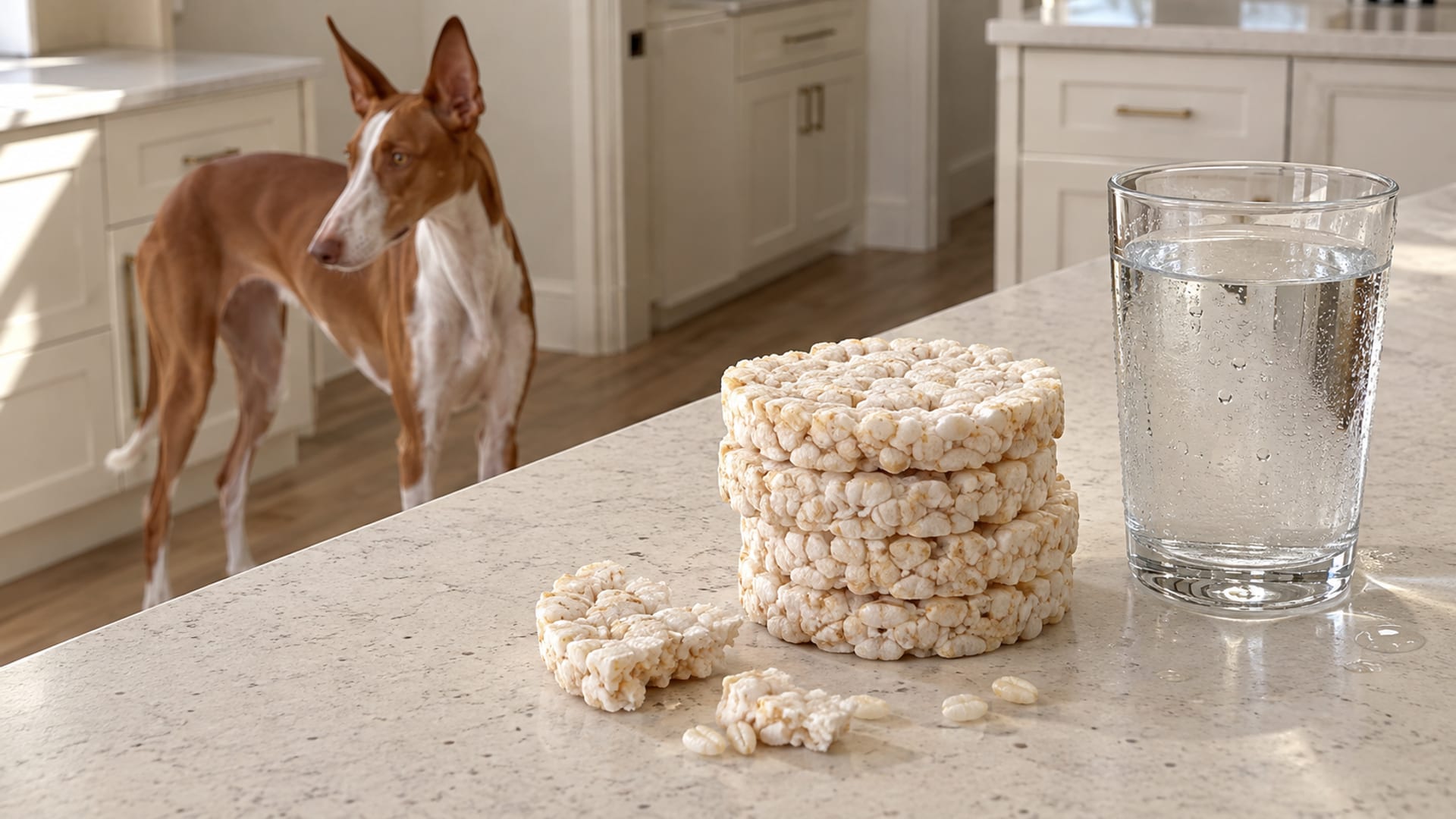
Yes, in a small amount. A piece of plain, unsalted rice cake is generally safe for a healthy dog, while salted and flavored kinds need an ingredient check for salt, onion, garlic, chocolate, cocoa and xylitol.
If your dog already got into one, grab the package first. A plain cake, a piece or two, and a dog acting like itself usually means you clear away the rest and keep an eye on things. Any of those ingredients, a lot of salt, a seasoning you can't identify, or a big dry piece that went down whole is a reason to call your vet or a pet poison line now.
The American Kennel Club considers plain rice safe for dogs when it's prepared without seasoning and given in moderation. What changes the answer is whatever the maker added, and how fast a dog swallows a dry, crumbly disc.
Key takeaways
Tap a card to bring it forward.
- A small piece of plain, unsalted rice cake is generally safe for a healthy dog as an occasional snack.
- Read the label on salted and flavored kinds; onion, garlic, chocolate, cocoa and xylitol each change the answer.
- Call your vet or a pet poison line for any of those, a lot of salt, an unknown seasoning, or a large piece swallowed whole.
- Choking, trouble breathing, collapse or seizures need emergency care right away.
- Rice cakes are an extra and never stand in for your dog's regular food.
What to do if your dog just ate a rice cake
Go through these in order; with a plain cake and a calm dog, you'll likely stop after step four.
- Head to an emergency vet for choking, breathing trouble, collapse or seizures. Severe weakness, repeated vomiting, bloody stool, marked tremors or fast-worsening illness also need hands-on care, and Cornell University's College of Veterinary Medicine treats a dog going downhill quickly as urgent.
- Move your dog away and pick up what's left. A dog that liked the first bite will go back for the rest of the sleeve.
- Find the package and read the ingredients. Plain, salted, cheddar, caramel and chocolate cakes often share a pantry shelf, and the label is the only way to know which one this was.
- Estimate how much went down. A few crumbs, one cake and half a bag are very different situations, especially for a small dog.
- Call if the label or the amount worries you. Reach your vet or a pet poison service for xylitol, chocolate, cocoa, onion, garlic, heavy salt, a mystery seasoning, or a large or intact piece swallowed. The ASPCA Animal Poison Control Center is open 24 hours, and the FDA lists your vet, an emergency hospital or an animal poison control center as the places to call.
- Have the details in front of you. The package, the ingredient list, your guess at the amount, the time and your dog's weight let the person on the phone judge the risk quickly.
- Hold off on home treatment. Pet Poison Helpline tells owners not to give home antidotes or make a dog vomit without professional advice, because the right step depends on what was in the cake.
For a little plain rice cake and a dog with no signs, a poison-line call usually isn't needed. Call your vet if signs show up later, or if your dog has diabetes or a history of pancreatitis.
Plain, salted and flavored rice cakes compared
The table sorts the kinds you're most likely to find in a pantry or lunch bag.
Tap or hover a row to highlight it.
| Type | What to know | What to do |
|---|---|---|
| TypePlain, unsalted puffed | What to knowGenerally safe in a small amount | What to doShare a small piece, or just watch your dog |
| TypeLightly salted or salted | What to knowSodium varies by product | What to doRead the label; call if a lot was eaten |
| TypeBrown rice | What to knowSame safety as white, though it may be harder to digest | What to doJudge it by the label, like any plain or salted cake |
| TypeCheddar, barbecue, spicy | What to knowSeasoning may include onion, garlic or extra salt | What to doCall for onion, garlic or an unknown seasoning |
| TypeChocolate, caramel or yogurt coated | What to knowChocolate and cocoa are toxic to dogs; coatings add fat and sugar | What to doCall for chocolate, cocoa or xylitol |
| TypeCrumbs and broken bits | What to knowNo separate toxic hazard; a big dry mouthful can cause choking | What to doWatch for gagging or coughing |
Salt is the one people underestimate. The Merck Veterinary Manual reports that signs of salt poisoning in dogs may start at roughly 2 to 3 grams of salt per kilogram of body weight, and that dogs short on water are at greater risk. That figure is for sodium chloride, which isn't the sodium number printed on a label, so it can't be turned into a safe cake count at home. Lab testing by the FDA found rice cake products ranging from unsalted to much higher in sodium. If a lot of salted cakes went down, read the label to your vet.
According to the AKC's list of people foods, onion and garlic contain compounds that damage a dog's red blood cells, and chocolate and cocoa contain theobromine and caffeine. The AKC's page on bread flags xylitol in baked goods, and xylitol can drop a dog's blood sugar fast and injure the liver. Our entries on onions, garlic and chocolate go further.
How to share a piece of plain rice cake
If your dog is staring at your snack, a small piece of plain, unsalted cake now and then is reasonable. Break it into bits first, since a dry disc can crumble into a mouthful that's hard to get down. Skip anything with seasoning, a coating, a sweetener, onion, garlic, chocolate or cocoa, and keep fresh water nearby. Check any topping, like peanut butter, too.
Keep it occasional. The Merck Veterinary Manual notes that diets built from a limited set of foods can leave dogs short on nutrients, and your dog's complete food still does the real work.
Some dogs need more care with this snack:
- Small dogs. The same amount of salt or seasoning is a bigger dose for a dog that weighs less, according to Merck.
- Puppies. They're more likely to choke on a dry piece and to get dehydrated if vomiting or diarrhea follows.
- Dogs with diabetes. The AKC notes that white rice has a higher glycemic index and shouldn't be fed to diabetic dogs regularly, so ask your vet first.
- Dogs prone to pancreatitis. Skip high-fat coated cakes. The Merck Veterinary Manual's page for dog owners lists table scraps as a possible trigger and names Miniature Schnauzers, Yorkshire Terriers, Cocker Spaniels, Dachshunds and Poodles among breeds where it shows up more often.
Signs to watch for, and when they show up
After a small piece of plain rice cake, the likely result is nothing, or a mild upset stomach: vomiting, diarrhea, gas, a sore belly or less interest in dinner.
A large dry piece is a different problem. Gagging, coughing, trouble breathing, swallowing over and over, vomiting, belly pain, low energy or not keeping food down can mean something is stuck, and timing depends on where it lodged.
With a lot of salt, Merck describes vomiting within several hours, then weakness, diarrhea, a wobbly walk, muscle tremors and seizures. Severe cases can lead to brain swelling and death, so a big salty haul is worth a call even if your dog seems fine at first.
Onion and garlic can take a while to show, because red blood cell damage builds over time. Xylitol can drop blood sugar quickly. Chocolate can cause vomiting, restlessness, tremors, an abnormal heart rate, seizures or collapse.
My dog ate rice cakes before and was fine
That happened. A dog grabs a cake off the coffee table and nothing comes of it. For that dog, that day, it was fine.
It still isn't a rule for every rice cake or every dog:
- The amount. Merck puts salt poisoning signs at roughly 2 to 3 grams per kilogram, so a nibble and a whole sleeve aren't the same event.
- The dog's size. One salted cake is a much larger dose for a small terrier than for a big retriever.
- The product. Last time it may have been plain; this time it might be cheddar, chocolate or caramel.
- The individual dog. A dog with a history of pancreatitis can react to something its housemate handles fine.
- Delayed signs. Onion and garlic harm can take a while to show, so a quiet evening isn't the final word.
- Luck. Sometimes a dog simply ate too little of the risky ingredient to get sick.
The earlier experience was real. Read this label, count this amount and watch this dog.
Rice crackers, tteok, senbei and other look-alikes
"Rice cake" covers more than one food. In the US it usually means the round puffed snack. Korean tteok is a chewy cake made from rice, Japanese senbei is a crisp rice cracker, and a homemade rice cake is often pressed cooked rice. They differ in moisture, salt, sugar, fat and seasoning, so each needs its own label or recipe check.
Rice crackers may have soy sauce, onion, garlic, seaweed seasoning or a lot of sodium. A dessert called rice cake can include raisins, chocolate, xylitol or macadamia nuts, and those ingredients set the answer.
Plain cooked rice has its own entry, and rice milk and rice water are separate products. Also, the ASPCA's plant list uses "Formosa rice tree" as a common name for Fatsia japonica, a plant unrelated to the snack.
Check what you learned
Three quick questions on what matters most in the moment.
Quick check
Questions about dogs and rice cakes
A few more things owners ask.
Are brown rice cakes better for dogs than white ones?
For safety they're treated the same. Brown rice may sit a little harder on some stomachs, while the AKC points out that white rice has a higher glycemic index, which matters for diabetic dogs. The flavor and salt count for more than the rice color.
Can my dog have a rice cake every day?
A daily rice cake starts to crowd out food that actually meets your dog's needs. Save it for the odd small piece, and count those calories as part of the day's food.
My dog ate a Quaker or Lundberg rice cake. Does the brand matter?
The flavor matters far more than the name on the bag. Check the ingredient list on the exact package and follow the same steps: plain and a little, watch; seasoned, heavily salted or sweetened with xylitol, call.
Is a rice cake safe for my cat too?
Plain rice cake isn't a known cat toxin, and the same risks apply: salt, choking and toxic flavorings. Cats have different nutritional needs from dogs, according to the Merck Veterinary Manual, so a snack that suits one isn't automatically right for the other.
Sources
Checked September 25, 2026.
- American Kennel Club, Can Dogs Eat Rice?
- American Kennel Club, People Foods Dogs Can and Can't Eat
- American Kennel Club, Can Dogs Eat Bread?
- Merck Veterinary Manual, Salt Toxicosis in Animals
- Merck Veterinary Manual, Nutritional Requirements of Small Animals
- Merck Veterinary Manual, Pancreatitis and Other Disorders of the Pancreas in Dogs
- ASPCA, ASPCA Poison Control
- ASPCA, Toxic and Non-Toxic Plant List, Dogs
- Pet Poison Helpline, Emergency Instructions
- Cornell University College of Veterinary Medicine, First-aid for Poisonous Substances
- U.S. Food and Drug Administration, Who Do You Call if You Have a Pet Emergency?
- U.S. Food and Drug Administration, Full Analytical Results, Rice Products