

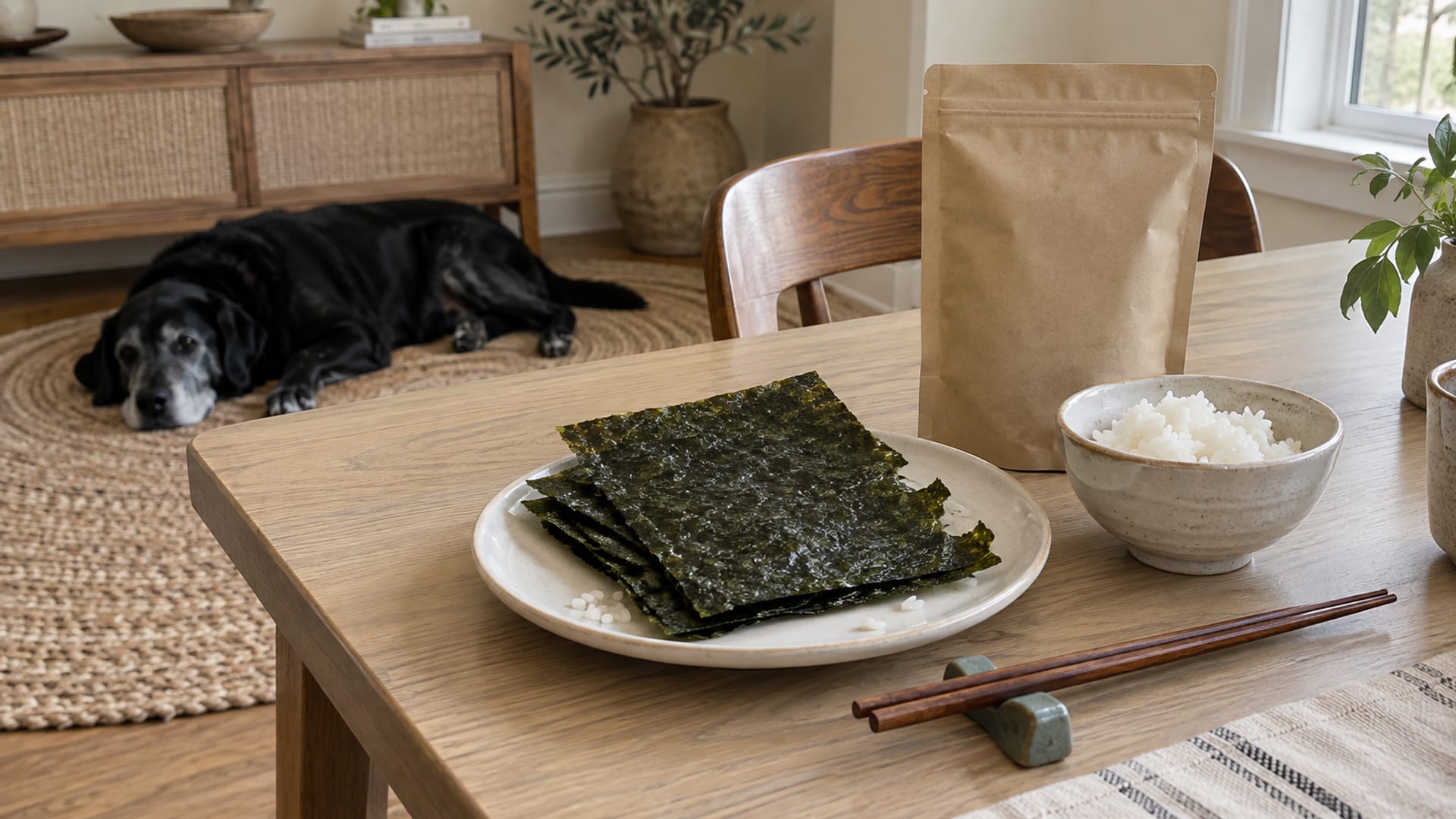
A small piece of plain nori, the pressed sheets sold with no salt or garlic added, can be given to a dog in moderation, according to the AKC. Seaweed your dog picked up on the beach is another matter: it can carry salt, sand and hidden debris, and long or dried strands can get stuck in the gut.
If your dog ate a bite of plain packaged seaweed and is acting like themselves, keep the package and watch them. If it was beach seaweed, an unknown amount, a seasoned snack, a kelp supplement, or scum from a pond or lake, call your vet or a poison line now.
Key takeaways
Tap a card to bring it forward.
- Plain, unseasoned nori in a small amount is generally fine for a healthy dog.
- Keep dogs off washed-up and dried beach seaweed. Salt, sand, debris and blockage are the risks.
- Blue-green algae in ponds and lakes can kill a dog fast. Call right away after any contact.
- Seaweed snacks, seaweed salad and sushi often come with salt, soy sauce, garlic or onion.
- Leave kelp powder and seaweed supplements to your vet, because iodine levels vary widely.
My dog ate seaweed: what to do now
Tap or hover a row to highlight it.
| What your dog ate | What to do |
|---|---|
| What your dog ateA bite of plain packaged nori | What to doKeep the package and watch for vomiting or diarrhea over the next day or two. |
| What your dog ateSeasoned seaweed snacks, seaweed salad or sushi | What to doRead the label. Call your vet if it lists garlic or onion, is very salty, or your dog ate a lot. |
| What your dog ateSeaweed from the beach, wet or dried | What to doCall your vet, especially for a large or unknown amount, or long, dry or tangled strands. |
| What your dog ateKelp powder or an iodine supplement | What to doCall your vet or a poison line with the product and how much is gone. |
| What your dog ateScum or algae from a pond, lake or bloom, or red tide | What to doCall now, before any signs show. |
The ASPCA says to call your vet or its poison control center right away if you think your pet swallowed something that could be toxic. Before you dial, have your dog's weight, the kind of seaweed or product, a rough amount, and the time it happened.
Get to a vet right away for repeated vomiting or retching, belly pain, weakness, tremors, seizures, trouble breathing, yellow gums or eyes, collapse, or a dog who refuses food.
Which kinds of seaweed are safe
Tap or hover a row to highlight it.
| Form | Safe? | What matters |
|---|---|---|
| FormPlain nori sheets | Safe?Yes, a small amount | What mattersOnly with no salt, garlic or seasoning added |
| FormPlain kelp or dulse | Safe?Small amounts only | What mattersIodine content differs a lot from one seaweed to the next |
| FormRoasted seaweed snacks | Safe?Check the label | What mattersOften salted, oiled, or flavored with soy sauce, garlic, onion or chili |
| FormSeaweed salad | Safe?Better not | What mattersUsually dressed with vinegar, sugar, sesame oil, salt or soy sauce |
| FormSushi | Safe?Better not | What mattersRaw fish, soy sauce and wasabi come with the nori |
| FormKelp powder, sea moss, seaweed supplements | Safe?Only in an amount your vet sets | What mattersConcentrated, and products vary in iodine and contaminants |
| FormWild or washed-up beach seaweed | Safe?No | What mattersSalt, sand, parasites and debris; dried clumps can expand and block the gut |
| FormBlue-green algae or red tide | Safe?No, and call now | What mattersToxic algae, a separate danger from food seaweed |
The AKC's warnings about beach seaweed cover salt, long strands that can lodge in the intestines, hidden animals and parasites, and dried pieces that swell. Cooking does not fix a salty, seasoned or dirty seaweed. Seaweed can also take up arsenic and other metals from the water it grows in, and the FDA monitors arsenic in foods and supplements, which is one more reason to stick with food-grade products.
Garlic and onion in a seasoned snack are dangers of their own. Can dogs eat garlic? covers what to do about those.
How much seaweed to give, and how
No veterinary source sets a seaweed portion by dog size, so keep it small: a torn strip of plain nori once in a while, less for a small dog.
- Use a food-grade product with an ingredient list you can read.
- Tear it into small pieces so it cannot wad into a lump.
- Give it now and then, alongside your dog's regular food.
- Do not stir kelp powder into meals on your own. Kelp and other brown seaweeds can hold high and uneven amounts of iodine, and the AKC cautions that too much iodine is a concern.
- If your dog has thyroid disease or takes thyroid medicine, ask your vet before giving any seaweed or kelp.
- Dogs with kidney or heart disease, or on a low-salt diet, should skip salted seaweed snacks.
Signs to watch for, and when
Too much of any seaweed can bring vomiting, diarrhea, belly discomfort, thirst, tiredness or a dog who does not want to eat.
A blockage from beach seaweed can take anywhere from hours to several days to show. Lauren Jones, VMD, answering an owner's question on Petco's vet Q&A, said appetite loss and vomiting could appear over the next few days. Watch for:
- vomiting again and again
- refusing food
- a sore or tight belly
- unusual tiredness
- straining without passing stool
Salt from seaweed or seawater can cause vomiting, diarrhea, heavy thirst, tiredness, tremors and seizures. Toxic blue-green algae moves much faster. Pet Poison Helpline describes nerve toxins that can cause tremors, seizures, breathing trouble and death within an hour, and liver toxins that can cause vomiting, weakness, yellowing and death within 24 hours to several days. None of this is expected from a strip of plain nori.
"My dog eats seaweed at the beach every summer"
Plenty of beach dogs chew seaweed and go home fine, and that is real for that dog. It still does not make beach seaweed safe for the next dog, or for the same dog next summer. Maybe they only swallowed a little. Maybe it was wet and loose that day, where a dried clump would have swelled. A big dog gets far less per pound from the same mouthful than a small one does. What washes up changes with every tide, and sand, shells, dead animals or algae can come along with it. A blockage can also take a few days to show, so a dog who seemed fine that evening may not have been. Bring a toy or a chew to the beach and steer your dog away from the tide line.
Nori, kelp, sea moss and other names
- Nori, laver and gim: the pressed sheets used for sushi and snacks. Plain is the only version to share.
- Kelp: a loose name for several brown seaweeds with different iodine levels. Kelp powder and kelp meal are concentrated.
- Wakame, kombu, dulse and sea lettuce: different seaweeds, same rule: small, plain and food grade.
- Sea moss: usually an edible red seaweed, but products may add iodine, minerals or herbs.
- Seaweed dental powders: formulated products that need a label-by-label look, and a word with your vet if your dog has thyroid trouble.
- Sargassum: the brown seaweed that piles up on some beaches. Treat it like any beach seaweed.
- Blue-green algae: cyanobacteria, a completely different organism from nori or kelp, which can bloom in ponds and lakes.
- Red tide: a harmful algae bloom in the sea, also unrelated to the seaweed people eat.
Check what you learned
Quick check
Questions about dogs and seaweed
Can dogs eat nori?
Yes, a small amount of plain nori with no added salt, garlic, onion or other seasoning is generally fine.
Can I add kelp powder to my dog's food?
Not without your vet. Kelp types differ in iodine, and too much iodine can affect the thyroid. A vet can decide whether your dog needs it and how much.
What if my dog ate seaweed at the beach?
Call your vet if you do not know how much went down, if the seaweed was dried or tangled, or if your dog starts vomiting, stops eating, seems sore in the belly or turns tired and weak.
Can dogs eat seaweed salad or sushi?
The seaweed itself is seldom the issue. Seaweed salad and sushi can carry salt, soy sauce, garlic, onion, spice, oil or raw fish. Can dogs eat fish? covers the raw fish side.
Is blue-green algae the same as seaweed?
Blue-green algae is cyanobacteria, a different organism. Some blooms make liver or nerve toxins that can kill a dog quickly, so any contact is a reason to call.
Can cats eat seaweed?
The same concerns apply to cats: salt, too much iodine, seasonings, contaminants and blockage. Blue-green algae and dirty beach material are dangerous for cats as well.
Sources
Checked September 24, 2026.
- American Kennel Club, Can Dogs Eat Seaweed?
- ASPCA, Beach Day the Safe Way: Pet Safety Tips
- Pet Poison Helpline, Summer Pet Poisons
- U.S. Food and Drug Administration, Arsenic in Food
- Petco, Lauren Jones, VMD, My Puppy Ate Seaweed at Beach. Should I Worry About Blockage?