
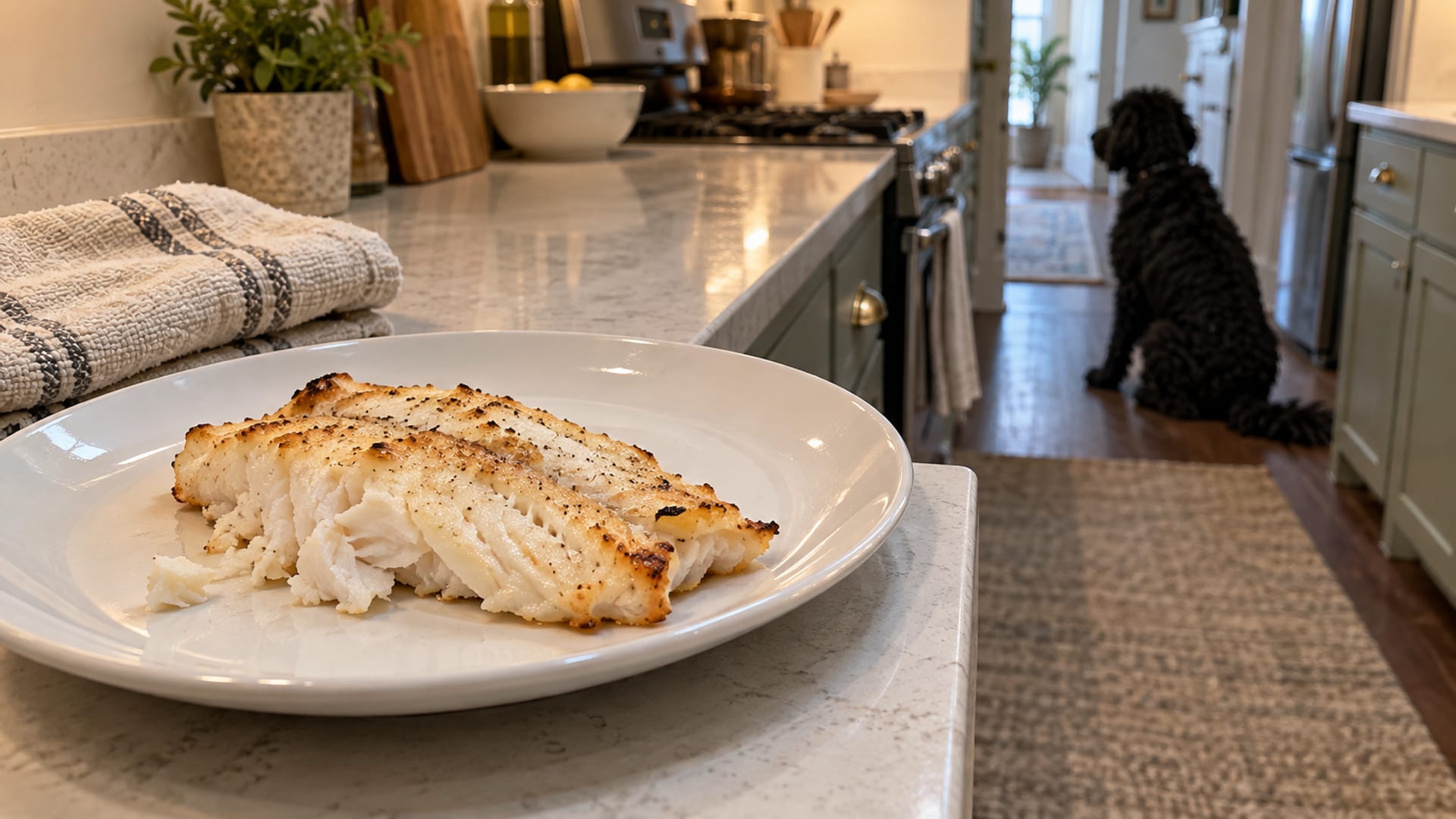
Yes. Plain fish that is fully cooked, cooled and completely deboned is safe for most dogs in moderation. The American Kennel Club lists cooked fish among foods dogs can eat and suggests keeping it to no more than twice a week. Raw or undercooked fish is where the trouble starts, especially salmon, trout and char from the Pacific Northwest.
If your dog ate a bite of your plain baked cod, there is nothing to do. If they ate raw fish, fish scraps from a river trip, a fish with bones in it, or a heavily seasoned dish, the table below covers each case.
Key takeaways
Tap a card to bring it forward.
- Plain, fully cooked, boneless fish is a fine occasional extra for most dogs.
- Raw salmon, trout and char can carry salmon poisoning disease, which can kill a dog without treatment.
- Signs of that disease usually start 5 to 7 days after the fish, so a normal-looking dog is no guarantee.
- Take out every bone, and skip fried, smoked, salted or heavily seasoned fish.
- Pick lower-mercury fish like cod, sardines or salmon over swordfish, shark or king mackerel.
My dog ate fish: what to do now
Tap or hover a row to highlight it.
| What they ate | What to do |
|---|---|
| What they ateA bite of plain, cooked, boneless fish | What to doNothing. A big helping may cause a loose stool. |
| What they ateRaw or undercooked salmon, trout or char | What to doCall your vet today, even if your dog seems fine. Say where the fish came from. |
| What they ateOther raw fish, or fish scraps from a river, beach or fishing trip | What to doCall your vet and describe the fish, where it was found and when. |
| What they ateFish with bones, a fish head or a whole fish | What to doCall your vet. Watch for gagging, drooling, pawing at the mouth or vomiting. |
| What they ateSmoked, salted, fried or seasoned fish | What to doCheck for onion, garlic and a lot of salt or fat. Call if any were in it, or if it was more than a small bite. |
| What they ateFish oil capsules or a fish supplement | What to doCall with the label in hand. |
With raw fish, there is no amount small enough to rule out illness. Tell your vet the kind of fish, whether it was raw, where it was caught or found, roughly how much, when, and whether any bones went down. The ASPCA says that even when a pet shows mild signs or none after eating something potentially hazardous, you should get help without waiting for the signs to get worse.
Head to an emergency vet now for choking, trouble breathing, collapse, seizures, or bloody diarrhea.
Which fish, and which forms, are fine
Tap or hover a row to highlight it.
| Form | Safe? | Why |
|---|---|---|
| FormPlain fish, fully cooked and boneless | Safe?Yes, in moderation | WhyThe AKC's recommended way to serve fish |
| FormRaw or undercooked salmon, trout or char | Safe?No | WhyCan carry the fluke that causes salmon poisoning disease |
| FormOther raw fish | Safe?No | WhyCan carry parasites and bacteria |
| FormFish bones | Safe?No | WhyCan choke a dog, lodge in the gut or pierce it |
| FormCooked fish skin, plain | Safe?Small amounts | WhyNot toxic, but fatty; no seasoning and no bones |
| FormHeads, tails, guts and whole carcasses | Safe?No | WhyBones, parasites and concentrated contaminants |
| FormCanned fish in water, low salt | Safe?Yes, a little | WhyAvoid cans with oil, sauce, onion or garlic |
| FormSmoked, salted, cured or pickled fish | Safe?No | WhySalty, and some of it was never cooked |
| FormFish sticks, breaded or fried fish | Safe?No | WhyBreading, oil and salt |
| FormHome-dried raw fish | Safe?No | WhyDrying may not kill parasites or bacteria |
| FormFish-based dog food, complete and balanced | Safe?Yes | WhyMade and processed for dogs |
The organism behind salmon poisoning disease is a bacterium called *Neorickettsia helminthoeca*, carried by a tiny fluke that lives in fish. The Merck Veterinary Manual says the disease occurs mainly in the Pacific Northwest. Cooking kills the fluke, which is why cooked fish is fine and raw fish is not. Our page on salmon for dogs goes deeper on salmon itself, and can dogs eat fish bones? covers bones.
How much fish, how often, and how to cook it
The AKC suggests fish no more than twice a week, as a small portion on top of your dog's normal food. It is a topper or a treat, and it does not replace a complete and balanced diet. To prepare it:
- Cook it all the way through. The AKC gives an internal temperature of 140°F for salmon.
- Let it cool, then pick out every bone by hand.
- Serve it plain: no oil, butter, salt, sauce, onion or garlic.
- Break it into small pieces and mix it into the regular meal.
No published chart gives grams of fish by body weight, so keep it small for a small dog and see how the first serving goes.
Some fish carry more mercury than others. The FDA puts shark, swordfish, king mackerel, Gulf of Mexico tilefish, marlin, orange roughy and bigeye tuna in its highest-mercury group. Lower-mercury picks for a dog's bowl include salmon, sardines, cod, pollock, whitefish and trout, cooked.
Go lighter on fish, or skip fatty and fried kinds, for a dog with pancreatitis, obesity or kidney disease, and ask your vet what fits the diet they are on.
Salmon poisoning disease: signs and timing
Salmon poisoning disease is slow to show. According to the Merck owner guide, signs usually appear suddenly about 5 to 7 days after a dog eats infected fish, and can take as long as 33 days. Watch for:
- fever
- not eating
- weakness or tiredness
- vomiting
- diarrhea, sometimes bloody
- weight loss or dehydration
- swollen lymph nodes
- discharge from the eyes or nose
Merck says up to 90% of dogs that get sick die without treatment, and that untreated dogs can die within 7 to 10 days of the first signs. Vets treat it with antibiotics, medicine for the fluke and fluids, which is why the early call matters. UC Davis points out that dogs often pick up raw fish while scavenging along rivers and coasts, or on fishing and hunting trips.
Plain cooked fish is a different story. If it upsets your dog at all, expect vomiting, a loose stool, a sore belly or a skipped meal.
"My dog has eaten raw fish before and was fine"
That happens, and it can be true. Not every fish carries the infected fluke, and a fish from outside the Pacific Northwest is less likely to. The fish may have been cooked, or a species that does not carry the disease. The amount may have been too small to cause illness, and dogs vary in how sick they get. There is also the timing: signs can take a week or more, so a dog who looked fine the next morning was not yet in the clear. The AKC warns that even a small piece of contaminated raw salmon can make a dog sick. Cook the fish, every time, and call when a raw one gets eaten.
Canned fish, fish sticks, fish oil and other fish products
- Canned tuna: fine as a small, occasional bite if packed in water with no added salt. The AKC notes that tuna species differ in mercury, and the FDA rates canned light tuna lower than bigeye.
- Canned sardines and salmon: pick water-packed and low salt. The soft bones in some cans are different from sharp fresh bones, but oil and sauces are still worth skipping.
- Smoked salmon, lox and gravlax: may be cured without being cooked, and they are salty. Skip them.
- Fish sticks and fried fish: breading, oil and salt make them a poor treat.
- Fish jerky and dried fish: only if it is made for dogs or was fully cooked before drying.
- Fish oil: a supplement, not a food, and a separate question for your vet.
- Fish-flavored dog food and treats: fine when they are complete and balanced and made for dogs.
- Shellfish and shrimp: a different question from fin fish; see can dogs eat shrimp?
Cats can pick up the same fluke from raw fish, so a cat that shared the catch is worth mentioning when you call.
Check what you learned
Quick check
Questions about dogs and fish
Can dogs eat cooked fish?
Yes. Plain fish, fully cooked, cooled and deboned, is fine in moderation. Leave out oil, butter, sauces, onion, garlic and heavy salt.
Can dogs eat raw salmon or raw fish?
No. Raw salmon, trout and char can carry the fluke that causes salmon poisoning disease, and other raw fish can carry parasites and bacteria. Cook it first.
What if my dog ate raw fish but seems fine?
Call your vet anyway, especially if it was salmon, trout or char from the Pacific Northwest. Signs usually start 5 to 7 days later and can be delayed up to 33 days.
Can dogs eat fish bones?
No. Fish bones can choke a dog or injure the gut. Call your vet if your dog swallowed bones, or if you see gagging, pain, vomiting or trouble breathing.
Can dogs eat tuna?
A small, occasional bite of plain tuna is fine. The FDA places bigeye tuna in its highest-mercury group and canned light tuna in a lower one, so keep tuna an occasional extra and skip the big steaks. Can dogs eat tuna? has the details.
Sources
Checked September 24, 2026.
- Merck Veterinary Manual, Salmon Poisoning Disease in Dogs
- Merck Veterinary Manual, Salmon Poisoning Disease and Elokomin Fluke Fever in Dogs
- University of California, Davis School of Veterinary Medicine, Salmon Poisoning Disease in Dogs
- American Kennel Club, Which Human Foods Can Dogs Eat and Which Are Dangerous?
- American Kennel Club, Can Dogs Eat Salmon?
- American Kennel Club, Can Dogs Eat Tuna?
- U.S. Food and Drug Administration, Advice about Eating Fish
- ASPCA, My Pet Ate Something! When Should I Seek Help?