

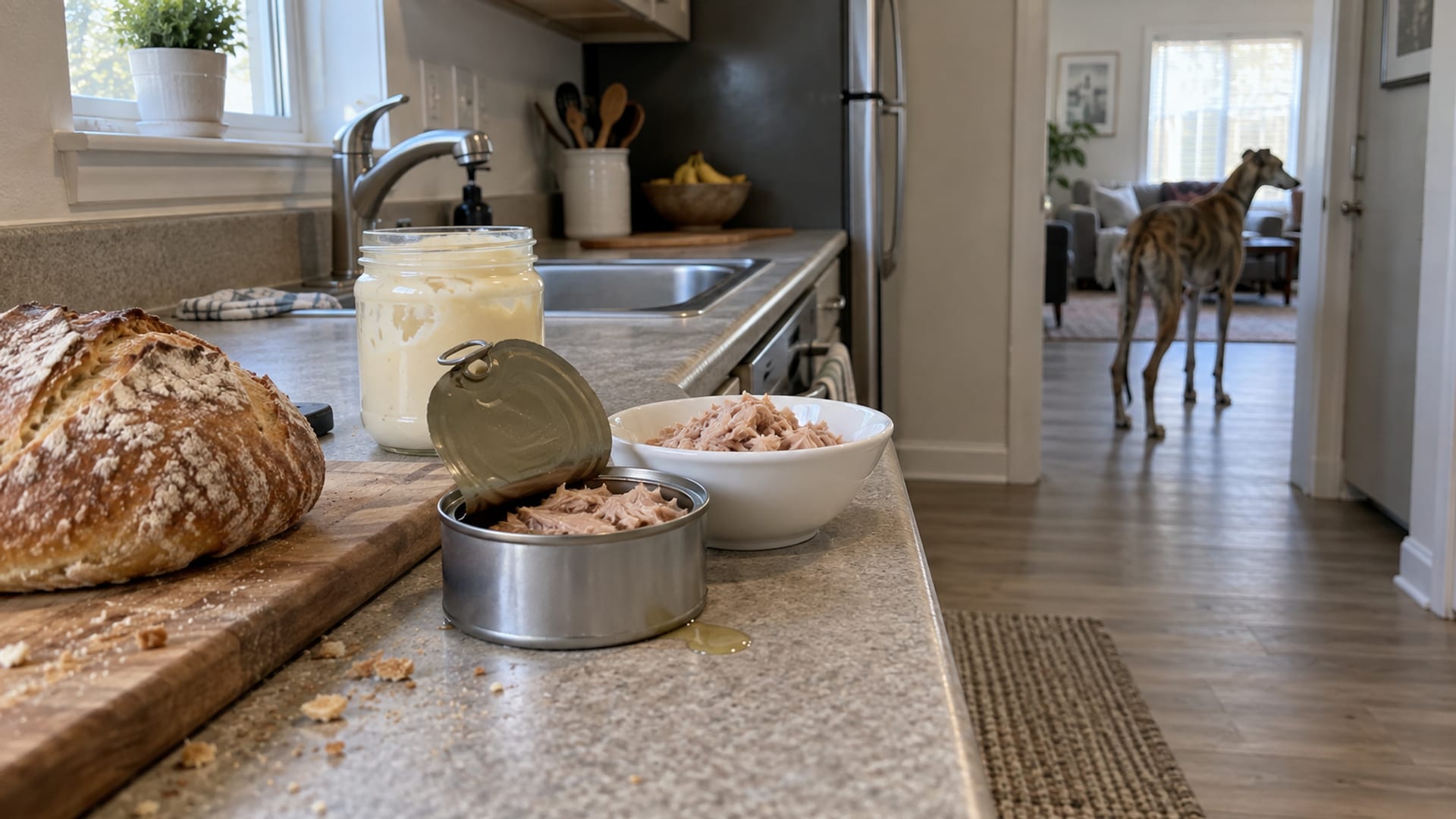
Not as a regular food. A small bite of plain tuna is unlikely to cause poisoning, but tuna can contain methylmercury, and the American Kennel Club advises avoiding it because it tends to run high in mercury. Mercury builds up with repeated meals, and the damage it does to the nerves and kidneys can be permanent.
If your dog licked the can or grabbed a forkful of plain tuna, do not give any more and watch them as usual. Call your vet if it was a lot, if it was albacore, bigeye or raw tuna, if it had onion, garlic or bones in it, or if your dog has been getting tuna often.
Key takeaways
Tap a card to bring it forward.
- One stolen bite of plain tuna is not expected to cause mercury poisoning.
- Tuna carries methylmercury, which accumulates over repeated meals, so skip it as a regular treat.
- Albacore (white) tuna usually has about three times the mercury of canned light tuna, and bigeye is higher still.
- Tuna salad, sushi and seasoned tuna add onion, garlic, salt, oil or raw-fish risks.
- Mercury signs can take days to weeks to show: stumbling, tremors, blindness, odd behavior.
Your dog ate tuna: what to do now
Tap or hover a row to highlight it.
| What they ate | What to do |
|---|---|
| What they ateA bite or a lick of plain canned light tuna | What to doNothing more than keeping the rest out of reach. Do not offer extra. |
| What they ateA whole can, or albacore or bigeye tuna | What to doCall your vet for advice with the label and your dog's weight. |
| What they ateRaw tuna, sushi or poke | What to doCall your vet. Raw fish can carry bacteria or parasites, and sushi may include other ingredients. |
| What they ateTuna salad, casserole or a sandwich | What to doCheck for onion, garlic, salt and mayonnaise or oil. Call if onion or garlic was in it. |
| What they ateTuna with bones, skin or fins | What to doWatch for gagging or choking and call your vet. |
| What they ateTuna that smelled off or sat out | What to doCall your vet. Spoiled fish can make a dog sick. |
| What they ateTuna several times a week for a while | What to doBook a vet visit and mention the tuna, even if your dog seems fine. |
When you call, have the can or package, the kind of tuna if you know it, how much, when, and your dog's weight. Leave treatment to the vet: Merck describes testing, supportive care and, when needed, drugs that bind mercury, all of which happen at the clinic.
Pet Poison Helpline points out that poisoning signs overlap with other illnesses, which is one more reason to tell the vet about any tuna your dog has been eating.
Why tuna gets a caution
Tuna does not poison a dog in one bite. The concern is methylmercury, a form of mercury that builds up in fish and then in whoever eats the fish. Cooking and canning do not remove it.
The Merck Veterinary Manual says the effects depend on the form of mercury, how much, and how often. It describes organic mercury poisoning as able to cause lasting nerve and kidney damage, and it can be fatal in advanced cases. Merck also notes that young, growing animals are especially sensitive, and that organic mercury can cross the placenta, so puppies and pregnant dogs are the ones to be most careful with.
Size plays in too. The same forkful is a bigger dose for a 10-pound dog than for a 70-pound one.
Which tuna carries more mercury
"Tuna" covers several fish, and the FDA sorts them differently for people.
Tap or hover a row to highlight it.
| Type | Label names | Mercury, per FDA |
|---|---|---|
| TypeSkipjack | Label namesCanned light tuna, sometimes bonito | Mercury, per FDALower than albacore, still present |
| TypeYellowfin | Label namesYellowfin | Mercury, per FDAListed as a "Good Choice" for people |
| TypeAlbacore | Label namesWhite tuna | Mercury, per FDAAbout three times canned light tuna |
| TypeBigeye | Label namesBigeye | Mercury, per FDAAmong the highest-mercury fish |
The three-to-one comparison comes from the FDA's questions and answers on its fish advice. None of these categories were set for dogs. They show which tuna is the bigger concern if your dog gets into some.
Canned, raw, in oil and other forms
- Canned light tuna in water, no salt added: the least risky form if a dog gets some. It still carries mercury.
- Tuna in oil: extra fat and calories, and the oil does nothing about mercury. Fatty food can also upset the stomach.
- Salted or seasoned tuna, tuna with broth: extra sodium, and seasonings may include onion or garlic.
- Tuna water or juice from the can: it can hold dissolved fish, sodium and some of what is in the tuna. Avoid using it as a routine topper.
- Raw tuna, sushi and poke: mercury plus possible bacteria and parasites. The AKC's fish guidance calls for fish to be fully cooked, plain and boneless.
- Bones, skin, fins: choking, mouth injury or a blockage. Can dogs eat fish bones? walks through what to do.
- Dried, freeze-dried or powdered tuna treats: removing the water can concentrate what is left, mercury included. Read the label.
If your dog does get some tuna
If tuna ends up in the bowl anyway, the least risky version is a small amount of plain, boneless, fully cooked tuna, or canned light tuna in water with no added salt, oil, onion, garlic or seasoning. Treat that as an occasional exception.
If you are weighing other fish, can dogs eat salmon? covers another one owners often share.
Signs of mercury poisoning, and when they show
Mercury trouble usually comes from repeated meals over time. Merck says signs can take days to develop, and its pet owner guide notes that animals may look normal until several weeks after organic mercury poisoning.
Watch for:
- stumbling, poor coordination or trouble judging where their feet are
- tremors or seizures
- blindness or bumping into things
- odd behavior, dullness or depression
- not eating
- signs of kidney trouble, such as changes in drinking or peeing
Any of those after a stretch of tuna meals means a call to your vet today. Tremors, seizures, collapse, repeated vomiting, bloody diarrhea or trouble breathing mean go now.
"My dog has eaten tuna for years with no problem"
That may be true for your dog, and it is worth taking seriously. A lot depends on which tuna it was, how big each serving was and how often, and the size of the dog. Canned light tuna now and then is a different exposure from albacore every week. Mercury also works quietly: signs can lag days or weeks behind the meals, and early nerve or kidney changes are hard to spot at home. A dog that has done fine so far tells you about that dog, on that amount. Another dog on the same can could fare differently.
Cat food, tuna treats and look-alikes
- Tuna cat food: made for cats, and can dogs eat cat food? covers a dog that raided the cat's bowl. Cats build up mercury too: a study of kittens fed commercial cat food found mercury accumulating in their tissues, so human tuna is a poor regular food for them as well.
- Dog food made with fish: a complete, balanced formula is a different thing from feeding canned tuna. Follow the label.
- Tuna salad and tuna melts: the onion, garlic, salt and fat are extra problems, and onion is the one to act on fast: can dogs eat onions? explains why.
- "Bonito": on some labels this means skipjack. Check what the can actually says.
Check what you learned
Quick check
Questions about dogs and tuna
Is it an emergency if my dog ate a little canned tuna?
Usually not. A small amount of plain tuna is low risk. Call your vet if it was a large or repeated amount, albacore or bigeye, or if any signs show up.
Is tuna in water better than tuna in oil for dogs?
Water-packed tuna skips the extra oil and fat. It has the same mercury, so it is still an occasional exception at most. Check the label for salt and seasonings.
Can dogs eat raw tuna?
Better not. Raw tuna keeps its mercury and may carry bacteria or parasites. The AKC recommends fish only fully cooked, plain and boneless.
Can puppies eat tuna?
Leave it out. Merck says young, developing animals are especially sensitive to organic mercury.
Which tuna has the most mercury?
The FDA lists bigeye among the highest-mercury fish. Albacore, sold as white tuna, usually has about three times the mercury of canned light tuna, which is mostly skipjack.
What does mercury poisoning look like in a dog?
Stumbling, tremors, seizures, blindness, odd behavior and kidney problems, often days to weeks after the exposure. If you notice them, call your vet the same day.
Sources
Checked September 24, 2026.
- American Kennel Club, Can Dogs Eat Tuna?
- American Kennel Club, Can Dogs Eat Fish?
- Merck Veterinary Manual, Mercury Toxicosis in Animals
- Merck Veterinary Manual, Mercury Poisoning
- U.S. Food and Drug Administration, Advice about Eating Fish
- U.S. Food and Drug Administration, Questions and Answers from the FDA/EPA Advice about Eating Fish
- Pet Poison Helpline, Signs and Symptoms of Pet Poisoning
- PubMed, Accumulation of Mercury and Selenium in Tissues of Kittens Fed Commercial Cat Food