
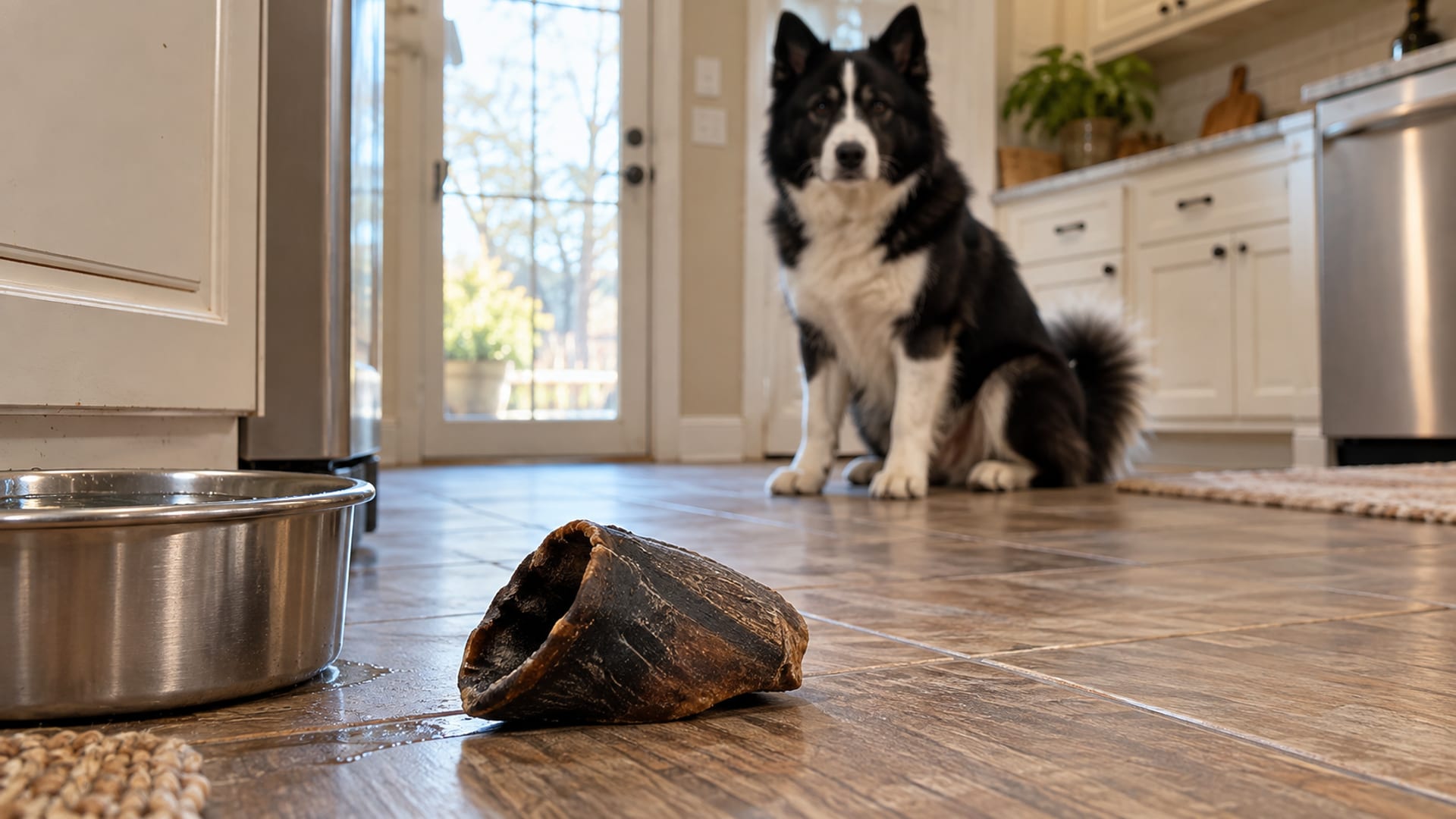
Cow hooves earn a caution, and I'd keep them out of your dog's chew basket. A plain hoof is not a poison, but a whole, dried, cooked or broken hoof is very hard. The World Small Animal Veterinary Association and the University of Pennsylvania's Ryan Veterinary Hospital both warn that hooves can fracture teeth, and the Merck Veterinary Manual lists dental chews among the objects that can lodge in a dog's esophagus.
If your dog already chewed or swallowed some, call your vet or an emergency clinic now when the piece was large or sharp, when you can't tell how much went down, or when you see gagging, drooling, vomiting or belly pain. The FDA says signs from a stuck chew can appear hours to days later, so a dog who looks fine right now still needs close watching.
Key takeaways
Tap a card to bring it forward.
- A plain cow hoof is not a poison; the dangers are a cracked tooth, choking and a blockage in the throat or gut.
- Raw, cooked, dried, smoked, baked, stuffed and broken hooves all share the hardness problem.
- Call a vet right away for gagging, trouble breathing, heavy drooling, repeated vomiting, belly pain, collapse, blood, or a large or sharp piece swallowed.
- Blockage signs can show up hours to days later, so keep watching even if your dog seems normal tonight.
- Puppies, small dogs and dogs with weak teeth face the most risk, and I'd leave hooves out of the routine.
What to do if your dog already chewed or swallowed a hoof
Work through these in order; each step has a reason.
- Take the rest of the hoof away and keep the package or label. The label shows any coating, filling or flavoring, and your vet will want to know what your dog actually ate.
- Look at your dog's mouth and breathing. Gagging, coughing, struggling to breathe, a bluish color, collapse or severe distress can mean the airway is blocked, which is immediate and life-threatening according to the Merck Veterinary Manual. Go to an emergency vet now.
- Call a vet or an emergency animal hospital. The FDA tells owners to call a veterinarian, an emergency animal hospital or an animal poison control center when a pet eats something it should not have. Call even if your dog looks normal when the amount is unknown, the hoof was cooked or brittle, or your dog is small.
- Tell them what you know: your dog's weight, what kind of hoof it was (raw, dried, smoked, stuffed), how much is missing, when it happened, and any signs so far. Weight and amount are what your vet needs to judge the risk.
- Hold off on home treatment. Pet Poison Helpline says not to give home antidotes and not to induce vomiting without talking to a vet or the Helpline first. That includes hydrogen peroxide, laxatives and any medicine your vet hasn't directed.
- Keep watching for the next several days. The FDA notes that blockage signs can appear hours to days after the dog swallowed the chew.
Which hoof forms are a problem
Every common form of hoof shares one trouble: it is hard, and pieces can break off and get swallowed. Raw products can also carry bacteria.
Tap or hover a row to highlight it.
| Form | Main concern | What I'd do |
|---|---|---|
| FormWhole raw hoof | Main concernHardness and swallowing risks remain; raw animal products can carry bacteria | What I'd doSkip it |
| FormCooked hoof | Main concernCooked animal parts can break into pieces | What I'd doSkip it |
| FormDried, dehydrated, smoked or baked hoof | Main concernHard chew products, the group tied to tooth fractures | What I'd doSkip it |
| FormSmall broken pieces and hoof chips | Main concernSmall enough to swallow, so choking and blockage hazards | What I'd doPick them up and skip them |
| FormHoof wall or outer capsule | Main concernHard keratin that can fracture teeth | What I'd doSkip it as a chew |
| FormStuffed or commercial hoof chew | Main concernThe filling, coating or salt can add its own hazards | What I'd doRead the ingredient panel and ask your vet first |
| FormHoof powder or ground hoof | Main concernNot the same as a whole chew; it has no established dog serving | What I'd doAsk your vet before adding it to food |
Raw does not remove the hardness risk, and cooking can change how brittle a hoof is. A plain hoof is mostly keratin rather than fat, though added fat, marrow, meat or gravy in a commercial product could change that.
Giving a hoof as a chew: why I'd skip it
There is no safe serving size or preparation to aim for, so I leave hooves out. Amount matters less here than it does with a poison. A single fragment can cause a mechanical emergency, so the size and shape of the piece, your dog's size and chewing habits, the condition of the teeth and how your dog swallows all count for more than how much was eaten.
Teeth are the first thing at stake. A fracture can expose the pulp inside the tooth and let bacteria in, as the University of Pennsylvania describes. A peer-reviewed study in Frontiers in Veterinary Science found that the fourth premolar can fracture under forces within the chewing power of an average dog. That study tested teeth rather than hooves, but it shows how little force a rock-hard chew needs.
Size and age change the odds. Small dogs have a narrower esophagus and gut, and the WSAVA notes that esophageal foreign bodies from dental chews have been reported especially in smaller breeds. Puppies chew on everything, have less control over how they chew, and have developing teeth that hard material can still fracture. Dogs with dental disease, weak teeth, past oral surgery, swallowing problems or an earlier intestinal blockage should not get hard hooves at all.
If your dog loves to chew, ask your vet which chews suit your dog's teeth.
Signs to watch for, and when they show up
What you see depends on where the piece lands. Some signs come within minutes and others take days.
- Airway blocked: gagging, coughing, trouble breathing, a bluish color, collapse or severe distress. This happens right away and is life-threatening.
- Piece stuck in the esophagus: drooling, gagging, repeated swallowing attempts, regurgitation and trouble swallowing. Signs can begin immediately, according to the Merck Veterinary Manual.
- Broken tooth: reluctance to chew, dropping food, pawing at the mouth, drooling, facial swelling or refusing to eat. You may see this at once or notice it later.
- Blockage in the stomach or intestines: vomiting, diarrhea, belly pain, less appetite, tiredness, and straining or passing less stool. The FDA says these can appear hours to days later.
- Illness from contamination: vomiting, diarrhea (sometimes bloody), fever, tiredness and belly pain, with timing that varies by germ.
The worst outcomes include an infected tooth pulp, a blocked airway, a hole in the esophagus or intestine, emergency surgery and death, so an early call to your vet is worth it.
My dog ate one before and was fine
I believe you. Plenty of dogs have gnawed a hoof with nothing to show for it, and that story is real. It just isn't a rule for the next hoof or the next dog.
- How much was swallowed. Your dog may have licked or gnawed the hoof without swallowing a fragment.
- The piece itself. A small, smooth fragment may pass while a large or sharp one lodges or cuts.
- Dog size and form. A piece that clears a large dog can block a smaller one, and raw, dried, cooked, brittle and filled hooves differ in hardness, shape and ingredients.
- How your dog chews. Some dogs grind material down and others gulp big pieces.
- The teeth. A healthy tooth may survive a force that breaks a weakened one, and no dog is guaranteed safe.
- Delayed signs. The FDA says blockage signs can appear hours to days later, and your dog may simply have been lucky.
Stuffed hooves, hoof powder and look-alikes
Labels blur together in this aisle. Cow, beef, cattle and bovine hoof usually mean the same animal part, and names like "natural" or "classic" say nothing about safety; the ingredient panel and processing information do.
Hock or knuckle is a leg joint or bone-containing cut, and bone adds its own fracture and blockage worries; see beef bones.
Hoof-filled chews can hold peanut butter, cheese, meat, fat, salt or flavorings. The filling may add toxic or dietary hazards, and a product with onion, garlic, xylitol or chocolate carries extra risk; see onions, garlic and chocolate if you spot those on the label.
Horn and antler are different tissues sold as hard chews that share the tooth-fracture concern.
Pezuña and pata de res. In Spanish, pezuña usually means the hoof itself. Pata de res can mean the whole lower leg or the cooking cut of beef foot, which includes skin, tendon and bone, according to the Real Academia Española. If your label says pata, you may be looking at something with bone in it.
Check what you learned
Quick check
Questions about dogs and cow hooves
These come up once the immediate worry has settled.
Should I call my vet or a poison line?
For a plain hoof, start with your vet or an emergency clinic, because the danger is a physical blockage or a broken tooth rather than poison. A poison line such as Pet Poison Helpline or the ASPCA Animal Poison Control Center becomes more useful when the chew had a coating, filling, flavoring or preservative, or when you suspect contamination.
Are hooves safer for big dogs or strong chewers?
A large dog can pass a piece that would block a small dog, but a strong chewer also puts more force on the teeth, and the tooth-fracture study found that the forces involved sit within what an average dog can produce. Size changes which problem you are more likely to see, and it does not make the hoof safe.
Can my cat chew a cow hoof too?
The same risks apply to cats, including choking, mouth injury and a blockage in the gut. The Merck Veterinary Manual says esophageal foreign bodies are more common in dogs, yet cats can develop gastrointestinal blockages too. Keep hooves out of reach of both.
Is hoof powder a safe supplement for my dog?
Hoof powder is not the same as a whole hoof chew, and it has no established serving size for dogs. Check the ingredients and ask your vet before you add it to meals.
Sources
Checked September 30, 2026.
- World Small Animal Veterinary Association, Global Dental Guidelines
- University of Pennsylvania Ryan Veterinary Hospital, Dentistry & Oral Surgery
- Merck Veterinary Manual, Esophageal Foreign Bodies in Small Animals
- Merck Veterinary Manual, Gastrointestinal Obstruction in Small Animals
- FDA, Keep Your Dogs and Cats Safe From Holiday Hazards
- FDA, Who Do You Call if You Have a Pet Emergency?
- Pet Poison Helpline, 24/7 Animal Poison Control Center
- ASPCA, Animal Poison Control
- Frontiers in Veterinary Science, Fracture Limits of Maxillary Fourth Premolar Teeth in Domestic Dogs Under Applied Forces
- Real Academia Española, Diccionario de la lengua española: pata