
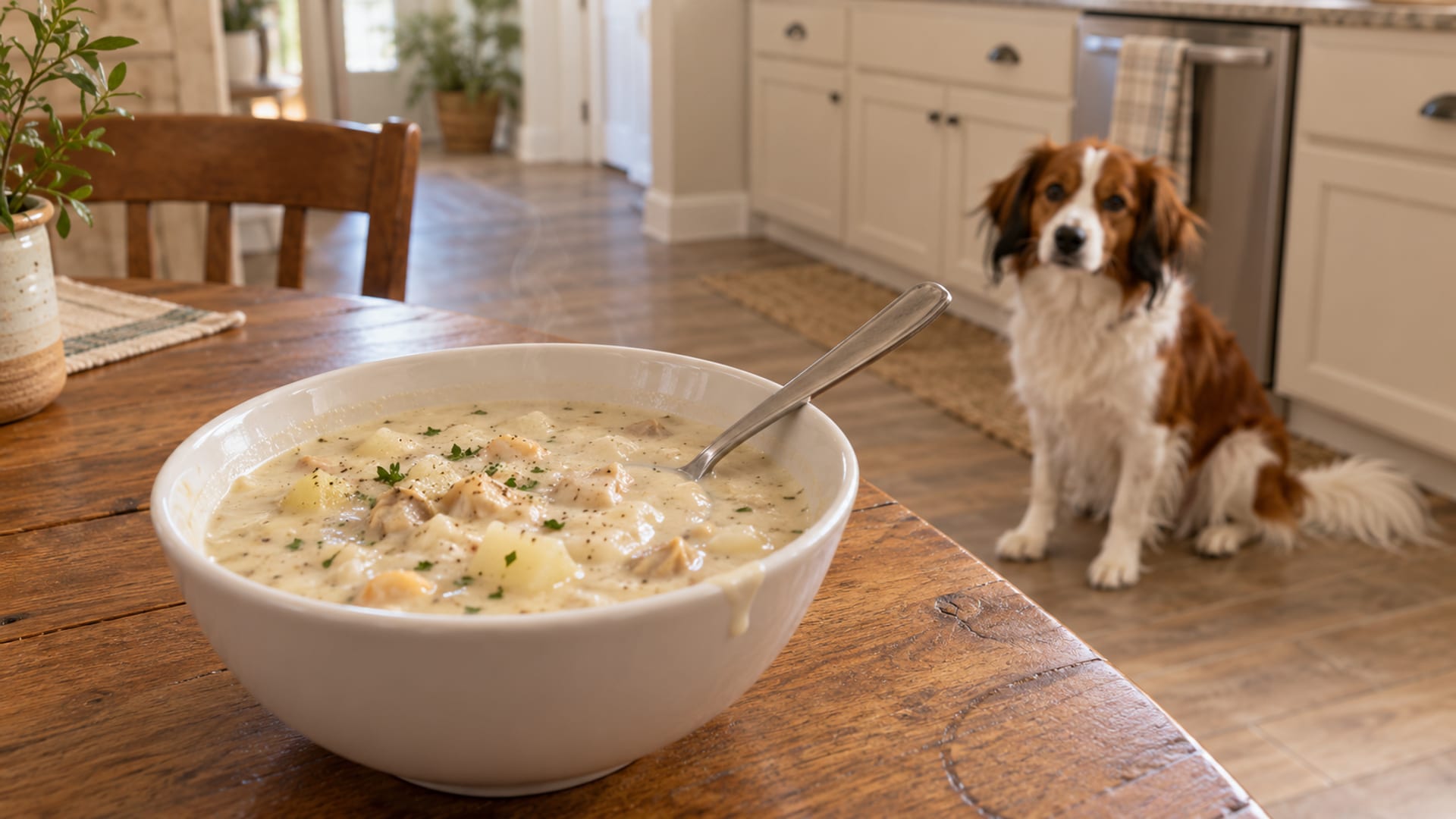
Clam chowder is a caution food, because the answer depends on what is in the bowl. Plain, fully cooked clam meat is not identified as toxic to dogs. Chowder usually carries salt, onion, garlic, cream and fat, though, and a large amount can be serious.
A lick off the spoon is a very different event from half a bowl. If your dog ate more than a lick, or you do not know the ingredients, the amount or your dog's weight, I'd call your vet or a pet poison line right away. Onion and garlic can cause trouble that shows up days later, so a dog who looks fine tonight can still need a check. Shells, raw clams and a dry chowder mix raise the stakes, and I'd make the call for any of those too.
Key takeaways
Tap a card to bring it forward.
- The risk in chowder comes from onion, garlic, salt, cream and fat, since plain cooked clam meat is not identified as toxic.
- A lick of a chowder you know has no onion or garlic is a different situation from a bowl of one you cannot check.
- Onion and garlic can damage red blood cells, and the effects can take several days to appear.
- Keep your dog's weight, the amount eaten, the ingredients and the time ready before you call.
- Shells, raw clams and dry chowder mixes are each a reason to call.
What to do tonight if your dog got into clam chowder
Work through these in order. The first three take a couple of minutes and give your vet what they need to judge the risk.
- Put the bowl, pot or can out of reach, and keep the label or the recipe. The ingredient list drives almost every decision that follows.
- Gather four facts: the ingredients (especially onion, garlic, chives or leeks), how much your dog ate, your dog's weight, and what time it happened. The risk depends on how much onion, garlic and salt your dog took in compared with body weight, so these four facts let a vet judge it fast.
- Check for shells and for raw clams. Shell fragments can cause choking, mouth injury or a blockage, and raw clams can carry infection.
- Call your vet or a pet poison line right away if the amount or the ingredients are unknown, if there was onion or garlic, if it was a soup mix or a lot of salty chowder, if there were shells or raw or spoiled clams, or if your dog shows any signs. The ASPCA asks owners who suspect a toxic substance to call poison control or their vet as soon as possible, and VCA Animal Hospitals shares Pet Poison Helpline advice to call right away after any Allium exposure.
- Tell them whether your dog has had access to water. According to the Merck Veterinary Manual, water access substantially affects the salt risk. Leave any treatment to the vet, since the right step depends on what they learn from you.
If your dog had a lick of a fully cooked chowder you know has no onion or garlic in it, your vet may only ask you to watch your dog. Let them make that call after you describe what happened.
Which forms of chowder and clams matter
The name on the menu tells you very little, and the common versions sort out like this.
Tap or hover a row to highlight it.
| Form | Concern | Why |
|---|---|---|
| FormPlain cooked clam meat, no shell | ConcernLower risk | WhyServe it separate from any chowder, with no seasoning |
| FormRaw clams or raw clam juice | ConcernAvoid | WhyThe FDA lists Vibrio, Salmonella, hepatitis A virus, norovirus and marine toxins as hazards of raw shellfish |
| FormClam shells | ConcernAvoid | WhyFragments can cause choking, mouth injury or a blockage |
| FormNew England chowder | ConcernCaution | WhyUsually cream-based; can hold onion, garlic, salt and fat |
| FormManhattan chowder | ConcernCaution | WhyTomato-based; can hold the same onion, garlic, salt and fat |
| FormCanned, restaurant or homemade chowder | ConcernCaution | WhyThe label or recipe decides; canned versions can hold onion, garlic, sodium and dairy |
| FormChowder mix with dried onion or garlic | ConcernHigher concern | WhyDehydration concentrates the onion and garlic |
| FormChowder broth | ConcernCaution | WhyBroth with little visible clam meat carries the same salt, onion, garlic, dairy and fat |
The FDA describes raw molluscan shellfish as a possible source of those infections. Cooking lowers that risk, but a cooked clam in a rich chowder still brings the onion, garlic, salt and cream with it.
How much is too much, and what a safer bite looks like
Chowder has no per-kilogram figure of its own, because recipes differ so much in onion, garlic, salt, fat and clam content. The ingredients do have figures, and the Merck Veterinary Manual and its salt toxicosis chapter give them.
Tap or hover a row to highlight it.
| Ingredient | Published figure for dogs | What it means |
|---|---|---|
| IngredientRaw onion | Published figure for dogsSigns after about 15 to 30 g/kg | What it meansA range where signs were seen, not a safe threshold |
| IngredientSalt | Published figure for dogsSigns after about 2 to 3 g/kg | What it meansWater access changes the risk |
| IngredientSalt | Published figure for dogsAcute oral lethal dose about 4 g/kg | What it meansA severe outcome level |
| IngredientGarlic | Published figure for dogs3 to 5 times more toxic than onion | What it meansNo universal dog dose is given |
| IngredientClam chowder | Published figure for dogsNo per-kilogram figure | What it meansCall, and give your dog's weight and the amount |
Here g/kg means grams per kilogram of your dog's body weight. Small dogs take in more per kilogram from the same spoonful, so a bite that is minor for a big dog can matter for a small one. Since you cannot measure the onion, garlic and salt in a bowl of chowder, the useful move is to give your vet the weight and the amount and let them work from there.
If you want to share the clam, keep it separate from the soup. A plain, fully cooked piece of clam meat with no shell, onion, garlic, extra salt, cream, butter, bacon or seasoning is the lower-risk half. There is no chowder serving to aim for, and no amount by dog size to hand you, so ask your vet what fits your dog.
Signs to watch for and when they show up
Some signs come early and others take days, so the watching period is longer than most owners expect.
- Early, from rich food, salt, dairy or shellfish: drooling, nausea, vomiting, diarrhea, belly discomfort and tiredness.
- Salt: vomiting can start within several hours, followed by weakness, diarrhea, muscle tremors, wobbly walking, seizures and, in severe cases, coma and death.
- Onion and garlic: stomach signs may come first. The Merck Veterinary Manual says red blood cell damage can increase within 24 hours, while true anemia may take several days to appear. Look for weakness, pale gums, a fast heartbeat, panting, yellow gums or skin, red urine and collapse.
- Contaminated shellfish: vomiting and diarrhea. The FDA says foodborne illness symptoms commonly appear 12 to 72 hours after exposure, and some infections take longer.
Call your vet right away for vomiting, diarrhea, weakness, pale or yellow gums, red urine, panting, tremors, wobbliness, seizures, collapse, severe belly pain or trouble breathing. The ASPCA also flags fatty human foods as a pancreatitis concern, and cream, butter and bacon in chowder all add fat.
My dog ate chowder before and was fine
I believe you, and it happened just that way. Lots of dogs have licked a bowl or taken a spoonful and gone on with their day, and that is a real experience worth trusting for that meal.
It still cannot tell you how the next bowl will go. These are the things that change the outcome:
- The amount of onion, garlic, salt, fat or shellfish compared with the dog's body weight.
- The recipe. One pot might have no onion or garlic, or only a little, while the next holds a lot.
- The form. Cooked food carries less infection risk than raw shellfish.
- Water. A dog with water on hand is less likely to have a salt problem.
- The individual dog, since sensitivity varies.
- The timing. Merck notes that anemia from onion or garlic may take several days to show, so a good first evening does not settle the question.
So, the earlier meal was real, and no two bowls are the same recipe, amount and dog.
Chowder types, clam juice and look-alikes
Plenty of products sound close to clam chowder and carry their own concerns.
- Seafood chowder, clam soup and bisque. These are different recipes with different ingredients, so read the label or ask the cook.
- Clamato. This is a tomato-and-clam drink or mixer that can be high in sodium and spices.
- Clam juice. This is the liquid from clams, sold on its own, and it is not automatically low in salt or free of seasoning.
- Onion powder, garlic powder, dried onion and dry soup mix. These hold more active material by weight than fresh onion or garlic.
- Chives, scallions, shallots, leeks and ramps. These are relatives of onion and garlic and are no safer swap. See our pages on chives and leeks.
- Cream, butter and bacon. These add fat, and our pages on butter and bacon cover them. Cream or milk can also cause diarrhea in dogs that do not tolerate lactose; see milk.
Check what you learned
Three quick questions to see what stuck.
Quick check
Questions about dogs and clam chowder
These come up once the first worry has settled.
Can dogs eat plain cooked clams?
Plain, fully cooked clam meat without shell is the lower-risk part of the dish, and cooking lowers the infection risk that raw clams carry. Serve it separate from any chowder and skip the seasoning. Ask your vet how much suits your dog's size.
Is chowder dangerous for cats too?
Yes, and cats are the more sensitive of the two. The Merck Veterinary Manual says cats are the species most susceptible to onion and garlic poisoning, followed by dogs, and it names dehydrated flakes, powders and dry onion soup mixes as common sources. Keep onion or garlic chowder away from both pets.
What if my dog has pancreatitis or kidney disease?
A dog with a history of pancreatitis is a bigger practical worry with cream, butter or bacon in the bowl. A dog with kidney disease may have less reserve for handling sodium and fluid changes. Tell your vet about the condition when you call, because it changes how closely they will want to watch.
Is a puppy or small dog at more risk?
A small dog takes in more per kilogram from the same spoonful, and a puppy can be more vulnerable to dehydration and stomach illness. Give the weight and age when you call, so your vet can size up the risk.
Sources
Checked September 29, 2026.
- Merck Veterinary Manual, Garlic and Onion (Allium spp) Toxicosis in Animals
- Merck Veterinary Manual, Salt Toxicosis in Animals
- ASPCA, Be On the Lookout at Your Cookout
- ASPCA Animal Poison Control, Garlic
- VCA Animal Hospitals, Onion, Garlic, Chive, and Leek Poisoning in Dogs
- FDA, Seafood
- FDA, People at Risk of Foodborne Illness