

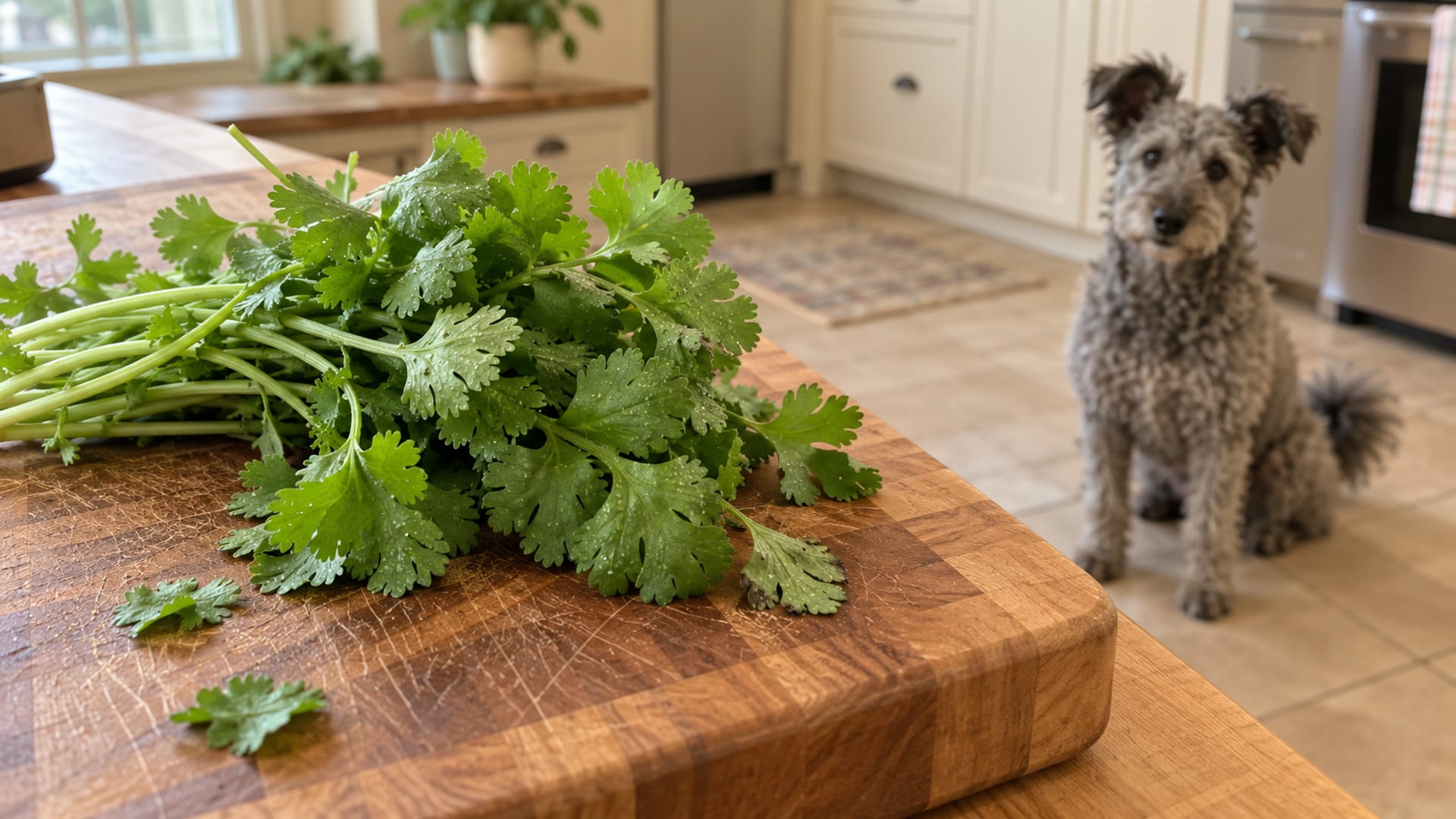
Yes. The ASPCA lists fresh cilantro, *Coriandrum sativum*, as non-toxic to dogs, and a few leaves are generally fine. A big helping can upset the stomach, so this is a herb to share in small bites.
If your dog just got into some, the first thing to work out is what was actually in the mouthful. Plain leaves are a small matter. Salsa, guacamole and seasoning blends can carry onion, garlic or other ingredients that change the answer completely. I'd call your vet if you are not sure the plant was cilantro, if your dog ate an oil or extract, if the dish had onion or garlic in it, or if your dog seems unwell in any way.
Key takeaways
Tap a card to bring it forward.
- Fresh cilantro leaves are listed as non-toxic to dogs, and a small amount is generally fine.
- Tough stems are harder to digest than leaves, so leave them out of your dog's bowl.
- Salsa, guacamole and spice blends need a second look, because onion and garlic are the real problem in those.
- Oils, extracts and supplements are concentrated products and are not the same as a few fresh leaves.
- Call your vet for an unidentified plant, a mixed dish with onion or garlic, or any signs of illness.
What to do if your dog already ate cilantro
Start with these steps in order. Most of the time they take a couple of minutes and tell you whether this is a watch-and-wait situation or a phone call.
- Take away whatever is left and work out what your dog ate. Fresh leaves, a stem, dried herb and a bowl of salsa are four different situations, and the amount matters for each of them.
- If it was a prepared food, go through the ingredients. Onion, garlic, a lot of salt, chili peppers, avocado parts, alcohol or xylitol can be the actual hazard in a dish, and the cilantro is just along for the ride. Our pages on onions, garlic and avocado cover what to do for each.
- Make sure it really was cilantro. Flat-leaf parsley looks similar, and some wild plants in the carrot family get mistaken for kitchen herbs. A label, the scientific name *Coriandrum sativum* or a reliable plant identification settles it.
- If it was a small amount of plain fresh cilantro and your dog acts normal, keep an eye on your dog. The ASPCA does not class this as a poisoning. Skip home remedies and medication, since nothing needs treating.
- Call your vet or a pet poison line if the plant was unidentified, the product was concentrated, the food held risky ingredients, or your dog shows signs. Get urgent veterinary care for choking, repeated vomiting, severe or lasting diarrhea, marked weakness, trouble breathing, collapse, tremors, seizures, or a suspected blockage.
Which parts and forms of cilantro are fine
Cilantro shows up in more forms than most herbs, and each one gets a slightly different answer. The table sorts them by what you are most likely holding.
Tap or hover a row to highlight it.
| Form | For your dog | What to know |
|---|---|---|
| FormFresh leaves | For your dogFine in small amounts | What to knowListed as non-toxic to dogs by the ASPCA |
| FormTender stems | For your dogBetter left out | What to knowThe AKC advises avoiding stems because they can be hard to digest |
| FormMature, fibrous stems | For your dogLeave out | What to knowTough plant material is a stomach and choking concern |
| FormFlowers and roots | For your dogAsk your vet first | What to knowSkip them unless your vet says otherwise |
| FormCoriander seed | For your dogAsk your vet first | What to knowThe seed of the same plant, but it is a dry, concentrated form |
| FormGround coriander | For your dogCheck the label | What to knowBlends can contain other ingredients |
| FormOil, extract, tincture, supplement | For your dogCall your vet | What to knowConcentrated products are not the same as a few leaves |
| FormSalsa, guacamole, sauces | For your dogDepends on the recipe | What to knowOnion, garlic, salt, chili, alcohol or xylitol may be the hazard |
The AKC points to leaves as the part to use, and that is the simplest rule to remember. In American kitchens, cilantro usually means the fresh leaves, and coriander usually means the dried seeds, according to the University of Wisconsin-Madison Division of Extension. Both come from the same plant, so a recipe that says coriander is a different form of the same herb.
How much to give and how to serve it
The AKC recommends small quantities, with diced leaves used as a garnish. In practice, that means washing a few leaves, chopping them finely and mixing them into your dog's regular food. Think of a sprinkle on top of dinner, and leave the whole bunch on the counter.
Size matters here in a common-sense way. A small dog reaches "too much" on less plant material than a large dog does, so start with a pinch and see how your dog does before offering it again. If your dog turns away from the bowl or seems to have a sore stomach afterward, stop offering it.
Keep stems out of the serving. Stems are the part the AKC says can cause digestive trouble, and long stringy pieces are also easier to gag on.
Signs to watch for after your dog eats cilantro
Cilantro is not a poison for dogs, so the usual trouble is a stomach that objects to a lot of plant material. Watch for:
- Vomiting or diarrhea.
- Drooling.
- A stomach that seems irritated or tender.
- A dog who eats less than usual or refuses food.
The AKC mentions stomach upset, irritation and reluctance to eat. For a healthy dog that ate ordinary fresh cilantro, the likely worst case is a brief upset that settles on its own.
A swallowed mass is a separate concern from an upset stomach. If your dog ate a big wad of cilantro, or a lot of stem, watch for gagging, repeated vomiting or a belly that looks uncomfortable, and call your vet right away if you see them. The ASPCA points out that eating any plant material can cause vomiting or an upset stomach, and it asks owners to contact a vet or the APCC if an animal is ill.
My dog ate cilantro before and was fine
I believe you, and that dog really did fine. Plenty of dogs eat a leaf or two off the counter or out of the garden bed and go on with their day. That is what you would expect from a plant the ASPCA lists as non-toxic.
What that one good outcome cannot tell you is how the next time will go. A few things change the result:
- The amount. A leaf or two is different from half a bunch, and a larger amount can still upset the stomach.
- The dog's size. A small dog gets a bigger share of plant material for its body size from the same mouthful.
- The form. A fibrous stem or a swallowed clump is a different problem from finely chopped leaf.
- What else was in it. Cilantro in a bowl of salsa comes with everything else in the bowl.
- The individual dog. Some dogs have sensitive stomachs and some do not.
So, the earlier experience is real, and it is a good sign that leaves suit your dog. It just does not promise the same result for every serving.
Salsa, guacamole and look-alikes
Most cilantro that dogs get into arrives inside another food, so this is where the real decisions happen.
Salsa and guacamole, along with chutney, sauces and seasoning blends, can contain onion, garlic, salt, chili, avocado, alcohol or xylitol. Judge the finished food by its ingredient list. Cilantro is rarely what makes a dish risky, while the garlic and onions that travel with it sometimes are.
Names cause confusion too:
- Coriander and Chinese parsley. Cilantro, coriander, Chinese parsley and dhania can all refer to *Coriandrum sativum*.
- Culantro. This is usually a different species, *Eryngium foetidum*, also called sawtooth coriander or recao. The University of Wisconsin explains the difference. Because it is a different plant, it should not automatically get cilantro's answer, so ask your vet if your dog ate culantro or recao.
- Parsley. Flat-leaf parsley can be mistaken for cilantro. Our parsley page covers it on its own terms.
- Oils and supplements. Cilantro oil, coriander oil, extracts, tinctures and capsules are concentrated. Treat them as a different product from the herb.
Check what you learned
Three quick questions to see what stuck.
Quick check
Questions about dogs and cilantro
These come up once the basics are settled.
Is cilantro safe for cats too?
The ASPCA lists *Coriandrum sativum* as non-toxic to cats as well as dogs. It also cautions that eating any plant material can still cause vomiting or an upset stomach, so the same small-portion rule holds if you share a home with both.
Can puppies, seniors or dogs with health problems have cilantro?
Nothing sets puppies, older dogs or particular breeds apart on cilantro. Size changes how much plant material is "a lot," so keep bites tiny for a small dog or a puppy. If your dog has pancreatitis, diabetes, kidney disease or another condition, the trouble usually comes from the rest of a prepared dish, such as fat, salt or seasoning, so ask your vet before sharing anything beyond a few plain leaves.
What if my dog ate a whole bunch or the whole plant?
A large amount is a reason to call your vet, even though the plant itself is non-toxic. The worry shifts to stomach upset from the sheer volume, plus choking or a blockage from a big swallowed mass. Describe what was eaten and how much, and follow the advice you get.
Can dogs have cilantro tea, oil or supplements?
A cup of tea, a few drops of oil or a capsule delivers plant material in a concentrated form, and that is a different product from the fresh herb the ASPCA lists. Ask your vet before giving any of them, and bring the label with you.
Can dogs eat coriander seeds or ground coriander?
Coriander is the dried seed of the same plant as cilantro, so it is a familiar ingredient rather than a strange one. The seeds and the powder are still a dry, concentrated form, and spice blends often include other ingredients. Read the label, and ask your vet before adding either to your dog's meals.
Sources
Checked September 29, 2026.
- ASPCA Animal Poison Control Center, Toxic and Non-Toxic Plants: Cilantro
- ASPCA Animal Poison Control Center, Toxic and Non-Toxic Plants
- American Kennel Club, Can Dogs Eat Cilantro?
- University of Wisconsin-Madison Division of Extension, Cilantro / Coriander, Coriandrum sativum
- University of Wisconsin, It's all in the family: Are Cilantro and Culantro the same?