

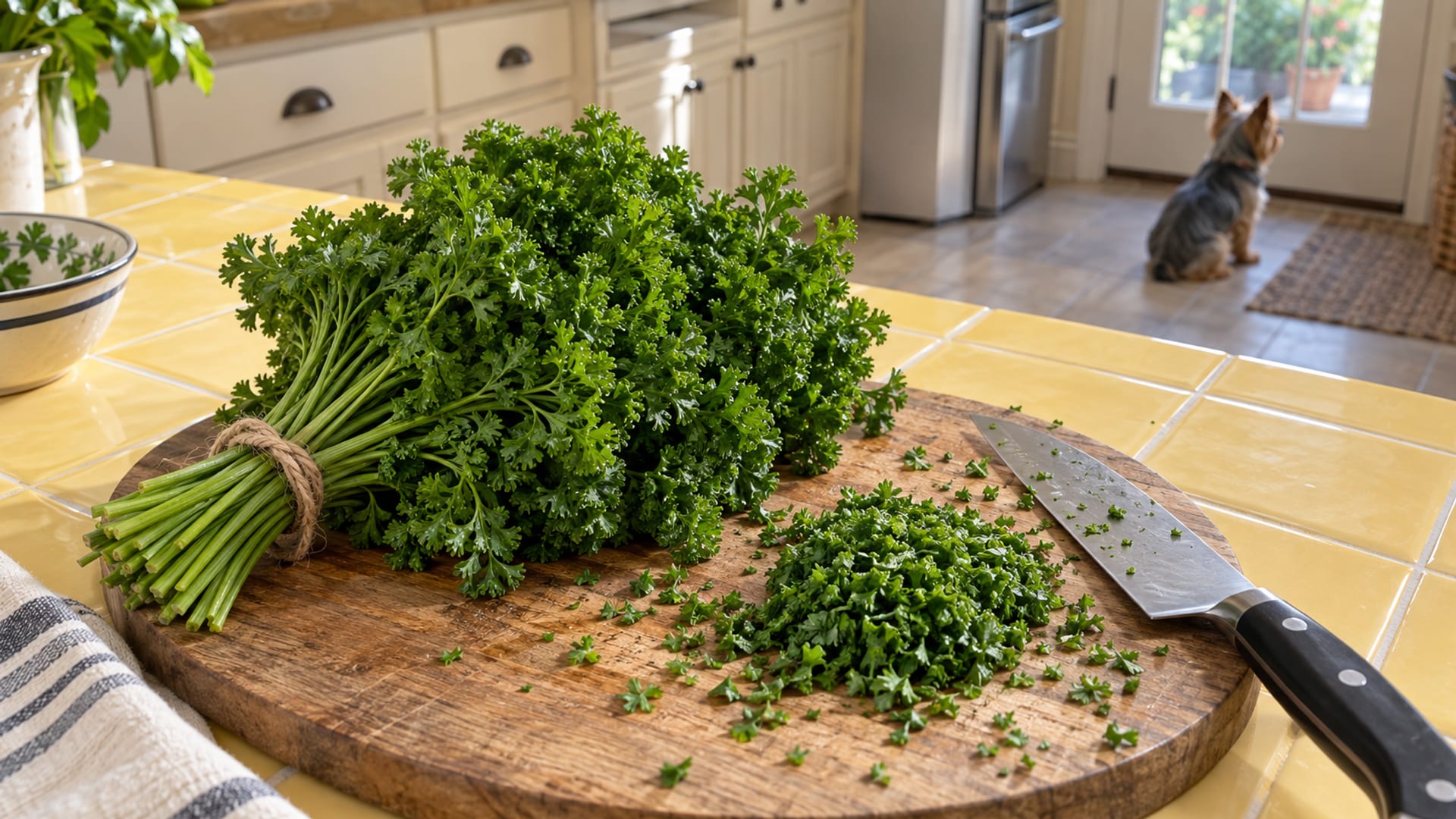
A little grocery-store parsley, the kind you chop over dinner, is unlikely to cause serious harm, so keep it to a small sprinkle. The ASPCA lists common parsley as toxic to dogs because of compounds called furanocoumarins, and it notes that large amounts are needed before a dog develops skin problems from them.
If your dog licked a garnish off a plate, watching them for the rest of the day is usually enough. If they ate a whole bunch, dried parsley by the spoonful, parsley oil, or a yard plant you cannot identify, call your vet or a pet poison line.
Key takeaways
Tap a card to bring it forward.
- A small sprinkle of fresh curly or flat-leaf parsley is unlikely to cause serious signs.
- Parsley contains furanocoumarins, which can leave skin prone to sunburn after a large amount.
- Spring parsley is a different wild plant and is toxic to dogs. Call if your dog ate it.
- Seeds, powder, oil, extract and supplements pack more plant into less space. Skip them.
- Dogs prone to calcium oxalate bladder stones are better off without parsley, according to the AKC.
Your dog ate parsley: what to do next
Tap or hover a row to highlight it.
| What they ate | Next step |
|---|---|
| What they ateA few leaves or a garnish off a plate | Next stepNothing urgent. Watch for an upset stomach. |
| What they ateA whole bunch of fresh parsley | Next stepCall your vet for advice, sooner for a small dog. |
| What they ateDried flakes, powder or seeds, more than a pinch | Next stepCall your vet or a pet poison line. |
| What they ateParsley oil, extract, juice or a supplement | Next stepCall now and keep the label in hand. |
| What they ateA parsley-like plant from the yard or a trail | Next stepCall now. It may be spring parsley or another plant. |
| What they ateA dish with parsley plus garlic, onion or salt | Next stepCheck the recipe. Garlic and onion are the bigger worry. |
When a dog may have eaten a poisonous plant, the AKC says to contact your veterinarian, an emergency clinic or the Pet Poison Helpline. Before you call, gather a photo or a piece of the plant (or the product label), a rough idea of how much, the time, and your dog's weight.
Call right away for vomiting that keeps coming back, diarrhea, drooling, weakness, heavy panting, or red and sore skin.
If the parsley came in a dish with garlic or onion, those change the picture more than the herb does. See can dogs eat garlic? and can dogs eat onions? for what to do.
Why a pinch is fine and a pile is not
Furanocoumarins can cause photosensitization, meaning the skin overreacts to sunlight and turns red, sore and sunburned. The ASPCA links that to large amounts and does not put a number on it. Without a per-pound figure, the practical rule is to keep servings small and go smaller for a small dog, since the same handful is a bigger share of a small body.
The AKC calls curly parsley generally safe in small amounts and says large amounts of Italian parsley may be toxic. The ASPCA files both under the same plant, *Petroselinum crispum*. Treat the two kinds alike: a pinch, now and then.
Parsley, form by form
Tap or hover a row to highlight it.
| Form | Where it lands | Why |
|---|---|---|
| FormFresh curly parsley, a pinch | Where it landsLow concern | WhyAKC calls it generally safe in small amounts |
| FormFresh flat-leaf (Italian) parsley, a pinch | Where it landsLow concern, same caution | WhyASPCA lists it under the same plant |
| FormStems | Where it landsSmall amounts only | WhySame plant, tougher to chew |
| FormDried flakes or powder | Where it landsSparingly | WhyMore leaf packed into every pinch |
| FormSeeds | Where it landsAvoid | WhyAKC warns against them |
| FormOil, extract, juice, supplements | Where it landsAvoid | WhyConcentrated plant chemicals |
| FormSpring parsley (*Cymopterus watsonii*) | Where it landsToxic | WhyA separate wild plant, per the ASPCA |
| FormCilantro | Where it landsA different herb | WhyListed as non-toxic to dogs by the ASPCA |
The ASPCA lists spring parsley as toxic to dogs and cats, with the same furanocoumarins and the same sun-sensitive skin. It can look like kitchen parsley, which is why a plant picked outdoors deserves a call.
How much parsley to give, and how to serve it
The AKC suggests a small sprinkle over your dog's food, used once in a while. Stick to parsley you bought or grew and can name for certain, chop it fine, and keep it plain. Herb butters, salted seasoning mixes and garlic blends belong on your plate, not in the dog bowl. Leave parsley-looking plants on walks alone.
One group should skip it. The AKC points out that parsley is high in calcium oxalate, so a dog prone to calcium oxalate stones is better served by a different topper. Our page on kale covers another green in that group.
Signs to watch for
The AKC lists these possible signs after a dog eats too much parsley:
- vomiting or diarrhea
- itching or irritated skin
- peeing more than usual
- heavy panting
- acting unlike themselves
Skin trouble from furanocoumarins shows up with sunlight, so it may appear after your dog has spent time outdoors rather than right after the meal. Red, sore or peeling skin after a parsley binge is a reason to call your vet.
"My dog gets parsley on dinner all the time and is fine"
That is probably true, and for a few leaves it will likely stay true. A sprinkle is a small amount, and the ASPCA ties skin trouble to large ones. It still is not a rule for every dog or every form. A spoonful of dried flakes or a dropper of parsley oil is a much bigger dose than a few fresh leaves. A wild plant that looks like parsley may be something else entirely. Skin signs need sunlight, so a mild reaction can go unnoticed. And a dog with a history of bladder stones has its own reason to avoid parsley that has nothing to do with poisoning.
Parsley treats, breath products and look-alike herbs
- Dental chews and breath treats: the AKC notes parsley appears in some dog dental treats as a breath freshener. Read the whole label, since garlic, xylitol or salt matter more than the parsley. A fresher-smelling mouth is not the same as healthy teeth, so bad breath that lingers is worth a vet visit.
- Parsley supplements and herbal blends: concentrated products. Ask your vet before giving one.
- Cilantro, coriander or "Chinese parsley": a different plant that the ASPCA lists as non-toxic to dogs.
- Culantro (recao): another different herb, common in Caribbean and Central American cooking.
- Cats in the house: the ASPCA lists both parsley and spring parsley as toxic to cats as well.
Check what you learned
Quick check
Questions about dogs and parsley
Is curly parsley safe for dogs?
A pinch of fresh curly parsley is unlikely to cause problems. The AKC calls it generally safe in small amounts, and the ASPCA links trouble to large amounts.
Is flat-leaf or Italian parsley bad for dogs?
It is the same plant as curly parsley in the ASPCA listing, so the same rule applies: a small amount now and then, never a bowlful. The AKC singles out large amounts of Italian parsley as a possible problem.
Is dried parsley safer than fresh?
Dried parsley is more concentrated, so a spoonful holds far more plant than a few fresh leaves. Use no more than a pinch, and call your vet if your dog got into the jar.
Does parsley freshen a dog's breath?
Parsley is an ingredient in some breath-freshening dog treats, according to the AKC. It will not fix dental disease, so persistent bad breath still calls for a vet or dental check.
What if my dog ate spring parsley?
Call your vet or a pet poison line. Spring parsley is a toxic wild plant, and a photo or sample helps them confirm what it was.
Can cats eat parsley?
The ASPCA lists parsley and spring parsley as toxic to cats. Keep parsley plants and garnishes out of a cat's reach too.
Sources
Checked September 25, 2026.
- ASPCA Animal Poison Control Center, Parsley
- ASPCA Animal Poison Control Center, Spring Parsley
- ASPCA Animal Poison Control Center, Toxic and Non-Toxic Plant List: Dogs
- American Kennel Club, Can Dogs Eat Parsley?
- American Kennel Club, Poisonous Plants for Dogs