
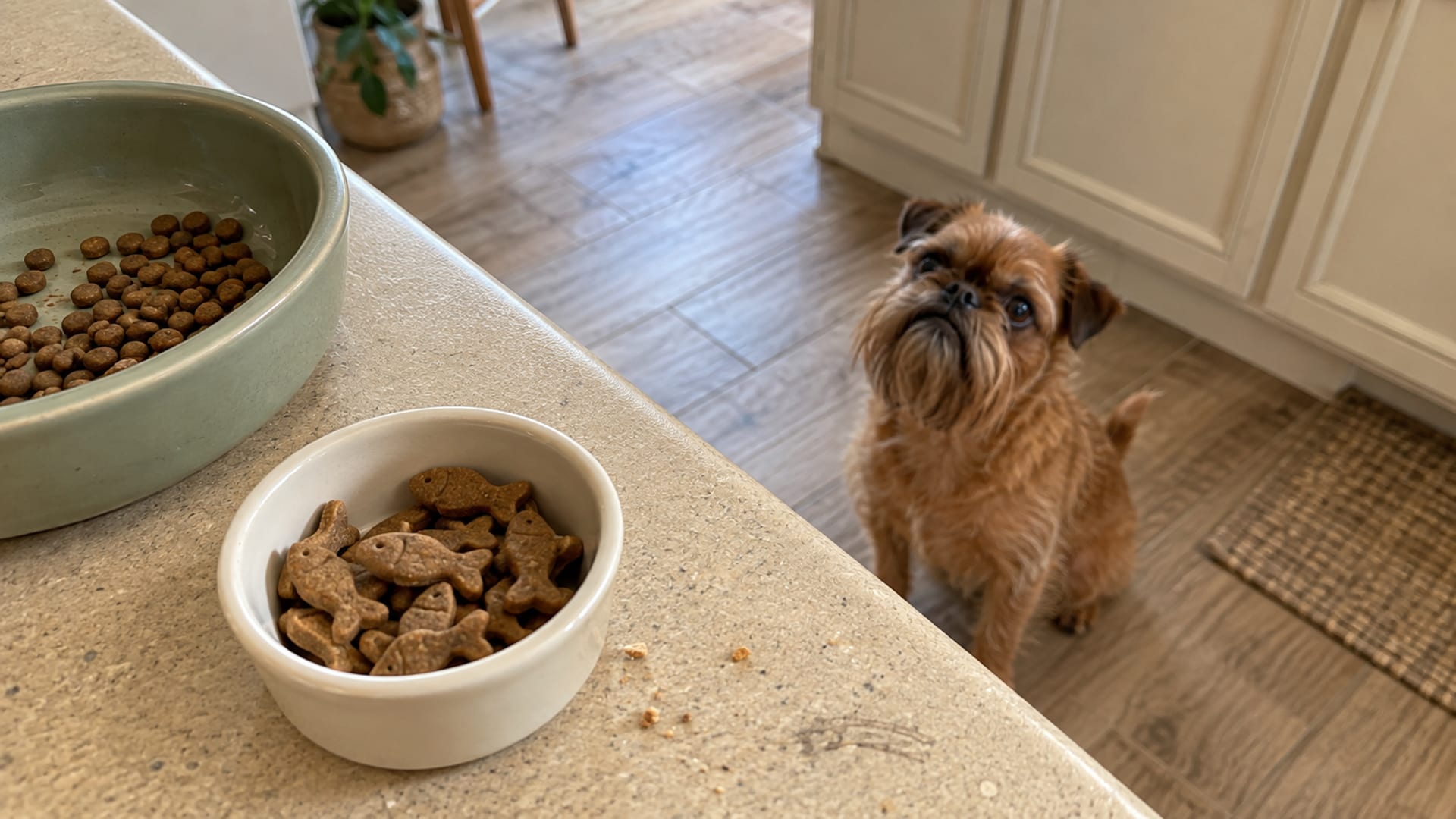
Yes. One or two small, ordinary cat treats are generally fine for a healthy adult dog, and beyond that the things that matter are how many went down, how often it happens, and what the label says. If your dog just got into the cat's stash, pick up the bag, work out roughly how many are missing, and read the ingredient list before you decide anything else.
A couple of stolen treats usually leave you with nothing worse than a dog who looks very pleased with himself. A torn-open bag, a dog with a health condition, or a treat with an unusual ingredient is when a call to your vet makes sense.
Key takeaways
Tap a card to bring it forward.
- One or two small cat treats, usually 1 to 4 calories each, should not cause a problem for an otherwise healthy dog, according to VCA.
- Larger or repeated amounts can lead to vomiting, diarrhea, weight gain and a higher risk of pancreatitis.
- Raw, freeze-dried and dehydrated cat treats can carry germs such as Salmonella and E. coli.
- A treat with xylitol, chocolate, onion, garlic, grapes, raisins, medication or bones, or one that was recalled, calls for a phone call right away.
- All treats together, cat treats included, should stay within 10 percent of your dog's daily calories.
What to do if your dog already ate cat treats
Take these steps in order. For a dog who snatched a treat or two, the first three and a calm evening of watching are usually all it takes.
- Find the package. It lists the calories per treat, the fat content and every ingredient, and those details answer most of the question of how worried to be.
- Estimate how many are gone. Two treats and half a bag are very different amounts, and one treat is a bigger share of a tiny dog's day than a large dog's.
- Read the ingredients for anything unusual. The WSAVA Nutrition Committee names chocolate, caffeine, xylitol, alcohol, onions, garlic, grapes and raisins among the things a dog should never get, and a treat containing one of them is judged by that ingredient.
- Check for a recall. A recalled or contaminated package is its own reason to call, even after a few pieces.
- Call if the amount was large or your dog is at higher risk. The ASPCA advises contacting your veterinarian or its poison control center right away if you think your pet swallowed something toxic. Puppies, small dogs, and dogs with pancreatitis or on a prescription diet deserve that call sooner.
- Keep watching after tonight. Stomach upset can start soon after eating, while signs of pancreatitis or a contaminated treat may take longer to show.
Which cat treats are low risk and which need a closer look
"Cat treat" covers many different products, and the form your dog ate tells you more than the word on the bag.
Tap or hover a row to highlight it.
| Form | What to know |
|---|---|
| FormCrunchy or soft treats | What to knowGenerally low risk in one or two small pieces; check calories, fat, salt and ingredients |
| FormFreeze-dried or dehydrated treats | What to knowCan still be raw, with the same germ concerns |
| FormRaw treats | What to knowPossible Salmonella, E. coli and other germs |
| FormDental treats | What to knowHard pieces can cause choking, a broken tooth or a blockage |
| FormLickable pastes, broths and powders | What to knowSafety depends on the ingredient panel |
| FormCalming, hairball and urinary treats | What to knowMay contain active ingredients plain treats lack |
| FormCat food used as a treat | What to knowAn occasional small amount is generally tolerated; regular feeding is not a balanced dog diet |
Freeze-dried treats surprise a lot of owners. Removing water doesn't sterilize meat, so a freeze-dried chicken or fish treat may still be raw, and the WSAVA warns that unprocessed raw animal treats can pass along germs, the same concern that comes with raw meat. Cooked treats carry less of that risk, though bones, high fat, salt or seasonings would still change the answer.
Cat food eaten as a snack works much the same way. Cats need more concentrated protein and different nutrient ratios than dogs, and VCA notes that the extra protein in cat food can be turned into fat in a dog. If your dog raids the cat's bowl more than the treat bag, the cat food entry covers that habit.
How many cat treats a dog can have, and how to serve them
For a healthy adult dog, VCA says one or two small cat treats a day, usually 1 to 4 calories each, should not pose a problem. That guide is for ordinary treats, so a handful, or a high-fat or unusual product, still comes back to the label.
The wider rule is the treat budget. The WSAVA recommends that all treats combined stay at or below 10 percent of daily calories, and it gives these ceilings for healthy adult dogs. Every treat in the day counts toward the same total, cat treats included.
Tap or hover a row to highlight it.
| Dog's weight | Treat calories per day |
|---|---|
| Dog's weight2 kg | Treat calories per day14 kcal |
| Dog's weight4 kg | Treat calories per day24 kcal |
| Dog's weight6 kg | Treat calories per day32 kcal |
| Dog's weight8 kg | Treat calories per day40 kcal |
| Dog's weight10 kg | Treat calories per day47 kcal |
| Dog's weight15 kg | Treat calories per day64 kcal |
| Dog's weight20 kg | Treat calories per day79 kcal |
| Dog's weight25 kg | Treat calories per day94 kcal |
| Dog's weight30 kg | Treat calories per day108 kcal |
| Dog's weight35 kg | Treat calories per day121 kcal |
| Dog's weight40 kg | Treat calories per day134 kcal |
| Dog's weight45 kg | Treat calories per day146 kcal |
If you share, give the treat as it comes from the bag, broken small for your dog's mouth, and stay nearby while it gets eaten. Skip anything with bones, sharp hard pieces or raw animal ingredients. Dogs with pancreatitis, food sensitivities or a prescription diet are a separate case, and VCA's page on nutrition and pancreatic disease explains why fat matters so much for them. Ask your vet first.
Keeping the dog out of the cat's supply is usually the easier fix. Store the bag in a closed cabinet, feed the cat on a shelf or behind a baby gate, and pick up leftovers when the cat walks away. Raids tend to happen when routines shift: a new cat arrives, the feeding spot moves, or the treat bag ends up in an open tote while you pack for a trip.
Signs to watch for after a cat treat raid
Most dogs who eat a few cat treats show nothing at all. When a larger amount or a rich product causes trouble, the American Kennel Club describes vomiting and diarrhea as the usual result, with weight gain and pancreatitis as the risks of a regular habit. You might also see gas, belly discomfort, tiredness or a dog who skips the next meal.
The Merck Veterinary Manual lists eating something a dog shouldn't as a recognized risk factor for pancreatitis, and its signs include belly pain, a hunched posture, weakness, vomiting, diarrhea, a swollen belly and fever. Those signs, and illness from a contaminated treat, may not appear right away.
Call your vet promptly if your dog:
- ate a large amount
- vomits or has diarrhea more than once
- seems to have belly pain, a swollen belly or a fever
- is weak or unusually tired
- is choking or struggling to breathe
- has blood in the vomit or stool
- could have a blockage from a hard piece or bone
The worst realistic outcomes are a blocked intestine, a serious foodborne illness, or pancreatitis that needs treatment. None of those is typical after a few ordinary treats, which is why the amount and the label carry so much weight.
My dog ate cat treats before and was fine
That happened, and plenty of dogs have cleaned out a cat's treat dish without trouble. The reasons it went smoothly that time don't carry over to every bag or every dog.
The amount was probably small, or your dog was big enough that it barely registered. The treat was likely an ordinary cooked one with nothing toxic in it and not enough fat to upset the stomach, it wasn't contaminated, and your dog's gut handled it. Change any one of those and the result can change too. A freeze-dried or raw brand, a much bigger haul, a smaller dog, or a dog who now has a medical condition is a new situation.
Timing matters as well. Pancreatitis and foodborne illness don't always show up the same evening, so keep an eye on a dog who seemed fine at bedtime.
Products and names that get mixed up with ordinary cat treats
"Cat treats," "kitty treats" and "feline treats" can mean kibble, wet food, soft treats, freeze-dried meat, dental chews, lickable pastes, supplements or raw products. The ingredient panel is what tells them apart, and a few labels deserve a second look:
- Freeze-dried and dehydrated. These don't mean sterile. Freeze-dried minnows are whole small fish that may still be raw.
- Dental treats. Some are hard enough to break a tooth, lodge in the throat or cause a blockage.
- Hairball, calming and urinary treats. These can contain active ingredients, so read the full panel.
- Flavor names. "Salmon," "tuna" or "liver" on the front says nothing about the rest of the formula, and plain cooked fish or salmon is a separate question.
- "Natural," "premium" and "human grade." None of these tells you a product suits dogs or is free of toxic ingredients.
The Merck Veterinary Manual explains that pet foods are formulated for one species, so a "complete and balanced" claim on a cat product applies to cats. If a treat lists chocolate, grapes or raisins, onions, garlic or xylitol, the ASPCA's top pet toxins list shows why that ingredient becomes the real concern.
Check what you learned
Three quick questions on the main points.
Quick check
Questions about dogs and cat treats
A few things owners ask once the first worry has passed.
Can puppies eat cat treats?
Puppies deserve a lower threshold for calling the vet, since a treat is a bigger share of a small body's intake. One ordinary treat is unlikely to matter, but keep cat products out of reach, and call sooner than you would for an adult dog if a puppy gets into a bag.
Is it okay to give my dog a cat treat every day?
For a healthy adult dog, one or two small ordinary treats a day can fit if they count toward the 10 percent treat budget. They add calories without balanced nutrition, so if your dog is gaining weight, that daily cat treat is an easy one to drop.
My dog has had pancreatitis. Is one cat treat a problem?
Dogs with pancreatitis, obesity, diabetes, kidney disease, food allergies or a prescription diet may have limits on fat, protein or calories. Even one treat is worth a quick call to your vet, who knows the diet and can tell you whether the slip matters.
Will my cat be affected if the dog keeps stealing its treats?
The treats are fine for the cat, but a dog who keeps raiding the supply means the cat may not get its share. Separate feeding spots and closed storage protect both animals.
Sources
Checked September 25, 2026.
- VCA Animal Hospitals, Feeding Multiple Pets
- VCA Animal Hospitals, Nutrition and Pancreatic Disease in Dogs
- American Kennel Club, Can Dogs Eat Cat Food? Is Cat Food Bad For Dogs?
- WSAVA Nutrition Committee, Feeding treats to your dog
- Merck Veterinary Manual, Dog and Cat Foods
- Merck Veterinary Manual, Pancreatitis in Dogs and Cats
- ASPCA Animal Poison Control Center, Sharing is Caring: Foods You Can Safely Share with Your Pet
- ASPCA Animal Poison Control Center, The Official Top 10 Pet Toxins of 2022