

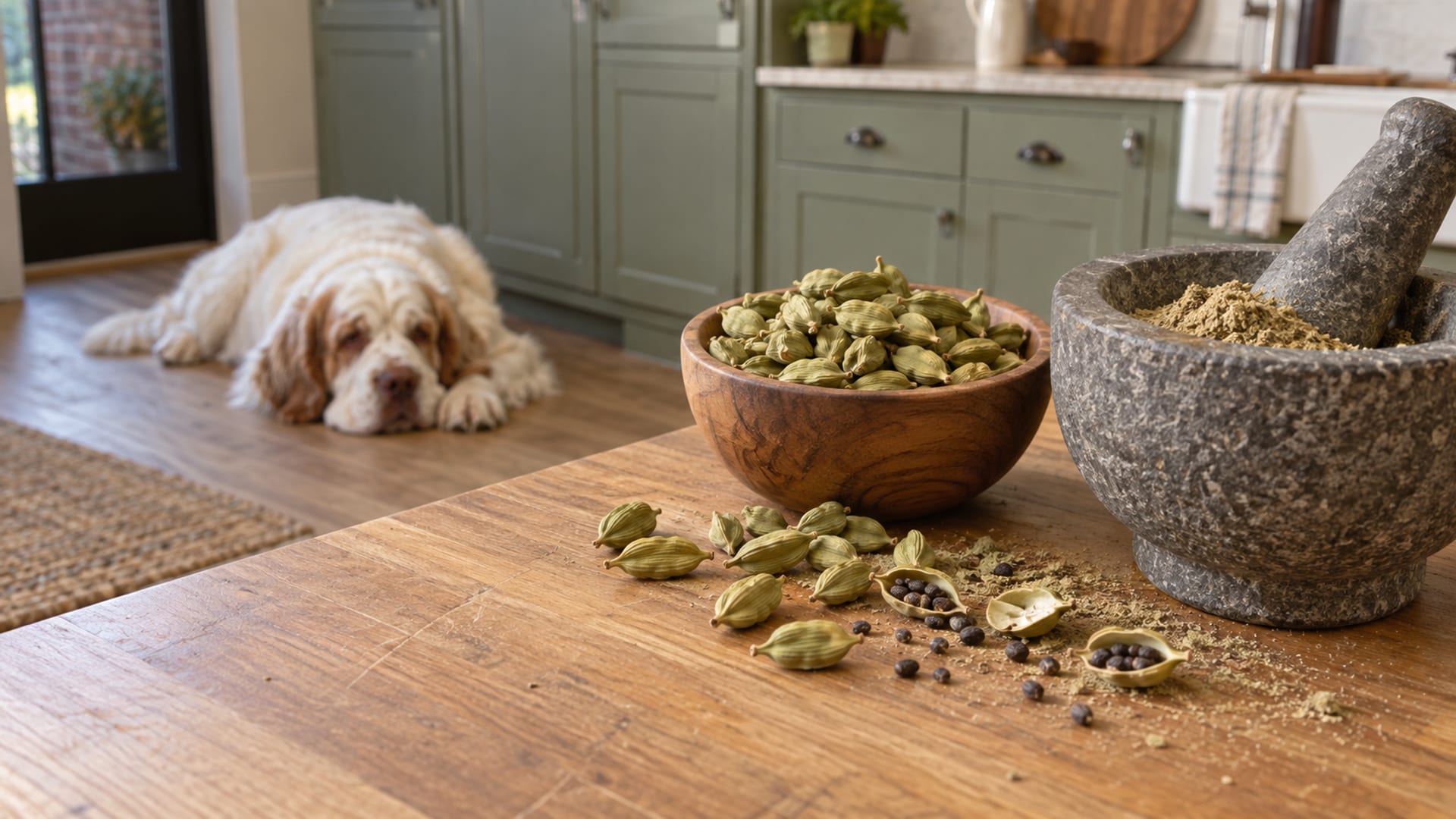
Yes, in a small amount. A pinch of ground cardamom or a few seeds in food is low concern for most dogs, and the ASPCA does not list cardamom among the plants toxic to dogs. Two things sit apart from that answer: cardamom essential oil, extracts and supplements, which are concentrated and count as a separate exposure, and a whole pod, which can choke a small dog or get stuck in the gut.
If your dog already got into some, a few seeds off the floor usually means watching your dog. Oil in any amount, a whole pod in a small dog, or a cardamom food that also held chocolate, xylitol or raisins means calling your vet or a pet poison line now.
Key takeaways
Tap a card to bring it forward.
- A small amount of culinary green or black cardamom is low concern, and the ASPCA does not list cardamom as toxic to dogs.
- Cardamom essential oil, extracts, capsules and diffuser liquids are concentrated. Call promptly if your dog swallowed any, got it on the skin or breathed it in.
- A whole pod can cause choking or a blockage, and a small dog is at the greatest risk.
- In cakes, buns, curries and chai, the other ingredients usually matter more than the cardamom.
- Repeated vomiting, drooling, breathing trouble, tremors, wobbling, weakness, seizures or collapse mean call now.
What to do if your dog just ate cardamom
The questions a vet will ask are the same ones that tell you how urgent this is.
- Move your dog away from the spill, the plate or the bottle. Every extra lick adds to the amount, which is one of the first things you'll be asked.
- Work out the form. Seeds, powder, a pod, a baked good, tea and oil each carry a different level of concern, as the table below shows.
- Keep the jar, bottle, wrapper or recipe. The label shows whether it was plain spice or a concentrated product, and what else went down with it.
- Estimate how much, and note your dog's size. The same amount is a bigger dose for a small dog, which also has more trouble passing a whole pod.
- Call right away for oil, extracts, supplements, a whole pod in a small dog, risky ingredients, or any signs at all. Pet Poison Helpline advises immediate veterinary care if a pet swallowed, breathed in or got an essential oil on its skin, and the ASPCA advises calling poison control or your local vet as soon as possible whenever a toxic substance may have been eaten.
For one or two seeds or a lick of powder, with a dog acting normal, a poison call isn't automatically needed. Put the spice away, keep your dog close, and call your vet if signs appear, if you can't tell how much was eaten, or if your dog is very small.
Which forms of cardamom are low concern and which need a call
Green and black cardamom come from two different plants. Green cardamom, also sold as true or small cardamom, is *Elettaria cardamomum*, while black cardamom, sometimes called large or brown cardamom, is usually *Amomum subulatum*, according to the Codex Alimentarius Commission. A small culinary amount of either is low concern; the form matters far more than the color.
Tap or hover a row to highlight it.
| Form | Level of concern | What to do |
|---|---|---|
| FormA few seeds | Level of concernLow; dried spice can upset the stomach | What to doWatch your dog and call if signs appear |
| FormA pinch or lick of ground powder | Level of concernLow in a small culinary amount | What to doWatch, and call if the amount is unknown or signs appear |
| FormA whole pod | Level of concernNot a listed toxin, but it can cause choking or a blockage | What to doCall if your dog is small, the count is unknown, or your dog gags or vomits |
| FormCakes, buns, curries and rice with cardamom | Level of concernThe cardamom is usually minor; the rest of the recipe decides | What to doRead the ingredients and call if anything risky is in them |
| FormChai and cardamom tea | Level of concernDepends on strength and what else is in the cup | What to doCheck for caffeine, xylitol and alcohol |
| FormEssential oil, extract, tincture, capsules, diffuser liquid | Level of concernConcentrated, a separate exposure | What to doCall promptly, whether swallowed, on the skin or breathed in |
Cardamom's volatile oil made up about 5 percent of the seed's weight in a 1996 study published in Pharmacological Research, and a bottle of essential oil is that part of the spice, distilled and concentrated. The Merck Veterinary Manual explains that the risk from essential oils rises with concentration, and it lists vomiting, breathing problems, seizures and possible liver or kidney failure among the possible signs in animals.
A whole pod is a physical problem instead. According to the Merck Veterinary Manual, a pod can still cause choking or a blockage even though the plant isn't a listed toxin.
How much cardamom a dog can have, and how to share it
There's no dog-size serving of cardamom to go by, so I'd treat it as something your dog meets in food rather than something you hand out. Never give cardamom essential oil, an extract, a supplement or whole pods as a treat, since concentrated products carry the higher risk.
When the real question is a bite of your cardamom bun or a spoonful of spiced rice, look at the rest of the recipe. Cardamom turns up in sweet breads, cakes, cookies, rice dishes and curries, and those foods can also hold chocolate, grapes and raisins, xylitol, onions, garlic, alcohol, or a lot of butter and sugar. Any one of those is a bigger concern than the spice.
If none of those are in it, a small plain bite with a light dusting of cardamom, minus any frosting or glaze, is the version least likely to cause trouble.
Signs to watch for after your dog eats cardamom
After a small amount of culinary cardamom, the effects, if any, tend to be mild: some vomiting, loose stool, drooling, or a mouth and stomach that seem irritated. Vomiting that keeps coming back is a reason to call, even if the amount seemed small.
A swallowed pod shows itself in its own way. Gagging, repeated vomiting, a sore belly, or a dog who goes quiet and flat can mean the pod is stuck, and that needs a vet.
Oil tends to move faster. Pet Poison Helpline lists vomiting, diarrhea, depression, seizures, poor coordination, weakness and collapse after essential-oil exposure, and the Merck Veterinary Manual adds breathing problems and possible liver or kidney failure. Those signs can come on quickly after the oil is swallowed, breathed in or rubbed onto the skin. The worst outcomes from a concentrated oil are serious: severe nerve or breathing illness, organ failure, or death. There's no set timeline for cardamom oil, so call as soon as you know your dog got into it.
After any form of cardamom, repeated vomiting, heavy drooling, trouble breathing, tremors, wobbling, weakness, seizures or collapse mean call now. If the food also held chocolate, xylitol, raisins, onion or garlic, mention that first, because it has its own signs and timing.
My dog ate cardamom before and was fine
If your dog has licked a chai mug or stolen a corner of cardamom cake before and nothing happened, I believe you. It tells you something true about that dog on that day. It can't promise the same next time, or for another dog:
- The amount. A crumb holds very little spice, and the Merck Veterinary Manual notes that essential-oil risk climbs as concentration goes up.
- The dog's size. The same amount is a very different dose per pound for a Chihuahua and a Labrador.
- The form. A seed or a pinch of powder and a bottle of oil are different exposures, even though they carry the same name.
- The route. Pet Poison Helpline says signs from essential oils vary with the type of oil, the dose, the route and the concentration.
- The individual dog. One dog who stayed well doesn't show that every dog will.
- Signs that slipped by. Mild vomiting, loose stool or a little unsteadiness can go unnoticed or get blamed on something else.
- The rest of the recipe. Last time's cake may not have had the raisins, chocolate or xylitol this one does.
Foods, products and names that contain cardamom
Cardamom shows up well beyond the spice jar.
Foods and drinks. Chai and other spiced tea drinks, Scandinavian cardamom buns and breads, holiday cookies and cakes, and many Indian, Middle Eastern and Ethiopian dishes use cardamom. Chai is usually brewed with black tea, so caffeine comes along with the spice; the tea entry covers that part. Spice blends such as curry powder mix in other spices, and caraway, for instance, is listed by the ASPCA as toxic to dogs because of its oils, carvone and limonene. If the recipe also used cinnamon, ginger or black pepper, check those entries too.
Concentrated products. "Cardamom oil" on a label usually means essential oil distilled from the seeds. Extracts, tinctures, oleoresin, capsules, supplements, fragrances and diffuser liquids are all concentrated, and any of them is a reason to call.
Names that cause mix-ups. Cardamon, cardamum and cardimom are common misspellings of the same spice. Green, true and small cardamom all mean *Elettaria cardamomum*. Black, brown, large, greater, Nepal and Bengal cardamom usually mean *Amomum subulatum*, though the European Food Safety Authority notes that the common name "cardamom" covers more than one plant. When it matters, check the label for the scientific name, product type, concentration and full ingredients, because color alone won't tell you which plant you have.
Check what you learned
Three short questions on the points that matter most.
Quick check
Questions about dogs and cardamom
These come up once the first worry passes.
Can dogs have chai or cardamom tea?
A small lick of plain, cooled, weak tea is a very different exposure from concentrated oil, and it isn't known to be toxic. Most chai carries caffeine from black tea and often sweeteners, which could include xylitol, so check the cup first.
Is a cardamom oil diffuser a problem for my dog or cat?
It can be, because breathing in an essential oil or getting it on the coat counts as an exposure too, and Pet Poison Helpline advises immediate veterinary care for inhaled and skin contact as well as swallowing. Cats face more risk than dogs, according to the Merck Veterinary Manual, because their bodies clear these compounds poorly and they lick oil off their fur while grooming.
Is black cardamom riskier than green cardamom?
Neither one is on the ASPCA's toxic list, and a small culinary amount of either is low concern. Black pods are larger, though, so a whole one is a bigger thing for a small dog to swallow.
My dog has pancreatitis or diabetes. Does cardamom matter?
For dogs with pancreatitis, diabetes or kidney disease, the concern is what comes with the cardamom. Rich buns, cakes and curries can carry a lot of fat, sugar or salt, and those are the parts to raise with your vet.
Sources
Checked September 25, 2026.
- ASPCA, Toxic and Non-Toxic Plants List, Dogs
- ASPCA, Toxic and Non-Toxic Plants: Caraway
- Merck Veterinary Manual, Toxicoses From Essential Oils in Animals
- Merck Veterinary Manual, Plants Poisonous to Animals
- Pet Poison Helpline, Essential Oils
- Pet Poison Helpline, Essential Oils 2
- Codex Alimentarius Commission, Proposal for New Work on Codex Standard for Small Cardamom
- European Food Safety Authority, Safety and efficacy of an essential oil from Elettaria cardamomum
- Pharmacological Research, Pharmacological studies of cardamom oil in animals