
Yes. A small amount of plain ginger, fresh or powdered, is safe for most dogs, according to the American Kennel Club. A large amount can irritate the mouth and stomach and bring on diarrhea. The bigger risks usually come from what ginger is mixed into: cookies, candy and drinks can contain xylitol, alcohol, caffeine or raisins.
If your dog licked a bit of grated ginger or ate a thin slice, there is nothing to do but watch for a sore stomach. If they ate a big chunk, a ginger supplement, essential oil, or a ginger food with other ingredients, use the table below.
Key takeaways
Tap a card to bring it forward.
- A pinch of plain fresh or powdered ginger is safe for most dogs.
- The AKC's upper limit is 1/16 teaspoon per pound of body weight.
- Too much can irritate the mouth and stomach and cause diarrhea.
- Extracts, supplements and ginger essential oil are concentrated; call your vet if your dog got into them.
- Gingerbread, ginger snaps, candy and ginger ale can hide xylitol, raisins, nutmeg, alcohol or caffeine.
My dog ate ginger: what to do
Tap or hover a row to highlight it.
| What they ate | What to do |
|---|---|
| What they ateA lick or a thin slice of plain ginger | What to doNothing. Watch for drooling, vomiting or a loose stool. |
| What they ateA large piece or a lot of ginger powder | What to doWatch for vomiting, diarrhea or belly pain, and call your vet if they appear. A big chunk can also choke a small dog. |
| What they ateGinger supplements, capsules, tinctures or extract | What to doCall your vet or a pet poison line with the label. |
| What they ateGinger essential oil | What to doCall now. It is far more concentrated than kitchen ginger. |
| What they ateGingerbread, ginger snaps, candy, pickled ginger, ginger ale or ginger beer | What to doRead the label. If it lists xylitol, alcohol, caffeine, raisins, chocolate or nutmeg, call now. |
| What they ateA garden plant called ginger you cannot identify | What to doCall, and bring a photo or a piece of the plant. |
When you are unsure what your dog ate, the ASPCA says to move your pet away from it so they cannot eat more, and to keep the package or a sample so you can say what and how much. Have your dog's weight and the time handy before you call.
Call right away for choking, trouble breathing, collapse, seizures, repeated vomiting or severe diarrhea.
Fresh root, powder, juice and the plant
Tap or hover a row to highlight it.
| Form | Safe? | Notes |
|---|---|---|
| FormFresh ginger root, peeled and minced | Safe?Yes, a small amount | NotesThe AKC says to peel it and mince or slice it thin |
| FormGround or dried ginger powder | Safe?Yes, a small amount | NotesThe AKC lists powdered ginger as safe in moderation |
| FormGinger juice | Safe?Yes, a small amount | NotesThe AKC includes it with fresh and powdered ginger |
| FormPeel | Safe?Remove it | NotesPeeling gets rid of dirt and pesticide residue and lowers the choking risk |
| FormLarge chunks | Safe?No | NotesA choking and stomach-upset risk, especially for small dogs |
| FormExtract, capsules, tinctures | Safe?Ask your vet first | NotesConcentrated, with no established dose for dogs |
| FormGinger essential oil | Safe?No | NotesConcentrated oil, a different thing from kitchen ginger |
| FormPickled or candied ginger | Safe?Skip it | NotesSalt, sugar, vinegar and sometimes xylitol |
| FormOrnamental "ginger" plants | Safe?Depends on the plant | NotesThe name covers several unrelated plants |
Kitchen ginger is the root of *Zingiber officinale*. Several garden plants share the name. The ASPCA lists white ginger, also called butterfly ginger or ginger lily, as non-toxic to dogs and cats, but that listing covers that plant only. If your dog chewed a plant and you do not know its name, call.
How much ginger a dog can have
The AKC suggests no more than 1/16 teaspoon of ginger per pound of body weight. Its own examples are:
Tap or hover a row to highlight it.
| Dog | Most ginger at one time |
|---|---|
| DogSmall dog | Most ginger at one time1/4 teaspoon |
| DogLarger dog | Most ginger at one time3/4 teaspoon |
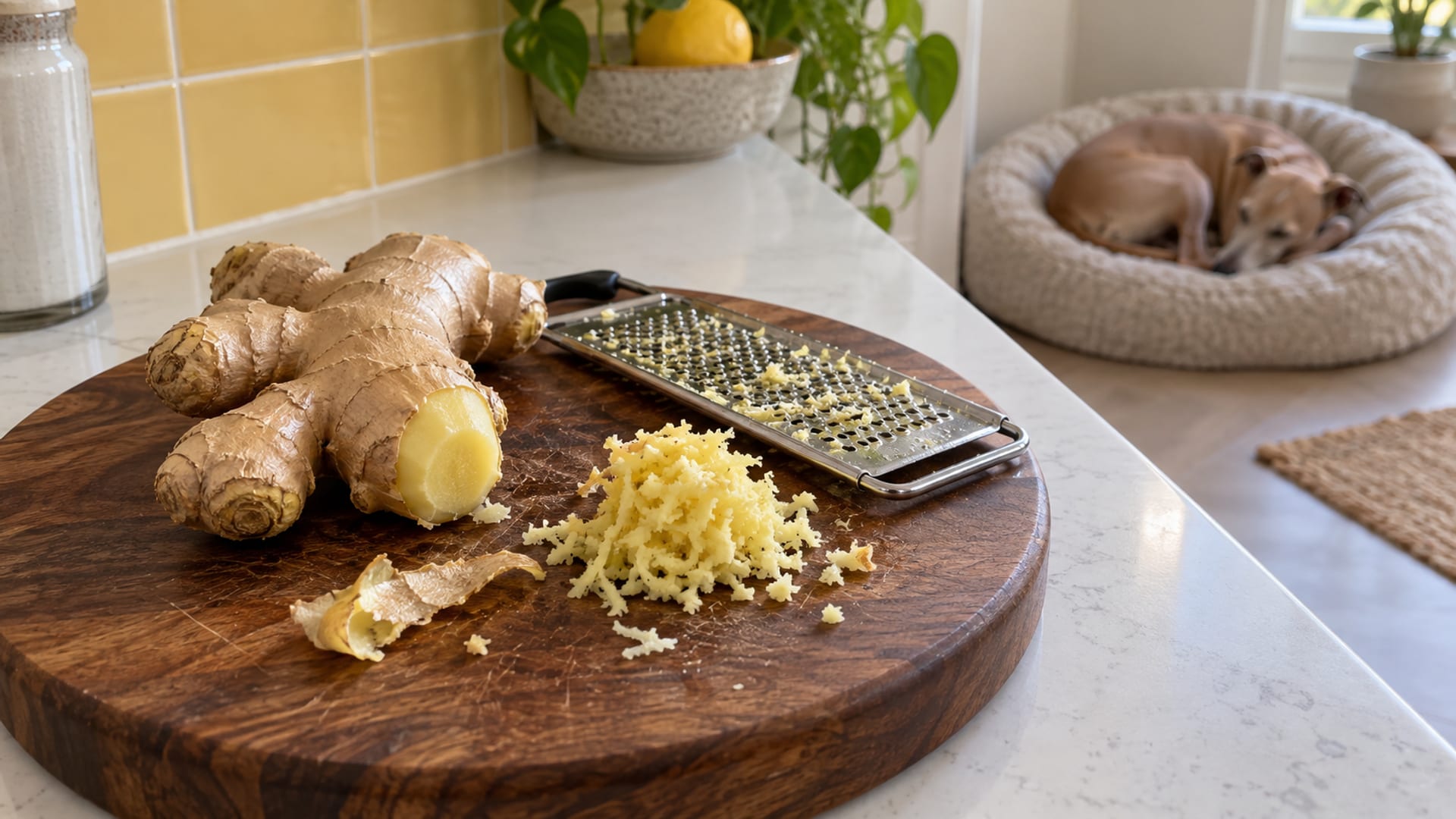
That is the AKC's serving ceiling, and less is fine. Peel fresh ginger and mince it fine or slice it very thin, then sprinkle it over food. Start with a pinch and see how your dog does.
Some dogs should skip ginger unless the vet says otherwise. The AKC advises avoiding it in dogs with bleeding disorders, dogs about to have surgery, and dogs taking NSAID pain medicine, because ginger may affect how blood clots. It also says to ask your vet first for a dog with diabetes or heart disease, and notes that some vets advise against ginger for pregnant or nursing dogs.
If you are thinking of ginger for a dog that is vomiting or carsick, call your vet first. A 1997 study found that ginger extracts reduced vomiting caused by a chemotherapy drug in dogs, but those were measured extracts in a lab, and vomiting has many causes that need a vet to sort out.
Signs your dog had too much ginger
The Merck Veterinary Manual lists these possible side effects of ginger:
- a sore or irritated mouth and throat
- stomach irritation and belly discomfort
- diarrhea
Vomiting can happen too. If your dog seems normal after a small amount of plain ginger, serious trouble is not expected. When the ginger came in a product, the other ingredients decide the risk, and a product with xylitol, alcohol or caffeine can be life-threatening.
"My dog has had ginger before with no problem"
That is likely true, and many dogs handle a little ginger fine. It still depends on the day. A pinch sprinkled on dinner is a very different amount from a whole knob of root pulled off the counter. The same piece is a bigger dose for a 10-pound dog than for a 70-pound one. Form changes things too, since plain root, powder, an extract, essential oil and a xylitol-sweetened candy are five different exposures. And dogs differ in how sensitive their stomachs are. Stick to a pinch of the plain spice, and read the label on anything else.
Ginger ale, gingerbread, pickled ginger and other ginger foods
- Gingerbread, ginger snaps and ginger cookies: can contain nutmeg, raisins, chocolate, macadamia nuts, xylitol, and lots of sugar and fat. Check the recipe before anything else.
- Ginger ale and ginger beer: sugar or artificial sweeteners, and some ginger beers contain alcohol or caffeine. Water is the better drink.
- Pickled sushi ginger: salt, vinegar, sugar and sometimes xylitol. A tiny taste is unlikely to hurt from the ginger alone, but skip it.
- Ginger tea: check what else is in the blend and whether it is sweetened.
- Supplements and capsules: concentrated, with no set dose for dogs. Ask your vet before using one.
- Other spices: cinnamon has its own answer, and so do nutmeg and garlic.
Check what you learned
Quick check
Questions about dogs and ginger
Can dogs eat fresh ginger?
Yes, a small amount. The AKC says to peel it and mince it finely or slice it thin. Large chunks can irritate the stomach or cause choking.
Can dogs eat ginger powder?
Yes, in moderation. The AKC lists powdered ginger as safe for dogs in small amounts. Keep within its limit of 1/16 teaspoon per pound.
Can I give my dog ginger for an upset stomach?
Ask your vet first. Ginger extracts reduced vomiting in one lab study in dogs; that study did not test kitchen ginger for everyday nausea, and vomiting can be a sign of something that needs a vet.
What if my dog ate gingerbread or drank ginger ale?
Read the label. The danger is usually in the other ingredients, such as xylitol, alcohol, caffeine, raisins, chocolate or a lot of fat and sugar.
Is ginger safe for cats?
The dog answer does not carry over automatically. Ask your vet before giving ginger to a cat, and keep ginger supplements and oils away from cats.
Sources
Checked September 24, 2026.
- American Kennel Club, Can Dogs Eat Ginger?
- Merck Veterinary Manual, Herbal Medicine in Veterinary Patients
- ASPCA Animal Poison Control Center, White Ginger
- ASPCA, What to Do if Your Pet Is Poisoned
- Sharma SS and others, Antiemetic efficacy of ginger (Zingiber officinale) against cisplatin-induced emesis in dogs, Journal of Ethnopharmacology, 1997