
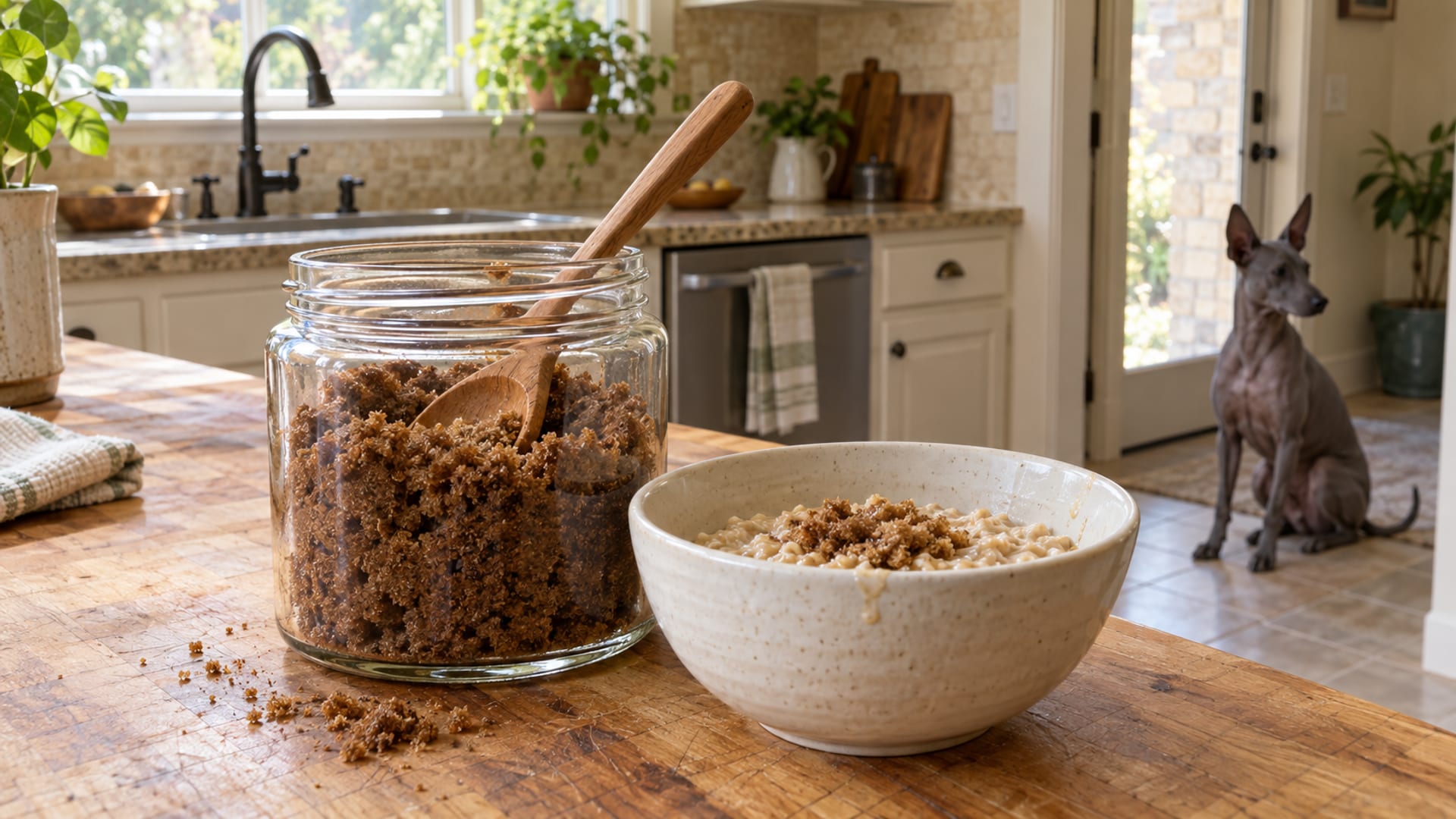
A small lick of plain brown sugar off the floor is usually low concern for a healthy dog. Plain brown sugar is not a typical dog poison, but it still sits in the caution group, because it is added sugar your dog has no use for and it should not be fed on purpose.
If your dog already got into some, pick up the bag and read the label before anything else. A sugar-free brown sugar, a substitute or a sweetener blend can contain xylitol, which is dangerous for dogs, and that one ingredient changes the whole answer. Once you know it was real sugar, the next questions are how much your dog ate, what else was in the food, and how big and healthy your dog is. The ASPCA Animal Poison Control Center advises calling a veterinarian or poison line after a potentially hazardous ingestion even when the dog seems fine, so call right away for any xylitol, a product you can't identify, a large amount, or vomiting, diarrhea, wobbliness or tremors.
Key takeaways
Tap a card to bring it forward.
- Plain brown sugar is not a named dog poison, and a small lick is usually low concern in a healthy dog.
- Read the label first. Sugar-free and substitute brown sugars can contain xylitol, also sold as birch sugar or wood sugar.
- Call your vet or a pet poison line right away for xylitol, an unknown product, a large amount, or any signs.
- A very large amount of sugar can cause heavy thirst, watery diarrhea, vomiting, wobbliness and tremors.
- Skip it as a treat, and keep it well away from diabetic and overweight dogs.
What to do if your dog just got into brown sugar
These steps answer the urgent question first, which is whether you are dealing with plain sugar or something worse.
- Move the bag and any leftovers out of reach. A dog that found one spill often goes back for more, and a chewed bag adds its own problem, since plastic and wrappers can cause choking or a gut blockage.
- Read the ingredient list. Look for sugar-free, substitute, blend, xylitol, birch sugar or wood sugar; the AKC lists birch sugar and wood sugar as other names for xylitol.
- Estimate how much is gone and when. Your vet or the poison line will ask for the amount, the time and your dog's weight, and those three facts shape most of the advice you get.
- Check what else was in the food. The Pet Poison Helpline points out that chocolate, raisins, high fat, wrappers and xylitol in sweets change the risk, so a cookie or dessert matters more for its recipe than its sugar.
- Call right away if a warning sign applies. That means possible xylitol, an unknown product, a large or unknown amount, a puppy, a senior dog, a dog with an ongoing illness, or any signs, because these are the cases where waiting costs time.
- Get emergency care for serious signs. The ASPCA Animal Poison Control Center lists seizures, trouble breathing, collapse, unconsciousness and bleeding as reasons to go immediately.
- For a small lick of plain brown sugar, watch your dog and keep fresh water out. Most dogs show nothing or a short bout of stomach upset, and water matters because thirst and fluid loss are the first trouble after larger amounts.
Which brown sugar forms are low concern and which need a call
The sugar behaves about the same whether it is light, dark, packed or cooked into a sauce. What changes from one form to the next is what came along with it.
Tap or hover a row to highlight it.
| Form | What matters | What to do |
|---|---|---|
| FormPlain light or dark brown sugar | What mattersSugar with molasses, not a named dog poison | What to doSmall lick: watch. Large amount: call. |
| FormPiloncillo or panela | What mattersConcentrated cane sugar, the same basic concern | What to doTreat it like brown sugar |
| FormPowdered brown sugar | What mattersFine powder breathed in may irritate the airway | What to doCall if coughing or breathing trouble follows |
| FormSugar-free brown sugar, substitute or blend | What mattersMay contain xylitol | What to doCall right away, label in hand |
| FormSyrup, glaze, frosting or caramel | What mattersPossible butter, cream, salt, chocolate, alcohol or xylitol | What to doCheck every ingredient |
| FormCookies, cake, oatmeal or candy | What mattersMay add chocolate, raisins, macadamia nuts, caffeine, high fat or xylitol | What to doGo by the most dangerous ingredient |
| FormBrown sugar flavoring | What mattersMay be an alcohol-based extract or sugar-free | What to doCall for alcohol or xylitol |
| FormThe bag or wrapper | What mattersChoking or gut blockage | What to doCall if pieces were swallowed |
Piloncillo and panela, the solid cones and blocks of cane sugar found in many Latino kitchens, fall under the same questions about amount and dog size as the granulated kind. The row to take most seriously is the sugar-free one, because the Pet Poison Helpline describes xylitol as a cause of low blood sugar and liver injury in dogs.
Sharing a bite, and how much is too much
Brown sugar has no place in a dog's diet, so the useful answer to "how much can I share" is none on purpose. The AKC recommends avoiding added sugar for dogs. If your dog is begging at breakfast, a spoon of brown sugar oatmeal carries the sugar plus whatever else went into the bowl; our Oatmeal entry covers the oats on their own.
The longer-term reason to skip it is calories. The Merck Veterinary Manual explains that obesity comes from eating more energy than a dog burns, and it links obesity with pancreatitis and diabetes. Merck's page on diabetes in dogs adds that obesity predisposes dogs to insulin resistance and that diabetic dogs should avoid diets high in simple sugars. One spoonful won't give a dog diabetes, but sweet extras add up, and for a dog that is diabetic, overweight or has had pancreatitis, brown sugar is a clear skip.
As for how much is a concern after an accident, there is no published brown sugar dose by body weight, so nobody can hand you a safe number. The same amount is a bigger exposure for a small dog than a large one. Instead of guessing, call and give your dog's weight, how much is missing, the exact product and its label, everything else in the food, and when it happened. Mention any health problems too.
The one real number in this area belongs to xylitol. The Pet Poison Helpline notes that a single piece of xylitol gum may be enough to cause low blood sugar in a 10-pound dog, though the amount per piece varies. That is why a spoonful of a sugar-free blend deserves a phone call when a spoonful of the regular kind usually doesn't.
Signs to watch for and when they show up
After a small amount of plain brown sugar, the most likely result is nothing, or a short stretch of stomach upset. After a bigger amount, watch for:
- increased thirst and more trips to the water bowl
- loose or watery stool
- vomiting or belly discomfort
- weakness, or seeming tired and flat
- signs of dehydration, such as dry gums
The ASPCA Animal Poison Control Center warns that very large sugar ingestions can cause excessive thirst, fluid shifts, high blood sodium, unsteadiness, tremors and, in severe cases, seizures. That is the worst realistic outcome from ordinary sugar alone, and it follows a very large amount, especially when the dog isn't drinking enough. Wobbliness or tremors after a sugar binge are a reason to call right away.
Timing is sharper with xylitol. The Pet Poison Helpline says xylitol can drop a dog's blood sugar within about 30 minutes to 2 hours, and liver injury can follow later. A dog that looks normal right after eating a sugar-free product still needs that call.
My dog ate it before and was fine
That happens. Plenty of dogs have licked a sticky spoon or cleaned up a brown sugar spill with nothing to show for it, and that experience was real. It just doesn't carry over to every dog or every product:
- Amount. A lick and a torn-open bag are very different exposures, and the ASPCA ties the serious problems to large quantities.
- Size. The same spoonful is a much bigger share of a small dog's body.
- The product. Plain brown sugar, a sugar-free blend and a chocolate brown sugar cookie are three different situations under one name.
- The dog's health. Diabetes, obesity, past pancreatitis, age and other illness all change the concern.
- Timing. With xylitol, looking fine at first says little, since liver injury can come later.
So, if your last dog was fine, that tells you about that dog and that spill. For this one, the label and the amount are still the first things to check.
Brown sugar foods and look-alike products
Several products carry the words "brown sugar" or sit next to it on the shelf, and some of them are a different case.
- Birch sugar and wood sugar. Both are names for xylitol, and they are the ones to call about.
- Sugar-free brown sugar. These blends may use xylitol or other sugar alcohols such as erythritol, sorbitol or maltitol, and those are not interchangeable. Read the whole list to your vet.
- Brown sugar oatmeal, cookies and cake. Check for Chocolate, Grapes and raisins, macadamia and other Nuts, and heavy butter.
- Glazes, frostings and caramel. These bring fat, cream and salt, and some use flavorings with Alcohol in them.
- Brown sugar candy. Candy adds wrappers and sometimes xylitol; the Halloween candy entry covers the mixed-bag problem.
- Molasses, maple syrup and Agave. These are different products with different makeups.
- Sugarcane. Chewing the actual cane is a separate concern, since the tough fiber is hard to digest and can cause choking or a blockage.
- Stevia, sometimes called sugar leaf. The ASPCA plant list lists Stevia rebaudiana as non-toxic to dogs.
The Pet Poison Helpline notes that holiday candy and sweets are where xylitol, chocolate, fat and wrappers most often turn up, so judge the finished food as a whole.
Check what you learned
Three quick questions on what matters most when brown sugar goes missing.
Quick check
Questions about dogs and brown sugar
These are the questions that tend to come up once the first worry has passed.
Can brown sugar hurt my dog's teeth?
Sugar-fermenting bacteria can wear down tooth enamel, but the Merck Veterinary Manual notes that cavities are uncommon in dogs. One spill won't cause dental disease, though frequent sweet extras still aren't good for a dog's mouth.
My dog is pregnant and ate some brown sugar. Does that change anything?
The Merck Veterinary Manual lists pregnancy and the heat cycle phase called diestrus among factors that can predispose dogs to diabetes. That makes sweet extras an even poorer choice for a pregnant dog. Call your vet about anything beyond a lick, and mention the pregnancy.
Does erythritol or another sugar alcohol act like xylitol?
Sugar alcohols are not interchangeable, so one on the label doesn't tell you the risk of another. Because a sugar-free brown sugar can use any of them, read the full ingredient list to your vet or the poison line and let them sort it out.
My dog drank brown sugar syrup off a pancake plate. Is that different?
Syrup is sugar in liquid form, often with butter or flavoring mixed in. Check the bottle for alcohol-based flavoring or xylitol, think about how much was on the plate, and call if it was more than a few licks or your dog is small.
Sources
Checked September 25, 2026.
- ASPCA, My Pet Ate Something! When Should I Seek Help?
- ASPCA, Help! My Dog Just Ate Some Gummies! What Do I Do?
- ASPCA, Toxic and Non-Toxic Plant List, Dogs
- AKC, What Artificial Sweeteners Are Bad for Dogs?
- AKC, Which Human Foods Can Dogs Eat and Which Are Dangerous?
- Pet Poison Helpline, My Dog Ate Candy. What Do I Do Now?
- Pet Poison Helpline, Xylitol
- Pet Poison Helpline, Kitchen Toxins to Pets
- Merck Veterinary Manual, Nutrition in Disease Management in Small Animals
- Merck Veterinary Manual, Diabetes Mellitus in Dogs and Cats
- Merck Veterinary Manual, Dental Caries in Small Animals