

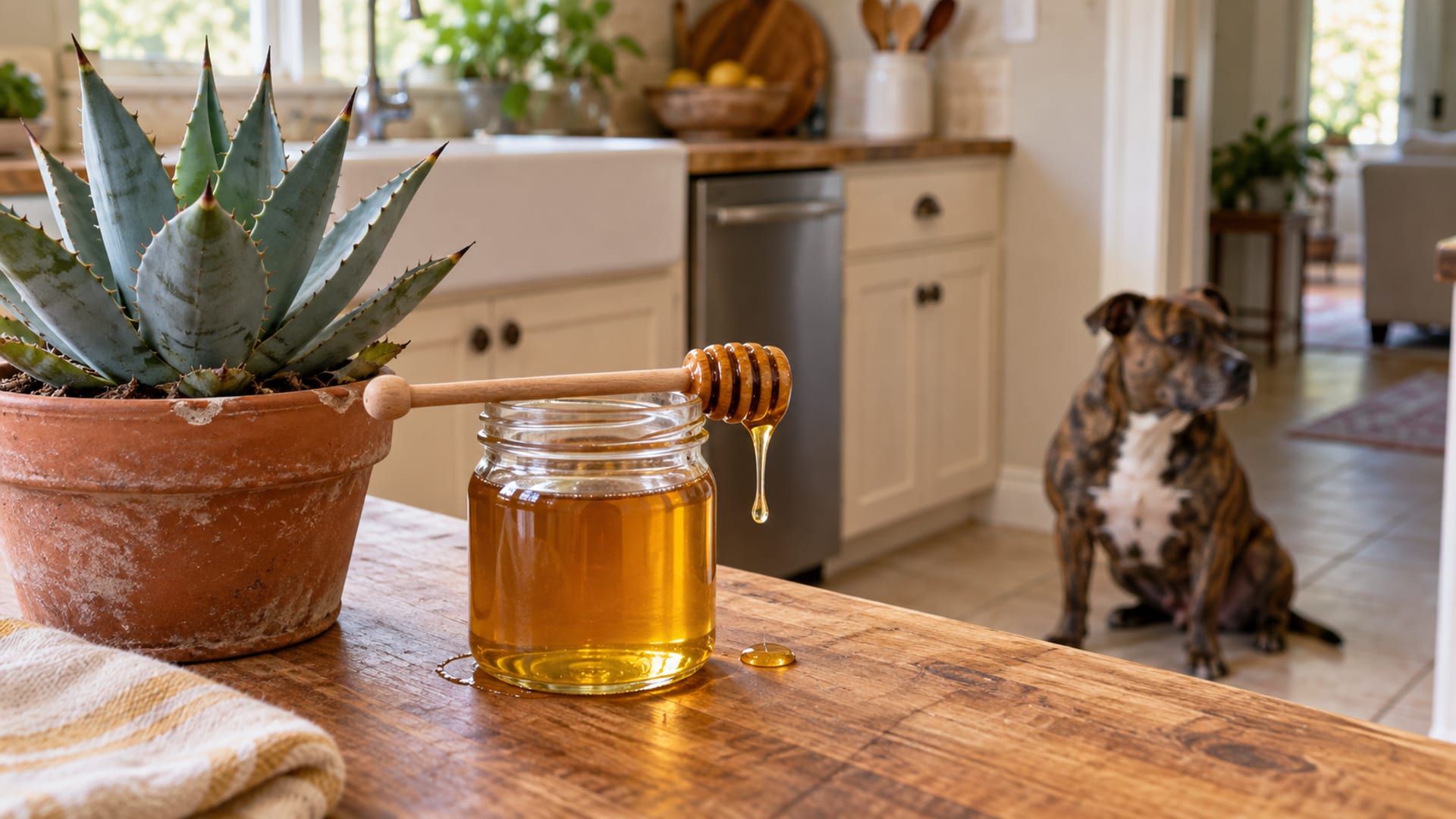
Dogs should not eat or chew agave plants. The leaves, sap and seeds can irritate a dog's mouth and skin and cause swelling, and the spines along the leaves can puncture. Agave nectar is a separate product, a concentrated sweetener, and a small lick of it is a much smaller worry than a chewed plant. If your dog just dug into an agave, century plant or maguey, get them away from it, save a photo or a piece of the plant, and call your vet if you see swelling, heavy drooling, vomiting or trouble breathing, or if a big chunk of the plant is missing.
Key takeaways
Tap a card to bring it forward.
- The live plant is the real concern: its leaves, sap and seeds can irritate the mouth and skin and cause swelling.
- The spines can puncture the mouth and make chewing painful.
- Facial swelling can show up several hours after the chewing, so keep watching even if your dog seems fine now.
- Agave nectar is a sugary sweetener; a small lick is a far smaller concern, but it has no place on the treat list and the label needs checking.
- Tequila and mezcal are alcohol exposures, and aloe vera is a different plant with its own answer.
What to do if your dog just chewed agave or licked the nectar
The first question is which agave your dog met, because a yard plant, a spoonful of syrup and a glass of tequila are three different situations. The steps below cover the most common case, a dog that chewed or dug up a live plant.
- Move your dog away from the plant and any torn leaves. Every extra minute of chewing adds more sap and more chances for a spine to go in, so stopping the exposure comes before anything else.
- Work out exactly what it was. If it was nectar, syrup or a flavored product, keep the jar or wrapper, because the label tells your vet whether anything besides agave, such as xylitol or alcohol, is in the mix.
- Take a photo of the plant, or cut off a piece with gloves on. Agave, aloe and yucca look alike and common names get used loosely, so a photo lets your vet or a poison line identify what your dog actually chewed.
- Write down the time and how much of the plant is damaged. Swelling can take hours to appear, and your vet will want to know when the chewing happened and roughly how much went in.
- Call your vet or a poison line if you see any signs, or if the amount is large or unknown. The ASPCA advises calling whenever you think your pet swallowed something potentially poisonous, and a large piece, a plant you can't identify, or a product that may contain alcohol or xylitol all count, even when your dog seems fine.
- Hold off on home remedies and human medicine. In the case Pet Poison Helpline describes, the vet team built a treatment plan around that dog's condition, and that decision belongs with your vet.
For a small lick of plain agave nectar and a dog acting normally, watching at home and calling if anything changes is a reasonable plan.
Which parts of agave cause trouble
The Merck Veterinary Manual lists *Agave americana*, the century plant, among plants poisonous to animals and names the leaves, seeds and sap as the parts that matter, with mouth and skin irritation and swelling as the result. Pet Poison Helpline describes agave sap as holding many different irritants, and the stiff spines add a second problem: punctures and painful injuries inside the mouth. USDA FoodData Central lists agave syrup as a food, a concentrated sweetener, so its concern is sugar instead of the plant's irritants.
Tap or hover a row to highlight it.
| Form | What it means for your dog |
|---|---|
| FormLive leaves | What it means for your dogCan irritate the mouth and skin and cause swelling |
| FormSap | What it means for your dogThe main irritant; the exposure behind the severe case Pet Poison Helpline reported |
| FormLeaf spines | What it means for your dogCan puncture the mouth and skin and cause painful chewing injuries |
| FormSeeds | What it means for your dogListed by Merck among the harmful parts |
| FormCooked plant | What it means for your dogTreat as unsafe; cooking can't be counted on to remove the irritants or the spines |
| FormDried leaves, powder or tea | What it means for your dogAvoid; drying packs more plant material into each bite |
| FormAgave nectar or syrup | What it means for your dogConcentrated sugar; a small lick is minor, larger amounts can upset the stomach |
| FormTequila or mezcal | What it means for your dogThe alcohol is the hazard; call |
| FormAgave-flavored products | What it means for your dogCheck the label for xylitol, alcohol, chocolate, caffeine, onion or garlic |
How much agave is a problem, and where the nectar fits
For the plant, there is no safe amount to aim for and no weight chart to hold a bite up against. What to do instead is call and give three facts: your dog's weight, which part they chewed, and roughly how much is gone. The same bite is a bigger share of a small dog's body, so have the weight ready.
The nectar is the other half of the question. A small accidental lick is a much smaller event than chewing a leaf, and it doesn't carry the plant's irritants. Larger amounts can upset the stomach, though, and no veterinary source recommends it as a dog treat or gives a serving size, so I'd keep it off the treat list altogether. It adds concentrated sugar and nothing a dog needs, which matters more if your vet has asked you to limit sugar. If you're comparing sweeteners, the Honey entry covers that one on its own terms.
Signs to watch for over the next several hours
Most dogs that mouth an agave end up with irritation and an upset stomach, and Pet Poison Helpline says skin irritation and stomach upset are what it expects in dogs. The signs to look for are drooling or reluctance to eat because the mouth hurts, redness or irritation on the lips, face or skin, swelling, hives, vomiting and diarrhea.
Timing is where people get caught out. In the case Pet Poison Helpline reported, a dog came in from the yard after digging up and chewing an agave, and its face swelled several hours later, along with hives, redness, peeling skin and painful chewing injuries. That was an uncommon, severe reaction, and it needed veterinary care. There's no set clock for when signs start or how long they last, so keep your dog where you can see them for the rest of the day and through the night.
Call right away if you see any of these:
- Swelling of the face, lips or muzzle
- Hives
- Any trouble breathing
- Heavy drooling or obvious pain
- Vomiting more than once
- Refusing to eat or drink
- A visible cut or puncture in the mouth
- Collapse
My dog ate it before and was fine
Plenty of people with agave in the yard have had a dog that nosed around it, chewed a leaf tip, and never had a problem. I believe that. It happened. It just can't tell you what will happen with this dog on this day, and the reasons are practical ones:
- The amount. A nibble on a leaf tip and a dug-up plant are very different exposures, and nobody has drawn a line between them.
- The part. Sap, leaf, seed, spine and nectar each bring their own risk.
- How much contact. One dog gets a mouthful of sap or a spine in the gum; another barely touches the plant.
- The individual dog. The severe reaction in the Pet Poison Helpline case was uncommon, and it shows how differently two dogs can respond to the same plant.
- Size. The same bite is a bigger dose for a small dog.
- Timing. That dog's swelling appeared hours after the chewing, so a dog who looks fine right afterward may not stay that way.
Your earlier dog's good outcome was real. Treat today's exposure on its own facts.
Tequila, aloe vera and other agave mix-ups
Agave turns up under many names and labels, and a few of them change the answer.
- Tequila and mezcal. Both are made from agave, and the danger in them is the alcohol. Treat a lapped-up drink as an alcohol exposure and call; the Beer entry covers alcohol and dogs.
- Aloe vera. "American aloe" is an old name for the century plant, which is an agave. True aloe vera is a different plant, and the ASPCA lists true aloe as toxic to dogs and cats. Tell your vet which one your dog got into.
- Yucca. Another spiky rosette that looks like agave from across the yard. It has its own answer, which is another reason the photo helps.
- Blue agave. On a bottle or syrup label, this usually means the agave grown for tequila, which may not be the plant in your yard.
- Agave syrup and nectar, light or dark. These are processed sweeteners, and formulas differ from brand to brand.
- Agave-flavored candy, drinks, supplements and cosmetics. The label can list xylitol, alcohol, caffeine, Chocolate or essential oils, and any of those can matter more than the agave does.
Check what you learned
Three quick questions on the points that matter most.
Quick check
Questions about dogs and agave
A few more questions owners ask once the first worry has passed.
I checked the ASPCA plant list and didn't see agave. Is it safe?
The ASPCA dog plant list doesn't have a specific agave entry, and a plant missing from one list isn't a sign that it's safe. The Merck Veterinary Manual does list the century plant, with the leaves, seeds and sap as the problem parts. Treat any live agave as a plant to keep your dog away from.
Can a dog get hurt just by brushing against agave?
Contact alone can matter. Merck lists skin irritation from the plant, and the spines can scratch or puncture a nose, face or paw. If you see redness, hives or swelling after your dog pushed through an agave, call your vet.
Can cats get sick from agave too?
The sap and spines that bother a dog can bother a cat, and Pet Poison Helpline describes agave as able to cause irritation and stomach upset in pets generally. Keep cats in the same home from chewing the plant for the same reasons.
What will the vet do if my dog's face is swollen?
Expect an exam of the mouth and skin and supportive care based on what the vet finds. There's no single protocol; the plan depends on the dog's condition, the same way it did in the Pet Poison Helpline case. Bring the photo or the plant piece with you.
Sources
Checked September 25, 2026.
- Merck Veterinary Manual, Plants Poisonous to Animals
- Pet Poison Helpline, A Severely Swollen Face with No Tequila High
- ASPCA, Frequent Asked Pet Questions
- ASPCA, True Aloe
- ASPCA, Toxic and Non-Toxic Plant List, Dogs
- USDA, FoodData Central