

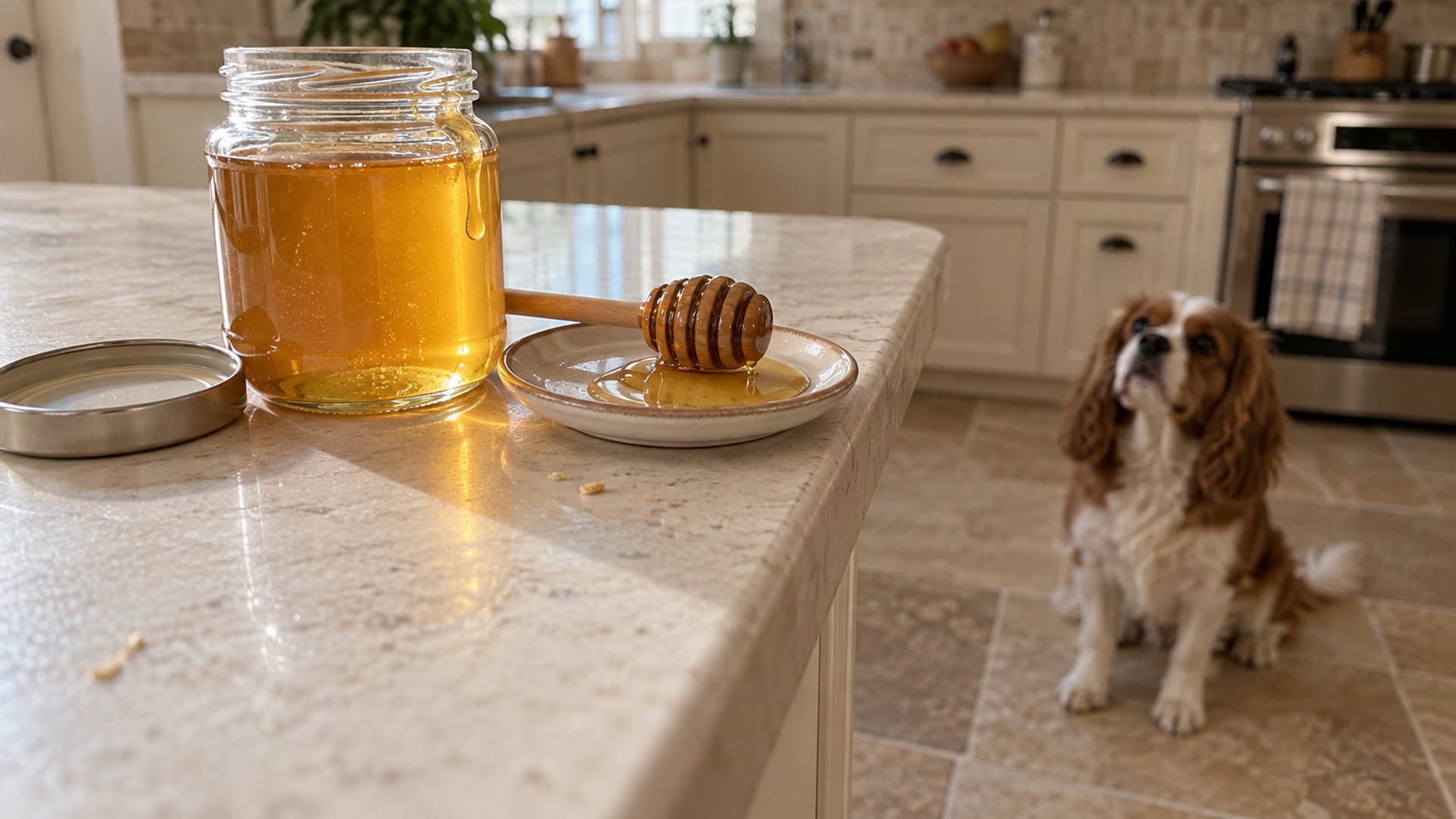
Yes, a little. The American Kennel Club says honey is safe for dogs in small quantities. Honey is concentrated sugar, which is why it stays an occasional treat. Raw honey is the one to keep away from puppies and dogs with weakened immune systems, because it can carry botulism spores.
If your dog licked a spoon or cleaned up a small spill of plain honey, keep an eye on them and carry on with your day. If it was a cough drop, a syrup, something labeled sugar-free, a whole jar, or a puppy who got raw honey, start with the table below.
Key takeaways
Tap a card to bring it forward.
- Plain honey is fine for most healthy adult dogs in small amounts.
- It is mostly sugar and calories, so a small dog gets less.
- No raw honey for puppies or dogs with weakened immune systems, because of botulism spores.
- Diabetic dogs should not get honey unless their vet says so.
- Honey cough drops, syrups and snacks can contain xylitol, chocolate, alcohol or medicine.
If your dog got into the honey
Tap or hover a row to highlight it.
| What they ate | What to do |
|---|---|
| What they ateA lick or a spoonful of plain honey | What to doNothing more than watching. A loose stool is possible. |
| What they ateMost of a jar or squeeze bottle | What to doCall your vet for advice, especially for a small dog. |
| What they ateRaw honey, and your dog is a puppy or has a weak immune system | What to doCall your vet and tell them it was raw. |
| What they ateAny honey, and your dog is diabetic | What to doCall your vet. The sugar can throw off blood glucose. |
| What they ateA big chunk of honeycomb, or the lid or packet | What to doCall your vet. Wax and packaging can upset the gut or block it. |
| What they ateHoney cough drops, syrup, lozenges, sugar-free or honey-flavored snacks | What to doCall now and read the ingredient list to whoever answers. |
The product matters more than the honey. The ASPCA warns that xylitol can drop a dog's blood sugar and damage the liver. Early signs include vomiting, tiredness and poor coordination, which can progress to seizures, and liver damage can show within 12 to 24 hours. That timeline belongs to xylitol, so a sugar-free honey product is never a wait-and-see.
Go to an emergency vet if your dog becomes weak, wobbly, has trouble swallowing, collapses, has a seizure or struggles to breathe.
Raw, manuka, honeycomb: how the forms differ
Tap or hover a row to highlight it.
| Form | For dogs | Why |
|---|---|---|
| FormPlain pasteurized honey | For dogsSmall amounts, healthy adults | WhyMostly sugar and calories |
| FormRaw honey | For dogsHealthy adults only | WhySame sugar, plus possible botulism spores |
| FormManuka and other named honeys | For dogsSame as any honey | WhyA type of honey, with no set dose for dogs |
| FormHoneycomb | For dogsA small piece at most | WhyWax can upset the stomach, and a big piece could block the gut |
| FormHoney powder or dried honey | For dogsGo easy | WhyThe sugar is more concentrated |
| FormBaked goods made with honey | For dogsDepends on the recipe | WhyCheck for chocolate, caffeine, alcohol or xylitol |
| FormMedical honey for wounds | For dogsOnly as your vet directs | WhyMade for use on the skin |
Researchers have found spores of *Clostridium botulinum* in honey samples, according to a study indexed on PubMed. Botulism is uncommon in dogs, the Merck Veterinary Manual says. The AKC's caution about raw honey is aimed at puppies and dogs with weakened immune systems.
Products like Medihoney and HoneyCure are wound dressings. VCA Animal Hospitals describes them as topical treatments and notes that health products can do harm when used the wrong way.
How much honey a dog can have
The AKC gives no chart. Its guidance is small quantities, less for smaller breeds, and a word with your vet about the amount for your dog. In practice that means a lick or a small dab on a treat for a big dog, and less than that for a small one, and not every day.
Treat honey as an occasional sweet, never as a supplement or a medicine. Leave it out entirely for:
- Puppies, if the honey is raw.
- Dogs with weakened immune systems, if the honey is raw.
- Diabetic dogs. The AKC's diabetes guide and its honey page both say to check with your vet first.
- Dogs on a weight-loss plan or a prescription diet, unless your vet approves.
Signs to watch for after honey
A small amount of plain honey usually causes nothing you would notice. A large amount can bring vomiting or diarrhea.
Botulism is rare, and it looks different. Merck describes weakness that gets steadily worse, paralysis, trouble seeing, trouble chewing and swallowing, and collapse. It can progress to the point of affecting breathing, so any creeping weakness after raw honey is an emergency call.
"My dog has had honey on his treats for years"
That can be completely true, and most dogs who get a dab of plain honey stay fine. It still does not make honey safe for every dog, for a few reasons:
- Amount. A dab and half a jar are different exposures.
- Size. The same spoonful is a bigger dose for a small dog, which is why the AKC says less for smaller breeds.
- What was in it. Plain honey is one thing. A honey cough drop with xylitol is a different product.
- The dog's health. A diabetic dog, a puppy on raw honey, or a dog with a weak immune system does not carry the same risk as a healthy adult.
- Slow signs. Botulism weakness builds gradually, so a dog can seem fine at first.
Honeydew, honeysuckle and other honey look-alikes
- Honeydew melon is a melon. The ASPCA lists honeydew as non-toxic to dogs. Its close cousin is covered in Can dogs eat cantaloupe?
- Honeysuckle is a group of plants with different species. Identify the plant before deciding anything.
- "Honey plant" can mean the wax plant, a houseplant listed in the ASPCA's plant database.
- Honey cough syrups and lozenges may hold xylitol, menthol, alcohol or drugs such as dextromethorphan or acetaminophen.
- Honey-flavored syrups and snacks may contain corn syrup, sweeteners or xylitol. The word "honey" on a label does not mean honey is the only thing inside.
- Honey water is still sugar water.
- Honey-sweetened chocolate treats carry the chocolate risk. Can dogs eat chocolate? has what to do.
Check what you learned
Quick check
Questions about dogs and honey
How much honey can I give my dog a day?
There is no daily amount for dogs. The AKC says small quantities, less for smaller breeds, and asks owners to check with their vet. A dab now and then is plenty, and it does not need to be daily.
Does honey stop dogs from itching?
It is unlikely to help. The AKC says the evidence is lacking and that honey is not guaranteed or even likely to help with allergies. An itchy dog is better served by a vet visit.
Can puppies eat honey?
Not raw honey. The AKC advises against it for puppies because of possible botulism spores. For any honey, ask your vet before giving it to a young puppy.
Can diabetic dogs have honey?
No, unless your vet specifically says yes. Honey is sugar, and it can upset blood glucose control.
Is manuka honey good for dogs?
As a food, treat it like any other honey: a small amount for a healthy adult dog, and no raw manuka for puppies. Manuka wound products are a different thing, used on the skin under your vet's direction.
Sources
Checked September 24, 2026.
- American Kennel Club, Can Dogs Eat Honey?
- American Kennel Club, Diabetes in Dogs
- Merck Veterinary Manual, Botulism in Dogs
- ASPCA, People Foods to Avoid Feeding Your Pets
- ASPCA, Honeydew Melon
- ASPCA, Toxic and Non-Toxic Plant List: Dogs
- VCA Animal Hospitals, Honey Topical
- PubMed, Incidence and Origin of Clostridium botulinum Spores in Honey