

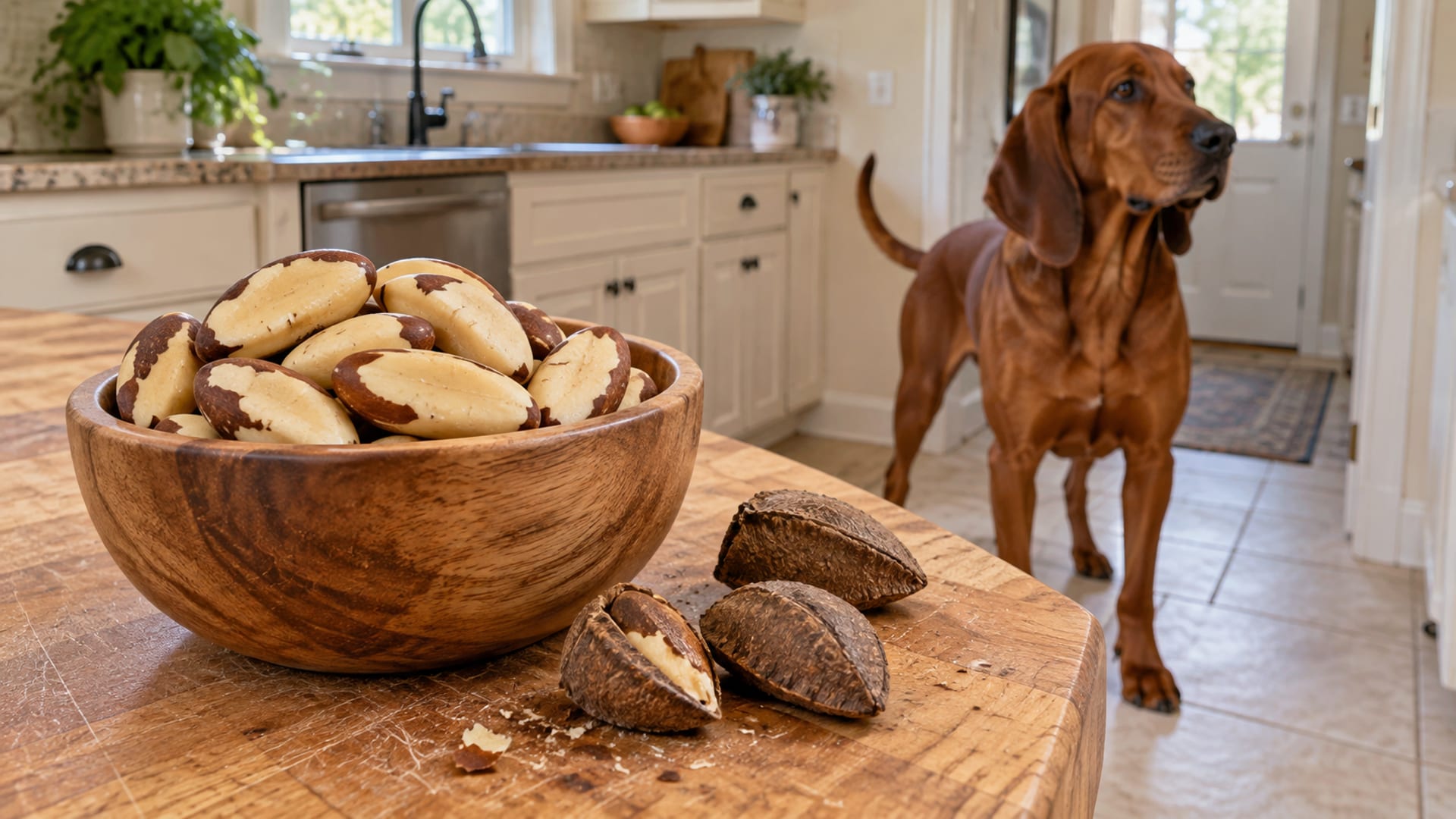
Brazil nuts are best kept off your dog's plate, though a small piece of a plain kernel is usually a lower concern than a handful, a shell, or a salted, chocolate-covered or mixed product. The reason for caution is selenium, which swings widely from one nut to the next, plus a lot of fat in every bite.
If your dog already ate some, move the bag out of reach, keep the package, and work out roughly how much is gone and when. A large or unknown amount, a swallowed shell, a small dog, a coated or seasoned product, or any sign of illness means calling your vet or a pet poison line now.
Key takeaways
Tap a card to bring it forward.
- Skip Brazil nuts as a treat; their selenium level varies a lot between nuts and they are heavy in fat.
- One small bite of plain kernel in a healthy dog is usually a watch-and-ask situation; a big or unknown amount calls for a phone call right away.
- Shells, ground nut products, nut butter, nut oil and coated or mixed nuts each add hazards of their own.
- Counting nuts can't tell you the dose, so give your vet the dog's weight, the product and the amount instead.
- Watch for vomiting, diarrhea, weakness, wobbliness, belly pain or trouble breathing.
What to do if your dog just ate a Brazil nut
The Merck Veterinary Manual's pet-owner page on selenium poisoning says the source should be removed as soon as possible and the animal given supportive care.
- Pick up whatever is left. Clearing the bag or tin stops a second helping and keeps the leftovers for counting.
- Keep the package or ingredient list. Chocolate, xylitol, raisins, heavy salt or macadamia nuts on the label change the advice, so whoever you call will want to read it.
- Estimate how much and when. Count the empty shells or compare what's left with a full bag, and note the time, because amount and product are what a vet works from.
- Check whether a shell went down. A whole shell or a big hard chunk brings choking, tooth damage and blockage risks that have nothing to do with selenium.
- Call if it was more than a small piece. The ASPCA Animal Poison Control Center advises calling a veterinarian or its 24-hour hotline whenever a pet may have swallowed something poisonous.
- Hold off on home remedies. Hydrogen peroxide, food, oil, supplements and medicine should wait until a vet tells you to give them, since the right step depends on what your dog ate.
- Keep your dog in sight. For a small plain piece in a healthy adult dog, watching closely and calling for advice is usually the right response.
Before I'd pick up the phone, I'd want those first four answers written down.
Which Brazil nut forms carry more risk
Even the plain kernel isn't a treat. According to Lisk and colleagues' study of selenium in Brazil nuts, selenium varies greatly between individual nuts and growing regions, and a 2021 review of Brazil nut composition describes the nut as a concentrated source of both selenium and fat.
Tap or hover a row to highlight it.
| Form | Main concern | What to do |
|---|---|---|
| FormPlain raw kernel | Main concernVariable selenium, high fat | What to doDon't feed on purpose; watch a small accidental piece |
| FormRoasted, cooked or dried kernel | Main concernCooking and drying leave the selenium in place | What to doTreat it the same as raw |
| FormShell | Main concernChoking, tooth injury, gut irritation, blockage | What to doCall, especially for a whole shell |
| FormFlour, meal or powder | Main concernHard to measure, more concentrated | What to doCall with the package in hand |
| FormNut butter or oil | Main concernConcentrated fat; may contain salt, sugar, xylitol or chocolate | What to doRead the label, then call |
| FormSalted, seasoned or chocolate-covered | Main concernSeparate hazards from salt, chocolate and seasonings | What to doCall |
| FormMixed nuts or trail mix | Main concernMay include macadamia nuts, raisins or chocolate | What to doCheck every ingredient, then call |
The brown skin on the kernel doesn't protect against anything, so count it as part of the nut. A chocolate-covered Brazil nut is a chocolate exposure first, and a trail mix with raisins brings in the grapes and raisins problem.
How much is too much, and why counting nuts won't answer it
For the plain kernel, no veterinary source gives a serving by dog size, so the cautious habit is to not feed it at all. If your dog snags a small accidental piece of plain, unsalted kernel, check the product, think about the amount, and watch or call based on what you find.
For the risky amount, the published numbers are for selenium itself, and they show why a nut count can't settle anything.
Tap or hover a row to highlight it.
| Figure | What it describes | Source |
|---|---|---|
| FigureAt least 1 mg of selenium per kg of body weight, single dose | What it describesMay be associated with lethal selenium poisoning in animals | SourceMerck Veterinary Manual |
| Figure60 to 200 micrograms per kg per day | What it describesNo-observed-adverse-effect level of organic selenium in Beagles fed selenium yeast over time | SourceSelenium and Dogs systematic review |
| FigureUp to eight-fold | What it describesSeed-to-seed difference in selenium between Brazil nuts in one study | SourceLisk et al. |
The Merck Veterinary Manual's professional page on selenium toxicosis gives the single-dose figure and lists Brazil nuts as a possible selenium source, but doesn't turn that into a number of nuts. The Beagle figure from a systematic review of selenium and dogs comes from a formulated food eaten daily. Because one nut can hold several times the selenium of the nut beside it, two dogs eating three nuts each may get very different doses.
A small dog gets a bigger dose per kilogram from the same nut, and a whole nut is a bigger choking and blockage risk in a small throat. Dogs with past pancreatitis, extra weight, or a vet-ordered low-fat diet have more reason for concern from the fat alone.
Signs to watch for, and how fast they can show up
After a small piece of plain nut, the likely outcome is nothing at all or a short bout of vomiting, diarrhea or belly discomfort, which fits the fat more than the selenium.
Too much selenium looks broader. The Merck pet-owner page lists stomach upset, depression, weakness, odd behavior, an unsteady walk, labored or fast breathing, a fast pulse, frothy discharge from the nose, and collapse. Merck describes acute selenium poisoning as coming on quickly, with some animals dying within a few hours. That timing comes from selenium exposure in animals generally, and ordinary Brazil nut snacking hasn't been shown to cause it often.
Call urgently for repeated vomiting, severe diarrhea, weakness, tremors, wobbliness, breathing trouble, belly pain, collapse, choking, or signs something is stuck. A case report in the Journal of the American Veterinary Medical Association describes a dog that died of acute selenium poisoning with fluid in the lungs, but that dog received injected selenium, so its timeline doesn't predict what a nut will do.
Long-term selenium overload shows up as poor growth, weight loss, poor appetite, anemia, coat changes and nerve problems. Merck ties those mainly to selenium-rich feeds or supplements given over time.
My dog ate Brazil nuts before and was fine
If your dog ate a Brazil nut before and nothing happened, that's a real result. It just doesn't carry over to the next time, or to the next dog.
The amount may have been too small to carry much selenium or fat. Size changes the dose per kilogram, so what a Labrador shrugs off can hit a Chihuahua harder. One plain kernel is a different exposure from a shell, a spoonful of nut butter or a chocolate-coated handful. The nut itself varies too: Lisk and colleagues measured up to an eight-fold selenium difference from seed to seed, so last time's nut may have been a low one. Dogs differ in health and response, and a single event is different from the slow build-up behind chronic selenium disease.
I'm glad your dog was fine; keeping the tin up high is still the safer habit.
Products and names that get mixed up with Brazil nuts
Brazil nuts come from the tree *Bertholletia excelsa* and are also sold as castanha-do-Pará, castanha-do-Brasil or paradise nuts. "Paradise nut" is a regional name, and "castanha" or "castaña" can mean a different nut, including chestnut, so check the label or scientific name if you're unsure.
Macadamia nuts, also sold as Australian or Queensland nuts, are a separate story. Pet Poison Helpline's page on the Australian nut covers their nerve signs, joint problems and pancreatitis in dogs, and that evidence belongs to macadamias alone. The same goes for walnuts, where black walnuts, English walnuts and hulls each carry their own hazards. The nuts entry sorts the rest one by one.
Brazil nuts turn up in gift tins, trail mix, granola, protein bars, baked goods and nut butters, and Pet Poison Helpline's Pantry of Pet Poisons flags high-fat nut products and mixed pantry ingredients as risks of their own. With any nut butter, read the label for xylitol first, the same check that applies to peanut butter.
Selenium yeast, selenium tablets, livestock selenium products and dandruff shampoos with selenium are concentrated selenium sources rather than nuts, and a dog that chewed into one needs a call right away.
Check what you learned
Three quick questions on the parts that matter tonight.
Quick check
Questions about dogs and Brazil nuts
Can puppies eat Brazil nuts?
Keep them away from puppies too. Puppies may be more vulnerable to toxic exposures in general, and one nut is a larger dose per kilogram and a bigger piece to swallow. There's no puppy-specific figure, so call with your puppy's weight if one got eaten.
Could a Brazil nut be a healthy source of selenium for my dog?
Selenium is an essential trace element, found in Brazil nuts mostly as organic forms such as selenomethionine. The trouble is how unevenly it's spread between nuts. If you think your dog's diet is low in selenium, ask your vet before reaching for the snack drawer.
What will the vet do if my dog ate a lot of Brazil nuts?
According to the Merck Veterinary Manual's professional page, treatment centers on stopping the exposure and supportive care. Diagnosis rests on the dog's signs plus lab confirmation of selenium in the diet, blood or tissues, so bring the package along.
Can my cat get sick from Brazil nuts?
Cats can get selenium poisoning too, and Merck gives the same maximum tolerable dietary selenium level, 2 micrograms per gram, for cats and dogs. Store the nuts and any selenium supplements where neither pet can reach them.
Sources
Checked September 25, 2026.
- Merck Veterinary Manual, Selenium Poisoning
- Merck Veterinary Manual, Selenium Toxicosis in Animals
- ASPCA Animal Poison Control, Toxic and Non-Toxic Plants: N
- PubMed Central, Selenium Accumulation, Speciation and Localization in Brazil Nuts (Lisk et al.)
- PubMed Central, Composition of Brazil Nut, Its Beverage and By-Products: A Healthy Food and Potential Source of Ingredients
- PubMed Central, Selenium and Dogs: A Systematic Review
- Journal of the American Veterinary Medical Association via PubMed, Acute selenium toxicosis in a dog (Janke)
- Pet Poison Helpline, Australian Nut Is Toxic to Dogs
- Pet Poison Helpline, Pantry of Pet Poisons