
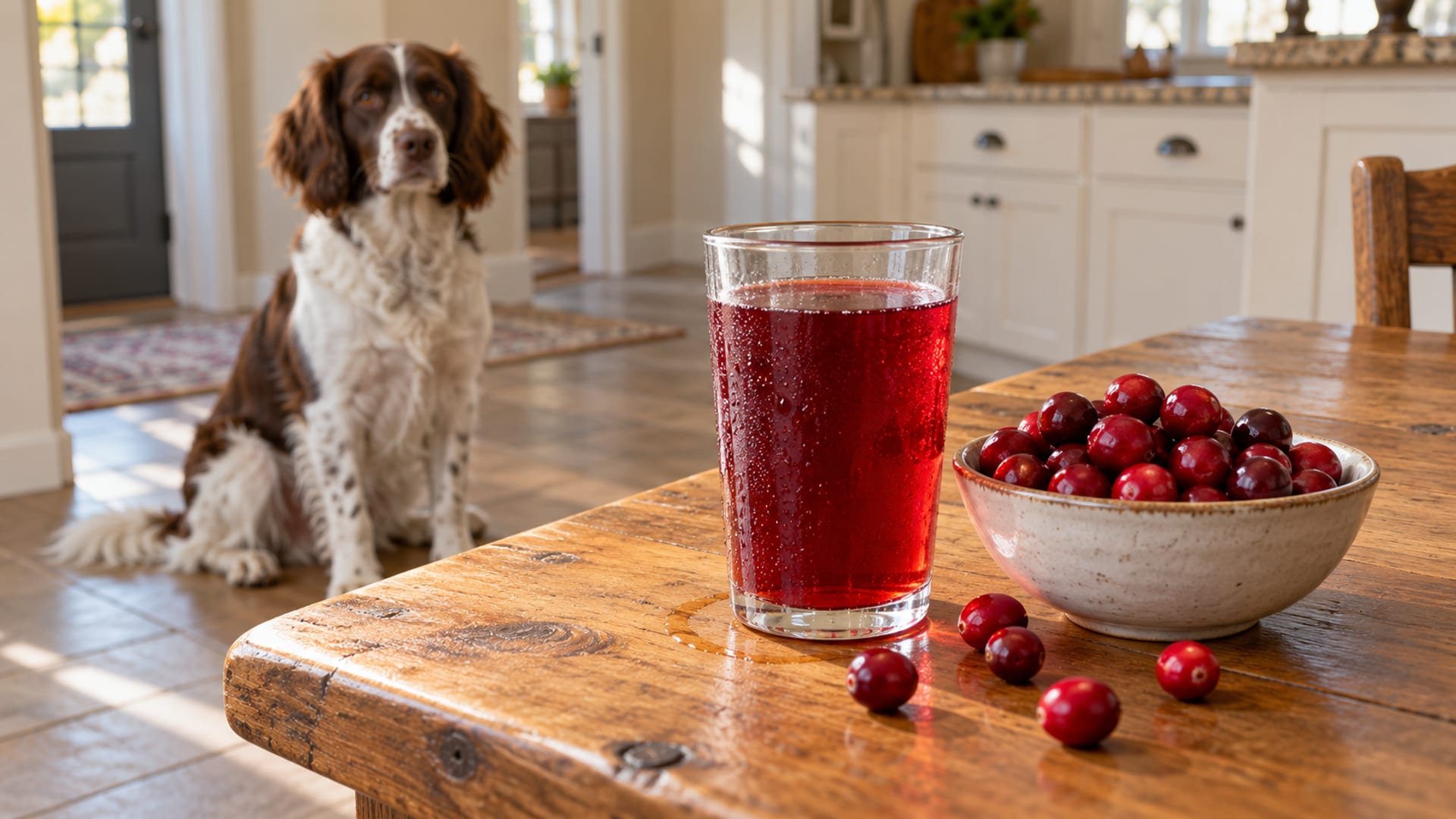
Plain cranberry juice gets a cautious yes. A small amount of plain cranberry juice is unlikely to poison a dog, and the label decides the rest, because xylitol, grape juice, raisins, alcohol and caffeine turn it into an urgent call. Cranberry juice is also not a proven treatment for a dog's urinary infection, so urinary signs are a reason to call your vet.
If your dog lapped up a spill, maybe after a holiday meal, pick up the bottle or carton before anything else. I'd want the product, the amount and your dog's weight written down before you pick up the phone, and the steps below go in the order you will need them.
Key takeaways
Tap a card to bring it forward.
- A small amount of plain cranberry juice is unlikely to poison a dog, and the ingredient list is what settles it.
- Xylitol, grape juice, raisins, alcohol and caffeine make the drink an urgent call.
- Juice cocktails, cranberry-grape blends, sauce, dried cranberries, powders and supplements each need their own label check.
- Cranberry juice is not a proven treatment for a dog's urinary infection, so urinary signs call for a vet.
- A dog who looks normal right after a risky ingredient has not been cleared.
What to do if your dog already drank cranberry juice
Work through these in order; the label comes first because it decides everything after it.
- Read the label now. Look for xylitol, grape juice, raisins or currants, alcohol, caffeine and any ingredient you don't recognize. Pet Poison Helpline says cranberries are pet safe raw and processed, and it also tells owners to check labels for xylitol and grape derivatives.
- Write down the product, how much, and your dog's weight. The ASPCA asks owners to note the amount ingested before calling, and those details are what a vet or poison line will need.
- Call your vet or a poison line promptly if the label lists xylitol, grapes, raisins, currants, alcohol or caffeine; if the amount was large, concentrated or unknown; if it was a supplement or powder; or if your dog has repeated vomiting, severe diarrhea, weakness, tremors or marked lethargy. Call even when your dog looks normal right now, since those ingredients work on their own timelines.
- Go to an emergency vet right away for collapse, seizures, abnormal behavior, trouble breathing, or a dog who cannot keep water down.
- If it was a small amount of plain juice and your dog is acting normal, a poison-control call is not necessarily required. Watch for vomiting, soft stool, diarrhea, belly discomfort, gas or a drop in appetite, and contact your vet if any sign develops or sticks around.
- If you were hoping the juice would help a urinary problem, book a vet visit instead of repeating the dose. The next sections explain why.
Which cranberry products are fine and which are not
The word "cranberry" on a bottle does not tell you what else is in it. This table sorts the forms people actually run into.
Tap or hover a row to highlight it.
| Form | What to check | Concern level |
|---|---|---|
| FormPlain juice from cranberries | What to checkA short ingredient list with no added sugar | Concern levelLow in a small amount |
| FormJuice cocktail or cranberry drink | What to checkSugar, xylitol, grape juice, alcohol, caffeine | Concern levelCaution |
| FormCranberry-grape blend | What to checkGrape content is linked to acute kidney injury in dogs | Concern levelUrgent call |
| FormCranberry sauce, jelly or relish | What to checkSugar, alcohol, raisins, currants, grapes, spices, xylitol | Concern levelCaution |
| FormDried cranberries or Craisins | What to checkSweeteners; some mixed dried fruit holds raisins or currants | Concern levelOnly unsweetened and raisin-free, in small amounts |
| FormFresh, frozen or cooked plain cranberries | What to checkLarge amounts can upset the stomach | Concern levelLow in small amounts |
| FormPowder, capsules or urinary supplements | What to checkConcentrated extracts and extra active ingredients vary by product | Concern levelProduct-specific; call |
The AKC says plain fresh or cooked cranberries are not inherently toxic, and that grape or cranberry blends and products with sugar or alcohol carry additional risks. Cranberry powder, extract and pills are concentrated and vary by product, so they should not be treated as ordinary juice. For the whole fruit, see cranberries.
Plain juice, urinary infections and the ingredients that change the answer
If you choose to offer any, the lower-risk choice is a plain, unsweetened product with a short ingredient list and nothing that matches the table below. Give a small amount as an occasional treat or flavoring. Pet Poison Helpline recommends that food outside a complete, balanced diet make up only 5 to 10 percent of daily calories, and that is a general treat guideline, which means it does not work as a juice serving. Sweetened products suit dogs who need calorie or glucose control least of all.
Cranberry juice is not a substitute for a vet visit when urinary signs show up. The Merck Veterinary Manual states that evidence supporting cranberry extract for bacterial urinary infections in animals is lacking. If you see changes in urination or any urinary sign, call your vet.
Tap or hover a row to highlight it.
| If the label lists | What it can do in dogs | What to do |
|---|---|---|
| If the label listsXylitol | What it can do in dogsRapid low blood sugar, seizures, possible liver injury | What to doCall right away |
| If the label listsGrape juice, grapes or raisins | What it can do in dogsAcute kidney injury | What to doCall right away |
| If the label listsAlcohol | What it can do in dogsNervous system depression, breathing problems, coma, death | What to doCall right away |
| If the label listsCaffeine | What it can do in dogsAgitation, abnormal heart rhythm, tremors, seizures, death | What to doCall right away |
These effects come from the ASPCA list of hazardous people foods. A toxic dose cannot be guessed for a product with any of these, so when you cannot judge the amount, call with your dog's weight, the product and how much is gone. For more, see grapes and raisins, alcohol and coffee.
Signs to watch for and when they show up
After a small amount of plain juice, most dogs show nothing. A larger amount may bring vomiting, soft stool, diarrhea, belly discomfort, gas or reduced appetite, and the AKC says too many cranberries can cause stomach upset. These usually appear while the juice is moving through the digestive system. The worst outcome from plain juice is significant stomach illness or dehydration after a large amount, especially in a small or medically fragile dog.
The other ingredients set their own timelines, so a dog who looks normal right after one has not been cleared. After a grape or raisin product, marked lethargy, vomiting, loss of appetite or changes in urination fit kidney injury and call for a vet right away. Tremors, seizures, weakness, collapse or breathing difficulty are emergency signs whatever the cause.
My dog drank cranberry juice before and was fine
I believe you, and it probably did go fine. A lick of plain juice off the floor rarely causes trouble. That was true for that dog on that day, and several things decide how any exposure goes.
- Amount. Small amounts of plain cranberry may cause no signs, while larger amounts may upset the stomach.
- Size. The same volume is a bigger dose per kilogram in a small dog.
- Form. Plain juice differs from sweetened juice, concentrated extract, sauce, a grape blend or a product with xylitol.
- Preparation. Fresh, cooked, dried and sauced cranberries carry different sugar levels and added ingredients.
- The individual dog. Pet Poison Helpline notes that dietary needs differ, and not every dog reacts the same way to a new food.
- Timing. Xylitol, grapes, raisins, alcohol and caffeine can produce signs on their own schedules.
So, one easy experience is real, and the next bottle still needs its label read.
Cranberry look-alikes and products with the same name
A few names overlap, and the differences change the risk.
- Pure juice, juice from concentrate and juice cocktail have different sugar and ingredient profiles.
- Cranberry-flavored drinks may hold little real cranberry and may add caffeine or artificial sweeteners.
- Cranberry sauce and jelly often carry sugar and sometimes alcohol or raisins; the holiday table is where dogs meet them.
- Blueberries are a different fruit, even though Spanish sometimes uses the same word for both. See blueberries.
- Other juices follow their own rules; apple juice has its own page.
Check what you learned
Three questions cover what matters most with a spilled glass.
Quick check
Questions about dogs and cranberry juice
These are the extra questions owners ask once the first answer is settled.
What do studies say about cranberry and dog urinary infections?
Merck notes that cranberry compounds called proanthocyanidins may interfere with E. coli sticking to urinary tract tissue. Even so, the same Merck page says evidence for cranberry extract in animal bacterial infections is lacking. A randomized trial of dogs after spinal disk surgery, published as Olby and colleagues, found that cranberry extract did not reduce bacteriuria in those dogs.
Is unsweetened juice a better choice?
It avoids added sugar and possibly some additives, so it is less concerning than a sweetened or mixed product. It is still optional, since a complete diet does not need juice. Offering any means a small amount, no more.
What about a dog with diabetes, kidney disease or bladder stones?
Sweetened products are a poor fit for a dog who needs calorie or glucose control, and a dog with pancreatitis or on prescribed medication may need individual advice. With kidney disease or a history of urinary stones, unsupervised cranberry supplements are a bad idea. The AKC adds that, according to the veterinarian it cites, large amounts may contribute to calcium oxalate bladder stones.
Do small dogs and puppies need extra care?
Small dogs get a larger dose per kilogram from the same amount of juice, so the amount and concentration matter more. Call sooner for a small dog or puppy who drank a sweetened, mixed or unknown product.
Sources
Checked September 30, 2026.
- Pet Poison Helpline, Friendly Fall Foods
- American Kennel Club, Can Dogs Eat Cranberries?
- ASPCA, People Foods to Avoid Feeding Your Pets
- Merck Veterinary Manual, Pharmacotherapeutics in Bacterial Urinary Tract Infections in Animals
- Olby NJ et al., Effect of Cranberry Extract on the Frequency of Bacteriuria in Dogs with Acute Thoracolumbar Disk Herniation: A Randomized Controlled Clinical Trial