
How to Brush Your Dog's Teeth, Step by Step (Even If They Hate It)
By Cal Hewitt · Published , updated
Health
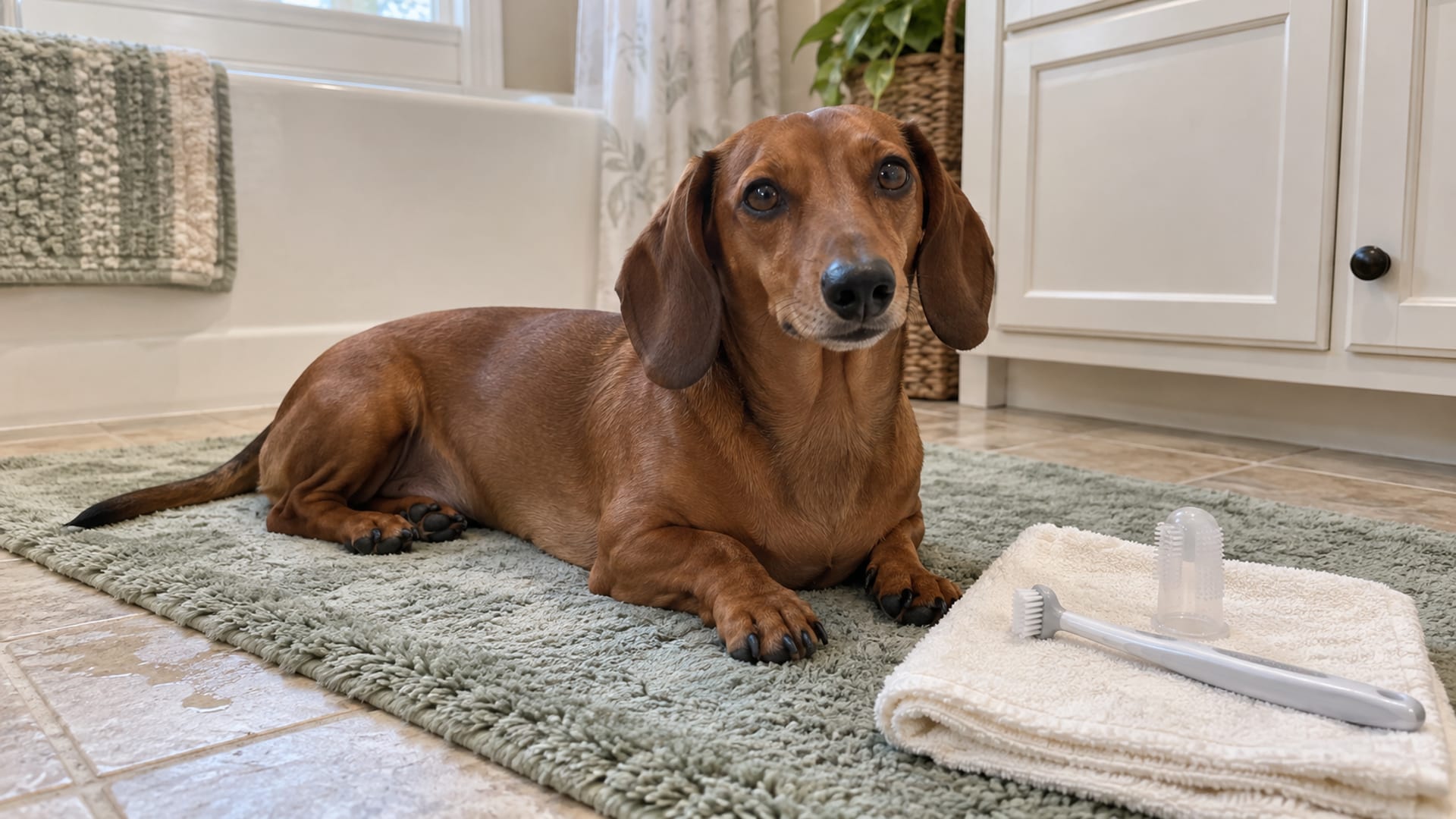
Maybe the vet mentioned tartar at the last checkup. Maybe you leaned in for a cuddle and the breath stopped you. Or you already bought a toothbrush and your dog made it very clear what they think of it. Whichever brought you here, you want to know how to do this without a fight, and whether it is already too late for brushing to help.
Go to an emergency vet now for trouble breathing, collapse, bleeding from the mouth you cannot stop, severe pain, fast or severe facial swelling, or blue, purple or pale gums. If your dog ate human toothpaste, check the label for xylitol and call your vet or a poison line right away: the ASPCA Animal Poison Control Center at (888) 426-4435 or the Pet Poison Helpline at (855) 764-7661.
For everyone else, the short answer: brush the outside surfaces of your dog's teeth every day with a soft pet toothbrush and toothpaste made for dogs. Teach it in tiny, rewarded steps, never by holding your dog down. Brushing controls new plaque. It cannot remove hard tartar that is already there, and it cannot fix disease under the gums, so a mouth with visible tartar, red gums or bad breath needs a vet exam as well.
Key takeaways
Tap a card to bring it forward.
- Brush daily. The Merck Veterinary Manual calls daily brushing best, and AAHA says brushing needs to be daily to help.
- Use a soft pet toothbrush (or gauze on a finger to start) and a dog toothpaste that is safe to swallow.
- Never use human toothpaste. It can contain xylitol or fluoride (ASPCA).
- Brush only the outside, cheek-facing surfaces. You do not need to pry the mouth open.
- Build up in seconds, not minutes, and stop at the first sign of stress. A dog who suddenly refuses may be in pain.
- Brushing removes plaque, not tartar. Bad breath, tartar, red or bleeding gums, or trouble eating mean a vet visit.
Check the mouth before you start
Before you pick up a brush, take a look. Lift the lip only if your dog lets you, and do not poke or probe. You are looking for brown or yellow buildup on the teeth, red or swollen gums, bleeding, drooling, a broken or loose tooth, swelling of the face or jaw, and a smell that has been there for a while.
Call your regular vet soon if you see any of those, or if your dog is dropping food, chewing slowly, eating less, pawing at the mouth or has a nasal discharge. Cornell lists bad breath, bleeding, drooling, facial swelling and trouble eating among the signs of dental disease. A dog who used to tolerate mouth handling and now pulls away belongs here too, because that change can be pain.
Start brushing at home if your dog is bright, eating normally, has no pain or swelling, and the only issue is that nobody has started a brushing habit yet. That still is not a reason to skip routine vet checks. Dental disease can hide under the gumline, and many dogs show little obvious pain. The VCA notes that dogs often show no outward signs of dental pain, so a dog who still eats well can still have a sore mouth.
A photo of what you see helps your vet compare later. It does not diagnose anything; only an exam can.
What you need, and what to leave in the cupboard
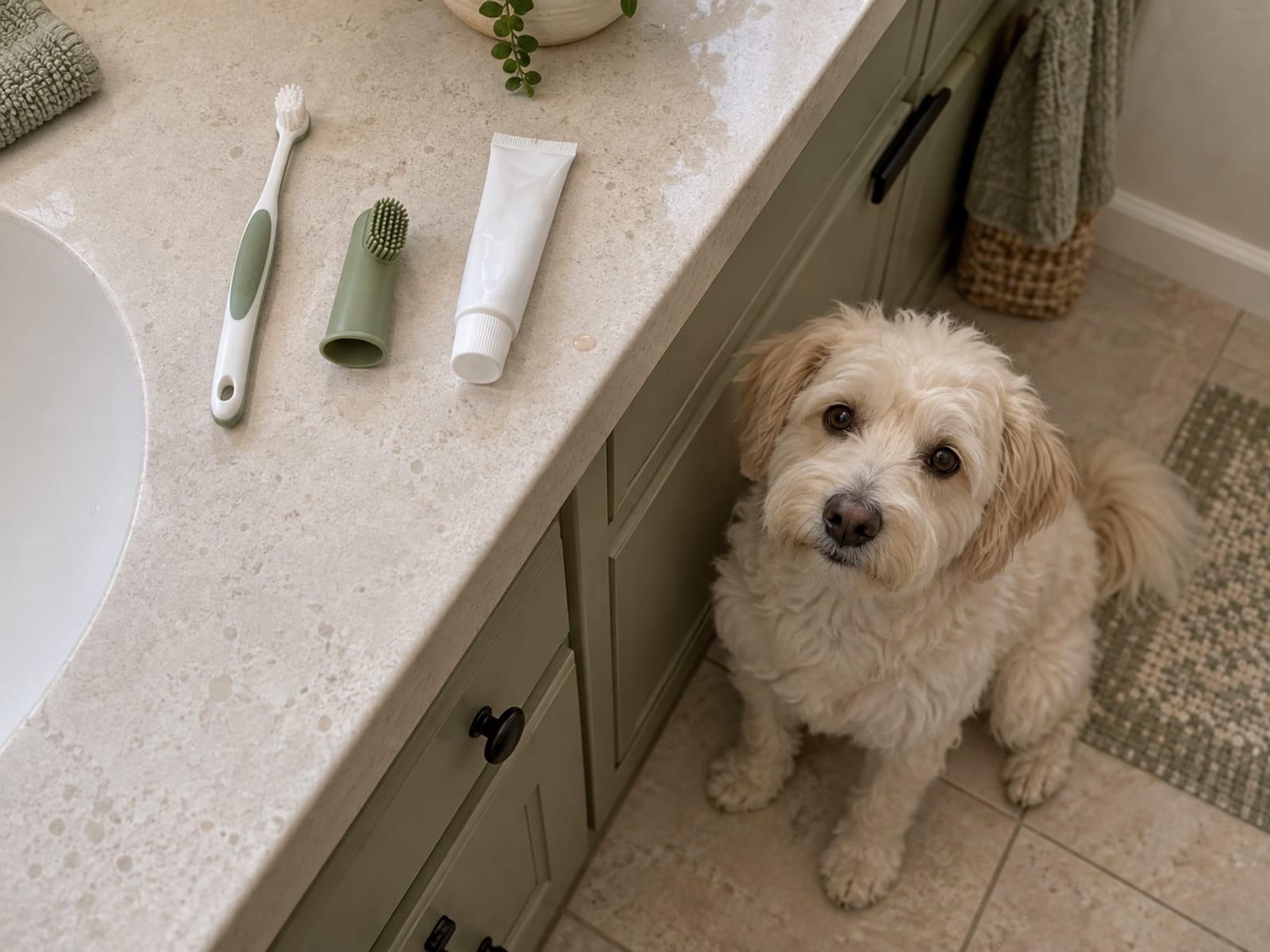
A soft toothbrush made for pets, sized to your dog's mouth. Small dogs need a small head. A finger brush, or soft gauze wrapped around a finger, is a good way to start with a nervous dog.
Toothpaste made for dogs, meant to be swallowed. Dogs do not rinse and spit. A flavor your dog likes makes training easier, though flavor says nothing about how well it works.
A reward your dog can lick or swallow without chewing, and a quiet spot with good light. A small dog may do best on your lap or a nonslip surface. A large dog can sit or stand beside you, so you are not leaning over them.
Leave out: human toothpaste, baking soda, human mouthwash, hydrogen peroxide, and any metal scraper or scaling tool. Scraping tartar at home can hurt your dog and does nothing about disease below the gums.
If you want a product with evidence behind its claim, look for the seal of the Veterinary Oral Health Council (VOHC), then check that the exact product, the species and the size on the label match your dog.
How to brush your dog's teeth, step by step
This sequence follows the VCA training plan for happy tooth brushing. Each step can take several short sessions. Move on only while your dog stays loose and willing.
- Practice the position. For a few short sessions, reward your dog just for coming to your brushing spot and holding still for a moment. VCA suggests working up toward about two minutes, the time a full brushing takes. Teaching your dog to rest their chin in your hand gives them a steady, voluntary way to hold their head.
- Touch the muzzle, then lift the lip. One second, a reward, and stop.
- Offer a taste of dog toothpaste from your finger or the brush.
- Rub a few outer teeth with a gauze-wrapped finger, gently, then reward. The outside surfaces are what matter. The Merck Veterinary Manual says only the outside surfaces need brushing or wiping.
- Introduce the brush. Let your dog lick a little paste off it, then touch one or two front teeth for a second.
- Add a few gentle strokes along the gumline, one small area at a time. VCA describes small circles with the bristles angled at about 45 degrees to the gumline.
- Work around the mouth over many sessions: the long canine teeth first, then the teeth behind them toward the back, then the small front teeth.
- Keep early sessions to seconds. End while your dog is still comfortable, and always give the reward you promised.
- Make it daily once your dog accepts it. A regular time, like after the evening walk, helps it stick.
Brushing training, stage by stage
The first sessions
Your dog comes to the spot, holds still briefly, and lets you touch the muzzle and lift a lip for a second. Every touch ends with a reward.
The next days to weeks
Toothpaste licks, a gauze finger on a few outer teeth, then the brush touching the front teeth. Progress looks like your dog staying relaxed and coming back for more.
After many calm sessions
Gentle strokes along the gumline on the outside of the teeth, working toward the back teeth, building toward about two minutes a day.
If your dog goes backward, the last step was too big. Go back to the last step where they were relaxed and move forward more slowly. For more on how reward-based training works, see positive reinforcement dog training.
If your dog hates having their teeth brushed
Slow down, and never hold your dog down or force the mouth open. VCA says forcing the mouth open can create resistance and fear, and it lists the signals that mean you should step back: turning away, tight lips, freezing, trembling, whining or other sounds, trying to leave, growling, snapping or biting. A growl is information, not bad behavior.
If your dog has never liked it, go back to the easiest step they accept, whether that is a muzzle touch, a lip lift or a lick of paste, and pair it with a reward. Stay there until it is boring, then add one small piece.
If your dog used to allow brushing and now refuses, do not train through it. A new refusal can mean a painful tooth, a fracture or gum disease. The AAHA guidelines note that brushing inflamed gums causes pain and makes dogs averse to brushing. Book a vet exam first. A trainer who does cooperative-care work can help with a fearful dog once pain is ruled out, and you can find one in the DogServ directory.

If your dog swallowed human toothpaste
Human toothpaste is made to be spat out, and some brands contain ingredients that are dangerous for dogs. The ASPCA says toothpaste can contain fluoride or xylitol. A small amount of fluoride usually causes mild stomach upset, but a large amount can cause severe stomach upset, an irregular heartbeat, low blood pressure and dangerous changes in the blood. Enough xylitol can cause low blood sugar and liver damage.
The Pet Poison Helpline says xylitol signs can come on quickly and advises calling a vet or poison service right away. How much xylitol a tube contains varies a lot, and "sugar-free" on the label does not tell you the amount. The same sweetener turns up in candy too, which is why the sugar-free candy canes entry in Can My Dog Eat also says to call a vet.
What to do:
- Keep the tube and check the ingredients for xylitol and fluoride.
- Call your vet, an emergency vet, or a poison line: ASPCA Animal Poison Control at (888) 426-4435 or the Pet Poison Helpline at (855) 764-7661. Tell them the product, roughly how much, your dog's weight and when it happened.
- Do not make your dog vomit unless the vet or poison line tells you to.
- Weakness, trembling, collapse, a seizure, repeated vomiting or trouble walking is an emergency. Go now.
Dental chews, water additives and dental diets
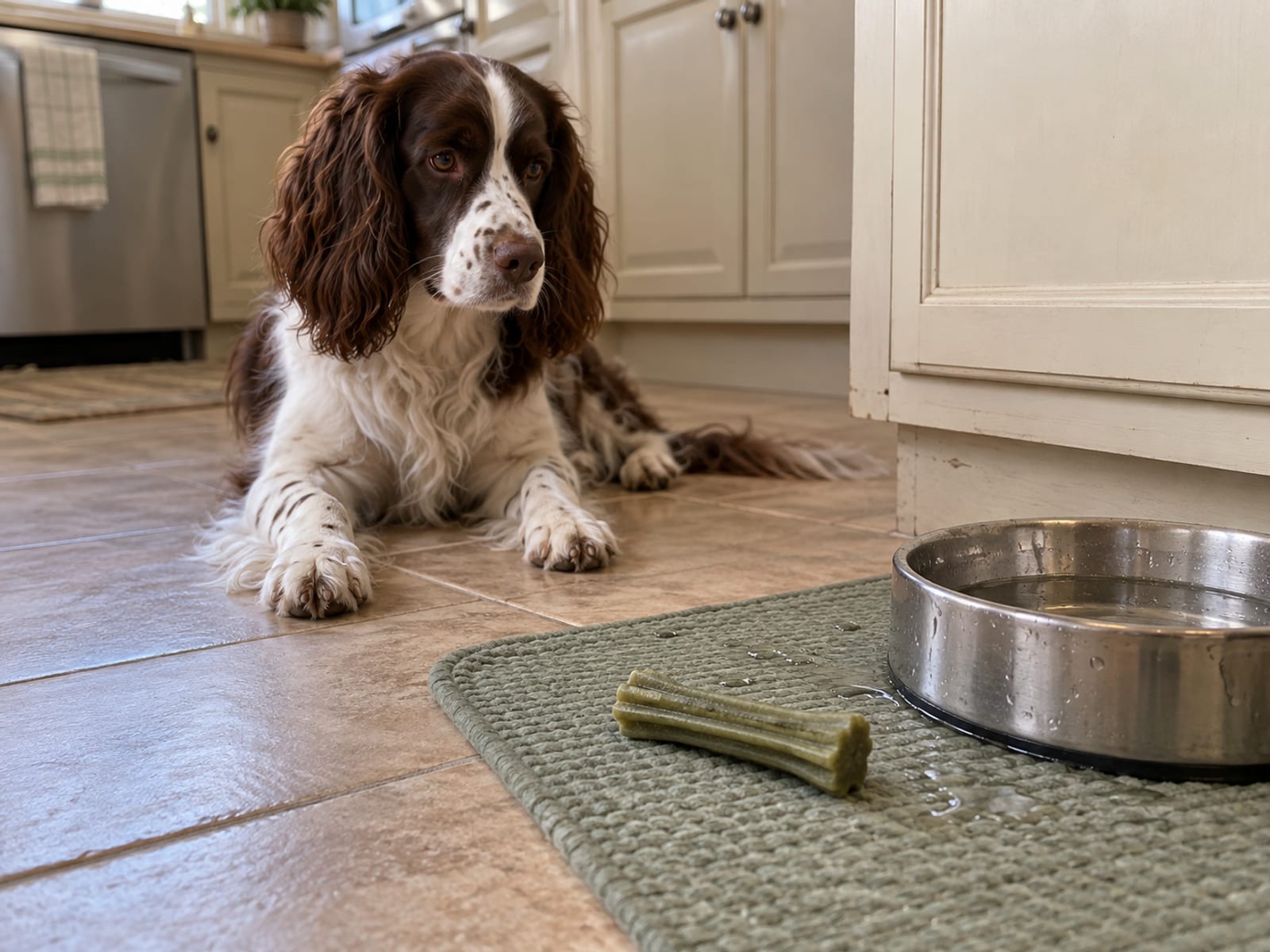
These can help, and they are a supplement to brushing and vet care, not a replacement. The VOHC awards its seal to products shown to help control plaque, tartar, or both, and each listed product carries its own specific claim. The seal applies to that exact product, not to the whole brand or category. Products and formulas change, so check the current list when you buy.
Tap or hover a row to highlight it.
| Product type | What the seal covers | Worth knowing |
|---|---|---|
| Product typeDental diets | What the seal coversA plaque and/or tartar claim from chewing the food | Worth knowingA diet change affects calories, allergies and medical diets. Ask your vet before switching. |
| Product typeEdible chews and rawhide chews | What the seal coversThe listed plaque and/or tartar claim | Worth knowingVOHC notes chews can cause a blockage if swallowed. Follow the size and supervision directions, and skip hard chews if the mouth may be sore. |
| Product typeWater additives, gels, sprays, toothpastes | What the seal coversUsually a plaque claim, sometimes plaque and tartar | Worth knowingUse exactly as labeled. A water additive does nothing if your dog will not drink the water. |
| Product typeToothbrushes and wipes | What the seal coversThe listed plaque claim | Worth knowingStill only works with daily use on a dog who accepts it. |
Source: Veterinary Oral Health Council dog product table, May 21, 2026.
If daily brushing is not possible yet, ask your vet which VOHC-listed chew, wipe, gel, diet or water additive suits your dog. The Merck Veterinary Manual says wiping the teeth with gauze at least every two to three days can remove plaque when a dog will not allow brushing.
When brushing is not enough: professional dental cleaning
Brushing cannot remove tartar. Plaque can start hardening into tartar in as little as 24 hours, according to Cornell, and once it hardens a brush will not take it off. That is a job for your vet.
A full dental cleaning is done under general anesthesia. Cornell's dentistry service explains that a definite diagnosis and treatment plan needs anesthesia, probing and charting each tooth, and full-mouth X-rays. Scaling and polishing above and below the gumline usually follow, and some dogs need extractions or other treatment once the vet can see what is going on.
Anesthesia-free cleaning is not a substitute. The American Veterinary Dental College says a complete oral exam and important parts of professional scaling cannot be done on an awake dog. Its advice is daily home care to reduce how often cleanings are needed.
What it costs. There is no single national price. Location, your dog's size, pre-anesthetic tests, X-rays, how many teeth need work and referral care all change the bill. As of October 2025, PetMD reported these U.S. ranges:
Tap or hover a row to highlight it.
| Item | Reported range |
|---|---|
| ItemRoutine dental cleaning | Reported range$350 to $500 |
| ItemAdvanced dental care | Reported range$1,500 or more |
| ItemBlood work before anesthesia | Reported range$75 to $200 |
| ItemExtractions | Reported range$500 to $2,500 per tooth |
These are planning figures, not a quote. Ask your clinic for a written estimate that lists anesthesia, pre-anesthetic testing, full-mouth X-rays, pain control and how they will ask you before any extraction.
Puppies, seniors, small dogs and dogs with health conditions
Puppies. Young dogs are generally easier to train, so start with short, happy handling sessions early. Adult dogs can learn too; it is not too late. Use a small brush or gauze. Baby teeth that stay put after the adult teeth come in are a question for your vet, never something to pull at home.
Seniors. Age alone is not a reason to leave a painful mouth untreated. It is a reason for your vet to check your dog carefully before anesthesia and plan around their health. PetMD notes blood work may cost more for a senior or a dog with other conditions.
Small and toy breeds. The Merck Veterinary Manual says small-breed dogs usually have more gum disease than large breeds. That does not mean every small dog will get it; it does make daily brushing and regular checks especially worth the effort. Choose a small brush and chews sized to your dog's weight.
Large breeds. No source suggests big dogs need less dental care. Use a brush that reaches the back teeth without force, and pick chews labeled for their weight.
Dogs with health conditions. Merck lists diabetes, immune problems and Cushing's disease (hyperadrenocorticism) among risk factors for gum disease. If your dog has a medical condition, your vet decides whether and how a dental procedure happens. A water additive does not treat any of it.

Mistakes to avoid
- Holding your dog down or forcing the mouth open. It builds fear and makes the next session harder.
- Using human toothpaste, baking soda or mouthwash. Dog toothpaste only.
- Scraping tartar yourself. It can injure the gums and misses disease below the gumline.
- Pushing through a new refusal. A dog who suddenly hates brushing may have a sore mouth.
- Brushing once a week and calling it done. Plaque comes back daily, so the habit has to be daily.
- Assuming a chew or water additive replaces brushing or a vet visit. Neither removes hardened tartar or treats disease.
- Waiting because your dog still eats. Dogs hide dental pain.
- Pulling a loose tooth or giving leftover pain pills or antibiotics. Leave diagnosis and medicine to your vet.
Check what you learned
Quick check: brushing your dog's teeth
Questions about brushing your dog's teeth
How often should I brush my dog's teeth?
Every day. The Merck Veterinary Manual calls daily brushing best, and AAHA says brushing needs to be daily to be of benefit because it removes plaque before it hardens.
Can I use human toothpaste on my dog?
No. Use toothpaste made for dogs and meant to be swallowed. Human toothpaste can contain xylitol or fluoride, according to the ASPCA. If your dog ate some, check the label and call your vet or a poison line.
My dog hates tooth brushing. Should I hold them still?
No. Go back to the smallest step your dog accepts and reward it. VCA advises never forcing the mouth open. If your dog suddenly started refusing, have a vet check the mouth for pain first.
Does brushing remove tartar from my dog's teeth?
No. Brushing removes plaque, not hardened tartar (calculus). Tartar and disease under the gumline need a vet's assessment and usually a cleaning under anesthesia.
Do dental chews or water additives work?
Products carrying the VOHC seal have evidence for the specific plaque or tartar claim listed for them. They add to brushing and vet care; they do not replace them or treat existing disease.
Why does a dog dental cleaning need anesthesia?
A complete exam means probing around each tooth and taking full-mouth X-rays, and the cleaning has to reach below the gumline. Cornell and the American Veterinary Dental College say that cannot be done properly on an awake dog.
Do I have to brush the inside of my dog's teeth?
No. The Merck Veterinary Manual says only the outside surfaces need brushing or wiping, so there is no need to pry the mouth open.
How much does a dog dental cleaning cost?
It depends on where you live, your dog's size and what the vet finds. As of October 2025, PetMD reported $350 to $500 for a routine U.S. cleaning and $1,500 or more for advanced care. Ask for a written estimate.
Start tonight with ten seconds
Tonight, sit with your dog in a quiet spot, touch their muzzle, lift a lip for one second, and give a treat. That is the whole session. Tomorrow, add a lick of dog toothpaste. If you saw tartar, red gums or anything else that worried you, book a vet visit alongside the training; you can find a vet near you in the DogServ directory.
Teeth are one part of a bigger picture. Signs of a healthy dog walks through a full nose-to-tail check, and how to clean your dog's ears uses the same slow, rewarded handling. If you have a question this guide did not answer, send it through the contact page.
Sources
- American Animal Hospital Association: AAHA
- ASPCA: ASPCA
- avdc.org: American Veterinary Dental College
- Cornell University College of Veterinary Medicine: Cornell's dentistry service
- Cornell University College of Veterinary Medicine: Cornell
- Merck Veterinary Manual: Merck Veterinary Manual
- Pet Poison Helpline: Pet Poison Helpline
- PetMD: PetMD
- VCA Animal Hospitals: VCA
- VCA Animal Hospitals: VCA
- Veterinary Oral Health Council: Veterinary Oral Health Council dog product table
- Veterinary Oral Health Council: Veterinary Oral Health Council