
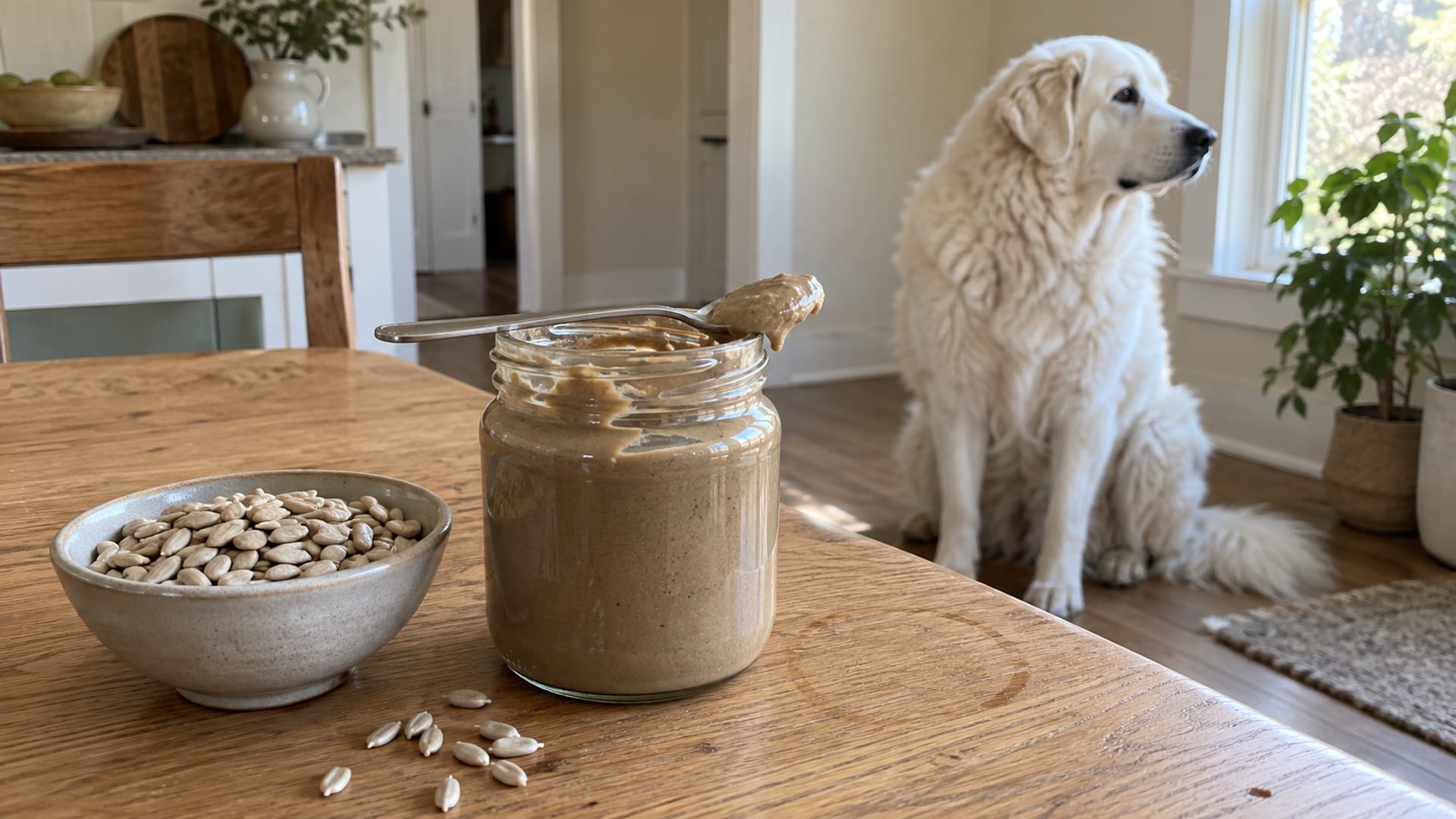
Usually, yes. A spoonful of plain sunflower butter made from shelled seeds is generally safe for a dog once in a while, but it gets a caution because some jars contain ingredients that can seriously hurt a dog. The one check that matters most is xylitol, a sweetener also sold as birch sugar or wood sugar, which the FDA warns is dangerous for dogs. Salt and add-ins like chocolate come next.
If your dog already licked the knife, cleaned the lunchbox or got into the jar, pick up the jar before anything else. A small amount of plain product usually means watching for an upset stomach at home. Xylitol on the label, a label you cannot find, a large amount, swallowed seed shells, or signs like vomiting, weakness or tremors mean you call your vet or a poison line now.
Key takeaways
Tap a card to bring it forward.
- Plain sunflower butter made from shelled seeds is generally safe in a small, occasional amount, about a spoonful once in a while.
- Read the label first. Xylitol, also listed as birch sugar or wood sugar, turns any jar into an emergency for a dog.
- Salt, chocolate and other add-ins cause their own problems, so plain and unsalted is the version to share.
- Seed shells are a separate risk from the spread; they can cause choking or a blockage in the gut.
- The spread is high in fat, so a dog with past pancreatitis or a touchy stomach needs a lighter hand.
What to do if your dog already ate sunflower butter
Start with the jar, because what is in it decides every step after.
- Read the ingredient list. If you see xylitol, birch sugar, wood sugar or birch bark extract, the FDA says to "call your vet, emergency animal clinic, or animal poison control center right away," since xylitol can drop a dog's blood sugar fast.
- Check for other add-ins. Chocolate, caffeine, raisins, macadamia nuts, onion, garlic and alcohol each cause their own poisoning, according to the ASPCA, so any of them means a call too.
- Estimate how much is gone. The ASPCA asks owners to note the amount eaten before contacting a vet, and the same spoonful is a much bigger share for a small dog.
- Look for shells. If whole sunflower seeds were also within reach, tell your vet, because the American Kennel Club warns the hard shells can cause choking or an intestinal blockage.
- Watch, and skip home remedies. For a small lick of plain spread, watch for vomiting, diarrhea or a sore belly. Don't give any home treatment or medicine unless a vet or poison-control professional tells you to, because the wrong fix can add a problem.
Also call if you see collapse, seizures, severe belly pain, repeated diarrhea, choking or trouble breathing. A known small amount of plain, unsalted spread in a healthy dog with no signs usually does not need an emergency call, though your vet is the one to ask if your dog has health problems.
Which sunflower products are fine and which to skip
The sunflower itself is not the worry. The ASPCA lists sunflower as non-toxic to dogs. What changes the answer is what went into the jar, how salty it is, and whether the shells came along.
Tap or hover a row to highlight it.
| Product or part | What to know |
|---|---|
| Product or partPlain sunflower butter made from shelled kernels | What to knowSafe in moderation, a small amount now and then |
| Product or partPlain shelled kernels, raw or dry-roasted, unsalted | What to knowSafe in small amounts |
| Product or partSalted or flavored seeds or butter | What to knowCaution; extra sodium and added ingredients can make a dog sick |
| Product or partSugar-free or low-sugar sunflower butter | What to knowCheck for xylitol; if it is listed, call right away |
| Product or partSpreads with chocolate, raisins, macadamia nuts, onion, garlic, caffeine or alcohol | What to knowSkip; each of those ingredients is harmful on its own |
| Product or partSeed shells or husks | What to knowKeep away; choking and blockage risk |
| Product or partSunflower plant, flowers and leaves | What to knowListed as non-toxic; a lot of plant material may upset the stomach |
Anything with cocoa belongs with Chocolate, and a spread with raisins falls under Grapes and raisins.
How much to share, and when the amount becomes a concern
The American Kennel Club suggests keeping sunflower butter to "a spoonful once in a while" and recommends natural, unsalted, shelled seeds. That is a feeding guide for a healthy dog, and it does not apply to a jar with xylitol or an ingredient list you cannot read.
On a lick mat, spread it thin so the whole mat adds up to about that spoonful. For a small dog, go smaller. Choose a jar that lists sunflower seeds and little else.
Plain sunflower butter has no toxic dose to measure against, so after a big helping, call with your dog's weight, the product name and your best guess at the amount. Xylitol has published figures:
Tap or hover a row to highlight it.
| Xylitol eaten | What it may cause | Source |
|---|---|---|
| Xylitol eatenMore than 0.1 g per kg | What it may causeLow blood sugar (hypoglycemia) | SourceDunayer, Journal of Veterinary Pharmacology and Therapeutics |
| Xylitol eatenMore than 0.5 g per kg | What it may causeAcute liver failure | SourceDunayer, Journal of Veterinary Pharmacology and Therapeutics |
Those figures from the Dunayer review of xylitol toxicity describe xylitol itself. You don't need to do that math at home; call first and let the vet or poison line work out the risk from your dog's weight.
Fat is the other thing to keep in mind. The spread is dense in fat and calories, and the American Kennel Club flags it for dogs prone to pancreatitis, while Pet Poison Helpline warns that fatty foods in general can lead to it. A review in the Journal of the American Veterinary Medical Association by Yamka and colleagues found the evidence tying dietary fat to pancreatitis in dogs inconsistent, so a spoonful is not a sure trigger. Still, a dog with past pancreatitis, high blood fats, extra weight or a sensitive gut should get a lick at most, and your vet should hear about it first. Dogs with diabetes or kidney disease may need their own limits on fat, calories and sodium.
Signs to watch for and when they show up
After a small amount of plain sunflower butter, many dogs show nothing at all. When something does show up, the American Kennel Club and the ASPCA point to stomach trouble: vomiting, diarrhea, belly discomfort, a smaller appetite or a dog who seems tired.
Swallowed shells look a little different. Watch for vomiting, belly pain, low energy, a dog who stops eating, gagging or choking. Those can point to a blockage, and a possible blockage calls for a vet visit the same day.
Xylitol moves on its own clock. The FDA says signs can begin within 10 to 60 minutes, and serious effects may be delayed 12 to 24 hours. Look for vomiting, weakness, staggering, collapse, tremors and seizures, and later for liver failure and bleeding problems. That delay is why a dog who seems normal an hour after eating a xylitol spread still needs the call.
The worst realistic outcomes are an intestinal blockage from shells, severe pancreatitis or salt poisoning from a very large exposure, and death from a xylitol product.
My dog ate it before and was fine
If your dog once licked a sunflower butter sandwich off a kid's plate and never had a problem, that really happened. It just does not make a rule for every jar or every dog.
That dog was probably fine for reasons that can change next time. The amount was small for its size, the jar had no xylitol and little salt, and it never touched a shell. Dogs also differ in how sensitive their stomachs are, and mild signs can be easy to miss or show up later. Another dog can get a bigger dose per pound from the same spoonful, eat a sugar-free recipe with xylitol, or already have pancreatitis in its history.
Sunflower butter look-alikes and label names
A few names on the shelf mean more than one thing.
- Sunflower butter, sunflower seed butter, sun butter and SunButter all describe the same general spread, but recipes differ from brand to brand and flavor to flavor.
- Sunflower seeds can mean shelled kernels or whole seeds with the hard hull still on. The hull is what raises the blockage risk.
- Butter on its own usually means dairy butter, a different fatty food with its own entry at Butter.
- Seed butter can mean tahini, pumpkin-seed butter, soy butter or a mixed seed spread, each with different ingredients.
- Sugar-free or low-sugar on the jar is the cue to look for xylitol, which may also appear as birch sugar, wood sugar or birch bark extract.
Check what you learned
Three quick questions on the parts that matter most when your dog gets into the jar.
Quick check
Questions about dogs and sunflower butter
A few more that tend to come up afterward.
Can dogs eat SunButter?
SunButter is a brand of sunflower seed butter, so the same rules apply. Brands make several recipes, so read the label on the exact jar in your pantry for added salt or sweeteners.
Is sunflower butter safer than peanut butter for my dog?
Neither one is automatically safer. Both are high-fat spreads, and xylitol can show up in nut butters as well as seed butters; our Peanut butter entry covers that side.
Can puppies have sunflower butter?
A puppy follows the same label rules as an adult dog. Because a puppy is small, the same spoonful is a bigger share of its body weight, so offer only a lick. If your puppy has a health condition or a sensitive stomach, ask your vet before adding any rich spread.
My cat licked the sunflower butter too. Is that a problem?
The ASPCA lists sunflower as non-toxic to cats as well as dogs, and the FDA says xylitol does not appear to be as dangerous for cats. A rich spread can still upset a cat's stomach, and other ingredients can cause their own trouble, so call your vet if your cat seems unwell.
Can I make sunflower butter at home for my dog?
You can, as long as you start from plain shelled kernels and add no salt or sweetener. Pick out any hulls before blending, since those are the part that can cause a blockage. Homemade does not change the serving size; it is still a spoonful once in a while.
Sources
Checked September 25, 2026.
- ASPCA, Toxic and Non-toxic Plants: Sunflower
- ASPCA, People Foods to Avoid Feeding Your Pets
- American Kennel Club, Can Dogs Eat Sunflower Seeds?
- U.S. Food and Drug Administration, Paws Off Xylitol; It's Dangerous for Dogs
- Journal of Veterinary Pharmacology and Therapeutics (PubMed), Xylitol Toxicity in Dogs, Dunayer
- Journal of the American Veterinary Medical Association, High fat, high risk? Evaluating the strength of evidence linking dietary fat and pancreatitis in dogs, Yamka et al.
- Pet Poison Helpline, Table Food: Is It Poisonous for Dogs?