
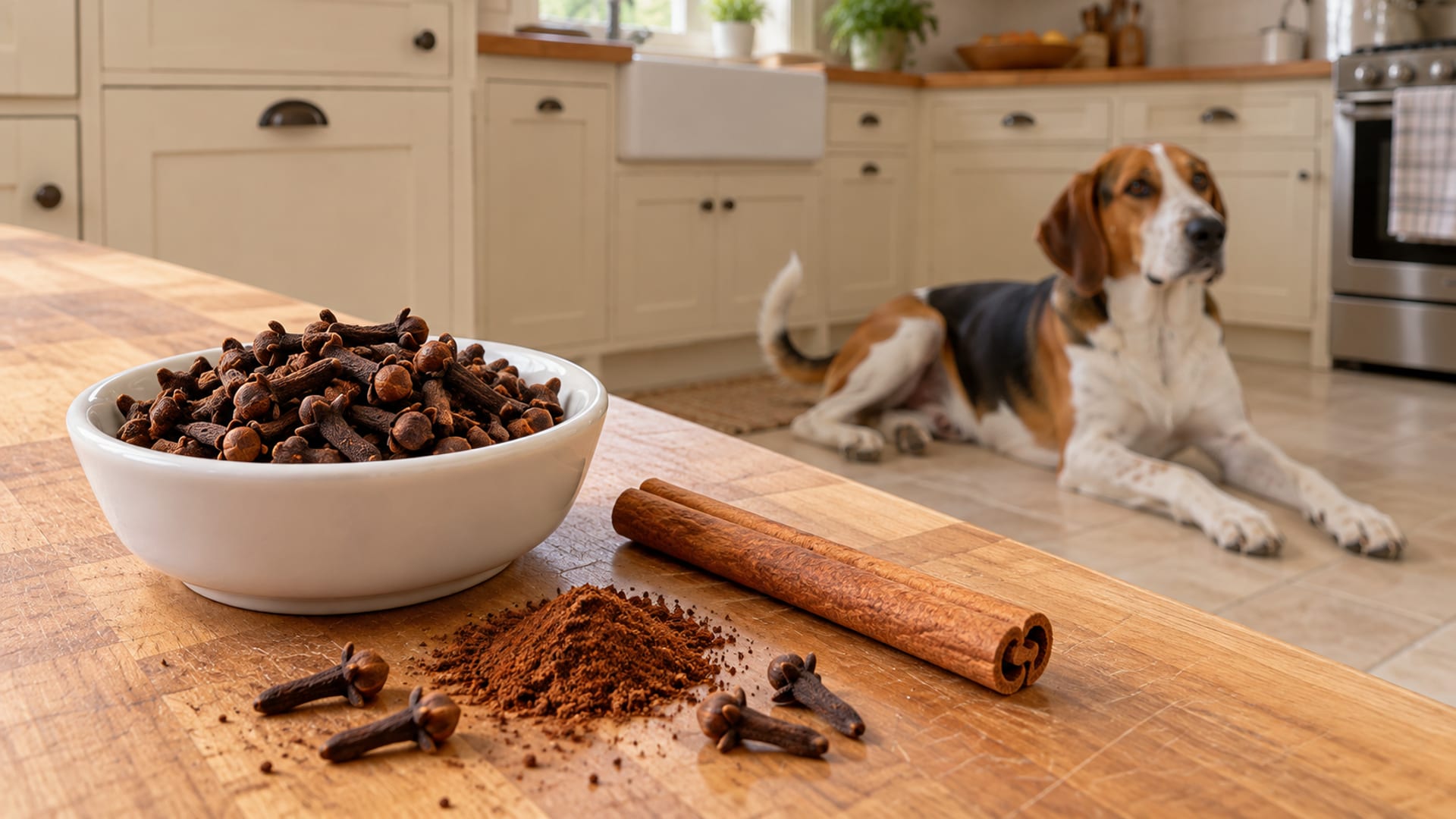
Cloves are not something to feed a dog on purpose, because there is no serving size that anyone has established as safe. What decides how worried to be is the form: one whole clove or a pinch of ground clove in a cookie is a much smaller problem than clove oil or a concentrated extract, which can cause vomiting, weakness, wobbliness and liver harm.
If your dog just got into some, work out which form it was, how much, and how big your dog is. Clove oil, an amount you cannot pin down, oil on the skin or mouth, or any sign that your dog is off means call your vet or a pet poison line now. I'd rather you make a call that turns out to be nothing.
Key takeaways
Tap a card to bring it forward.
- Cloves are not a treat or a supplement for dogs, and there is no safe serving to aim for.
- A whole clove or a pinch of ground clove is a lesser worry than clove oil, a concentrated extract or a product with clove oil in it.
- Call right away for clove oil, an uncertain amount, oil on the skin or mouth, a small dog with a real exposure, or any sign of illness.
- Keep the package and ingredient list in hand, since the other ingredients can be the bigger danger.
- Garlic cloves are a different item with a different risk.
What to do if your dog already got into cloves
Go through these in order.
- Take the rest away and look in your dog's mouth. Oil or powder on the gums matters, and so does a bud that is still there.
- Identify the form: a whole clove, ground clove, a food with clove in it, or clove oil. The concern climbs steeply from the first to the last.
- Estimate how much, and note your dog's weight. The same amount is a larger dose for a small dog, so a small dog with a real exposure is a reason to call.
- Check the skin and coat for oil. Concentrated oil can cause a problem through skin contact as well as swallowing, according to the ASPCA.
- Keep the package, bottle and ingredient list next to you. The product, the amount, your dog's weight, the time and whether oil touched the skin or mouth are what the ASPCA and your vet will ask for.
- Call your vet or a pet poison line for oil, extract, an unknown amount or any sign. The ASPCA advises contacting your veterinarian or its poison center immediately after a possible poisonous exposure instead of waiting for signs. Give nothing at home unless a vet tells you to.
Whole clove, ground clove or clove oil: which is which
Cloves are the dried flower buds of *Syzygium aromaticum*, and the compound behind the concern is eugenol. The Merck Veterinary Manual describes what concentrated essential oils can do to dogs, and clove oil is where the eugenol is most concentrated. A dried bud, a spoonful of ground spice and a bottle of oil are three very different exposures.
Tap or hover a row to highlight it.
| Form | How concerning | What to do |
|---|---|---|
| FormOne whole clove | How concerningLower concern; a bud can irritate the stomach or choke a dog | What to doWatch closely; call if the amount is uncertain or signs appear |
| FormGround clove or clove powder | How concerningLower concern in a pinch, but easy to eat in quantity mixed into food | What to doCheck the whole ingredient list and call if you are unsure how much |
| FormBaked goods with clove | How concerningDepends on the amount and every other ingredient | What to doRead the label for xylitol, alcohol, chocolate and raisins |
| FormClove oil, bud oil, essential oil or extract | How concerningHigh concern | What to doCall your vet or a poison line right away |
| FormToothpaste, mouthwash, flea products, potpourri and diffuser liquids with clove | How concerningDepends on the whole formula | What to doBring the label; xylitol, alcohol and other oils are separate hazards |
How much is a concern, and what to do without a safe number
There is no clove serving I can point you to for a dog, so cloves stay off the treat list.
The lower-risk part of the picture is the accidental one. A single bud or a pinch of ground clove that came along in a spiced food is a much smaller exposure than oil, but nobody has set a reliable safe threshold for it. Note your dog's weight and how much you think went down, and call if the amount is substantial or unclear. Small dogs and puppies deserve the call sooner, since the same amount per kilogram is bigger in a smaller body.
For the concentrated side, the only dose numbers come from one old lab study, and they describe pure eugenol put straight into dogs' stomachs, not spice.
Tap or hover a row to highlight it.
| Dose | What happened |
|---|---|
| DoseAbout 0.25 g per kg of body weight | What happenedVomiting now and then |
| DoseAbout 0.5 g per kg of body weight | What happenedVomiting in 65 percent of exposures, marked hind-leg weakness in half of the experiments, and two of four dogs died |
The study is by Lauber and Hollander. It shows that harm rises with the dose of concentrated eugenol and says nothing about a household amount of clove. If your dog got oil, do not try to match it to these numbers; call, and give the product, amount and weight.
Signs to watch for and when they show up
Concentrated essential oils can cause vomiting, diarrhea, depression, wobbliness, muscle weakness, behavior changes, low body temperature and collapse, and in severe cases seizures. The ASPCApro resource adds that signs can follow swallowing, skin contact or contact with concentrated oil. In the old dog study, body temperature dropped and the pulse went up.
A dog can look fine early. In people, eugenol poisoning is described as depressed consciousness or coma within hours, with liver injury showing up around 12 to 24 hours after swallowing, according to PubChem. Those are human figures, so I'd use them as a reason not to relax after a quiet first hour with a large or oil exposure.
Call your vet or a poison line right away for any of these:
- Vomiting or diarrhea
- A dog who seems flat, sleepy or not themselves
- Wobbly walking, weakness or tremors
- Trouble breathing, or a cold, limp dog
- Collapse or seizures
- Redness or irritation where oil touched the skin or mouth
My dog ate one before and was fine
That story is real, and I take it at face value. A dog can eat a clove, or lick up a spiced crumb, and never show a thing.
It just does not become a rule for the next exposure or the next dog. The ASPCA says concentration, formulation and route change the risk of an essential oil, and the Merck Veterinary Manual likewise says higher concentration means higher risk. A few things separate the fine dog from the sick one:
- Amount. A bud is not a teaspoon of powder, and neither is a mouthful of oil.
- Form. Culinary clove is diluted by food; oil is concentrated eugenol.
- Size. The same amount is a bigger dose per kilogram in a small dog.
- The individual dog. Dogs differ in sensitivity, and the ASPCApro notes that animals with underlying health problems, especially breathing problems or trouble metabolizing oils, may be at higher risk.
- Later effects. Organ damage after a large concentrated exposure can show up late.
So, if the neighbor's dog swallowed a whole clove last Christmas and was fine, I'm glad. Yours still gets the checks above.
Products and look-alikes
Clove shows up in more places than the spice rack. Check these first:
- Pumpkin spice foods and holiday baking. The ASPCA points out that a spiced baked treat needs its complete ingredient list read, since other ingredients can matter more than the clove. See also cinnamon, which usually rides along.
- Clove oil, clove bud oil and diffuser liquids. Keep bottles capped and out of reach, and do not put clove oil on your dog's skin or teeth. The AKC advises keeping essential oils inaccessible.
- Toothpaste, mouthwash, flea products, potpourri and herbal products. Read the whole label for xylitol, alcohol and other essential oils.
The name mix-up that catches people is garlic. A garlic clove is a segment of an *Allium* plant, and the ASPCA lists a separate toxic principle for it, N-propyl disulfide. It is its own risk, so read our pages on garlic and onions if that is what your dog ate.
Cats need stricter rules. The Pet Poison Helpline lists clove oil among oils known to poison cats, so keep it out of any home with a cat, whether or not the dog was fine.
Check what you learned
Quick check
Questions about dogs and cloves
Short answers to common questions.
Can I put clove oil on my dog's teeth or skin?
Do not apply concentrated clove oil to a dog. The ASPCA and Merck both warn that skin and mouth contact with concentrated essential oils can cause poisoning. If a product is meant for dogs, ask your vet about it first.
Does clove really harm the liver?
At high oral doses, eugenol has been linked to acute liver damage in dogs and other mammals, according to the WHO safety evaluation. In a lab study on dog liver cells, clove-leaf oil and eugenol were toxic to the cells, according to Monteiro and colleagues, but a dish of cells cannot tell you what a whole spice does inside a dog.
Are puppies or small dogs at more risk?
A small dog or puppy with a real exposure is a reason to call sooner, since the dose per kilogram is larger. Have their weight ready.
Can I use a clove diffuser around my dog?
Concentrated oils are the exposure that worries vets, and that includes what a diffuser puts in the air and liquid it holds. Keep the bottle out of reach, and call if your dog licks it or shows any sign.
Sources
Checked September 29, 2026.
- ASPCA, The Essentials of Essential Oils Around Pets
- ASPCA, When Pumpkin Spice Is Not So Nice
- ASPCA, Garlic
- ASPCApro, Are Essential Oils Dangerous to Pets?
- Merck Veterinary Manual, Toxicoses From Essential Oils in Animals
- Pet Poison Helpline, Updates on Essential Oils
- American Kennel Club, Are Essential Oils Safe for Dogs?
- Lauber and Hollander, Toxicity of the Mucigogue, Eugenol, Administered by Stomach Tube to Dogs
- Monteiro et al., Safety assessment of potential food ingredients in canine hepatocytes
- National Center for Biotechnology Information, PubChem: Eugenol
- WHO, Safety Evaluation of Certain Food Additives, clove oil chapter