
How to Start a Dog Walking Business in Texas: Steps, Costs, Insurance and First Clients
By Cal Hewitt · Published
Business guides
To start a dog walking business in Texas, choose your business structure and name, register an assumed name if one is required, get an EIN when you need one, and confirm your federal and Texas tax duties. Then ask your city or county about permits and zoning, buy liability coverage written for pet care, prepare a service agreement and emergency forms, set rates based on walk time and local demand, and start finding clients through Google, referrals, directories and marketplaces. Texas has no single dog-walker rule that fits every city. Park, zoning, business and commercial-use rules can differ, so confirm them with the office that governs your service area.
Key takeaways
Tap a card to bring it forward.
- Start with a small service area and a short list of walk types, then choose a business structure.
- An assumed name is a public notice, not a separate legal entity and not a liability shield.
- An EIN is free from the IRS; ask the Texas Comptroller how your service is classified before you charge sales tax.
- General liability can exclude injuries to a dog in your care, so ask about care, custody and control or animal bailee coverage.
- Dallas Rover data from September 2025 showed $18 to $25 for a 30-minute walk, before fees, taxes and travel.
- Revenue is not profit, and no benchmark here is a promise of what you will earn.
I'm Cal. Building websites and marketing for dog businesses is my work. I'm not a lawyer, an accountant, an insurance agent, a veterinarian or a trainer, so treat this as a map of the questions to ask and the offices that answer them. It is a lot to sort out when you just want to walk dogs, so I've put it in the order you can work through this week.
What should you decide before you register anything?
Before you file a form, decide what you are actually selling. The SBA says your business location determines the taxes, zoning laws and regulations you will face, so the service area comes first, not last.
Write down four things:
- Where you will work. Pick a few neighborhoods or one city, and decide how far you will travel between walks.
- Which services you offer. Solo walks, small group walks, puppy visits, senior dog visits, recurring weekday walks, and weekend or holiday coverage are all different jobs with different risks and prices.
- How long the walks are. Rover says walking bookings are generally built around 30- or 60-minute walks. You can add other lengths, but a short menu is easier to price and schedule.
- Whether you are part time or full time. Starting part time with a few recurring weekday walks lets you test demand and your own stamina before you count on the income.
A small start also makes the later steps easier, because you can ask your city one clear question instead of a dozen vague ones.
Which business structure should you choose, and how do you register the name?
You can operate as a sole proprietor, a partnership, an LLC or a corporation. The SBA says the structure you choose affects registration, taxes, licenses and permits. Liability and tax effects are different for each, so this is a good place to pay for an hour with a professional.
One point trips people up. An LLC is a business structure, not insurance, and it does not protect you from every claim. You still need coverage that fits what you do, which I cover below.
Names work like this. If you form an LLC or corporation, you file with the Texas Secretary of State. If you do business under any name other than your legal name, you generally file an assumed name certificate. The Texas Secretary of State's Form 503 instructions say the filing is a public notice, not a grant of exclusive rights to the name, and it does not create a separate entity. Where you file depends on who you are. Texas entities file with the Secretary of State, and the instructions list a $25 fee for that filing (revised August 2019, so confirm the current fee). Sole proprietors and general partnerships generally file with the county clerk where required, and county fees can differ. The Secretary of State's name filing FAQs explain the split.
Check that your chosen name is not already taken before you print anything with it.
Do you need an EIN, and what about Texas sales tax?
An EIN is a federal tax ID, and the IRS issues it directly and free of charge. The IRS says an EIN is required in several situations, including having employees and operating as a partnership, a corporation or an LLC. A sole proprietor without those conditions may not need one federally, but you can still request one for banking or state purposes. The IRS application itself is free. If you prefer Spanish, the IRS has a Spanish EIN page.
Sales tax is the question I hear most, and I can't give you a ruling. The Texas Comptroller's taxable services publication says taxable services are defined by Tax Code Section 151.0101 and lists categories such as dog grooming. The publication does not expressly classify ordinary dog walking. So, before you charge customers tax, or decide not to, ask the Comptroller's office or a tax professional how your exact service is classified, and keep a record of the answer.
Whatever the answer, keep business income and expenses separate from your personal money, track mileage and payments, and ask a tax professional about federal estimated taxes and self-employment tax. The IRS Spanish self-employed tax center says net self-employment earnings of $400 or more generally trigger a filing requirement.
Which city and county rules should you ask about?
This is where Texas gets local. The Texas.gov startup guide points you to federal, state and local offices, and the local ones are the ones that surprise people. Rules can differ by city and county on business certificates, home occupation, zoning, use of public parks, leash and dog-at-large rules, animal limits at a home, and boarding or daycare activity. Apartments, HOAs and landlords may add their own limits.
Two examples show why you should not assume. Austin Parks and Recreation says permits are required for covered trainers and activities on dedicated parkland, and its park reservation page says commercial activity and advertising generally need a permit or written permission. Dallas publishes park rules that cover commercial vehicles, dogs at large and sales of services or goods on park property. Neither page states how many dogs a commercial walker may handle, and neither one tells you what Houston, San Antonio, Fort Worth or a small town requires.
Put these questions to your city or county office:
- Do I need a local business certificate?
- Does a home-based dog walking business need a home-occupation permit?
- Does walking client dogs in a city park count as commercial activity, and do recurring paid walks need a park permit?
- Is proof of insurance required?
- Are there limits on dogs per walker, per household or per location?
- Does transporting dogs need a local or state permit?
- Which office handles this: planning, zoning, parks and recreation, animal services, the county clerk or a business permits office?
Write down who answered, the date and what they said.
What insurance should a dog walker buy?
Buy insurance before you take responsibility for a client's dog. The Insureon cost page (updated July 15, 2025) gives the numbers below, and they are marketplace averages, not Texas quotes.
- General liability commonly covers third-party bodily injury, property damage and advertising injury. Insureon reports an average of $42 per month for dog walkers, based on $1 million per occurrence and $2 million aggregate limits.
- Care, custody and control, or animal bailee is meant to cover injury, illness, escape, loss or death of an animal in your care. Insureon warns that general liability can exclude pet injuries unless this coverage or an endorsement is added. That gap is the one I would ask about first. Totten's dog walker page also describes care, custody and control coverage for dogs you don't own.
- Bonding can address certain theft or dishonesty claims involving an employee or business representative. It is not a substitute for liability insurance and does not cover every lost, damaged or injured pet.
- Commercial auto matters if you use a vehicle for business, especially to transport dogs or travel between assignments. Ask whether your personal auto policy excludes business use.
- Professional liability, or E&O, can address claims that professional services were negligent or late. Insureon's broad small-business average is $88 per month, or $1,051 a year, and it is not a dog walker quote.
- Workers' compensation is a question for an insurance professional if you hire. Calling someone an independent contractor does not automatically decide their legal status.
A full package with animal bailee, auto, bonding, higher limits or several walkers can cost more than either average, so get written quotes for your actual service model.
What should you charge, and how many dogs should you walk together?
The only Texas city figure I have is Dallas. Rover's Dallas data from September 2025 shows $18 to $25 for a 30-minute walk, averaging $21.22, and $30.62 to $37.62 for 60 minutes, averaging $33.84. I don't have current figures for Austin, Houston, San Antonio, Fort Worth or rural Texas, so look up your own market before you set a price.
PSI says professional pet sitters commonly charge by time rather than a flat fee per pet, and it recommends researching your local market instead of copying competitors. Group walks can use a base time rate plus a fee for each added dog, or a per-household rate. Solo walks generally cost more when they need individual handling, travel or a narrower schedule. Whichever model you choose, state it plainly before the first booking.
A 30-minute booking is not 30 minutes of paid work. Travel, key handling, client messages, scheduling, cancellations, insurance, taxes, mileage and equipment all take time or money. On Rover, providers generally pay a 20 percent service fee and keep 80 percent, with possible pilot variations, so a $25 booking there is not $25 in your pocket.
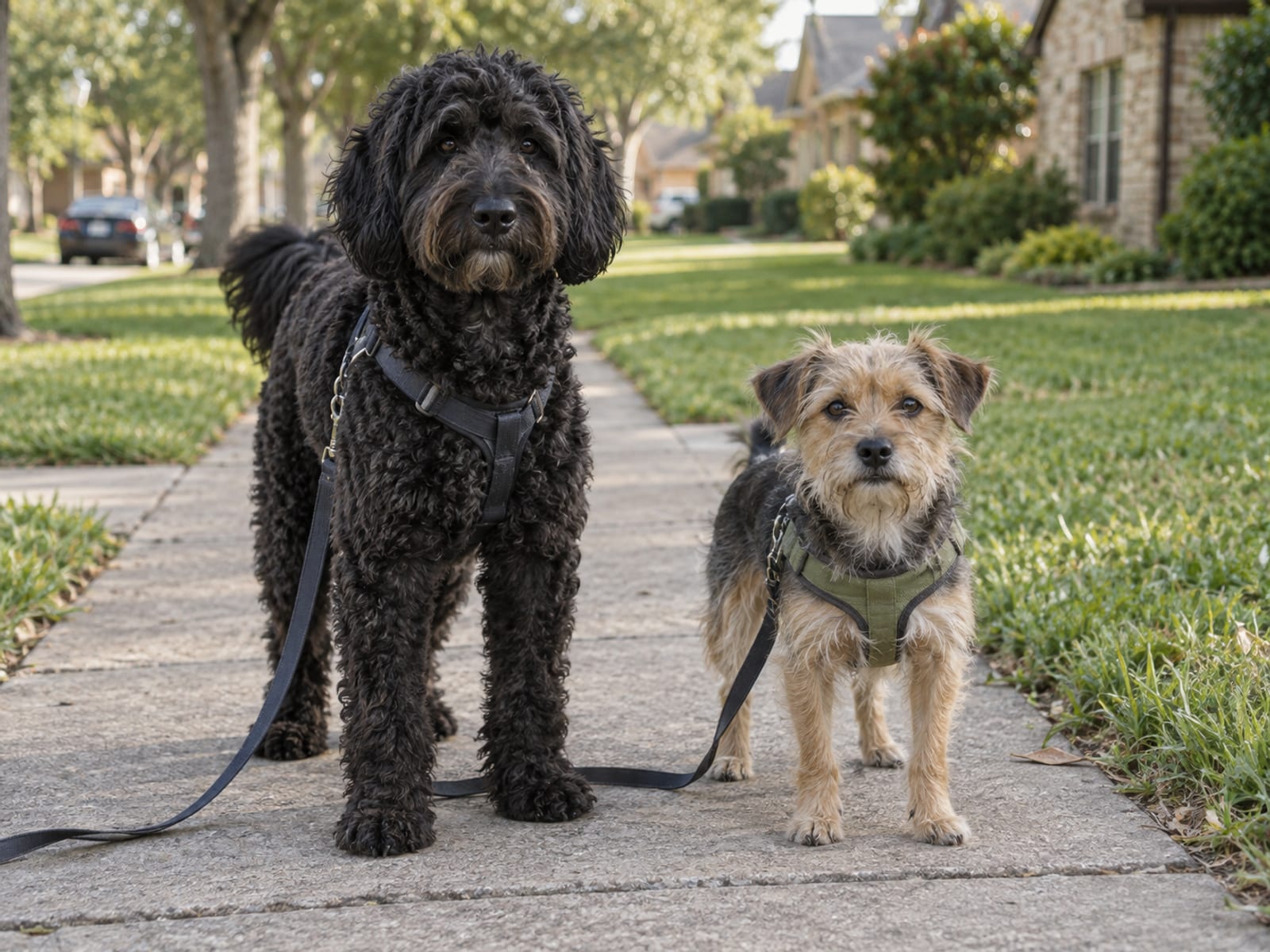
On dog numbers, Texas sets no statewide limit. Set your own conservative limit after looking at each dog's size, strength, age, health, leash skills and history with other dogs, along with your physical ability to handle an emergency. Add traffic, narrow sidewalks, heat and surface temperature, whether the dogs share a household, your leash and backup equipment, and whether you can separate dogs if something happens. Then check your insurance policy limits and the rules of your city, park, apartment, HOA or trail. Starting with solo walks or very small compatible groups gives you room to learn. Reading dog body language helps you spot stress before it becomes a fight.
What paperwork should every client complete?
Good paperwork protects the dog first and you second. PSI's standards recommend visiting the client's home and meeting the pets before you accept the job, recording detailed pet information, and using a legally compliant service agreement. The agreement should state the services, schedule, prices, liability policies, payment terms, cancellation rules, veterinary consent and emergency procedures. PSI also has a page on what to put in a pet sitting contract.
A client packet can include:
- The meet-and-greet record and service agreement.
- A pet profile with emergency contacts and veterinarian details.
- Vaccination information and identification details.
- An emergency veterinary authorization; PSI explains this in its veterinary release form guidance.
- Backup-care instructions and authorization, plus payment, cancellation and weather terms.
- Access instructions and a key-return procedure.
Keys, alarm codes and client data need to be kept secure. PSI also recommends preparing for illness, injury, your own absence, severe weather, natural disasters and lost keys, and its disaster plan tips cover backup caretakers. Carry spare leashes, collars or harnesses, water, waste bags and contact information, and write a lost-dog plan before you need it. If a dog does get loose, our guide on how to find a lost dog covers the first hour. Some emergency clinics want direct approval from the owner, so ask each client how to reach them.
How do you find your first clients?
Start with the places people already look. Each of these works better when it is accurate.
- Google Business Profile. Create a profile with your service area, hours, phone, website, services and photos. Ask for genuine reviews after completed service, and never offer misleading incentives or post fabricated reviews.
- A local website. Give it pages for the city or neighborhoods you actually serve, with walk lengths, policies, your pricing approach, emergency procedures, insurance information and a clear booking form.
- The DogServ directory. Claim an existing listing or submit a new one in the DogServ directory, with accurate service categories and service areas.
- Referrals. Build relationships with veterinarians, trainers, groomers, shelters, rescue groups and apartment communities. PSI describes relationships with veterinary practices as useful to a professional pet-care network.
- Marketplaces. Rover can bring first bookings while you build direct clients. Its help pages list a $49 to $79 profile-review fee that varies by location, along with the 20 percent fee above, and walkers set their own rates. Wag is another option; read its current terms and provider fees before you count on it. Read each platform's current terms before you try to move any client to a direct relationship.
What can a dog walker realistically earn, and why is revenue not profit?
I won't give you an income promise, because I can't back one up. The BLS reported a May 2025 median annual wage of $35,360 for animal caretakers, with the lowest 10 percent below $27,250 and the highest 10 percent above $50,060. Animal trainers had a median of $39,990. BLS projects 11 percent employment growth for animal care and service workers from 2025 to 2035. These are employee wages, not independent business income.
PSI's 2024 State of the Industry Survey reported average gross revenue of $100,537 in 2023 for U.S. member businesses. The survey covered active PSI members, had a 26 percent response rate among more than 3,500 contacted members, and measures gross revenue, not owner pay or profit.
Tap or hover a row to highlight it.
| Data point | Figure | Source and date |
|---|---|---|
| Data pointTexas assumed-name filing fee for entities | Figure$25 | Source and dateTexas Secretary of State Form 503 instructions, revised August 2019 |
| Data pointRover provider service fee | Figure20% | Source and dateRover Help Center, current page |
| Data pointDallas 30-minute walk range | Figure$18 to $25 | Source and dateRover Dallas data, September 2025 |
| Data pointDallas 60-minute walk range | Figure$30.62 to $37.62 | Source and dateRover Dallas data, September 2025 |
| Data pointInsureon general liability average | Figure$42 per month | Source and dateInsureon, updated July 15, 2025 |
| Data pointInsureon broad E&O average | Figure$88 per month | Source and dateInsureon, updated July 15, 2025 |
| Data pointBLS animal caretaker median wage | Figure$35,360 a year | Source and dateBLS, May 2025 |
| Data pointPSI member average gross revenue | Figure$100,537 in 2023 | Source and datePSI 2024 State of the Industry Survey |
Gross revenue is everything clients pay. Your profit is what remains after insurance, mileage, vehicle costs, taxes, advertising, payment processing, equipment, unpaid travel, cancellations, subcontractors and administration. Owner draw is the part of that profit you actually pay yourself. Keep those four numbers separate from the first month, and you will know whether part time should stay part time.
Questions dog walkers ask before they start
The answers below are short. Your own city, county and tax professional have the final word.
Do I need an LLC to start dog walking in Texas?
Not necessarily. Texas allows several business structures, and the right one depends on liability, taxes and paperwork. Ask a professional before you decide.
Does general liability cover an injured client dog?
Not automatically. Care, custody and control exclusions can apply. Ask any insurer about animal bailee or equivalent coverage and get the answer in writing.
How many dogs can I walk at once?
There is no universal Texas number. Set a conservative limit based on your handling ability, dog compatibility and route, then check local park, lease and insurance rules.
How much does Rover take from a booking?
Rover says its standard provider service fee is 20 percent, leaving 80 percent, though it notes possible pilot variations. It also lists a profile-review fee of $49 to $79 that varies by location.
What is your next step this week?
Pick one city and write your service menu, then call the office that handles business and park questions there. Your first three calls can be the Comptroller about sales tax, an insurance agent about care, custody and control coverage, and your city or county about permits and zoning. Once you have answers, file what you need, build your client packet and list your business in the DogServ directory. I'd rather you start small and correct than start fast and guess.
Sources
- austintexas.gov: dedicated parkland
- austintexas.gov: park reservation page
- bls.gov: BLS
- comptroller.texas.gov: taxable services publication
- dallasparks.org: park rules
- gov.texas.gov: Texas.gov startup guide
- insureon.com: Insureon
- irs.gov: IRS issues it directly and free of charge
- irs.gov: self-employed tax center
- irs.gov: Spanish EIN page
- petsit.com: disaster plan tips
- petsit.com: PSI's 2024 State of the Industry Survey
- petsit.com: PSI's standards
- petsit.com: PSI
- petsit.com: relationships with veterinary practices
- petsit.com: veterinary release form guidance
- petsit.com: what to put in a pet sitting contract
- Rover: $49 to $79 profile-review fee
- Rover: 20 percent service fee
- Rover: 30- or 60-minute walks
- Rover: Dallas data from September 2025
- sba.gov: SBA
- sos.state.tx.us: name filing FAQs
- sos.state.tx.us: Texas Secretary of State's Form 503 instructions
- tottengroup.com: dog walker page