
Home Dog Business in Birmingham, Huntsville and Mobile, Alabama: Zoning, Beau’s Law and Licenses in Order
By Cal Hewitt · Published
Business guides
Before you apply for any business license, confirm that your home address can legally host the dog care you plan to offer. Birmingham requires zoning approval and a Home Occupation Certificate of Agreement before it issues a city business license for a residence. Huntsville requires a business license for every residential-based business and sets it by your activity and location. Mobile allows a home occupation only if it stays incidental to the residential use and keeps the property’s residential character. And since October 1, 2026, Alabama’s Beau’s Law (SB361) sets statewide rules for dogs on tethers or in outdoor enclosures, including the yard of a home-based dog business.
Key takeaways
Tap a card to bring it forward.
- Zoning comes first: confirm the address can host the activity before you buy equipment or apply for a license.
- Birmingham wants zoning approval and an executed Home Occupation Certificate of Agreement before it licenses a home business.
- Huntsville licenses every residential-based business by activity and location; zoning, animal control and fire are separate calls.
- Mobile’s home occupations must stay incidental to the home and keep its residential character.
- Beau’s Law, in force October 1, 2026, covers tethers, fenced yards and shelter, and a home daycare yard has no general exemption.
- Ask zoning, animal control and fire how many dogs you may keep, and get the answers in writing.
Can your home host a dog business in Birmingham, Huntsville or Mobile?
A home dog business is possible in all three cities, but each gets there by a different route: Birmingham through zoning and a signed certificate, Huntsville through an activity-based license, and Mobile through its home-occupation standards. The deciding facts are tied to your exact address. I'm Cal, and I'm not a lawyer or a zoning official, so treat what follows as the order of questions to ask, not a ruling.
How many dogs you may keep is a question for the offices that cover your address. The zoning district, the parcel, overnight stays, client traffic and outdoor runs can all change the answer, so don't borrow a number from another Alabama town.
What to do this week, before you accept a single dog
If you're worried about buying crates, fencing or a grooming table and then learning the address doesn't work, start with this short, ordered list.
First, confirm your jurisdiction. Is the house inside Birmingham, Huntsville or Mobile city limits, or in an unincorporated part of the county? Huntsville offers a Quick Address Search on its licensing page for exactly this. Outside city limits, the county offices become your first stop.
Second, write a one-page service description: each service separately, overnight stays, dogs at a time, drop-off and pickup times, helpers, outdoor space, equipment and any sign. Offices answer a specific description better than "a dog business."
Third, contact zoning, then animal control, then the fire office, and ask each to answer in writing for your address and service model. If you rent or have an HOA, ask your landlord or HOA too. State and county registrations, the city license, insurance and client paperwork come after those answers.
Birmingham: zoning approval and the Home Occupation Certificate of Agreement come first
Under Birmingham’s Supplemental Documentation Checklist, every business in the city registers with the Finance Department using the Application for Tax Certificate. A home occupation must furnish a copy of the Home Occupation Certificate of Agreement, obtained through the Department of Planning, Engineering and Permits (205-254-2211). The agreement must be executed before the city can license a business run from a residence, and every business location needs zoning approval first.
The order, then: settle the exact location, get location and home-occupation approval from Planning, Engineering and Permits, obtain the executed certificate, and submit it with your license application to the Tax and License Administration Revenue Division, 710 North 20th Street, Room TL-100, Birmingham, Alabama 35203 (205-254-2198). The Birmingham license year runs January 1 to December 31, and a new business taxed on gross receipts files an affidavit covering its first 90 days.
The city’s planning FAQ includes the question of how many pets are allowed at a home; ask Planning, Engineering and Permits for that number as it applies to your business. Under the zoning ordinance, your district can decide whether dog care is permitted, needs another approval or isn't allowed there.
Huntsville: a license for every home-based business, plus separate zoning, animal control and fire calls
Huntsville’s business license page says anyone operating a commercial or residential-based business in the city needs a license, that the license depends on the operational activity, and that each location inside city limits needs its own.
The application help file shows what you'll be asked: new or renewal, whether the business is physically in Huntsville, commercial or residential location, ownership type (sole proprietorship, partnership, corporation, LP, LLP, LLC or other) and your business category or activity.
The license doesn't settle whether dog care is allowed at your house. Call Huntsville Planning and Zoning about the address and use, Huntsville Animal Control about animal-related operating questions, and Huntsville Fire and Rescue or the fire-prevention office about fire and evacuation. The Revenue Division or Clerk-Treasurer’s Office handles the license itself.
Mobile: what “incidental” and “residential character” mean for dog care at home
Mobile’s Article 4 Use Regulations treat a home occupation as a regulated accessory use. It must be incidental to living in the home and must not change the property’s residential character. That is a standard, not a blanket permission for every kind of animal care.
Apply it piece by piece. Describe overnight boarding specifically to zoning, animal control and fire, since the general wording doesn't settle it for every address. Repeated drop-offs, waiting cars and parking can change how a residential street looks. Don't assume a detached garage, an outdoor kennel, an employee or frequent client traffic is covered; ask about each.
Signs need their own check. Mobile’s 2021 edition of the Use Regulations allowed one non-illuminated home-occupation sign, no larger than one square foot, mounted flat against the dwelling wall. Confirm the current rule for your district through Mobile’s Unified Development Code page and the Build Mobile forms and applications before you order one.
Beau’s Law, in force October 1, 2026: tethers, fenced yards and shelter at your house
Beau’s Law, Alabama Senate Bill 361, was enacted April 13, 2026 and took effect October 1, 2026; FastDemocracy lists it as Act 2026-427. It applies statewide, including to dogs kept in the yard of a home-based dog business.
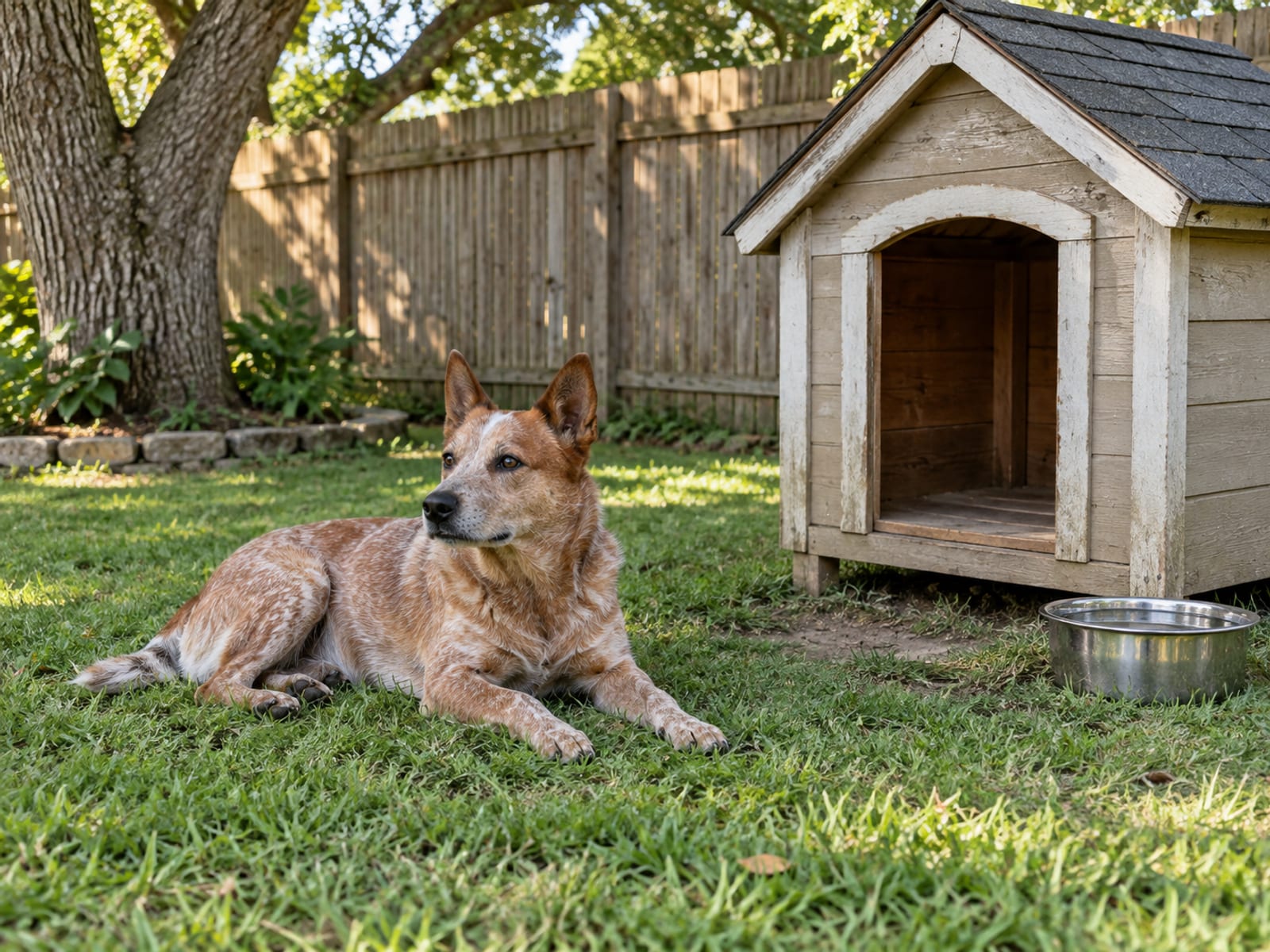
A tethered dog must be on a trolley system that isn't unreasonably heavy, keeps the dog on the property, holds only one dog, attaches to a properly fitted collar or harness, has a swivel at both ends, doesn't cross an object or edge that could cause injury or strangulation, prevents entanglement, and gives continuous access to adequate food, water and shelter (Section 2(a)). No logging chain, choke collar or pinch collar may be used to tether a dog. An outdoor enclosure must be secure, fully fenced, roomy enough for free movement, keep the dog on the property and give the same continuous access (Section 2(b)).
Section 3 shelter must keep the dog dry and protected from the elements, with shade and cold-weather bedding when necessary; be fully enclosed with an adequate opening and a solid floor; let the dog stand, turn around, lie down normally and extend its limbs; be durable and ventilated; stay free of built-up waste, standing water and debris; and allow unlimited access. The law sets no tether length, minimum yard size or general hourly limit.
For home businesses, the exemptions matter. A boarding kennel with "secure enclosures for the temporary boarding or housing of dogs" is exempt from Sections 2(a) and 2(b) under Section 2(c)(2). There is no general daycare exemption, so a home daycare yard should meet Section 2(b). A licensed grooming shop or facility is exempt during grooming, and walking a dog on a leash is exempt. Temporary tethering or confinement at a home is excluded only for a reasonable amount of time with respect to the weather.
SB361 has no express preemption clause, so city rules remain a separate question. Huntsville’s outdoor-dog ordinance requires clean potable water, proper food, a structurally sound water- and wind-proof shelter, and either a trolley system or a chain-link kennel run of at least 200 square feet; unattended outdoor dogs can't be chained. Birmingham’s zoning material defines an animal kennel to include outdoor animal runs and land used for the care, breeding, boarding, training or selling of animals, so ask zoning whether your yard puts you in that category. Mobile has had a draft tethering ordinance before its city council; ask the Mobile city clerk or animal-services office for the rule in force now.
City or county animal-control officers investigate. With probable cause, a certified officer may remove a dog whose life is believed to be in danger, or order care at the owner’s expense, subject to hearings under Alabama Code Sections 13A-11-244 and 13A-11-245, and may seek a warrant to enter private property.
Tap or hover a row to highlight it.
| Violation | Class | General maximum fine (Ala. Code 13A-5-12) |
|---|---|---|
| ViolationFirst | ClassClass C misdemeanor | General maximum fine (Ala. Code 13A-5-12)$500 |
| ViolationSecond | ClassClass B misdemeanor | General maximum fine (Ala. Code 13A-5-12)$3,000 |
| ViolationThird or later | ClassClass A misdemeanor | General maximum fine (Ala. Code 13A-5-12)$6,000 |
| ViolationAny violation | ClassFull costs of boarding and veterinary care | General maximum fine (Ala. Code 13A-5-12)Paid by the violator |
The act sets no separate dollar fine; the maximums come from Alabama Code Section 13A-5-12. Put three questions to your city animal-control office in writing: does my home boarding or daycare count as a "boarding kennel" under Section 2(c)(2); how long does "temporary," or "a reasonable amount of time with respect to the weather," last; and how does the act apply when I care for dogs at a client’s home? Until you have those answers, I'd set up the yard to meet Section 2(b).
The Alabama registrations, in order: Secretary of State, EIN, county license, My Alabama Taxes, then the city
Once zoning says yes, the paperwork follows a sensible order. For an LLC, the Alabama Secretary of State requires a name reservation, then the certificate of formation, with a $200 filing fee for a domestic LLC. An LLC is a structure choice; it doesn't replace zoning approval.
IRS Publication 583, revised December 2024, says an EIN can be requested online and issued right after validation, and it recommends separate business banking and records.
The Alabama Department of Revenue says state and county privilege licenses come from the county Probate Judge or License Commissioner, and a license may be required in every county where you do business, which matters if you sit or walk dogs across a county line. ALDOR doesn't administer city licenses, so check with each city. My Alabama Taxes registration is free, and account numbers generally arrive in 3 to 5 days. The city license comes last.
Tap or hover a row to highlight it.
| Figure | What it covers | Source |
|---|---|---|
| Figure$200 | What it coversDomestic LLC filing fee | SourceAlabama Secretary of State |
| Figure$0 | What it coversMy Alabama Taxes online registration | SourceAlabama Department of Revenue |
| Figure3 to 5 days | What it coversTypical wait for an account number | SourceAlabama Department of Revenue |
| FigureJanuary 1 to December 31 | What it coversBirmingham business license year | SourceCity of Birmingham |
| Figure90 days | What it coversBirmingham gross-receipts affidavit period for new businesses | SourceCity of Birmingham |
| Figure1 square foot | What it coversHome-occupation sign limit, 2021 edition | SourceCity of Mobile Use Regulations |
The exact questions to ask each office before launch
Bring your service description and ask every office the same core set, so you can compare answers:
- Is this address in your jurisdiction, and what is its zoning district?
- Is this a home occupation, kennel, animal boarding, commercial daycare, personal service or another use?
- Do I need a home-occupation certificate, conditional use, special exception, variance or hearing?
- Is there a limit on dogs present for business, and does it change for my own dogs, overnight dogs, puppies or dogs from different households?
- Are dogs allowed outdoors, in a fenced area, kennel, shed, garage or detached structure?
- Are drop-offs, pickups and training sessions allowed, and how often? Are employees or contractors allowed?
- What parking, sign, barking, odor, waste and sanitation rules apply?
- Does animal control require vaccination records, inspections, registration or a permit?
- Does fire prevention require an inspection, occupancy review, extinguishers, alarms, exits or an evacuation plan?
- What documents do I need before the business license, and can you put this in writing?
Then add one office-specific question: in Birmingham, how to execute the Home Occupation Certificate of Agreement; in Huntsville, which license category fits; in Mobile, whether your activity stays incidental and keeps the residential character; and at the county, which privilege license applies in each county you work in.
Insurance and operating safeguards: what the law asks and what the profession recommends
Keep two lists. The legal list is everything above: zoning, licenses, registrations, Beau’s Law and any city outdoor-dog rule. The professional list is how you run a safe business, and it comes from trade groups, not statutes.
Ask an insurer about general liability and care, custody and control coverage for the dogs in your care. Pet Sitters International’s quality standards, revised July 2020, say a professional business should get required licenses and permits before accepting assignments, provide references, and screen and train sitters. IBPSA tells pet owners to ask about cleanliness, secure fencing, evacuation plans, fire safety, climate control and provider-to-pet ratios, so expect clients to ask you. It also offers risk-management resources.
In practice: a written service agreement, a vaccination policy, an intake record for every dog, emergency contacts, an evacuation plan, and a plan for parking, noise, fencing, sanitation and waste.
Questions about running a dog business from home in Alabama
These answers cover startup costs, grooming at home, overnight boarding and renting.
How much does it cost to start a pet sitting business from home in Alabama?
The firm state figures are the $200 Secretary of State fee if you form a domestic LLC and $0 to register for My Alabama Taxes. City and county license amounts depend on your activity and location, so ask each license office before you budget. IRS Publication 583 notes that business expenses generally must be ordinary and necessary, which is worth keeping in mind as you buy equipment.
Can I groom dogs at home in Birmingham, Huntsville or Mobile?
Possibly, but it's a zoning question first. Describe your equipment, appointment times and client parking to zoning, animal control and the fire office. Beau’s Law exempts a licensed grooming shop or facility during grooming, so ask animal control how that applies to a home setup.
Can I board dogs overnight at my house?
Don't assume a home-occupation approval covers it. Ask zoning, animal control and fire about overnight care specifically, and ask animal control in writing whether your home boarding counts as a "boarding kennel" under Beau’s Law.
What if I rent my home or live under an HOA?
City approval and landlord or HOA permission are separate. Ask your landlord, property manager or HOA in writing whether business use and client dogs are allowed, alongside your zoning call.
Your next step
Make one call this week: the zoning office for your exact address, with your service description in hand. Once you have a written yes, work down the list: animal control, fire, the county privilege license, My Alabama Taxes, then the city license and insurance. When you're licensed and ready to be found, you can list your business in the DogServ local directory.
Sources
- alison.legislature.state.al.us: Alabama Code Section 13A-5-12
- alison.legislature.state.al.us: Alabama Code Sections 13A-11-244 and 13A-11-245
- alison.legislature.state.al.us: Alabama Senate Bill 361
- birminghamal.gov: Birmingham license year
- birminghamal.gov: planning FAQ
- birminghamal.gov: Supplemental Documentation Checklist
- birminghamal.gov: zoning ordinance
- buildmobile.org: Build Mobile forms and applications
- businesslicense.huntsvilleal.gov: application help file
- cityofmobile.gov: Unified Development Code page
- cityofmobile.org: 2021 edition of the Use Regulations
- cityofmobile.org: Article 4 Use Regulations
- cityofmobile.org: draft tethering ordinance
- fastdemocracy.com: FastDemocracy
- fursresponders.pet: Pet Sitters International’s quality standards
- gisweb.birminghamal.gov: zoning material
- huntsvilleal.gov: business license page
- huntsvilleal.gov: outdoor-dog ordinance
- ibpsa.com: IBPSA
- ibpsa.com: risk-management resources
- irs.gov: IRS Publication 583
- revenue.alabama.gov: Alabama Department of Revenue
- revenue.alabama.gov: My Alabama Taxes registration
- sos.alabama.gov: Alabama Secretary of State