

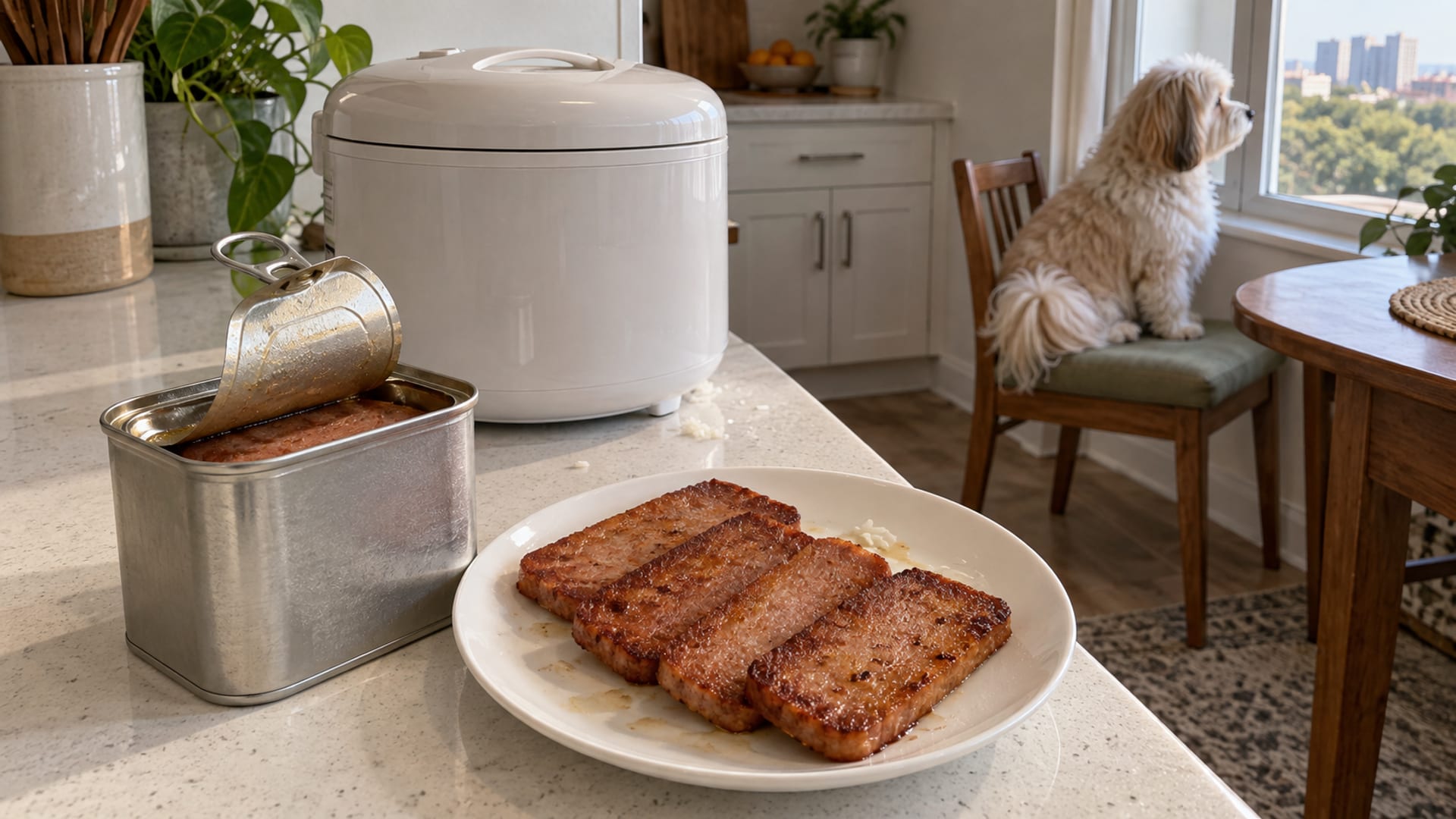
A small bite is unlikely to poison a healthy dog, but Spam shouldn't be on the menu. Hormel lists 770 milligrams of sodium and 16 grams of fat in each 2-ounce serving of Spam Classic, which is a lot of salt and fat to hand a dog.
If your dog took a slice off the counter and seems normal, give them water and watch them today. If they ate a whole can or most of one, got into fried Spam and its grease, are small, or have kidney disease or a history of pancreatitis, call your vet now.
Key takeaways
Tap a card to bring it forward.
- A small bite of Spam is unlikely to cause salt poisoning in a healthy dog with water nearby.
- Salt and fat are the concerns. Spam is fully cooked, so raw-meat germs are not the issue.
- The risk climbs with the amount, a smaller dog, no access to water, or a dog with kidney disease or pancreatitis.
- Frying adds fat, and rinsing slices does not reliably wash the salt out.
- The can, lid and wrapper can cut or block the gut if swallowed.
What to do if your dog just ate Spam
- Take the rest away and look over the can and lid. A chewed edge or a missing piece of the lid is a reason to call.
- Collect the details. Cornell University's College of Veterinary Medicine says to have the brand, the ingredient list, how much your dog ate, when they ate it and roughly what they weigh.
- Put fresh water down. Salt poisoning is most closely linked to times when a dog can't drink enough, according to the Merck Veterinary Manual.
- Call your vet or a pet poison line for a large or unknown amount, a small dog or puppy, a dog with kidney disease or pancreatitis, a seasoned variety, packaging, or any symptoms. The ASPCA advises against waiting for signs to get worse.
What is in a can of Spam
Hormel lists the ingredients of Spam Classic as pork with ham, salt, water, modified potato starch, sugar and sodium nitrite. It comes fully cooked from the can.
Tap or hover a row to highlight it.
| What your dog ate | How concerned to be | Why |
|---|---|---|
| What your dog ateOne small bite of Spam Classic, cold or cooked | How concerned to beLow for a healthy dog with water | WhySalty and fatty, but a small dose |
| What your dog ateSeveral slices, or most of a can | How concerned to beCall your vet | WhySodium and fat add up fast, especially in a small dog |
| What your dog ateFried Spam or the pan grease | How concerned to beCall if it was more than a bite | WhyFrying adds fat on top of what the meat already has |
| What your dog ateSpam Lite or Less Sodium | How concerned to beSame caution | WhyLess sodium, still processed, still fatty |
| What your dog ateSpicy, teriyaki, bacon or other flavored Spam | How concerned to beRead the label and call if you are unsure | WhySeasonings and sodium differ by variety |
| What your dog ateSpam musubi or Spam fried rice | How concerned to beCheck every ingredient | WhySoy sauce, sauces, onion, garlic and skewers can come along |
| What your dog ateThe can, lid or wrapper | How concerned to beCall your vet | WhyMetal edges and packaging can cut or block the gut |
| What your dog ateSpoiled or long-opened Spam | How concerned to beCall if your dog gets sick | WhySpoiled food brings its own risk of illness |
The sodium nitrite in Spam is a preservative. For a dog that ate some, salt is the ingredient that matters most.
How much Spam is too much for a dog?
There is no safe slice count for Spam. The published figure is for salt: Merck reports signs of salt poisoning in dogs at about 2 to 3 grams of salt per kilogram of body weight, and an oral dose around 4 grams per kilogram that can kill.
The Spam label lists sodium rather than grams of salt, so the label can't be turned into a precise salt dose. Give your vet the can, the variety and your dog's weight, and let them judge.
What you can see from the numbers is how much size matters. Because the dose is counted per kilogram, the same two slices carry several times more salt per pound for a 12-pound dog than for a 60-pound dog. Water access matters just as much: Merck notes that dogs with fresh water available handle extra salt better.
Fried Spam, fat and pancreatitis
Spam Classic has 16 grams of fat per 2-ounce serving, and frying it adds more. A 2025 review in the Journal of the American Veterinary Medical Association found the evidence linking dietary fat alone to pancreatitis limited, and pancreatitis has several possible causes. The same review notes that vets still advise dogs with repeat bouts of pancreatitis to avoid high-fat diets, table scraps and excess treats. If your dog has had pancreatitis, Spam is a food to keep well out of reach.
Signs to watch after Spam
Salt signs often start with thirst, peeing more, vomiting or diarrhea. Merck says vomiting from too much salt can begin within several hours and move on to weakness, diarrhea, muscle tremors and seizures. In severe cases a dog can become wobbly, dull or unresponsive.
Fat can cause stomach upset or pancreatitis on a slower clock, with vomiting, a sore belly or refusing food that may start later and last for days.
Go to a vet now for weakness, wobbling, tremors, seizures, collapse or trouble breathing. Call today for repeated vomiting or diarrhea, heavy thirst, a painful belly or a dog that won't eat.
"My dog ate a slice of Spam once and was fine"
That's very likely, and it was a real outcome. It just doesn't hold for every dog or every can. A slice is a small amount; a whole can is not. A large dog gets far less salt per pound from the same slice than a small one. Your dog probably had water available, which Merck says makes salt poisoning much less likely. Spam Classic, Less Sodium and a spicy flavor are different products. A dog with kidney disease or past pancreatitis starts from a different place. And the fat-related signs can show up later than the salt ones. So, be glad the first slice went fine, and keep the next can on a shelf your dog can't reach.
Spam musubi, canned ham and other look-alikes
- Spam musubi and Spam fried rice: the rice itself is fine for dogs (see can dogs eat rice?), but soy sauce, sauces, onion, garlic and skewers each add their own problem.
- Generic canned luncheon meat: may use different meats and more sodium, and some contain onion or garlic. Read the label.
- Canned ham: a different product with a different recipe. Can dogs eat ham? covers it.
- Potted meat, Vienna sausages, bologna and hot dogs: separate processed meats, judged by their own labels. See can dogs eat bologna? and can dogs eat hot dogs?
Check what you learned
Quick check
Questions about dogs and Spam
My dog ate one small piece of Spam. Is that an emergency?
Usually not. Think about the variety, the amount, your dog's weight, water and health. Call your vet if the amount was large or unknown, your dog is small or has health problems, or signs appear.
Can Spam cause salt poisoning in dogs?
It can if a dog eats enough, especially without water. Merck's figure of about 2 to 3 grams of salt per kilogram describes salt, which is a different measure from the sodium printed on the can.
Can Spam give my dog pancreatitis?
A high-fat food is a concern, most of all for a dog that has had pancreatitis before. There is no known amount of Spam that causes it, and the research on dietary fat alone is limited.
Is Spam Lite or Less Sodium safe for dogs?
Lower sodium doesn't make it a good treat. Check the exact label, since it is still processed meat that can be high in fat and sodium.
What if my dog ate Spam musubi?
Look at everything in it: the soy sauce and other sauces, any onion or garlic, and whether a skewer or plastic wrap was swallowed. Call your vet if you can't rule those out.
What if my dog swallowed part of the Spam can or lid?
Call your vet. Metal edges and packaging can injure or block the gut, whatever happened with the meat.
Sources
Checked September 24, 2026.
- Hormel Foods, SPAM Classic
- Cornell University College of Veterinary Medicine, First-aid for poisonous substances
- ASPCA, My Pet Ate Something! When Should I Seek Help?
- Merck Veterinary Manual, Salt Toxicosis in Animals (updated September 2024)
- Yamka and others, Journal of the American Veterinary Medical Association, High fat, high risk? Evaluating the strength of evidence linking dietary fat and pancreatitis in dogs