
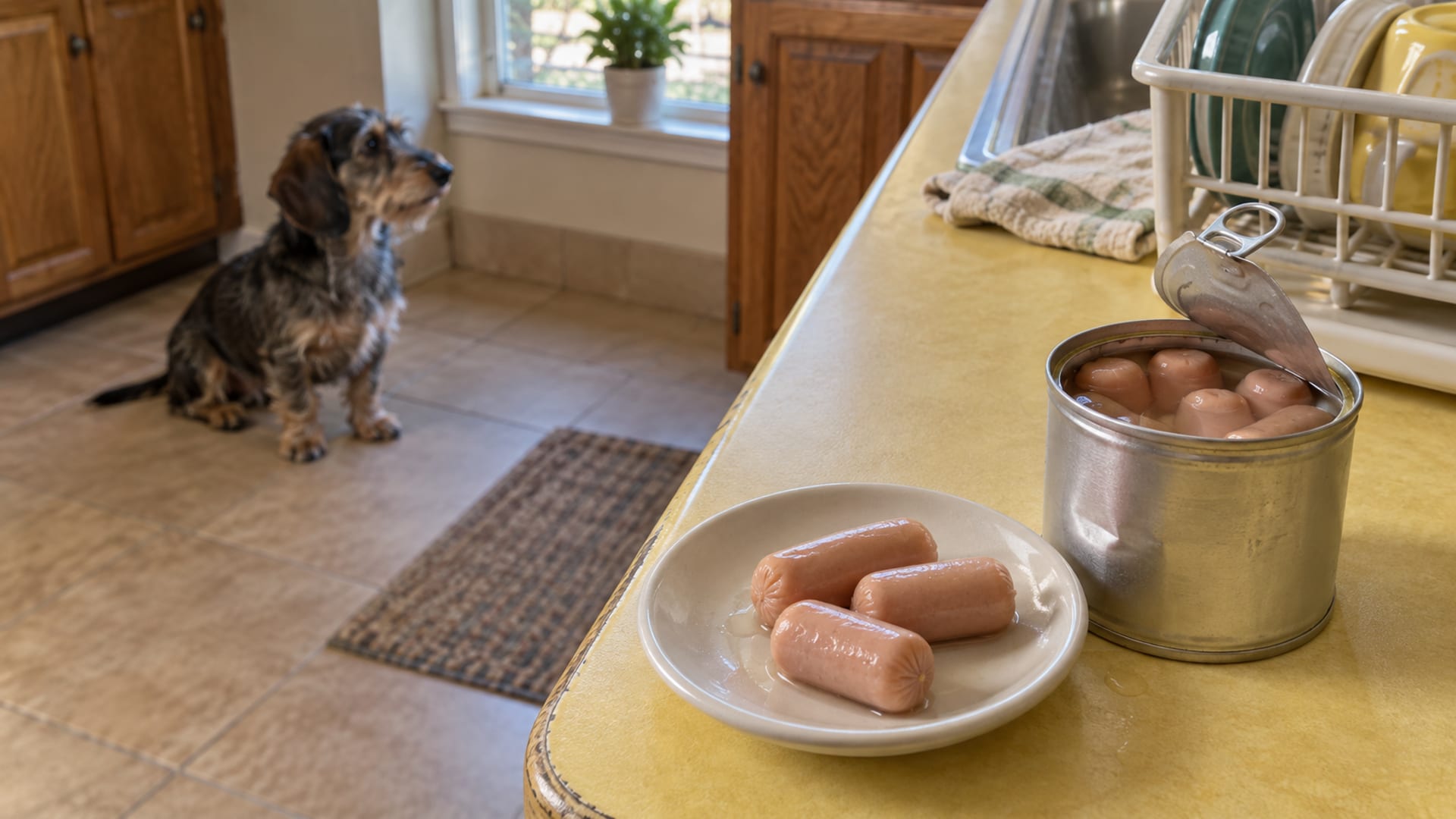
A single Vienna sausage is usually not a poisoning for a healthy dog, but it is a poor thing to share on purpose. The ASPCA advises keeping processed meats out of your dog's bowl because they can be high in salt, and it warns that too much fat can bring on pancreatitis.
If your dog just tipped over an open can, count how many sausages are missing and look at whether the liquid was lapped up too. One sausage in a medium or large dog is usually something you can watch at home. Most of a can, the liquid, a small dog, or any sign of sickness is a reason to call your vet.
Key takeaways
Tap a card to bring it forward.
- One Vienna sausage is a low-risk slip for most healthy dogs.
- The concerns are salt, fat, and onion or garlic powder in some brands.
- The liquid in the can is salty. Pour it down the sink, not into a bowl.
- Small dogs, puppies, and dogs with pancreatitis, kidney, heart or diabetes history need a call after more than a bite.
- Vomiting, heavy thirst, stumbling, tremors or collapse mean a vet visit now.
My dog ate Vienna sausages: the first few minutes
- Move the can and count. Note how many links are gone and whether the liquid is gone as well.
- Read the label. Look for onion, garlic, a spicy sauce or a sweetener, and find the sodium line so you can read it to your vet.
- Think about your dog's size. Three little sausages mean far more to a 9-pound terrier than to a 70-pound retriever.
- Set out fresh water. The Merck Veterinary Manual explains that salt poisoning is less likely when a dog's body can regulate sodium normally and fresh water is available.
- Call your vet or a pet poison line if your dog is small, young or has a health condition, if they ate several sausages or drank the liquid, if the label lists onion or garlic, or if you cannot tell how much is gone.
Hold off on home remedies and medicine. Pet Poison Helpline says to call them or get veterinary care right away when a pet may have eaten something toxic.
Which parts of the can matter most
Tap or hover a row to highlight it.
| What your dog got | How concerned to be | Why |
|---|---|---|
| What your dog gotOne plain sausage | How concerned to beLow for a healthy dog | WhySalty and fatty, but a small amount |
| What your dog gotSeveral sausages or a whole can | How concerned to beCall your vet | WhyThe salt and fat add up quickly |
| What your dog gotThe liquid from the can | How concerned to beCall your vet | WhyIt can be very salty and is no drink for a dog |
| What your dog gotA sausage swallowed whole | How concerned to beWatch closely | WhyA dog that gulps can choke on it |
| What your dog gotA brand with onion or garlic powder | How concerned to beCall your vet | WhyOnion and garlic can damage red blood cells |
| What your dog gotSpicy, smoked or flavored varieties | How concerned to beRead the whole label | WhySauces and added ingredients bring their own risks |
| What your dog gotDried sausage or sausage jerky | How concerned to beSkip it | WhyDrying packs more salt into each bite |
Heating the sausages does not take out the salt or the fat. The casing is not a poison on its own, but a long piece swallowed intact can add to a choking or blockage problem.
Seasoning is the part that changes from can to can. The ASPCA's cookout guide lists onion and garlic among the ingredients that make grill food risky for pets. The pages on onions and garlic describe what they do to a dog's blood and which signs to watch for.
How many Vienna sausages is too many?
Sodium differs from brand to brand, so there is no sausage count that fits every dog. What vets work from is the amount of salt itself. Merck puts the first signs of salt poisoning at about 2 to 3 grams of salt per kilogram of body weight, and a fatal dose near 4 grams per kilogram. Pet Poison Helpline adds that how sick a pet gets depends on the amount eaten, the animal's size and the individual pet.
Those are grams of salt, and a label lists milligrams of sodium, which is a different figure. Give your vet the can and your dog's weight and let them do the math. Since the numbers are per kilogram, a tiny dog reaches the danger zone on far fewer sausages than a big one.
Fat is the other half. The American Kennel Club names Miniature Schnauzers and some small toy and terrier breeds as more prone to pancreatitis, and lists obesity and diabetes among the conditions tied to it. If your dog fits any of those, call after more than a nibble.
Signs to watch for after Vienna sausage
Tap or hover a row to highlight it.
| How soon | What you notice | What it points to |
|---|---|---|
| How soonWithin minutes | What you noticeGagging, pawing at the face, struggling for air | What it points toA sausage is stuck. Head to a vet now. |
| How soonWithin several hours | What you noticeVomiting, thirst, peeing more, diarrhea | What it points toToo much salt or fat. Call your vet. |
| How soonSome hours after a big helping | What you noticeWobbly walking, confusion, weakness, trembling or seizures | What it points toSalt poisoning. Go to an emergency vet now. |
| How soonLater, after a fatty feast | What you noticeVomiting, belly pain, dullness, dehydration, not eating | What it points toPossible pancreatitis. Call your vet. |
According to Merck, salt-related vomiting can begin within several hours and may move on to weakness, diarrhea, tremors and seizures. Pet Poison Helpline's symptom list adds heavy thirst, peeing more, low energy and, in the worst cases, coma. For pancreatitis, the ASPCA describes vomiting, belly pain, depression, dehydration and a poor appetite.
"My grandpa's dog ate Vienna sausages straight from the can"
Plenty of dogs have, and many were fine. That memory can be completely accurate for that dog. It just does not make a rule for yours:
- Amount. One sausage is far below a toxic salt dose for a big dog. Half a can may not be.
- Size. The same sausage is a much larger dose per pound for a small dog.
- The can. Sodium, fat, seasoning and how much liquid the dog drank all differ by brand.
- Water. A dog with a full water bowl handles salt better than one shut in a room without it.
- The dog. Pet Poison Helpline says size and individual factors change how a pet reacts.
- Timing. Salt signs can take several hours, and pancreatitis may not show right away.
- Luck. A quiet night after one can says little about the next one.
If a sausage has always been part of the routine, a small piece of plain cooked meat does the same job with far less salt.
A better treat than Vienna sausage
The ASPCA suggests keeping snacks to no more than 5 percent of your dog's daily calories. Its safer meat option is a small amount of lean, cooked, unseasoned meat with the bones removed. Plain cooked chicken or beef, cut small, fills the same spot a canned sausage used to.
Vienna sausages and the foods people mix them up with
- Hot dogs and franks: close relatives with the same salt and fat questions. Can dogs eat hot dogs? covers them.
- Cocktail and mini sausages: similar little links, often with their own seasonings. Read the label.
- Chicken or smoked Vienna sausages: the meat changes, but salt and fat still vary by brand.
- Potted meat and deviled ham: different processed spreads with their own recipes. Check the ingredients the same way.
- Salchichas Viena or vienesas: the same canned product under its Spanish name, common in Latin grocery aisles.
- Ham and bacon: other salty processed meats. See can dogs eat ham? and can dogs eat bacon?
Check what you learned
Quick check
Questions about dogs and Vienna sausages
Can dogs eat one Vienna sausage?
One is usually a low-risk slip for a healthy dog. It still carries salt and fat, so keep it off the treat list and watch for vomiting or diarrhea.
What if my dog ate a whole can of Vienna sausages?
Call your vet or a pet poison line with the can, the amount and your dog's weight. A whole can is a much larger dose of salt and fat than a single link, especially for a small dog.
Can dogs drink the juice from Vienna sausages?
Keep it away from your dog. The liquid can be very salty and should never be offered as a drink or poured over food.
Is it a problem if the sausages had onion or garlic powder?
It can be. Onion and garlic can damage a dog's red blood cells, and the risk depends on how much was in the product and how much your dog ate. Call your vet and read them the label.
Can puppies eat Vienna sausages?
It is best to skip them. A puppy's small body means each sausage is a bigger salt dose than it would be for an adult dog.
Which signs mean I need help right away?
Vomiting, diarrhea, heavy thirst, weakness, belly pain, stumbling, tremors, seizures, collapse or any sign of choking all need a vet promptly.
Sources
Checked September 24, 2026.
- ASPCA, Sharing is Caring: Foods You Can Safely Share with Your Pet
- ASPCA, What BBQ Staples Are Dangerous to My Pet?
- ASPCA, Pancreatitis: Learn the Symptoms to Help Protect Your Dogs and Cats
- American Kennel Club, Pancreatitis in Dogs
- Merck Veterinary Manual, Salt Toxicosis in Animals
- Pet Poison Helpline, Salt
- Pet Poison Helpline, Sodium Toxicity Symptoms in Pets