

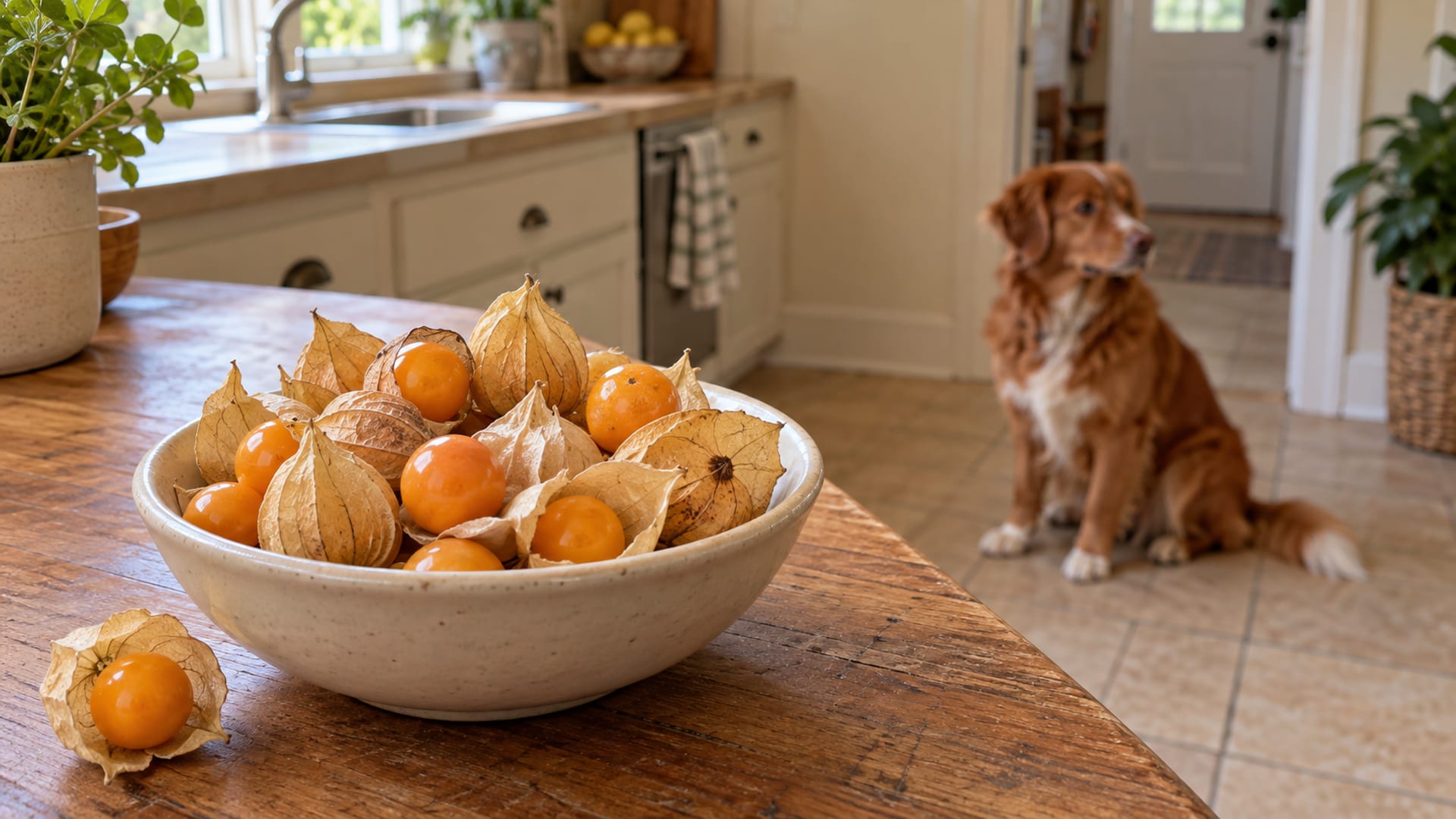
Yes, in a small amount, when the berry is ripe and orange and the papery husk has been pulled off. Green unripe berries, the leaves and stems, and the ornamental Chinese lantern plant are the parts that can make a dog sick, and any of those is a reason to call your vet today.
If your dog has already eaten some, look at what is left. The color of the berries, whether husks or leaves went down too, and where they came from decide how urgent this is.
Key takeaways
Tap a card to bring it forward.
- A ripe, orange golden berry with the husk removed is low concern for most dogs in a small amount.
- Green berries, leaves, stems and Chinese lantern plants carry natural plant compounds that can upset a dog's stomach and, after a bigger exposure, affect the nervous system.
- Call your vet or a poison line now if your dog ate green berries, plant parts, an unknown plant, a large amount or a mixed product, or if your dog seems unwell.
- Dried berries, jams and snack mixes need a label check for raisins, xylitol, chocolate and alcohol.
- Nobody has published a safe serving size for dogs, so a single small piece is the most to share.
What to do if your dog just ate golden berries
Work through these in order. Each one answers a question your vet will ask.
- Move your dog away and keep what is left. Save the bowl, the package or a photo of the plant. The ASPCA asks owners to gather this, because knowing exactly what was eaten shapes the advice.
- Check the color. Orange to yellow means ripe. Green means unripe, the form that carries more of the plant's defensive chemistry.
- Look for husks, leaves or stems. Mention any husks on the call. Leaves and stems are plant material and raise the level of concern.
- Work out which plant it was. Berries sold as golden berries or Cape gooseberries are *Physalis peruviana*. A Chinese lantern from a garden or dried arrangement is a different species with a stronger warning.
- Count what you can and note the time. Write down roughly how many berries or leaves are gone, when it happened and your dog's weight. The same handful is a bigger dose for a small dog.
- Call now if any of these apply. Your dog ate green berries, leaves, stems, a plant you cannot identify, a large amount, dried or powdered berries, or a product with unknown ingredients, or your dog is vomiting, drooling a lot, weak, wobbly or dull. The ASPCA says not to wait for your pet to act sick, and that holds even for a small amount of ripe fruit with no signs.
- Hold off on home treatment. Pet Poison Helpline advises against home antidotes, including hydrogen peroxide or any medicine a vet has not told you to give.
If your dog is unconscious, having a seizure, bleeding or struggling to breathe, go straight to an emergency veterinary hospital.
Which parts of the golden berry plant are fine for dogs
Golden berries grow inside a papery husk on a leafy plant, and each part carries a different level of risk.
Tap or hover a row to highlight it.
| Part or form | What it means for your dog |
|---|---|
| Part or formRipe orange berry, husk removed | What it means for your dogLow concern in a small amount, when it is a correctly identified *Physalis peruviana* |
| Part or formGreen unripe berry | What it means for your dogAvoid; unripe fruit contains more of the plant's potentially toxic compounds |
| Part or formPapery husk | What it means for your dogRemove before sharing; it is not the edible part and may carry plant compounds or farm residue |
| Part or formLeaves and stems | What it means for your dogAvoid; plant parts can hold higher levels of defensive compounds |
| Part or formCooked berries | What it means for your dogCooking does not make green berries or leaves safe to share |
| Part or formDried golden berries | What it means for your dogConcentrated and often sweetened; check the label and keep amounts small |
| Part or formJam, juice, candy, yogurt, baked goods | What it means for your dogDepends on the other ingredients; skip anything with xylitol, raisins, chocolate or alcohol |
| Part or formPowders, teas and supplements | What it means for your dogConcentrated and sometimes mixed with other plant extracts; call before assuming it is fine |
| Part or formChinese lantern (*Physalis alkekengi*) | What it means for your dogTreat as a separate plant; harmful if eaten except for the ripe fruit |
A study by Ray and Van Der Heiden found that levels of withanolides, plant defense compounds that include withanolide E, change as the fruit develops. A reference chapter on *Physalis peruviana* toxicity describes unripe fruit as containing solanine-type glycoalkaloids. The Royal Horticultural Society lists Chinese lantern as harmful if eaten, except for the ripe fruit.
How to share a ripe golden berry, and when the amount matters
If you want to offer a taste, use a berry you bought as food, labeled golden berry or Cape gooseberry, and only one that is fully orange. Peel off the husk, rinse it and cut it into a small piece, which matters most for very small dogs, since a whole round berry can be a choking risk. There is no published serving size for dogs, so I would keep it to one piece as an occasional treat. Dogs with diabetes or a weight problem are better off skipping the dried, sweetened kind unless their vet says otherwise.
The risky forms work the other way around. There is no known safe amount of green berries, leaves or Chinese lantern for dogs, so there is no number to check your count against. Instead, give your vet your dog's weight, the number of berries or leaves, whether they were green, and the time. Pet Poison Helpline also asks about breed, age and health, so have those ready.
Signs to watch for after green berries or plant parts
For a small amount of ripe fruit, you may see nothing at all, or a mildly upset stomach. Things change after a larger meal of unripe berries or leaves.
Signs that fit plant poisoning of this kind include vomiting, diarrhea, belly discomfort, drooling, weakness, a dull or depressed mood, and stumbling or poor coordination. The Merck Veterinary Manual notes that plant poisoning signs vary a great deal from one plant and toxin to the next, and they can start within hours. Pet Poison Helpline lists tremors, collapse and breathing trouble among the general signs that need prompt professional help.
Some plant poisonings show up late, so a calm first hour does not rule out trouble later in the day. Keep your dog where you can see them, watch the next meals and bathroom trips, and call as soon as anything looks off.
The worst realistic outcome, after a large amount of an unidentified *Physalis* plant or a lot of unripe material, is serious stomach and nervous system illness that needs treatment at a clinic. The Merck Veterinary Manual explains that how a dog does depends on the plant and how much was eaten.
My dog ate golden berries before and was fine
That happens, and I believe it. Plenty of dogs grab a berry off a counter and never show a sign. It was real for that dog on that day. It just does not work as a rule for the next dog, or for the same dog next time, because a few things change the outcome:
- How much. One ripe berry and a mouthful of leaves are very different exposures.
- Your dog's size. The same amount is a larger dose per pound in a small dog.
- Ripeness and form. Orange fruit, green fruit, leaves and a concentrated dried product each carry a different load.
- Which plant. The Merck Veterinary Manual points out that one common name can cover several species with different chemistry.
- The individual dog. Age, weight, breed and health all shape the risk, which is why the ASPCA asks about each of them.
- What really happened. The dog may have eaten less than it seemed, or had a mild upset nobody noticed.
Dried golden berries, jams, powders and look-alike plants
The name on the package does not always tell you what is inside.
Dried golden berries are concentrated by weight, and many brands add sugar. Trail mixes and dried fruit blends are the bigger worry, because they often include raisins; see our Grapes and raisins entry if your dog got into a mix. Chocolate-coated berries belong with our Chocolate entry, and anything soaked in liquor with our Alcohol entry.
Jams, yogurt toppings, candy and baked goods depend on the rest of the recipe, with xylitol as the sweetener to look for first. Powders, teas, chews and supplements can hold concentrated extracts, so read the label to your vet or poison line.
Garden plants raise the identification question. According to Agriculture and Agri-Food Canada, golden berry, Cape gooseberry, Peruvian groundcherry, Inca berry and poha berry are all names for *Physalis peruviana*, the edible Andean fruit. Chinese lantern, also called bladder cherry, is *Physalis alkekengi*, grown for its bright orange husks. Ground cherry can mean several *Physalis* species, some grown for food and some for show, so the scientific name on the plant tag is what counts. Tomatillos, or husk tomatoes, are a related *Physalis* usually cooked while green, and they should not be assumed to behave like ripe golden berries.
Check what you learned
Three quick questions to lock in the main points.
Quick check
Questions about dogs and golden berries
These come up once the first worry has passed.
Can cats eat golden berries?
Keep the plant and loose berries away from cats too. The same identification concerns apply, and the Merck Veterinary Manual notes that cats can be more sensitive than dogs to some plant toxins. Call your vet if a cat chews on the leaves or a Chinese lantern.
Are the seeds inside a golden berry a problem?
The seeds are tiny and are eaten along with the ripe fruit. For a very small dog, the whole berry is the bigger concern, since a round berry can lodge in the throat. Cutting it into a small piece takes care of that.
Is my puppy at higher risk around a golden berry plant?
Puppies chew on almost anything, including leaves, stems and husks, and they weigh less, so the same amount goes further. If you grow golden berries or Chinese lanterns, fence off the bed or keep potted plants out of reach until your puppy stops sampling the garden.
Are golden berries the same as gooseberries?
They are different plants. True gooseberries belong to the *Ribes* group and are unrelated to Cape gooseberries, which are golden berries. If the label says only "gooseberry," look for the scientific name before sharing.
Sources
Checked September 25, 2026.
- ASPCA, What to Do if Your Pet Is Poisoned
- ASPCA, My Pet Ate Something! When Should I Seek Help?
- Pet Poison Helpline, Emergency Instructions
- Pet Poison Helpline, What to Expect When You Call PPH
- Pet Poison Helpline, Signs and Symptoms of Pet Poisoning in Dogs and Cats
- Merck Veterinary Manual, Houseplants and Ornamentals Toxic to Animals
- Merck Veterinary Manual, Plants Poisonous to Animals
- Royal Horticultural Society, Physalis alkekengi
- Phytochemistry (Ray and Van Der Heiden), Chemical defence by withanolides during fruit development in Physalis peruviana
- ScienceDirect, Physalis peruviana toxicity and toxic elements
- Agriculture and Agri-Food Canada, Physalis peruviana L. Taxonomy Detail