
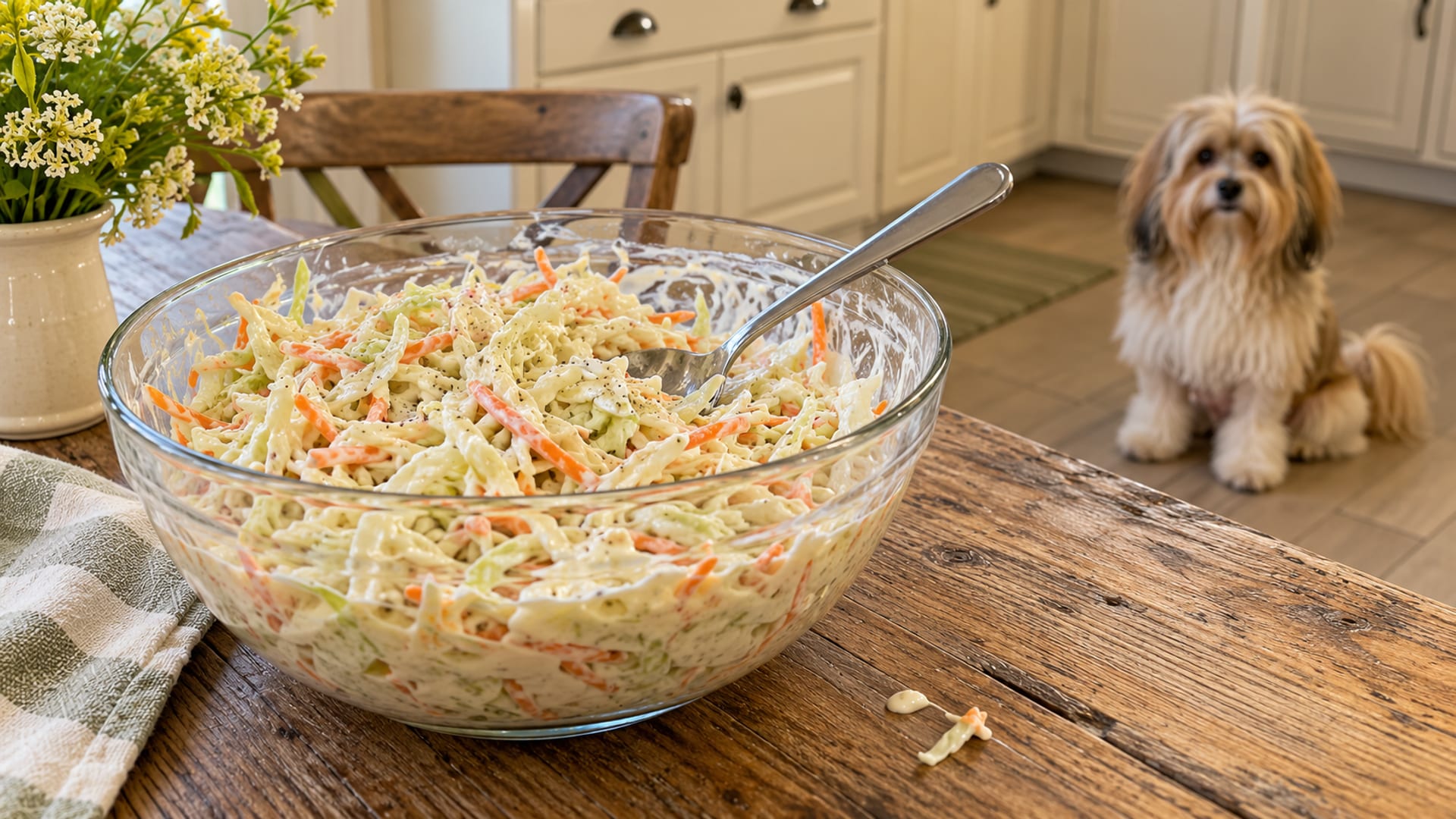
A small bite of plain, cabbage-only slaw is low risk, but ready-made coleslaw is a caution food, because the recipe decides the answer. Coleslaw is cabbage plus a dressing, and the dressing or the mix-ins are where the trouble hides: onion, garlic, chives, raisins and sugar-free sweeteners can all be dangerous, and creamy dressing is high in fat. If your dog just got into a bowl at a cookout or a deli counter, find out what was in it first, and do not plan on waiting for signs, because onion and garlic trouble can take days to show.
Key takeaways
Tap a card to bring it forward.
- Plain cabbage is fine in small amounts, but ready-made coleslaw depends on what else is in the bowl.
- Onion, garlic, chives, leeks, raisins, grapes and xylitol are the parts that turn a cabbage question into a vet call.
- Onion and garlic can damage red blood cells, and anemia signs may not show for several days, so a normal dog tonight is not the all-clear.
- Creamy, mayonnaise-based dressing is high in fat and can upset the stomach or set off pancreatitis.
- If you do not know the recipe, or the amount was large, call your vet with the label, your dog's weight and how much was eaten.
What to do if your dog already ate coleslaw
You are trying to answer one question fast: was there anything in it besides cabbage? Here is the order I would go in.
- Find the ingredient list. Check the container, the deli label, or ask whoever made it. The recipe decides the risk, and a guess is not good enough when the possible hazards include onion and garlic.
- Look for onion or garlic in any form, including powders and dried flakes, plus chives, leeks, raisins, grapes and a sugar-free dressing. Each one changes the answer, and powdered forms are more concentrated than fresh.
- Write down how much your dog ate, when, and what your dog weighs. The same spoonful is a bigger dose for a small dog than for a large one, and your vet will ask for all three.
- If the recipe had any of those ingredients, or you cannot tell, or the amount was large, or a small dog or puppy ate a big portion, call your vet or a poison line now. The ASPCA says to contact a veterinarian or poison control immediately for cookout foods like these.
- Do not wait for signs after a known or possible onion or garlic exposure. Merck Veterinary Manual states that anemia signs may take several days to appear.
- If you have checked and it was plain cabbage-only slaw, a small bite, and your dog is acting normal, you do not need a poison-control call. Call your vet if vomiting or diarrhea keeps going.
Treatment is the vet's to run and may include professional stomach decontamination, blood count monitoring, IV fluids, oxygen or a blood transfusion, and none of that is a home job.
What in coleslaw is fine and what is not
Cabbage itself is the easy part. The AKC says cabbage can be fed in small amounts and moderation, cut into small pieces. Everything else in the bowl needs a look, and this table sorts the usual ingredients.
Tap or hover a row to highlight it.
| Ingredient | Concern | What to do |
|---|---|---|
| IngredientPlain raw or cooked cabbage | ConcernLow; large fibrous pieces and stalks can be a choking risk | What to doFine in small amounts, diced small and unseasoned |
| IngredientOnion, raw or cooked | ConcernCan damage red blood cells and cause anemia | What to doAvoid; call your vet if eaten |
| IngredientGarlic, raw or cooked | ConcernGarlic is about 3 to 5 times more toxic than onion, according to Merck | What to doAvoid; call your vet if eaten |
| IngredientOnion or garlic powder, dehydrated or granulated | ConcernConcentrated forms, higher concern | What to doCall your vet |
| IngredientChives, leeks, scallions, shallots | ConcernOnion-family relatives with the same concern | What to doTreat them like onion |
| IngredientRaisins or grapes | ConcernCan cause kidney damage | What to doAvoid; call your vet if eaten |
| IngredientSugar-free dressing | ConcernMay contain xylitol, which can cause life-threatening low blood sugar and liver damage | What to doRead the label; call at once if xylitol is listed |
| IngredientMayonnaise or creamy dressing | ConcernHigh fat; can upset the stomach or cause pancreatitis | What to doSkip it; more risk for a dog with a pancreatitis history |
| IngredientVinegar dressing | ConcernUsually a small amount in slaw, but may upset the stomach | What to doSkip it, and check it for onion or garlic |
| IngredientDeli, restaurant or fast-food slaw | ConcernUnknown recipe, so higher concern than plain cabbage | What to doGet the ingredient list before deciding |
The ASPCA lists onion, garlic and the rest of that family as harmful to dogs, and names grapes and raisins as a cause of kidney damage. The ASPCA page on garlic and its warning on minced and powdered onion and garlic cover the concentrated forms and xylitol. You can read more on onions, garlic, chives and grapes and raisins on their own pages.
How much is a concern, and how to serve the safe part
Start with the low-risk part. If you want to share slaw, share plain cabbage: raw or cooked, unseasoned, diced small, with no onion, garlic, chives, leeks, salt-heavy seasoning, raisins, grapes, xylitol or rich dressing. The AKC recommends small quantities. There is no spoon-per-pound rule for coleslaw, so keep it to a taste.
For the risky part, the amount that matters depends on your dog's body weight. Merck reports that raw onion at 15 to 30 grams per kilogram of a dog's body weight has caused clinical signs, and Pet Poison Helpline gives the same range for blood changes. That figure is for raw onion, not a serving of slaw, and it is not a safe amount for any dog. Recipes vary and dogs differ, so treat the number as a reason to call. When you call, give your vet the weight, the amount and the label.
Fat is a separate concern. Pet Poison Helpline's kitchen guidance says fatty food can cause pancreatitis in dogs, and older, overweight or otherwise susceptible dogs may be more prone. A dog with a history of pancreatitis should not be given fatty dressing.
Signs to watch for and when they show up
Early signs usually come from the food or dressing itself: vomiting, diarrhea, belly discomfort, reduced appetite and tiredness. Those can show up soon after eating.
Onion and garlic work on a slower clock. Merck reports that red-cell changes can begin within about 24 hours, that methemoglobinemia, a change in the blood that limits the oxygen it can carry, begins within about 24 hours and peaks around 72 hours, and that red cells typically break down 3 to 5 days after exposure. Clinical signs may not be apparent until a lot of that has happened. Pet Poison Helpline states that signs may start 24 hours after eating and can last 10 to 20 days. That is why a dog who looks fine tonight after a slaw with onion is still someone to call about.
Watch for weakness, pale gums, fast breathing, a fast heart rate, tiring on a short walk, yellowing of the gums or eyes, and dark or bloody urine. Go to an emergency vet for collapse, pale gums, rapid breathing, abdominal pain, tremors or seizures. The worst realistic outcome from onion or garlic in coleslaw is life-threatening anemia, kidney injury from the blood-cell breakdown, collapse or death; from a very fatty dressing it is pancreatitis.
My dog ate it before and was fine
I believe you. Plenty of dogs have licked a bowl of slaw at a picnic and been fine the next day. It just is not a rule, because coleslaw is not one fixed food and each exposure is different.
The amount may have been small, and toxicity depends on dose; a small taste may hold much less onion than the range Merck reports. Body size matters, since the same portion is a different dose per kilogram in a small dog than in a large one. The recipe may have had no onion or garlic at all, and a slaw without them carries a different risk from one with them. Individual sensitivity plays a part too, and Pet Poison Helpline lists Japanese breeds such as Akitas and Shiba Inus as more sensitive to onion and garlic. Anemia signs can also arrive days later, so a dog that seemed normal right afterward has not ruled out risk.
Coleslaw types and look-alikes
The dressing and seasoning decide the risk, and these are the versions people run into.
Creamy and vinegar slaw. Creamy slaw is more likely to bring a high-fat problem. Vinegar slaw may seem lighter, but it can still contain onion or garlic.
Deli, restaurant and fast-food slaw. You often cannot see the recipe, so treat it as unknown until you have the ingredient list.
Coleslaw mix. A bag can hold cabbage, carrots, red cabbage, onion or seasoning, so the label determines the risk. Carrots and lettuce have their own pages if you want to check the other parts of a salad.
Red cabbage and red onion. Red cabbage is a cabbage variety and a different plant from red onion. Red onion is in the onion family, and the family is hazardous.
Green onion, scallion, spring onion, chive, leek and shallot. These are onion relatives and should be treated as onion.
Garlic salt, onion powder and garlic powder. Garlic salt contains garlic, not only salt. The powders are concentrated forms and are not the same as a trace of fresh cabbage.
Coleslaw dressing or the juice at the bottom of the bowl. It may hold concentrated onion or garlic seasoning, so do not treat it as plain cabbage.
Check what you learned
Three quick questions to see whether the main points stuck.
Quick check
Questions about dogs and coleslaw
Is mayonnaise coleslaw dangerous?
Mayonnaise is not a classic poison, but a creamy dressing is fatty. It can cause stomach upset or pancreatitis, more so in a dog that is older, overweight or already prone to pancreatitis. For a dog with a history of pancreatitis, skip rich dressing entirely.
What will the vet do if my dog ate coleslaw with onion?
The vet will ask about the recipe, the amount and your dog's weight. Depending on the case, treatment can include professional decontamination, monitoring blood counts, IV fluids, oxygen or a blood transfusion. Bring the label or a photo of it.
Do Akitas and Shiba Inus need extra care?
Pet Poison Helpline names Japanese breeds, including Akitas and Shiba Inus, as more sensitive to onion and garlic toxicity. If you have one of these breeds and any onion or garlic was in the slaw, call your vet even for a small amount.
What if the coleslaw dressing was sugar-free?
Read the label for xylitol. The ASPCA says xylitol can cause life-threatening low blood sugar and liver damage, so a sugar-free dressing with xylitol is an urgent call.
Sources
Checked September 29, 2026.
- AKC, Can Dogs Eat Cabbage?
- ASPCA, People Foods to Avoid Feeding Your Pets
- ASPCA, Garlic
- ASPCA, Be On the Lookout at Your Cookout
- ASPCA, When Pumpkin Spice is Not So Nice
- Merck Veterinary Manual, Garlic and Onion (Allium spp) Toxicosis in Animals
- Pet Poison Helpline, Kitchen Toxins To Pets
- Pet Poison Helpline, Toxic Foods to Pets